


Eastern Anatolia is one of Turkey’s most rewarding regions, but its star attractions sit hundreds of kilometres apart. Ani and Lake Çıldır, Lake Van and Akdamar Island, Mount Ararat and İshak Paşa Palace, the ski slopes of Palandöken and Sarıkamış: they cannot realistically be covered from a single hotel base. This guide compares the main hubs of Kars, Van, Doğubayazıt, Erzurum and Sarıkamış to help you decide where to stay, when day trips make sense, and when it is worth changing hotels to unlock a very different corner of the region.
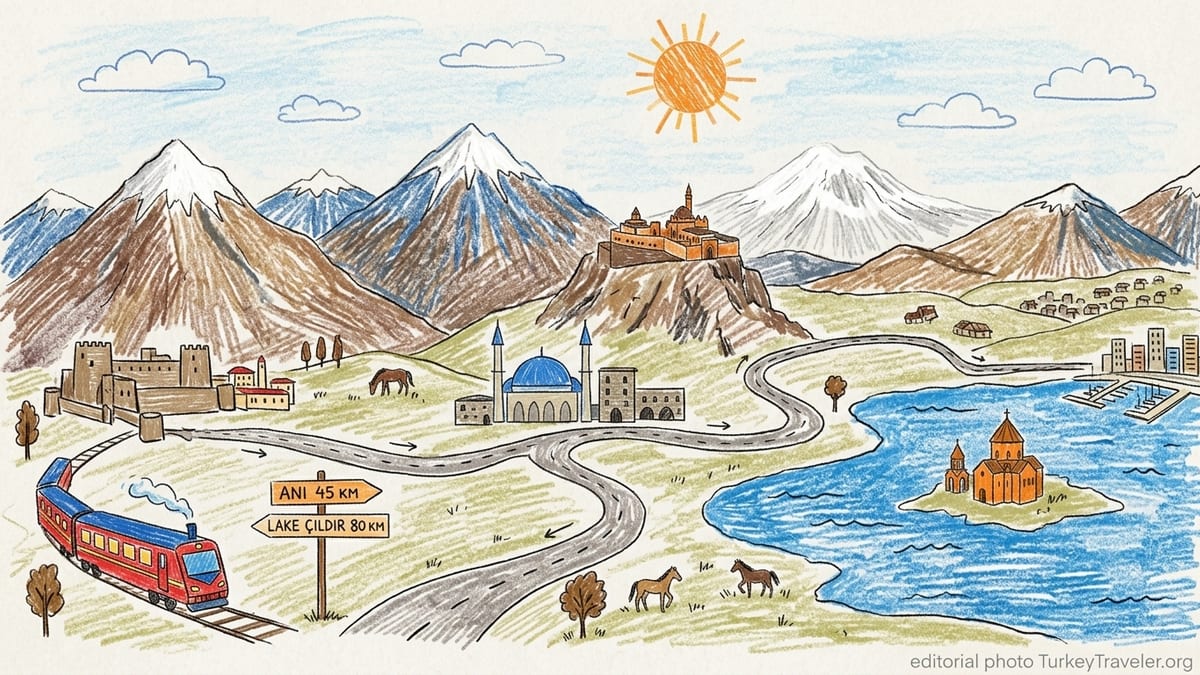
How Far Is Everything Really? Understanding Eastern Anatolia’s Distances
Look at a map and the main names in Eastern Anatolia appear temptingly close. In reality, the road distances are long, the terrain is mountainous and winter conditions can be harsh. Kars to Van is roughly a five to six hour drive in good weather. Erzurum to Van is a similar story. Even within Kars province, top sights are not side by side: Ani sits around 40 to 45 kilometres east of Kars city, while Lake Çıldır lies roughly 75 to 80 kilometres to the north on the Kars–Ardahan border. That already means two long day trips in opposite directions.
For a concrete example, imagine trying to see Ani, Lake Çıldır, Lake Van and İshak Paşa Palace while based only in Erzurum. Erzurum to Kars is around three hours by road, Kars to Doğubayazıt another four or so, and Doğubayazıt to Van close to three. You would spend entire days on the highway instead of exploring ruins, lakes and bazaars. This is why experienced Turkish tour operators routinely split trips into multiple bases rather than promising everything from one city hotel.
Transport patterns reinforce this. Eastern Express rail passengers often overnight in Kars at the end of the line, then continue by bus or private transfer to Erzurum or Doğubayazıt. Local ski enthusiasts ride the train from Erzurum to Sarıkamış for a weekend on different slopes rather than commute back and forth in a day. Once you understand those logistics, it becomes much clearer when to rely on day trips and when to re-pack your bag and move on to a new base.
As a rule of thumb, any destination more than 100 kilometres away in Eastern Anatolia is much more enjoyable as an overnight stop. Roads are generally decent asphalt, but mountain passes, occasional road works and slow truck traffic can easily turn a two-hour journey into three. In winter, snow and ice add yet more time. With that in mind, the following sections look at each key base city and what it realistically covers.
Kars: Best Base for Ani, Lake Çıldır and the Eastern Express
Kars is the natural base for visiting Ani and Lake Çıldır, and it is also the ceremonial end point of the famous Eastern Express train from Ankara. The UNESCO listed medieval city of Ani lies about 40 to 45 kilometres east of Kars, reached by a paved road through open grasslands and small villages. Taxi drivers and local agencies in Kars routinely offer half day trips to Ani, often leaving around 9:00 in the morning and returning mid afternoon, which gives you four to five hours among the cathedrals and city walls without needing to move hotels.
Lake Çıldır is in the opposite direction, roughly 80 kilometres from Kars depending on which lakeshore village you head for. In summer the drive is an easy hour and a half each way, and a Kars hotel works well as a base. Many travellers spend the morning on the lake and return to Kars for its Russian era stone architecture and hearty local food. In winter, however, it is worth factoring in short daylight hours and icy roads. A typical winter excursion might leave Kars shortly after breakfast, include a horse drawn sleigh ride on the frozen lake and a fish lunch in a simple lakeside restaurant, and return just before dark. You can still comfortably do this as a day trip; all you need is extra time for the journey.
If you are arriving on the Eastern Express, Kars rewards at least two or three nights. That allows for one full day at Ani, one for Lake Çıldır and a third to simply wander Kars itself, visiting the castle, the old stone bridges and the city’s museums. Attempting to add Van or Doğubayazıt as day trips from Kars is not realistic. Kars to Doğubayazıt via Ağrı is a long, tiring drive, and Kars to Van is longer still. For Ararat, İshak Paşa Palace or Lake Van, you should plan to change bases rather than push late night returns on mountain roads.
Accommodation in Kars spans renovated stone mansions and simple guesthouses. Prices fluctuate with Eastern Express demand, but you can expect mid range hotels in the city centre to cost roughly what you would pay in a mid sized Turkish provincial city, with cheaper pensions a short walk from the station catering to backpackers arriving on the train.
Van: Base for Lake Van, Akdamar Island and Regional Road Trips
Van is the obvious base for exploring Turkey’s largest lake and the iconic Akdamar Island, with its medieval Armenian Church of the Holy Cross. Most boat trips to Akdamar depart from piers around Gevaş on the southern shore of the lake, around 40 to 50 kilometres from Van city. A typical hotel organised outing includes transport to the pier, a short ferry crossing, and two to three hours on the island to visit the church, relax on the shore and perhaps swim in the lake in summer. All of this is entirely comfortable as a day trip from a Van city hotel.
Van also works as a base for exploring nearby lakeshore villages, hot springs and small archaeological sites. A practical two day plan would be to spend one full day on Akdamar and the south shore, and another circling the eastern and northern shores by car, stopping at viewpoints, lakeside tea gardens and small towns. Because Lake Van itself is large, overnighting in a second town on its perimeter can be rewarding, but it is not essential. Many visitors simply return to Van city each night, taking advantage of the wider choice of hotels and restaurants.
Where Van becomes less practical as a day trip base is for Doğubayazıt and Ararat. Van to Doğubayazıt is roughly a three hour drive in each direction even in good conditions. Trekking agencies offering Mount Ararat climbs usually start and finish in Doğubayazıt or Ağrı, not in Van, precisely because of the distance. If Ararat or İshak Paşa Palace are priorities on your itinerary, you should plan at least one or two nights in Doğubayazıt rather than attempt exhausting dawn to midnight runs from Van.
Van’s hotel scene is broader than Kars or Doğubayazıt, with a mix of business style city hotels and smaller pensions. Because Van also serves as a regional commercial centre, prices can be competitive outside peak summer and public holidays. The city’s lakefront promenade and busy centre make it a good base if you enjoy evenings in lively restaurants after quieter daytime excursions on the water and in nearby villages.
Doğubayazıt: Gateway to Mount Ararat and İshak Paşa Palace
Doğubayazıt is a rugged frontier town beneath the western slopes of Mount Ararat and the elegant İshak Paşa Palace. The palace stands on a rocky outcrop just above town, and the approach road winds up from the centre in only fifteen to twenty minutes by taxi. Many travellers arrive around midday, check into a central hotel, then head straight up to the palace for a late afternoon visit, when the light is softer over the Ararat plateau and the crowds thin out.
Climbers attempting Mount Ararat virtually always base in Doğubayazıt at the start and end of their expeditions. Agencies include one or two hotel nights in town before moving to high camps. Even for non climbers, it makes sense to stay at least one night instead of treating İshak Paşa as a distant side trip. From Kars, reaching Doğubayazıt typically takes most of a day by road, with a break in Ağrı or another provincial town en route. From Van, the drive is similarly long. Trying to tag the palace onto the end of those journeys and then push straight back the same day would leave you with a rushed hour in one of eastern Turkey’s most atmospheric landmarks.
In practical terms, Doğubayazıt is a good place for travellers to slow down. A full day lets you visit the palace, wander the town’s bazaar streets, and, in clear weather, enjoy panoramic views of Mount Ararat from nearby vantage points. Additional time allows for side trips towards the Iranian border or short walks in the surrounding hills. When planning your route, think of Doğubayazıt as the natural overnight link between Kars and Van if you are travelling by road, rather than a destination to be “done” from either city in a single, punishing day.
Accommodation quality in Doğubayazıt is simpler than in Van or Erzurum, but several mid range hotels and guesthouses cater well to trekkers and overlanders. Expect clean, functional rooms, hearty breakfasts and staff used to early departures and late arrivals. For many travellers, sunrise over the plateau and the silhouette of Ararat from a modest hotel balcony becomes one of the region’s enduring memories, and that is only possible if you choose to sleep in the town rather than pass through in a rush.
Erzurum: Urban Culture, Palandöken Skiing and a Transport Hub
Erzurum is Eastern Anatolia’s largest city and a key transport hub, with an airport, busy bus station and railway links westwards. Culturally, it offers far more than a transit stop. The city centre is dense with Seljuk and Ottoman monuments, including the twin minaret madrasa, old mosques and traditional houses. In the evening, you can eat in lively restaurants that cater both to students and visiting families, something that is harder to find in smaller towns.
Most visitors, however, know Erzurum because of Palandöken, one of Turkey’s leading ski resorts. Palandöken’s main lifts and hotel area sit only a few kilometres from the city, and local taxis and shuttles shuttle skiers back and forth in under twenty minutes. That makes Erzurum an excellent base if you want to combine city life and skiing, especially outside the busiest holiday weeks when resort hotels are at their most expensive. A practical pattern is to stay in a central Erzurum hotel, ski Palandöken during the day, then return to the city for dinner and nightlife.
Erzurum also works naturally as a staging point when moving between Kars and points further west or south. The train from Kars often passes here, and long distance buses converge on the city. That said, Erzurum is too far for day trips to Ani, Lake Van or Doğubayazıt. Erzurum to Kars is a journey in itself, and then Ani and Çıldır sit beyond that. Attempting to use Erzurum as a single base for both medieval ruins and Lake Van would mean waking before dawn, coming back late at night and seeing most of Eastern Anatolia through a bus window.
If skiing is your only mountain goal, you may not need to move beyond Erzurum and Palandöken at all. But if you also want to see Ani, Lake Çıldır, Van or Ararat, Erzurum should be seen as a gateway or a first stop in a larger circuit rather than your only accommodation choice in the region.
Sarıkamış: Ski Focused Stays Among Pine Forests
Sarıkamış is a smaller, more intimate ski centre than Palandöken, known among Turkish skiers for its dry, crystal like snow and tree lined pistes. The town lies around 50 to 60 kilometres from Kars, and ski hotels cluster near the lifts in a separate resort area above the town. There is a railway station that links Sarıkamış with both Kars and Erzurum, and Turkish winter sports enthusiasts often take the train up from Erzurum for a weekend or longer stay.
This is very much a place where it makes sense to change hotels if skiing is a priority. While you could, in theory, day trip from Kars to the Sarıkamış slopes, the added transfers eat into your ski time. Staying in a Sarıkamış resort hotel means breakfast a short walk from the lifts, the option of returning to your room for a rest at midday and the ability to enjoy evening activities such as night skiing without facing an hour or more on the road afterwards.
Because Sarıkamış is primarily a ski destination, it is less suited to travellers who are not interested in winter sports. In summer, the pine forests and high meadows are pleasant, but facilities are quieter and some hotels close. If your trip includes both history and skiing, a common approach is to spend two or three nights in Kars for Ani and Lake Çıldır, then move base to Sarıkamış for two or three nights on the slopes. Another pattern is to start in Erzurum and Palandöken and then ride the train or drive to Sarıkamış, sampling two distinct ski areas in a single itinerary.
Hotel prices in Sarıkamış vary widely by season and standard. Simple pensions in town can be surprisingly affordable, while full board resort hotels at the lifts charge higher rates over New Year and local school holidays. Booking ahead is wise in peak periods, especially if you want rooms that open directly onto the snow.
When to Change Hotels and When Day Trips Still Work
The most important planning decision in Eastern Anatolia is how many bases to include. For many travellers, three main hubs work well: Kars for Ani and Çıldır, Doğubayazıt or Van for Ararat and Lake Van, and Erzurum or Sarıkamış for skiing and onward connections. Trying to reduce this to a single base almost always results in exhausted days, missed sights and a skewed impression of the region.
Day trips work best for Ani and Lake Çıldır from Kars, for Akdamar Island from Van, and for Palandöken skiing from Erzurum. All of these destinations sit within roughly an hour of their natural base, sometimes even less. For example, staying in Kars and hiring a driver to Ani in the morning, then returning to enjoy dinner in a Kars restaurant, is both efficient and enjoyable. Likewise, staying in Erzurum and hopping up to Palandöken after breakfast is easy, with the option of coming back to the city each night.
You should plan to change hotels when your target lies more than about two hours away each way, especially where mountain roads or winter conditions are involved. That threshold clearly applies to Kars–Van, Kars–Doğubayazıt, Van–Doğubayazıt and Erzurum–Van. For example, if you want to photograph sunrise over Mount Ararat from viewpoints near Doğubayazıt or join a multi day trekking programme, trying to base in Van or Kars will either make those experiences impossible or force you into exhausting pre dawn departures. Sleeping in Doğubayazıt instead solves that problem and lets you enjoy the evening atmosphere and local food.
Another key reason to move bases is pace. Because Eastern Anatolia’s main attractions are often outdoors, the quality of light and your own energy levels matter. Arriving at Ani in the late afternoon after six hours on a bus from Erzurum cannot compare to reaching the site early from a Kars hotel, with enough time and energy to wander every church and city wall. The same is true of Lake Van sunsets, which are best enjoyed when your hotel is only a short ride away instead of a long highway return. Treat each base as a chance to slow down and sink into its own landscape, rather than to rush through a checklist from afar.
The Takeaway
Planning where to stay in Eastern Anatolia is really about respecting distance and variety. Kars, Van, Doğubayazıt, Erzurum and Sarıkamış each sit in a different landscape, with different rhythms and reasons to linger. Kars anchors visits to Ani, Lake Çıldır and the Eastern Express. Van opens up Lake Van and Akdamar Island. Doğubayazıt is inseparable from Mount Ararat and İshak Paşa Palace. Erzurum offers urban culture plus easy access to Palandöken. Sarıkamış is a quieter, pine forested ski retreat.
If your schedule allows, think in terms of a loose circuit with at least two or three different hotel bases, rather than a single anchor point. Use day trips for nearby highlights like Ani or Akdamar, but change hotels when your goals shift to another corner of the region. That way, the long roads between Kars and Van, or Erzurum and Doğubayazıt, become part of the experience instead of an exhausting obstacle, and you give each of Eastern Anatolia’s remarkable landscapes the time it deserves.
FAQ
Q1. Can I see Ani and Lake Çıldır while staying only in Kars?
Ani and Lake Çıldır are both realistic day trips from Kars. Many travellers spend at least two full days in Kars, dedicating one day to Ani and another to Lake Çıldır, and return to the same hotel each night.
Q2. Is it possible to visit İshak Paşa Palace from Kars or Van as a day trip?
In theory it is possible, but in practice it makes for an exhausting day with many hours on the road. Because Doğubayazıt sits much closer to İshak Paşa Palace, it is far better to plan at least one overnight there and visit the palace at a relaxed pace.
Q3. How many nights should I stay in Kars if I arrive on the Eastern Express?
Two or three nights in Kars works well. That gives you time for day trips to Ani and Lake Çıldır and at least half a day to explore Kars itself before moving on to Erzurum, Doğubayazıt or Van.
Q4. Is Van a good base for visiting Mount Ararat?
Van is too far from Mount Ararat for comfortable day trips. Most climbing and sightseeing programmes around Ararat and İshak Paşa Palace start from Doğubayazıt or Ağrı, so it is better to plan a separate stay there rather than commute from Van.
Q5. Should I stay in Erzurum city or up at Palandöken ski resort?
If you want nightlife, restaurants and a broader choice of hotels, staying in Erzurum and skiing Palandöken by day works well. If you prefer to maximise time on the slopes and enjoy ski in, ski out convenience, choose a hotel in the Palandöken resort area instead.
Q6. Is Sarıkamış worth a separate stop if I already plan to ski in Palandöken?
Many ski enthusiasts think so. Sarıkamış offers different snow conditions and a quieter, forested setting. If you have a week or more, splitting your time between Erzurum–Palandöken and Sarıkamış gives you two distinct ski experiences.
Q7. Can I use Erzurum as a single base to visit Kars, Ani and Lake Van?
Erzurum is too far from both Kars and Van for easy day trips. You would spend most of your time on the road. It is better to treat Erzurum as one of several bases and stay in Kars and Van separately if you want to see their main sights properly.
Q8. Do I need to book accommodation in advance in Eastern Anatolia?
Outside peak periods you can sometimes find rooms on arrival, but booking ahead is wise around public holidays, winter ski season and when the Eastern Express is in high demand, especially for well located mid range hotels.
Q9. Is it safe to drive between these towns in winter?
Winter roads are generally maintained, but snow and ice are common and mountain passes can be challenging. If you are not used to winter driving, consider using buses, trains or private drivers, and avoid planning very long nonstop drives.
Q10. How many bases should I plan for a ten day trip to Eastern Anatolia?
For around ten days, three bases work well for most travellers, for example Kars for Ani and Çıldır, Doğubayazıt or Van for Ararat and Lake Van, and Erzurum or Sarıkamış for skiing and onward travel.