


The lush Black Sea coast of Turkey is no longer a niche detour. With more direct flights into Trabzon, new boutique hotels opening in highland valleys, and growing interest in tea country, the question is no longer whether to go, but where to stay. This region is surprisingly spread out. Choosing the right base, and knowing when to change hotels instead of day-tripping, can make the difference between long days in the car and an easy, scenic journey through some of Turkey’s greenest landscapes.
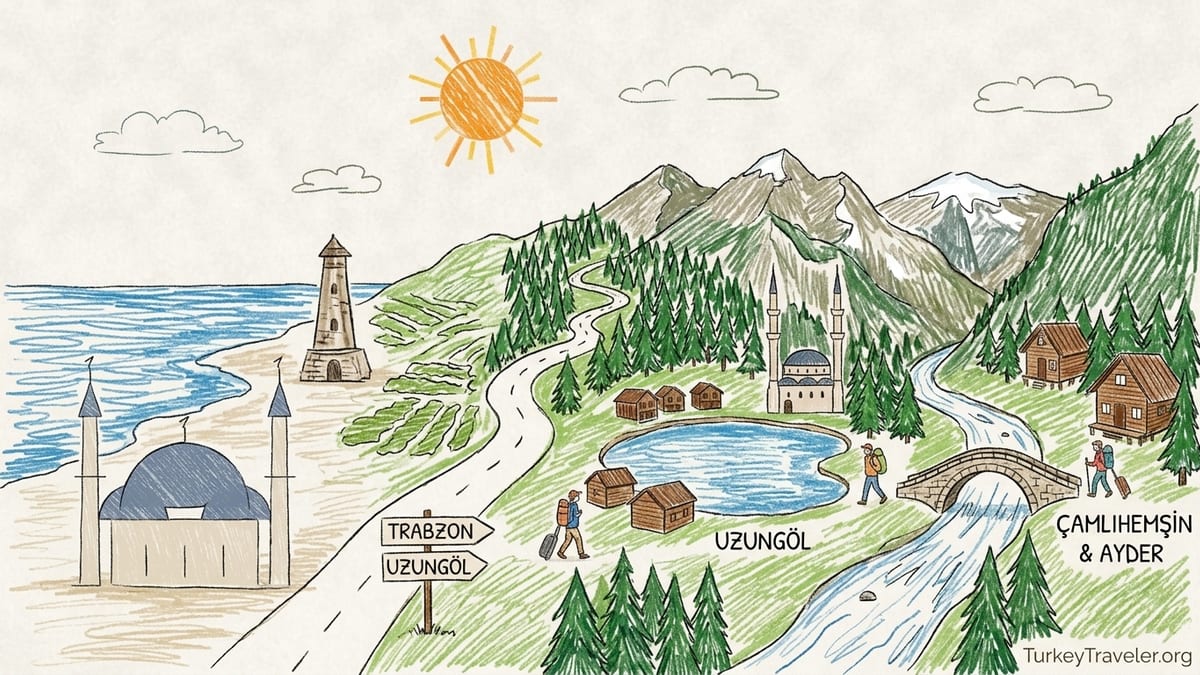
How to Think About Bases on the Black Sea
Most travelers begin in Trabzon, the main air gateway for the eastern Black Sea. From here you can fan out to Uzungöl, Rize, Çamlıhemşin and Ayder, or continue along the coast toward Ordu and Sinop. On the map, many of these places look close, but winding coastal and valley roads mean that a 70 kilometer drive can easily stretch beyond ninety minutes, especially in summer or on weekends. Building your itinerary around smart overnight bases, rather than trying to day-trip everywhere from one city, keeps your days balanced between driving and actually being outdoors.
Accommodation inventory has expanded quickly in recent years. On major booking platforms there are now close to 300 properties listed in and around Trabzon and over 130 around Uzungöl, with dozens more scattered through Rize and the Fırtına Valley. That range matters in practice: in Trabzon you might choose a midrange seafront chain hotel near Forum Trabzon mall, while in Çamlıhemşin you are more likely to end up in a riverside wooden bungalow with a private hot tub and breakfast served on a deck over the water. This mix supports a multi-base trip where you combine city comfort with nights in the forest and time up in the highlands.
A practical rule of thumb is to use Trabzon as a hub for your arrival, departure and nearby coastal sights, then plan at least one hotel change inland. Staying a night or two around Uzungöl and another two nights in the Fırtına Valley or Ayder lets you have early mornings and quiet evenings in the mountains instead of constantly racing back to the city. For travelers driving the whole coast from Samsun or Ordu toward Georgia, it can also make sense to add a one-night stop in Ordu or Sinop so that Trabzon does not have to shoulder every night of the trip.
Trabzon: Flights, City Comfort and Day Tours
Trabzon is the practical starting point for most international visitors thanks to Trabzon Airport, which currently handles frequent domestic flights from Istanbul and Ankara along with seasonal services from Gulf hubs. The airport sits right on the coast, only about fifteen minutes by taxi from many city hotels, so you can realistically land in the evening and still have time for a stroll along the waterfront and a proper dinner. Compared with smaller coastal towns, Trabzon offers a reliable spread of midrange hotels, serviced apartments and a few international brands, plus familiar conveniences such as supermarkets, malls and hospital-grade medical facilities.
For short stays of two or three nights, basing in Trabzon makes sense. From a central hotel near Meydan Park you can join half-day or full-day tours to signature sights such as the clifftop Sumela Monastery, the Hagia Sophia of Trabzon and Boztepe hill for sunset over the Black Sea. Tour agencies with English and Arabic signage cluster around the square; many offer shared minibus excursions for around the cost of a taxi, which is useful if you have not rented a car. At dinner, you can sample regional dishes like kuymak, an indulgent cornmeal and cheese dish, at long-running local restaurants rather than relying on hotel kitchens.
However, Trabzon is not ideal as a permanent base if you plan to explore the highlands in depth. A day trip from Trabzon to Uzungöl, for example, can involve more than five hours in the car once you factor in seasonal traffic, photo stops and a meal by the lake. Likewise, reaching Ayder or upper Çamlıhemşin in the Fırtına Valley and then returning to the coast in one day often leaves you with only a brief window of mountain time. If your plan includes both Uzungöl and the Fırtına Valley, consider spending no more than three nights in Trabzon itself before moving inland.
Uzungöl: Staying Beside the Iconic Lake
Uzungöl has become the postcard image of Turkey’s Black Sea interior: a long, narrow lake encircled by forested slopes, a cluster of hotels and restaurants around the shoreline, and a mosque with twin minarets mirrored in the water. The setting is undeniably striking and that is exactly why staying here can be rewarding despite the crowds. When you wake up steps from the lake, you can enjoy the quietest hours before the tour buses arrive mid-morning, or linger around sunset when day-trippers have already left for Trabzon or Rize.
Accommodation around Uzungöl ranges from simple wooden guesthouses up the side valleys to multi-story hotels immediately around the lake. On current booking platforms more than a hundred different stays appear in the broader Uzungöl area, from family-run apartments like İlhan Kardeşler Apart Otel a short walk from the water to midrange lake-view hotels with balconies and on-site restaurants. Prices fluctuate with demand, but in high season you might expect to pay a little more here than in central Trabzon for similar comfort, reflecting the premium location and limited flat land near the shore.
Uzungöl works best as a one or two-night stay if you are interested in short hikes, photography and relaxed evenings watching the weather change over the hills. From a hotel on the southern side of the lake, you can follow the road up toward the Haldizen plateau for views back down to the water, or arrange a local driver to take you deeper into the surrounding valleys. If you only visit on a day trip from Trabzon, most of your hours will be spent on the highway and in roadside traffic entering and leaving the village, especially on summer weekends and public holidays.
Families in particular benefit from staying overnight. Children can feed ducks by the lake in the early morning, rent pedal boats once the sun is higher, and retreat to their room for a rest during the midday crowds. Couples often choose small chalets with private terraces a bit removed from the central cluster, trading direct lake access for quiet and clearer night skies. In practical terms, if Uzungöl is a priority highlight for you, changing hotels here instead of commuting from Trabzon will make your experience calmer and less rushed.
Rize: Tea Country and a Quieter Coastal Base
Continuing east from Trabzon along the coast, Rize is the capital of Turkey’s tea-producing region. Steep green hills rise almost immediately behind the city, with terraced tea gardens climbing the slopes in repeating patterns. For travelers who want easier access to tea estates while still staying on the coast, Rize can be an appealing alternative or complement to Trabzon. The city is smaller and feels less hectic, though it still has a functioning port, commercial center and a handful of modern hotels with seafront views.
While Rize does not match Trabzon’s sheer number of beds, regional tourism reports indicate that the province offers more than a hundred officially registered accommodation facilities, including several star-rated hotels and many small pensions scattered into the countryside. On the ground, that translates into practical options like Babillon Hotel & Spa near the coast for those who want a pool and spa facilities, as well as compact business-style hotels within walking distance of Rize’s main square. From these bases you can take half-day drives up to panoramic tea gardens with café terraces overlooking the city.
Rize works well for travelers who prefer a quieter urban setting or who are especially interested in tea. A typical day might include breakfast at your hotel, a visit to a tea factory just outside town to see processing lines in action, and then an afternoon spent at a hillside tea garden where you sip fresh-brewed Rize tea from tulip-shaped glasses while watching clouds move in off the Black Sea. In the evening you can return to a coastal promenade with far fewer crowds than Trabzon’s central streets in high season.
In terms of routing, Rize is also a convenient stepping-stone into the Fırtına Valley and Ayder. If you are driving east from Trabzon, you might spend two nights in Rize, using the full day in between for coastal explorations and tea country visits, then move inland to Çamlıhemşin or Ayder for your final nights. That pattern lets you sample both the tea-focused landscapes around Rize and the wilder river canyons further south without doubling back unnecessarily.
Çamlıhemşin and the Fırtına Valley: Riverside Nature and Bungalows
South of the main coastal highway, the Fırtına River carves one of the Black Sea region’s most atmospheric valleys. The small town of Çamlıhemşin serves as a gateway, but most visitors aim for hamlets strung along the river where wooden bungalows and lodges sit amid dense forest and stone bridges arch over fast-moving water. If your image of this trip involves waking to the sound of a rushing river and eating breakfast on a deck just meters above it, this is where you want to sleep.
Over the last decade, Çamlıhemşin has seen a boom in small-scale riverside accommodations. Bungalow complexes such as Molva Bungalows, Kiyi Bungalov and Elva Bungalov combine cabin-style lodging with modern comforts like air conditioning, Wi-Fi and private terraces, often with large picture windows to frame views of the river or surrounding hills. Many serve generous Turkish breakfasts featuring local honey, village eggs and fresh cheeses on outdoor platforms beside the water. Prices vary, but couples can often find midrange bungalows at rates comparable to or slightly above a central Trabzon hotel, reflecting the more limited capacity and experiential setting.
This valley is where changing hotels becomes essential instead of optional. A day trip from Trabzon or even from Rize to upper Fırtına means at least three hours on the road, which leaves limited time for rafting, visiting historic stone bridges, or taking the steep side roads up to plateaus like Pokut or Gito. Staying two or three nights in a Çamlıhemşin bungalow allows you to slow down: one day for river activities and nearby villages, another day dedicated to highland plateaus, and flexible time to sit out periods of fog or rain, which are common in this microclimate.
Because Çamlıhemşin accommodations are dispersed, think about how remote you want to be. Some bungalows sit close to the main valley road, ideal if you do not have your own car and rely on transfers arranged by the property. Others are tucked further up narrow side roads that may require confident driving or pre-booked pick-ups, rewarding you with greater seclusion and darker night skies. In all cases, pack layers and a light rain jacket even in mid-summer, as river valleys and surrounding forests tend to feel significantly cooler than the coast after sunset.
Ayder: Highland Atmosphere and Hot Springs
Ayder Plateau, often shortened to simply Ayder, lies higher up from Çamlıhemşin and has long been known within Turkey as a summer escape and hot springs destination. The village stretches along a steep-sided valley, with hotels, pensions and restaurants lining the main road and forested slopes rising on either side. In recent years it has become busy in peak season, but the combination of cool temperatures, misty mornings and access to surrounding plateaus still makes it a compelling base, especially if you want to experience highland culture without tackling rougher tracks.
Most accommodation in Ayder consists of small hotels and guesthouses, many in chalet-style buildings with timber facades. Some offer access to traditional thermal baths or modern spa facilities fed by the area’s hot springs, where you can soak in naturally warm mineral water after a day of walking. Room rates can climb in July and August, particularly for properties with better views up or down the valley, so it pays to book ahead if your dates are fixed. Outside of high season, you may find quieter streets and more competitive prices while still enjoying fresh mountain air.
Using Ayder as a base makes sense if you are particularly interested in highland meadows, local yayla culture and short walks at higher elevations. From the village, drivers in sturdy minibuses shuttle visitors toward surrounding plateaus when road conditions allow, and you can return to consistent hot water and restaurant options each evening. Compared with Çamlıhemşin bungalows closer to the river, Ayder feels more like a concentrated resort village, which can be either a positive or a drawback depending on whether you value convenience or solitude.
In an ideal itinerary, Ayder follows time in Çamlıhemşin rather than replacing it. One approach is to spend two nights down in the Fırtına Valley for the riverside experience and adventure sports such as rafting or ziplining, then move up to Ayder for one or two nights focused on highland walks and hot spring relaxation before returning to the coast. Trying to see both areas on day trips from Trabzon would leave you with very early starts, late returns and minimal flexibility if the weather closes in on the mountains.
Ordu and Sinop: Extra Stops for a Full Coast Crossing
Travelers who are not flying in and out of Trabzon but instead driving the broader Black Sea coast should consider adding Ordu or Sinop as additional bases. Both cities sit west of Trabzon along the coastal highway and provide natural overnight points that break up what can otherwise be a long, monotonous drive. Ordu, in particular, has invested in its seafront promenade and hilltop viewpoints, including a cable car up Boztepe, giving the city a more developed visitor infrastructure than many smaller coastal towns.
Ordu’s hotel scene includes a mix of national chains and local properties, often at prices slightly below those in Trabzon for similar standards. Staying a night here is practical if you are arriving from inland cities such as Sivas or Tokat and want to rest before pushing on to Trabzon or Rize. You can walk the waterfront, take the cable car for a sunset tea overlooking the bay, and sample Black Sea anchovy dishes that appear on menus in season. For families undertaking a road trip from Istanbul along the coast, Ordu can function as a midway break that still feels like part of the journey rather than a random highway stop.
Farther west, Sinop occupies a narrow peninsula projecting into the Black Sea and has a smaller, historic-town atmosphere. Its compact harbor, stone city walls and cluster of pensions near the waterfront suit travelers who prefer to park the car and explore on foot. A night in Sinop allows you to wander its old streets, visit the historic prison museum and enjoy a harborfront dinner before resuming your drive eastward toward Samsun and eventually Trabzon. This pattern helps distribute your nights more evenly along the coast instead of bunching all your time at the far eastern end.
Ordu and Sinop are optional if your focus is solely on the eastern Black Sea highlands, but they become very useful if you are stringing together a longer coastal route. Including at least one of them reduces fatigue, gives you more varied impressions of Black Sea urban life, and eases pressure on your schedule once you reach Trabzon, since you will not need to use it as both a transit stop and a deep-exploration base.
When to Change Hotels vs Day-Trip From Trabzon
Deciding whether to change bases or rely on day trips comes down to distance, road conditions and your style of travel. As a basic guideline, places within an hour of Trabzon, such as the city’s own Hagia Sophia, Boztepe hill, or short stretches of neighboring coastline, can be comfortably handled as day trips. Sumela Monastery is borderline but still feasible thanks to organized excursions that take care of mountain driving and parking. Once you venture much beyond that radius, especially into narrow inland valleys, overnight stays start to pay off.
If you want only a teaser of the highlands and are short on time, you might do one long shared tour from Trabzon that combines Uzungöl with a brief stop in a Fırtına Valley village. In this case a single hotel in Trabzon for three or four nights is efficient, and you avoid the check-in and check-out cycles. On the other hand, if your main reason for visiting the region is nature and mountain culture rather than Trabzon itself, it makes more sense to limit the city to one or two nights and distribute the rest between Uzungöl, Çamlıhemşin and Ayder. That way, your drives between bases fall in the middle of the day when light is good and you are not rushing against dusk.
Another practical factor is who is in your group. Families with young children often find it easier to spend several nights in each place, minimizing repeated packing and unpacking, but they also suffer more from extremely long day trips. For them, a sequence like Trabzon for two nights, Uzungöl for two nights and Çamlıhemşin or Ayder for two or three nights strikes a good balance. Couples or solo travelers with light luggage may be more willing to change bases frequently, staying just one or two nights in each location, but even for them, basing in Trabzon alone for a week will likely feel commute-heavy.
Costs can also influence the decision. In busy periods, city hotels in Trabzon may become more expensive than simple bungalows inland, especially when demand from domestic tourists spikes. Checking price ranges across your dates for city hotels, lakeside stays and valley bungalows can reveal that upgrading your experience by sleeping beside a river or in tea fields does not always mean paying more. In many cases, moving your base closer to what you came to see both improves your trip and keeps transportation costs like fuel, tolls or private drivers under control.
The Takeaway
Seen on a map, the Black Sea region around Trabzon, Uzungöl, Rize, Çamlıhemşin and Ayder looks compact. In reality, deep valleys, twisting roads and changeable weather mean that smartly chosen overnight bases will shape your experience more than any individual sight. Trabzon remains the logical entry and exit point with its airport, restaurants and tour infrastructure, but it is best treated as a launchpad rather than your only stop.
If the lake is a highlight, give Uzungöl at least one night so that you can experience its quietest hours and nearby plateaus without spending most of the day in transit. If riverside forests and small wooden bungalows appeal, focus time in Çamlıhemşin and the Fırtına Valley. If you dream of cool air, hot springs and high meadows, add Ayder. Tea lovers and those seeking a softer urban rhythm can fold Rize into the route, while long-distance drivers benefit from detours to Ordu or Sinop to break up the coast.
The region’s growing accommodation inventory, from simple pensions to polished spa hotels and glass-fronted bungalows, now supports multi-base trips far better than it did a decade ago. By matching your overnight stays to the landscapes you most want to wake up to rather than clinging to a single city base, you will spend less time staring through a windshield and more time listening to rivers, watching fog roll over tea hills and feeling the distinctive character of Turkey’s Black Sea in each place you stop.
FAQ
Q1. How many days do I need for the Black Sea region around Trabzon?
Most travelers find five to seven days enough for a first visit, splitting time between Trabzon, one night at Uzungöl and two or three nights in the Fırtına Valley or Ayder.
Q2. Should I rent a car or rely on tours and public transport?
Renting a car gives the most flexibility for valleys and plateaus, but many visitors manage with shared tours from Trabzon and Rize plus hotel-arranged transfers in Çamlıhemşin and Ayder.
Q3. Is Uzungöl worth an overnight stay instead of a day trip?
Yes, if you care about atmosphere and photography. Staying by the lake lets you enjoy quiet early mornings and evenings that day-trippers from Trabzon or Rize miss.
Q4. What is the best base for exploring tea plantations?
Rize is the most convenient base for tea-focused visits, with easy access to terraced tea gardens and factories while still offering coastal hotels and city services.
Q5. How do Çamlıhemşin and Ayder differ as places to stay?
Çamlıhemşin and the lower Fırtına Valley feel more rural and riverside, dominated by bungalows, while Ayder is a higher, cooler plateau village with hot springs and a denser resort feel.
Q6. Can I visit both Uzungöl and the Fırtına Valley in one day from Trabzon?
It is technically possible on a long tour, but you will spend many hours driving. For a more relaxed trip, plan at least one overnight in each area instead.
Q7. When is the best time of year to visit this part of the Black Sea?
Late spring through early autumn offers the greenest scenery and the broadest accommodation choice, though July and August are busiest and often require advance booking.
Q8. Are Ordu and Sinop essential stops on a Black Sea itinerary?
They are optional for those flying in and out of Trabzon, but very useful overnight breaks for travelers driving the wider coast between Istanbul or Ankara and the eastern Black Sea.
Q9. Is it more expensive to stay in bungalows in Çamlıhemşin than in Trabzon hotels?
Prices vary by season, but simple riverside bungalows are often comparable to midrange city hotels, with some premium properties costing a bit more for the setting and privacy.
Q10. How far in advance should I book accommodation in these areas?
For July, August and major holidays, booking several weeks ahead is wise, especially for lakeside rooms in Uzungöl and popular bungalows in the Fırtına Valley and Ayder.