


Bozcaada looks like a small dot off the northern Aegean coast, but once you start swimming around it the island turns into a maze of wind patterns, pebbled coves and long sandy arcs that feel completely different from one another. Over several visits I spent my days doing exactly what most travelers dream of here: driving or walking from bay to bay, getting in the water at each one, timing how long I actually wanted to stay, and paying close attention to what the north wind was doing to the surface and to my comfort. This is a report from those swims, not from drone photos or ranking lists, and it only covers beaches and bays I personally got into the sea at.
How I Swam Around Bozcaada And Chose These Bays
I based myself in Bozcaada town, hired a small car from the harbor area and treated the island like a clock face. Over three long summer days, plus an earlier spring trip, I swam at Ayazma, Habbele, Akvaryum, Çayır, Sulubahçe, Beylik and a couple of unnamed rocky entries near the center. Some I revisited at different times of day specifically to see how the north wind and waves changed the experience. I ignored the temptation to chase the most photogenic scenes and instead asked a simpler question each time I got out of the water: would I genuinely come back here tomorrow, knowing what I know now.
Conditions on Bozcaada change fast because the island sits right in the path of strong summer meltem and poyraz winds that come from the north and northeast. When those winds are up, the north coast can feel raw and restless with whitecaps, kite sails and sand that needles your legs, while the southern coves are more sheltered and almost pool-like. On rare calmer days, even the exposed beaches can be swimmable and beautiful, but if you arrive in July or August you should expect wind to shape at least half your decisions.
Rather than list all 12 bays and 17 islets the island is known for, this article focuses only on places where I actually swam and spent time on the shore. I looked at a few things every time: sand or pebble type underfoot, water temperature, how quickly the sea got deep, wave chop, the balance between beach clubs and free access, parking ease, natural shade, food and drink options, toilets, crowd level and, most honestly of all, how long I truly wanted to linger before packing up my towel.
For prices and services I cross-checked what I found on the sand with recent notes from local blogs and island guides, because fees here have risen quickly in the last couple of seasons and the experience at some beaches has shifted with that. When something could not be confirmed, I prefer to say so clearly instead of guessing. All of the subjective judgments though, from the shock of cold water at Ayazma to the contented drowsiness of an afternoon at Akvaryum, are from my own time in the sea.
Ayazma: Famous, Beautiful, And Not Where I Stayed Longest
Ayazma is the beach everyone tells you to see first, and there is a good reason. The bay is a wide, bright curve of pale sand on the south side of the island, framed by low cliffs and backed by beach tavern-style restaurants. The sand is genuinely soft and fine compared with many Aegean pebble coves, and when the north wind is blowing inland the water clears out to a sharp turquoise, so transparent that your feet are visible well past waist depth. Underfoot it is sand for the first several meters, with only occasional small stones. For people who hate sharp pebbles this is a gift.
The trade-off is temperature and crowd. Even at the height of summer, the sea at Ayazma bites. Locals told me water here hovers several degrees cooler than many mainland Aegean beaches, and my own swims support that. On a July afternoon I measured my "brain-freeze" time at under a minute: that is how long it took before I needed to duck out for a breather. It does warm slightly as you move into the shallows, but if you stay out where the sand drops at around 15 to 20 meters from shore, it remains sharply refreshing. That is wonderful if you want a cold plunge, less so for small children or anyone sensitive to cold.
On land Ayazma feels organized and busy. Most of the width of the beach is covered by rows of sunbeds and umbrellas managed by restaurants and seasonal operators. Recent seasons have seen prices climb; in my last visit, a pair of loungers with umbrella was being quoted in the several hundred lira range for the day, with some of that redeemable at the associated restaurant, a pattern echoed by current reports from Turkish travel writers who have seen per-person entry or minimum spend at popular island beaches rise in the last year. There is still free space at the edges where you can throw down a towel, but you need to walk a little farther and accept less convenient access to showers and toilets.
Would I go back to Ayazma? Yes, but with a plan. I would return early in the morning when the sand is still cool and the restaurant music is down, swim hard for twenty minutes to wake up in the cold water and then leave for somewhere calmer. It disappointed me a little not because of the sea itself, which is clean and invigorating, but because the overall atmosphere felt more like a packaged beach club zone than a place to laze away an afternoon. I rarely lasted more than an hour and a half before wanting to move on.
Habbele: A Split Personality Between Beach Club And Quiet Corner
Habbele sits one cove along from Ayazma and feels like a cousin that made different life choices. The heart of the bay is now dominated by a named beach club that charges for entry and sunbeds, often with a minimum spend system. On my visit, staff at the entrance were quoting a fee per person where about half could be used as credit for food and drink, in line with recent Turkish-language travel pieces that describe similar pricing at the same spot. The club area comes with music, a bar, a more curated crowd and easy access to changing rooms and toilets. The sand here is mixed: thin sand closer to the waterline, thickening into coarser granules and small pebbles as you walk toward the back.
In the water Habbele offers a softer welcome than Ayazma. The water is still Bozcaada-cold, but I felt a shade less brain-freeze here, possibly because the cove is slightly more enclosed. The first few steps are on sand, then you meet rounded pebbles, and the bottom slopes gently for a while before dropping more steeply. The sea is usually clear, and on days with moderate north wind there was a light chop that made swimming interesting without feeling rough. It is a place where I could swim steadily parallel to the shore for ten or fifteen minutes without battling big waves.
The surprise at Habbele comes if you ignore the main entrance, follow the line of parked cars a little farther and walk down dusty side paths to the far edge of the bay. There, away from the umbrellas, the shore feels closer to how locals describe Habbele in older accounts: lower-key, with people bringing their own umbrellas, coolers and folding chairs. Parking in high season can still be tight, but I found a space on the access road without trouble just after 10 a.m. There is almost no natural shade except where the rock meets the sand, so a simple beach tent or umbrella is worth having if you choose this side.
Overall, Habbele did not steal my heart, mostly because of the sense that the beach is now defined by its paid club experience. I appreciated the slightly warmer feeling water and the option to have lunch without getting back in the car, but the ticket price to sit comfortably under shade and the music volume around midday made it a place I was happy to visit once per trip rather than every day. I typically stayed around two hours: one swim, one simple meal or cold drink, a bit of people-watching, and then a move to a quieter bay.
Akvaryum: The Clear-water Cove I Actually Stayed All Day
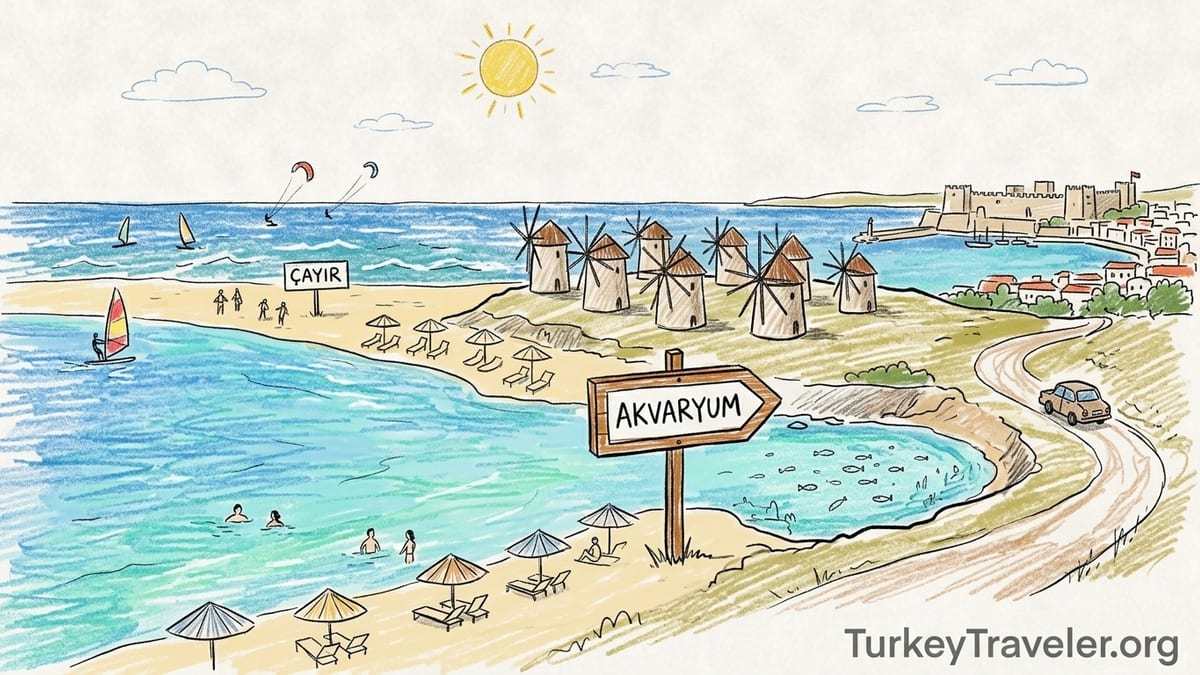
Akvaryum is where I finally stopped rushing. The cove is smaller than Ayazma and Habbele, tucked between low headlands on the south side, and it takes a slightly bumpier drive on a narrower road to reach. There is no big beach club here. Instead, the shore is a patchwork of pebbles and coarse sand, with a couple of small-scale kiosks and a simple camper-style snack van when I visited, selling cold drinks, basic toast and chips. Many people still bring their own food in coolers and sit on camping chairs under their own umbrellas. The absence of heavy infrastructure keeps the bay feeling more relaxed.
The name Akvaryum is accurate. On my first swim I waded in over smooth rounded pebbles that became smaller underfoot as I moved out, and within a couple of strokes I could see tiny fish flicking between the stones. Even from waist depth you can look straight down and spot the pattern of each pebble and the moving shadows below. Local snorkeling fans are not exaggerating when they call this one of the best places on the island for mask and snorkel. The water is cold but, compared with Ayazma, I found it easier to stay in continuously for fifteen to twenty minutes. The bay is shallow for quite a distance, with the bottom dropping very gradually, which helps families and less confident swimmers.
Wind matters less here than on the north coast. On a day when poyraz gusts were whipping whitecaps just visible on the northern horizon, the water in Akvaryum remained mostly flat, with only light ripples from passing boats. That made it my preferred place for a long, lazy swim. I would go in, float on my back watching the hill above, then return to a towel, read a few pages and wander back for another round. By the time late afternoon shadow crept down the slope, I realized I had been there for nearly six hours, far longer than any other bay on this trip.
Facilities are basic but adequate if you come prepared. There were a couple of portable toilets and a simple shower when I went, not spotless but usable. Prices for drinks from the kiosk were a little higher than in town, as you would expect, but not extreme compared with the organized clubs. There is no real natural shade, so arriving before 11 a.m. or bringing your own cover is essential in high summer. Parking runs along the dirt track behind the cove; arriving before midday I found a spot within a two-minute walk each time. For anyone who values time in the water more than beach scene, this was the bay that genuinely made me consider staying until sunset.
Çayır: Wind Sports Heaven, Challenging For A Swim
Çayır Beach lies on the north side of Bozcaada and is the island’s open-air wind gauge. As you crest the last hill on the approach road, you can already tell what kind of day it is from the state of the water and the number of kites in the sky. On my windiest visit, the scene was dramatic: lines of whitecaps marching toward shore, kiteboarders arcing over the waves and spray blowing off the tops. The sand here is fine and pale, comfortable to walk on barefoot when it is not being flung into your ankles by gusts.
In the water, however, Çayır is honest work. With the prevailing north and northeast winds, the sea here is almost always at least moderately choppy in summer. The bottom is sandy underfoot for a long way out, and depth increases gradually, but even standing waist-deep you feel the swell push and pull strongly. On the gustiest day, I lasted less than five minutes in the water before I decided I was fighting more than swimming. The temperature felt similar to the south coast bays, but the combination of wind chill when I came out and constant spray on my face made the whole thing less about pleasure and more about endurance.
On a second attempt in slightly calmer conditions, the character changed. With fewer whitecaps and a steadier breeze, the waves turned to regular, rolling sets and I was able to swim parallel to the shore for a solid twenty minutes, diving through rather than over each peak. It still never felt like a family-friendly environment but as an active swim it was rewarding. For reference, local and international windsurf guides regularly quote average winds here in the high teens in knots during peak season, which matches what my body told me in the water.
On shore, Çayır is very different from Ayazma or Habbele. There are no big built-up beach clubs, just a scattering of surf schools, simple containers or wooden shacks and wide stretches of undeveloped sand where people park their cars almost directly on the beach. Access and parking are usually easy even in high season. There is plenty of free space to lay a towel, but natural shade is almost nonexistent. Facilities are limited to the schools and a few small seasonal setups, so you should not count on spotless toilets or full-service food. For kitesurfers and windsurfers, this is clearly a dream: steady wind, reliable waves and a long launch area. For a relaxed swimmer looking for a long, warm float, it is more of a curiosity than a base.
For my own future trips, I see Çayır as a place I would return to on purpose for wind sports or to watch them, not for a leisurely afternoon in the sea. It is also a good strategic indicator: if you drive up there in the morning and the wind is already pounding, you know the north side of the island is having a wild day and the south coves will likely be the safer bet for comfort.
Quieter Bays: Sulubahçe, Beylik And The Little Surprises
Beyond the headline beaches, a lot of Bozcaada’s charm comes from its smaller bays and half-hidden entries that sit between the famous names. Sulubahçe was one that surprised me. It lies not far from Ayazma and shares the same general south-coast protection from the north wind, but the atmosphere is noticeably calmer. The shore here is mostly coarse sand and fine pebbles, with a strip of low shrubs behind it instead of big restaurants. When I arrived mid-morning in high season, there were still plenty of free patches to put down a towel, and even by early afternoon it felt full but not squeezed.
The water at Sulubahçe felt slightly warmer on my skin than Ayazma, though still in the cool northern Aegean range. The entry is easy, with small rounded stones that do not punish bare feet, and the depth increases more slowly than at some steeper coves. Waves were modest even on a breezy day, enough to keep the surface lively without making it hard to keep your head above water. Families had set up small camps with umbrellas and coolers, and children were playing comfortably at the shoreline for long stretches, which matched my sense that this is a forgiving place for less experienced swimmers.
Beylik is another bay that left a stronger impression than I expected, despite its simple appearance. Reached after a short drive past vineyards, it consists of a curving pebble and sand shore with a clear view out to a small wreck site that has become something of a landmark in local travel writing. The sea here was among the clearest I encountered, with visibility that made every stone on the bottom look close enough to touch. There was more wind exposure than in Sulubahçe, but the bay shape kept the waves organized. I swam two long circuits along the arc of the shore and did not feel hurried by conditions or crowd.
Facilities at both Sulubahçe and Beylik are modest. In my visits there were small operators renting sunbeds and umbrellas on only part of the beach, leaving generous sections free for anyone to use. A couple of seasonal snack shacks and mobile vendors handled drinks and simple food, often at prices similar to or slightly above those in town, but far below the minimum spend levels quoted at the more branded clubs. Toilets were basic and shared, sometimes portable units. Parking was along the access roads, and I never had to walk more than five minutes even at busier times.
These quieter bays, rather than any single famous name, are where I found myself lingering without watching the time. At Sulubahçe I stayed over four hours almost by accident, cycling between shade from my own umbrella, half-hour swims and long breaks watching the light shift on the water. Beylik became my late afternoon favorite; the way the sun dropped behind the low hills gave the bay a gentle, melted light that made even a short dip feel special.
Reading The Wind: Which Side Of The Island Works When
If there is one practical skill that changed how much I enjoyed swimming on Bozcaada, it was learning to read the wind and match it to the right coast. In peak summer the dominant winds are from the north and northeast. On days when these winds were strong, the north coast around Çayır and the more exposed rocky entries near town were whipped into chop that made swimming a challenge and sitting on the sand a test of patience as grains blew into bags and eyes. At the same time, the southern bays like Ayazma, Habbele, Akvaryum, Sulubahçe and Beylik were significantly more sheltered, with only modest surface texture on the water.
On my calmest day, when flags in town were barely moving in the morning, the difference was less stark. I drove first to Çayır and found long, glassier sections between smaller wave sets, which gave me my best swim there. The south coast was mirror-like by early afternoon, almost too still for my taste, with heat building above the sand. Those are the rare days when choosing a beach becomes more about crowd levels and what kind of shore you want under your feet rather than safety or comfort in the water.
Lodos, the south wind, can flip that logic, and it did once during my stay. As the wind shifted, the normally calm southern coves became more turbid with short, sharp waves, while the north coast felt unexpectedly gentler. Local guides often recommend heading north when lodos is in charge and south when poyraz is howling. My experience matched that. On the lodos afternoon, a quick swim at Ayazma felt more like being in a washing machine than in an Aegean postcard, while a later dip at Çayır was vigorous but manageable.
For travelers without access to detailed marine forecasts, a simple routine helps. Step out in Bozcaada town in the morning and check which way the flags are pointing and how sharply. If they are snapping and pointing inland from the sea, expect the north side to be wild and the south side to be your friend. If the air feels heavy and the wind is coming up from the south, consider reversing that. Either way, plan to be flexible. On some days I changed bays twice, chasing the combination of clear water, tolerable wind and space on the sand that let me actually enjoy being there rather than defend my towel.
The Takeaway: Where I Would Honestly Go Back
After circling Bozcaada’s swim spots more than once, a pattern emerged. The beaches that dominate postcards and quick-hit lists are not always the ones that deliver the most satisfying time in the water or on the sand. Ayazma, for all its beauty, left me a little cold both literally and figuratively. I would still send first-time visitors there, but as an early morning dip before they head elsewhere. Habbele felt like a compromise between natural bay and commercial club, interesting to see once, less compelling as a daily habit.
The bays I would happily return to for pure swimming are Akvaryum and Beylik. Akvaryum wins for water clarity and the ability to stay in for long, unhurried sessions, especially with a mask and snorkel. Beylik combines that same clean, see-to-the-bottom feeling with gentle slopes and a crowd level that, at least on my visits, never tipped into stressful. For families, Sulubahçe and the quieter side of Habbele felt best suited, thanks to their gradual depth, mix of sand and small pebbles that are kind to bare feet and space to set up your own small base without paying for a full beach club experience.
For wind sports, there is no real competition with Çayır. Its exposure to the north winds makes it the natural home on the island for kitesurfers and windsurfers, and even if you do not ride, an hour watching the sails carve across the horizon can be exhilarating. Just do not confuse that energy with a relaxed swimming environment. If you prize quiet above all, look beyond the headline names and aim for Sulubahçe, Beylik and some of the unnamed rocky entries between them, ideally outside the peak midday window. Those were the places where I most often found myself listening to waves rather than music.
For sunsets, I had the best experiences on bays that open slightly more westward, including Beylik, where the end of the day wrapped the hills and vineyards in a warm, diffuse light that reflected softly off the water. Akvaryum also worked beautifully on one clear evening, with the surface turning from blue to silver as the sun sank. None of these spots are formal sunset-view platforms with bars and live music. They are simply beaches where, after a day in cool, clear water, you can stay barefoot, watch the sky change color and feel that, out of all Bozcaada’s many coves and islets, you have found a corner you would gladly return to again.
FAQ
Q1. Which Bozcaada beach is best purely for swimming?
Akvaryum was the best for long, enjoyable swims during my visits, with very clear water, gentle entry over pebbles and relatively sheltered conditions from the north wind.
Q2. Where should families with children go on Bozcaada?
Sulubahçe and the quieter side of Habbele worked best for families I saw, thanks to their gradual depth, mix of sand and small pebbles and space to set up your own umbrella and blankets.
Q3. Is Ayazma Beach worth visiting despite the crowds?
Yes, Ayazma is worth a visit for its soft sand and iconic setting, but I recommend going early in the morning for a cold, invigorating swim before the sunbeds and music dominate.
Q4. Which bay is best if I want fewer beach clubs and more natural feeling?
Akvaryum, Sulubahçe and Beylik felt much less commercial than Habbele and Ayazma, with smaller-scale services, more free areas and a generally calmer, more local atmosphere.
Q5. Where is the best place on Bozcaada for windsurfing or kitesurfing?
Çayır Beach on the north coast is the clear choice for wind sports, with consistent north winds, waves suited to riding and surf schools operating directly on the sand.
Q6. How cold is the water around Bozcaada in summer?
The northern Aegean around Bozcaada is noticeably cool even in high summer. At Ayazma and Çayır I could only stay in comfortably for short bursts, while more sheltered bays like Akvaryum and Sulubahçe felt slightly easier to tolerate for longer swims.
Q7. Do I always have to pay for sunbeds and umbrellas at Bozcaada beaches?
No. Ayazma and Habbele are dominated by paid setups, but at Akvaryum, Sulubahçe, Beylik and along parts of Habbele there were still free sections where people brought their own umbrellas and chairs.
Q8. Which side of the island should I choose on very windy days?
When strong north winds blow, I found the south coast bays like Ayazma, Habbele, Akvaryum, Sulubahçe and Beylik much more comfortable for swimming than the exposed north coast around Çayır.
Q9. Is parking difficult at Bozcaada’s main beaches?
Parking fills up near Ayazma and Habbele by late morning in peak season, but I was still able to find spots along access roads. At Akvaryum, Sulubahçe, Beylik and Çayır I generally parked within a few minutes’ walk without serious difficulty.
Q10. Which Bozcaada beach would you personally return to first?
If I had one afternoon back on the island, I would drive straight to Akvaryum with a mask, towel and my own shade, then aim to finish the day with a short swim and sunset light at Beylik.