


On paper, Büyükada sounded like everything I needed after a week of Istanbul traffic: car free streets, pine covered hills, historic wooden mansions and quiet views over the Sea of Marmara. GoTürkiye calls it the largest Princes’ Island and one of the city’s classic escapes, a place to slow down when Istanbul becomes too much. I believed that completely, right up until my weekend ferry pulled into the island’s main pier and I realised half the city had apparently decided to escape there with me.
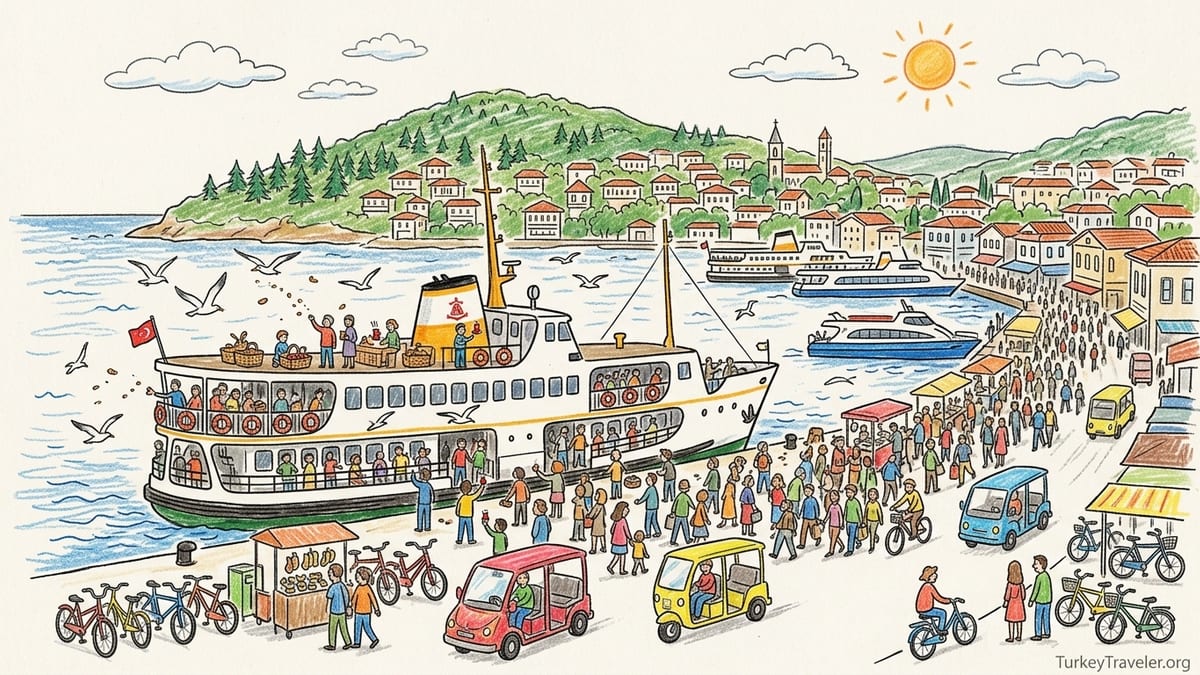
Arriving With Half of Istanbul
I chose a bright Saturday in July and an early morning ferry from Kadıköy, thinking I could stay one step ahead of the day trippers. The Şehir Hatları pier was already busy at 9 am. Families with picnic bags, groups of friends with Bluetooth speakers, tour groups following raised umbrellas and solo travellers like me were all funneled through the same turnstiles. The two level ferry filled quickly. By departure time almost every outside bench was taken and people were leaning on the railings, sipping tea from tulip glasses and feeding seagulls simit crumbs.
The crossing itself still matched Büyükada’s peaceful reputation. Leaving Istanbul’s Asian shoreline, the city skyline softened and the wind finally felt cooler than the asphalt heat I had left behind. The Princes’ Islands appeared slowly, low green shapes in the haze. Büyükada, the largest at about five square kilometres, sat furthest out, its two hills stacked with houses and pine trees. From that distance it looked exactly as promised in every brochure: no cars, just red tiled roofs, church towers and the white line of the waterfront.
As we approached the island, the calm view collided with reality. The closer we came to the main pier, the more details emerged: several ferries already docked, another arriving from Kabataş, a fast boat pulling in from Bostancı, and a dense, moving mass of people on the quay. Loudspeakers crackled with boarding calls in Turkish and English. Even before we tied up, I could see vendors holding up laminated beach brochures through the railings, ready to catch arriving passengers the moment they set foot on the island.
Disembarkation was slow, and this was my first hint that Büyükada today is an escape shared with thousands. The ferry emptied in one steady stream that met an incoming crowd waiting to board for the return to the city. There were no cars, but there were enough people to feel like a small stadium had just emptied into a single street.
The Pier Gauntlet: Crowds, Touts and First Impressions
The area directly in front of the Büyükada pier is where the tension between the island’s reputation and its popularity hits hardest. The instant I stepped off the ramp, I was faced with overlapping offers: “Beach club, madam?” “Electric taxi tour!” “Bicycle rental, good price!” Men with clipboards handed out printed price lists for beaches like Yörükali and Viranbağ. Another waved a brochure for a beach that promised “no children, no noise” for a fee that was, in reality, high enough to keep it that way.
It was difficult to even pause and get my bearings because of the constant movement. Lines formed in front of ice cream stands and simit sellers that ring the small square. A queue for island taxis and larger electric shuttle vehicles snaked across the pavement. The soundscape was pure summer chaos: ferry horns, music from cafes, announcements about the next departure to Kabataş, children crying, luggage wheels rattling on the cobblestones. Any expectation I had of stepping into instant calm disappeared in that first ten minutes.
Restaurant staff along the waterfront were already out on the pavement, menus in hand. A couple of them approached with well practiced lines: “Sea view table upstairs,” “Fresh fish, good price, you can check menu.” To their credit, most backed off with a smile when I said I wanted to walk first, but the effect was still a gauntlet of attention when I was just trying to orient myself. I noticed a few visitors give in quickly, sitting down at the first empty table they saw simply to escape the flow of bodies on the street.
It would be unfair to say this first impression defines all of Büyükada, but anyone arriving in midsummer on a weekend should be prepared. The island might be car free, yet the square outside the pier feels like a busy Istanbul junction, compacted into a tighter space and layered with tourism services. The escape exists, but it starts somewhere beyond this first block.
Electric Vehicles, Rental Bikes and Main Street Congestion
Once famed for its horse drawn phaetons, Büyükada now runs on electric power. The road parallel to the waterfront is packed with small white island taxis, elongated open sided shuttles and municipal electric buses that serve routes toward Maden and Nizam. Their quiet engines are a relief for the horses that used to work here, but at peak times the sheer number of vehicles circling the square is jarring. I watched three shuttles reverse and turn at once in front of the pier while porters pushed trolleys stacked with crates of water toward waiting restaurants.
Bicycle rental shops line the road behind the waterfront, sometimes three or four in a row. On my visit in 2026, standard single gear bikes started around a few hundred lira for the day, with slightly more for tandems and e bikes. Business was brisk. Staff wiped down saddles and adjusted seat heights while customers signed quick rental forms. Within an hour of my arrival, the main coastal road became a moving blend of pedestrians, families on rented bikes, and electric shuttles.
On the first stretch of the island’s main drag, İnönü Caddesi, I found it almost impossible to stroll at a natural pace. People stopped every few meters to take photos of the Atatürk statue, to buy corn on the cob or to check their bearings on a map. Cyclists wobbled around them, sometimes ringing bells politely, sometimes darting past more aggressively. Despite the absence of cars, stepping off the curb without checking both ways could still result in a near miss with an electric vehicle or a tandem bike.
For anyone who arrives expecting a sleepy, traffic free resort, this main area can feel like a theme park concourse. The fact that everything is human scale helps: the buildings are low, there is constant sea breeze, and occasional gaps in the crowds give quick views between restaurants to the water. Still, Büyükada’s popularity as Istanbul’s favourite day trip means that for several blocks, you are sharing your escape with what feels like the population of a small town.
Walking Away From the Harbour: Where Peace Begins
The turning point of my day came when I made a deliberate decision to walk inland, resisting every shuttle, taxi and bike offer. I followed the street past the busy cafes, turned right at a small bakery where locals were buying fresh simit, and started climbing slowly into the residential backstreets. Within ten minutes, the sounds from the pier had thinned to a distant murmur.
This is where Büyükada started to resemble the image in my head. Narrow lanes edged by stone walls and bougainvillea, cats sleeping on steps, laundry hanging between balconies. The houses shifted from modern pensions to late Ottoman and early Republican wooden mansions with delicate balconies and wraparound verandas. Some were weathered and peeling, others freshly restored, painted in shades of cream, pale blue or green. The smell changed too, from grilled fish and sunscreen to pine needles and damp earth.
In the Nizam neighbourhood on the eastern side of the island, I found entire streets where I passed only a handful of people in twenty minutes. One elderly couple sat under the shade of a fig tree, and a man on a bicycle delivered bread in a front basket. The climb was steady rather than steep, and each turn brought short glimpses of the sea between rooftops. It felt a world away from the ferry square, yet I had walked less than two kilometres.
Continuing uphill toward the ridge that leads to the Aya Yorgi (St George) hilltop, the quiet deepened further. Traffic here consisted mainly of a few electric island service vehicles and more confident cyclists attempting the ascent. I stopped at a simple bench with a broken plank and realized I could hear individual birds and, faintly, the call to prayer drifting over from the mainland. This, finally, was the Büyükada that brochures promise: slow, shaded, slightly faded and wholly absorbing.
Historic Mansion Streets That Restore the Island Dream
Büyükada’s built heritage does a lot of work in restoring the island’s aura of calm. In the upscale parts of Nizam and the leafy backstreets of Maden, long rows of historic wooden konaks line the slopes. These mansions once belonged to wealthy Ottoman Greek, Armenian and Turkish families who escaped the city for the summer. Some still serve as private homes, others as discreet boutique hotels and pensions behind modest gates.
One of the most atmospheric walks of my day began just beyond the main bustle, on a street where a faded wooden house with intricate latticework faced a freshly restored cousin with white shutters and bright pink geraniums. Here, jasmine spilled over garden walls and old iron lamp posts leaned slightly at odd angles. I walked for fifteen minutes and counted more cats than people. Occasionally, an electric service cart trundled past, stacked with crates of bottled water headed downhill to supply the waterfront restaurants.
Further along, near the upper edges of Nizam, houses thinned and pine forest thickened. The road surface turned from cobbles to simpler asphalt patched with sand. Details reflected Büyükada’s layered communities: a small Greek Orthodox chapel with blue trim tucked behind a hedge, a synagogue shielded by tall cypress trees, a modest mosque with its own pocket of shade. Benches overlooked the sea in directions that most day trippers never seem to reach, their attention focused on the island’s more obvious viewpoints.
Walking these mansion streets was where I finally relaxed into the day. The tension between postcard imagery and reality did not disappear completely, but it shifted. Büyükada revealed itself not as a single, coherent mood, but as a patchwork: crowded waterfront, quietly affluent hills, hidden religious corners and patches of forest where time slowed down again.
Beaches, Sea Access and the Cost of a Swim
Like many visitors, I had hoped to cool off with a swim. That is where the other side of Büyükada’s popularity becomes clear. The coastline immediately around the harbour is rocky and reserved largely for boats, so actual swimming means choosing between beach clubs and a few more basic public access spots further away. Brochures handed to me on arrival quoted 2024 season prices for private beaches starting from around a few hundred lira per person and rising to 500 lira or more at better known spots, usually including a sunbed and umbrella.
On my visit, one beach representative at the pier quoted a weekend entry price that was noticeably higher than the weekday rates listed online. When I mentioned what I had seen on a printed sheet, the price dropped slightly. It was a reminder that on a busy Saturday, demand is high enough that some negotiation is expected. Another beach tout promised free boat transfer from the harbour to a cove, but the fine print revealed that you needed to commit to a minimum spend on food and drinks once there.
Public options are fewer but they exist, often a short walk or a combination of walking and electric shuttle into the Maden side of the island. Municipal announcements over recent summers have highlighted efforts to keep some beaches affordable, with modest entrance fees and basic facilities. The trade off tends to be larger crowds and less space per person, especially on weekends when Istanbul’s heat pushes more residents toward the sea.
In the end I compromised, choosing a mid range beach reachable by shuttle. The water was refreshingly cool, the view across to the mainland was lovely, but the soundtrack was loud club music and the space between sunbeds was tight. It was pleasant, yet not the serene dip I had imagined while staring at the sea from the ferry. For quieter, more natural swimming, several locals I spoke to later suggested choosing a smaller island like Burgazada or coming to Büyükada on a weekday and heading straight toward the less developed stretches beyond the main beach clusters.
Lunch, Queues and the Price of Popularity
By early afternoon the crowds seemed to peak. Queues formed for almost everything: to board return ferries, to buy ferry tickets from machines, to rent bicycles, to claim seats at shaded cafes. I watched a line of more than twenty people outside a well known ice cream shop while a nearby fruit juice stand did brisk business with almost no wait, simply because its sign was less Instagram famous.
Food on Büyükada covers a spectrum from simple gözleme stands to seafood restaurants where lunch for two can rival central Istanbul prices. Along the waterfront, lunch menus in July 2026 often listed sea bass, sea bream and mezze spreads at prices that reflected both inflation and captive audience economics. A basic fish plate with salad and soft drink could run to several hundred lira per person, while a more casual meal of pide or köfte at a side street lokanta cost noticeably less.
I chose a second line street cafe a few minutes’ walk inland, where there were no touts and the menu was printed only in Turkish. The waiter pointed out the day’s dishes in a glass counter: stewed green beans, stuffed peppers, grilled chicken. For roughly half of what I had been quoted on the waterfront, I ate a satisfying plate of home style food, drank tea and watched a local family celebrate a birthday with a simple cake they had brought from the mainland. The experience felt closer to the everyday island life that still exists behind the tourism machine.
If you come in summer on a weekend, it is worth planning lunch strategically. Either reserve a specific restaurant, commit to a simpler lokanta away from the harbour, or assemble a picnic of bakery goods, cheese and fruit before you leave Istanbul. That way, you spend less of your supposed escape standing in line or bargaining over menus and more of it actually enjoying the streets and views that make Büyükada special.
Was Visiting on a Weekend a Mistake?
Mid afternoon, as I watched yet another full ferry arrive while people queued for the one back to the city, I asked myself whether my choice of a summer Saturday had been a mistake. In some ways, yes. If your mental picture of Büyükada is a sleepy, near empty island, arriving in high season on a weekend will almost certainly be a shock. The crowds are real, the queues are long, and the square outside the pier can feel more like a transport hub than a tranquil resort.
On the other hand, the crowds are also part of the story. Büyükada has served as an escape valve for Istanbul for over a century. Seeing families spread picnics in small patches of shade, teenagers posing with bicycles in front of the Atatürk statue, and older couples promenading in their best summer clothes is witnessing the island fulfilling that social role. It is not the marketing image of solitude, but it is a very real expression of how the city uses its islands.
There were moments when I wished I had the roads to myself, particularly on the climb toward the hilltop chapel of Aya Yorgi, where a stream of hikers and cyclists moved in both directions. Yet even there, a small detour down a side lane led me instantly into a quiet pocket of pine forest with only the sound of cicadas. The lesson was not that Büyükada is overrated, but that it demands a more thoughtful strategy than simply hopping on the next sunny weekend ferry.
Looking back, my day was a mix of frustration and delight. I lost time weaving through crowds and dodging rental bikes, but I also gained a better understanding of the island’s dual personality. Büyükada is both the peaceful refuge of its brochures and the lively, sometimes chaotic playground of Istanbul’s summer weekends. Which side you experience more intensely depends largely on when you come and how quickly you are willing to leave the harbour behind.
The Takeaway: How I Would Do Büyükada Next Time
I left Büyükada on an evening ferry with my skin salty from a crowded swim and my notebook full. The island had been far more congested than I expected, yet parts of it were every bit as beautiful and peaceful as promised. The main difference between the cliché and my reality was timing and tactics, not the island itself.
On a future trip, I would start by avoiding summer weekends. A Tuesday or Wednesday in late June or early September would be ideal, when the weather is still warm enough to swim but the heaviest local crowds thin out. I would aim for the very first morning ferry from Kadıköy or Bostancı, leaving Istanbul before the city properly wakes up, and I would resist the temptation to sit around the harbour on arrival.
Instead, my plan would be an immediate escape from the pier. I would bypass the touts with a firm smile, skip renting a bike in the busiest zone, and walk ten or fifteen minutes inland before making any decisions about transport or food. That short buffer is enough to swap the chaos of the square for the calm of mansion lined streets, to hear footsteps on stone instead of loudspeakers and bicycle bells.
If budget allows, I would seriously consider an overnight stay. Spending a night in one of the island’s quieter pensions in Nizam or Maden would let me experience Büyükada’s evenings and early mornings, when day trippers have gone and locals reclaim the promenade. I can imagine watching the lights of Istanbul flicker across the water from a nearly empty waterfront, then waking up to quiet lanes where the loudest sound is a bread delivery bike and the island finally matches its peaceful reputation.
FAQ
Q1. Is Büyükada still worth visiting if it is so crowded?
Büyükada is worth visiting if you adjust your expectations. The waterfront and main streets can be very busy, especially on summer weekends, but quieter mansion areas and hill roads still offer the calm, leafy atmosphere many people hope for. Planning your route away from the pier helps you find that side of the island.
Q2. What is the best time to take the ferry to Büyükada?
For a calmer experience, an early morning ferry on a weekday is best, ideally the first or second departure of the day. This lets you arrive before the largest tour groups and gives you a few quieter hours to explore before the island fills up.
Q3. How expensive is a day on Büyükada in 2026?
Costs vary by choices. A round trip ferry from the city, simple lunch at a side street lokanta and a mid range beach entrance can add up to a noticeable but manageable expense in Turkish lira. Waterfront seafood meals and higher end beach clubs push the total higher, while picnics and public beaches keep it lower.
Q4. Are the electric vehicles on Büyükada noisy or dangerous?
Electric taxis, shuttles and municipal buses are quieter than cars but they are numerous around the pier and main roads. Combined with bicycles and pedestrians, this can feel chaotic. Paying attention when crossing and avoiding the busiest stretches during peak hours makes walking feel safer and more relaxed.
Q5. Is renting a bicycle a good idea on Büyükada?
Renting a bike can be enjoyable if you are comfortable riding in light traffic and can handle some hills. On busy weekends, main roads get congested with inexperienced cyclists and pedestrians, which can be stressful. Confident riders who head quickly toward quieter loops usually enjoy it more than beginners who stay near the harbour.
Q6. How easy is it to find a quiet place away from the crowds?
It is easier than the waterfront suggests. A fifteen to twenty minute uphill walk into the Nizam or Maden neighbourhoods leads to residential streets where you may see more cats than people. Continuing toward forested hill roads brings even more peace, especially outside peak midday hours.
Q7. What should I know about Büyükada’s beaches and swimming spots?
Most easy access swimming spots are managed beach areas with entrance fees that often include a sunbed and umbrella. Prices can be higher on weekends and at more popular clubs. Public access points exist but may require more walking, and facilities are simpler. Asking locals or checking up to date information in Istanbul before you travel helps with choosing a beach that matches your budget and noise tolerance.
Q8. Are restaurant touts very aggressive on Büyükada?
Along the waterfront near the pier, staff commonly invite passersby to see menus and sit down. In my experience they stepped back politely when declined, but the sheer number of invitations can feel overwhelming. A short walk inland leads to quieter places where no one calls you in and prices are often more reasonable.
Q9. Is it better to visit Büyükada as a day trip or stay overnight?
A day trip is enough to see the main sights, but staying overnight shows a different, much calmer side of the island. Evenings and early mornings are noticeably quieter once day trippers leave. If your schedule and budget allow, one night in a small pension in a residential area can transform the experience.
Q10. What is the single best strategy for enjoying Büyükada despite the crowds?
The most effective strategy is to arrive early on a weekday, walk straight past the pier crowds without stopping, and head uphill into the mansion streets before doing anything else. From there you can decide calmly whether to rent a bike, take an electric vehicle farther out, or continue on foot, all while keeping the island’s more peaceful side in view.