

The Marmara region is where many first-time visitors meet Turkey: Istanbul’s skyline, Ottoman imperial cities, battle-scarred peninsulas and lakeside retreats all cluster around the Sea of Marmara. Yet most travelers barely step beyond Istanbul. This guide focuses on the wider Marmara region for a first trip, using Istanbul mostly as a transport gateway and spotlighting Bursa, Uludağ, Sapanca, Yalova, Çanakkale with Gallipoli and Troy, Edirne, İznik and the region’s national parks, thermal springs and ferry routes.
Understanding the Marmara Region
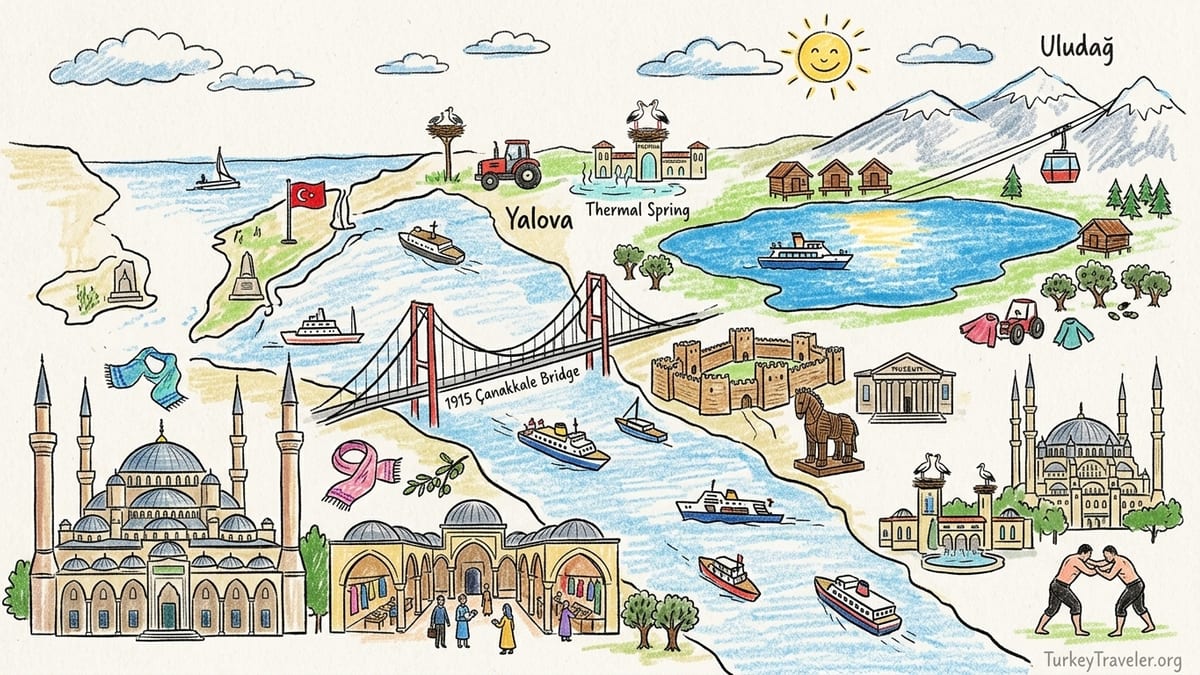
Marmara is Turkey’s northwestern bridge between Europe and Asia, wrapped around the inland Sea of Marmara and bordered by the Aegean and Black seas. Istanbul dominates the headlines, but GoTürkiye also highlights Bursa, Edirne and Istanbul together as defining centers of Marmara, with Sapanca, Yalova and regional national parks promoted as nature escapes. For first-time visitors, this means you can combine city breaks, ski days, thermal spa time and major archaeological sites within a single, compact region.
Distances are manageable. Bursa lies roughly 2 to 3 hours from Istanbul by a mix of ferries and buses. Edirne is about a 3-hour drive northwest, near the Greek and Bulgarian borders. Çanakkale, gateway to Gallipoli and Troy, is usually 5 to 6 hours by bus from Istanbul including a Dardanelles crossing. Sapanca and Yalova sit within about 2 hours of Istanbul, making them popular weekend getaways for local residents as well as visitors.
The region is also layered with history. Bursa and Edirne were both early Ottoman capitals before the conquest of Constantinople, and their mosques, bazaars and külliye complexes help newcomers understand Ottoman culture in a more compact, less overwhelming setting than Istanbul. Around Çanakkale you step into two very different pasts: the Bronze Age world of Homeric Troy and the 20th century battlefields of Gallipoli, now a place of quiet memorials set above the Dardanelles.
Climate varies within Marmara, which affects how you plan. Uludağ above Bursa is a winter ski area, while coastal towns around the Sea of Marmara, the Gallipoli peninsula and Edirne experience hot, dry summers with relatively mild winters. Spring and autumn are often the most comfortable seasons for combining sightseeing, hiking and ferries without extreme heat or snow.
Bursa and Uludağ: Ottoman Heartland and Winter Playground
Bursa was the first major Ottoman capital and still feels like an ideal introduction to the empire’s architecture and urban life. The city’s historic core centers on the Ulu Cami, a vast 14th century Great Mosque, and the Koza Han silk caravanserai, where shops still sell silk scarves and textiles. A first-time visitor might spend a morning walking from the Green Tomb and Green Mosque complex, with its turquoise tiles, through narrow bazaar streets up toward the citadel district and its old city walls.
Ottoman heritage here is not just monuments. Neighborhoods such as Cumalıkızık on Bursa’s eastern outskirts preserve timber-framed Ottoman houses along cobbled lanes, now a UNESCO-listed site. Staying in a restored konak guesthouse in this village or in Bursa’s central Hisar area gives a feel for traditional domestic architecture. In practical terms, midrange hotels in Bursa often price rooms at the equivalent of around 60 to 120 US dollars per night, with family-run pensions in older quarters at the lower end of that range.
Uludağ rises just behind Bursa and is one of Turkey’s best-known ski resorts and a national park. The modern gondola, Bursa Teleferik, climbs from the city’s outskirts to ski village areas above 1800 meters. In winter you can rent skis or a snowboard from slope-side shops and buy a day lift pass on the spot. Travelers commonly report total costs for basic rental gear, lift passes and hot drinks around what you might pay for a single lift ticket at a midrange European resort, which many find affordable for a day trip from Istanbul or Bursa.
Uludağ is not only for skiers. In summer, the national park’s forests and meadows attract hikers and picnickers escaping city heat. Short waymarked trails lead to viewpoints over Bursa and the Gulf of Gemlik, and there are basic mountain hotels and chalets for overnight stays. Reaching Bursa from Istanbul is straightforward: many visitors take a high-speed ferry from central Istanbul piers or from Yenikapı or Eminönü to Mudanya or Güzelyalı on the Marmara coast, then continue 30 to 60 minutes by bus into Bursa, or travel directly by intercity bus from Istanbul’s major bus stations and airports.
Sapanca, Yalova and Marmara’s Lakes and Thermal Springs
The inland lakes of Marmara are promoted by GoTürkiye as easy nature escapes close to the big cities. Lake Sapanca sits roughly 135 kilometers east of Istanbul and around 50 kilometers from Kocaeli. Suburban trains and frequent intercity buses link Istanbul to nearby Sakarya province, which makes Sapanca a popular weekend escape for Istanbul residents. Visitors usually stay in lakeside boutique hotels or wooden bungalows in forested hills above the shore, many of which advertise private hot tubs, fire pits and breakfast baskets delivered to your terrace.
A typical first visit to Sapanca might involve checking into a small hotel near the lakeshore, renting a bike or e-scooter to follow the lakeside promenade, and then driving or taking a taxi up into the hills above Mahmudiye or İstanbuldere villages for short waterfall hikes and trout restaurants. Many menus here feature simple grilled fish, fresh salads, gözleme flatbreads and strong Turkish tea served on riverside platforms. Prices are usually lower than in central Istanbul but higher than in inland Anatolian towns, so it helps to check menus before ordering.
Across the Sea of Marmara, Yalova is known in national tourism materials as a relaxation center with beaches, forests and especially thermal springs. The Termal district a short drive from Yalova town has long been visited for its hot mineral waters; today, historic hamams and modern spa hotels sit side by side. A traveler might, for example, take a fast ferry from Istanbul’s Yenikapı or Kadıköy piers, check into a midrange thermal hotel with breakfast and spa access included, spend the afternoon in hot pools and traditional steam rooms, then walk in the surrounding forests the next morning before returning to the city.
Both Sapanca and Yalova work well as one- or two-night trips between busier stops such as Istanbul and Bursa. Because they are so popular on weekends with local families, first-time visitors who prefer quieter stays should consider weekdays outside national holidays. Rental cars pick up from Istanbul’s Sabiha Gökçen Airport often make it easy to loop through Sapanca, Yalova and Bursa without needing to return to Istanbul in between.
Çanakkale, Gallipoli and Troy: Battlefields and Bronze Age Legends
Southwest of the Sea of Marmara, the city of Çanakkale straddles the Asian shore of the Dardanelles strait and serves as a hub for two of Turkey’s most important heritage areas: the Gallipoli battlefields and the archaeological site of Troy. Most travelers arrive from Istanbul by intercity bus, a journey of roughly 5 to 6 hours depending on traffic and whether the operator uses highway bridges or local ferries across the strait. Some self-drivers now use the 1915 Çanakkale Bridge as the fastest link between European and Asian sides of the Dardanelles.
The Gallipoli peninsula, to the northwest of Çanakkale, is today a quiet, pine-covered landscape dotted with cemeteries and memorials. Visitors from Australia and New Zealand often come specifically to see ANZAC Cove, Lone Pine Cemetery and Chunuk Bair, though the Turkish memorial at Conkbayırı and the Çanakkale Martyrs’ Memorial also tell the story from the Ottoman side. Many agencies in both Istanbul and Çanakkale run full-day guided tours that include transport, ferry crossings, lunch and guiding at several battlefield sites. Prices can vary widely, but a typical small-group day trip from Istanbul usually costs in the low hundreds of US dollars per person, while locally booked tours from Çanakkale are usually less.
Troy, around 30 kilometers south of Çanakkale, blends myth and archaeology. The hill at Hisarlık shows multiple settlement layers, some associated with the Late Bronze Age city that inspired Homer’s Iliad. The on-site Museum of Troy displays finds from the region, and many visitors appreciate combining a few hours at the ruins with museum time to understand how the site fits into the wider Aegean world. Public minibuses and taxis link Çanakkale to Troy, though many travelers prefer small-group tours or rental cars for flexibility.
For first-time visitors, combining Gallipoli and Troy in two days based in Çanakkale often feels more relaxed than a single, very long day trip from Istanbul. A simple plan is to overnight in Çanakkale’s waterfront hotels or pensions, where many rooms overlook the strait and harbor, then join one tour day to Gallipoli and another to Troy and the museum. Those on tighter schedules can take overnight packages from Istanbul that bundle transportation, guiding and a hotel in Çanakkale into one price.
Edirne and İznik: Ottoman Capitals, Mosques and Lakeside Calm
Northwest of Istanbul, Edirne is one of Marmara’s most rewarding cities for architecture and history. Once the Ottoman capital after Bursa and before Istanbul, Edirne sits close to the Greek and Bulgarian borders and retains a distinctly Balkan flavor. The skyline is dominated by the Selimiye Mosque, regarded as a masterpiece of the architect Sinan, whose towering minarets and spacious dome are visible from highways long before you reach the city center.
A first-timer might spend a day walking between Selimiye, the Old Mosque and Üç Şerefeli Mosque, stopping at the historic bedestens and bazaars that link them. In summer, the city also hosts the centuries-old Kırkpınar oil wrestling festival on fields outside town, which brings in visitors from across Turkey and neighboring countries. While hotel and restaurant prices in Edirne are typically lower than in Istanbul, the city’s position on major European road routes means booking ahead on summer weekends is wise.
On the eastern shore of the Sea of Marmara, İznik is a smaller and quieter destination with a long history. Known as Nicaea in antiquity and the site of early Christian councils, İznik later became famous in the Ottoman era for its blue-and-white ceramics used in many of Istanbul’s mosques and palaces. Today, travelers visit to walk the surviving city walls and gates, see lakeside Byzantine and Ottoman ruins and browse modern tile workshops that still produce hand-painted ceramics.
İznik lies within reach of both Istanbul and Bursa, making it a good stop on a regional loop. Many visitors arrive by car from Bursa in around an hour and continue northeast to the İzmit Gulf or Sapanca. An overnight stay at a small lakeside hotel allows time for a sunset walk along Lake İznik and a relaxed visit to the town’s tile ateliers. Buying a small hand-painted tile or plate here, often for less than the equivalent of 20 to 30 US dollars, can be a more personal souvenir than similar items in Istanbul’s Grand Bazaar.
Sea of Marmara Ferries, Airports and Realistic Regional Routes
Although this guide treats Istanbul mainly as a transport gateway, understanding how you move through Marmara is essential. The region is one of Turkey’s best connected by road, sea and air. Istanbul’s main airports, Istanbul Airport on the European side and Sabiha Gökçen on the Asian side, serve as primary entry points. From there, frequent intercity buses run to Bursa, Edirne, Çanakkale, Yalova and Sakarya for Sapanca. In addition, fast ferries across the Sea of Marmara link central Istanbul or nearby ports to Mudanya and Güzelyalı for Bursa and to Yalova.
For a first-timer without a car, a realistic one-week Marmara route might look like this: arrive in Istanbul and stay 3 to 4 nights to see the main sights. Then take a ferry or bus to Bursa for 2 nights, with a day on Uludağ if you are visiting in ski season or a summer hike if not. From Bursa, continue by bus around the southern shore of the Sea of Marmara to Çanakkale for 2 or 3 nights, using local tours or buses to visit Gallipoli and Troy. Return to Istanbul by bus for your departing flight.
With a rental car and more time, you can create a wider circuit. For example, start in Istanbul, drive east to Sapanca for a night by the lake, then continue via İznik and Yalova to Bursa. After exploring Bursa and Uludağ, drive west to Balıkesir province and follow the coast to Çanakkale, visiting islands such as Bozcaada if schedules permit. From Çanakkale, cross to the European side after your Gallipoli visit and drive north to Edirne, then return to Istanbul along the main highway. This kind of loop allows you to combine lakes, forests, battlefields and Ottoman cities without doubling back too often.
Travelers relying on public transport should note that while major cities have frequent buses, smaller nature reserves and some national parks can be harder to reach without a car. In those cases, many visitors join local day tours from nearby cities. In Bursa, for instance, several agencies sell day trips to Uludağ that include transport, basic equipment rental and sometimes a brief stop at a nearby waterfall. Around Çanakkale, local operators offer minibus tours to multiple Gallipoli sites or to Troy and nearby ruins in a single day, which can be more efficient than trying to connect local buses and taxis yourself.
National Parks, Lakes and Outdoor Experiences
Marmara’s reputation as an industrial and urban region hides the fact that it contains a dense network of national and nature parks. Uludağ National Park in Bursa is the most famous, with ski runs in winter and hiking, camping and wildflower meadows in summer. The park’s altitude means temperatures are often noticeably cooler than in Bursa itself, making it a pleasant escape in the hotter months.
Birdwatchers and those interested in wetlands gravitate toward lakes such as Manyas and Gala. Lake Manyas, south of the Sea of Marmara, is known for its bird sanctuary, while Lake Gala National Park in Edirne province protects wetlands that host numerous migratory species. Organized wildlife tours here are still relatively low-key compared with coastal resorts, so first-time visitors usually base themselves in nearby towns and then take guided boat trips or walks into the protected zones when conditions allow.
Closer to the big cities, several designated nature parks and forest recreation areas offer day hikes, picnic sites and short canyon walks. Examples include areas around Yalova’s Termal district, where forest paths connect hot springs with viewpoints, or upland plateaus in the foothills of Uludağ where locals camp in summer. Facilities can be simple, sometimes just basic toilets and picnic tables, so it is wise to bring water, snacks and layers suitable for changing mountain weather.
Many of these natural areas see their busiest days on national holidays and sunny Sundays when city residents arrive in large numbers. For quieter experiences, early mornings, weekdays and shoulder seasons are best. Taxis from nearby towns, shared minibuses where available or pre-arranged transfers with your hotel can bridge the final kilometers into parks that are not served directly by intercity buses.
The Takeaway
For first-time visitors, the Marmara region is far more than Istanbul. Bursa and Uludağ offer a compact introduction to Ottoman urban life and mountain landscapes. Sapanca and Yalova provide lakeside calm and thermal springs within easy reach of the metropolis. Çanakkale connects the ancient world of Troy with the modern memory of Gallipoli, while Edirne and İznik round out the picture with monumental mosques, historic city walls and quiet lakeshores.
With efficient ferries, frequent buses and a growing network of highways and bridges, it is increasingly practical to weave several of these destinations into a single itinerary. By using Istanbul as a flexible gateway rather than your only base, you can see more of how northwest Turkey fits together: the way trade routes, battlefields, pilgrimage sites and resort towns all cluster around the Sea of Marmara. The result is a trip that balances history and landscape, reflection and recreation, in a region many travelers only glimpse from an Istanbul hotel window.
FAQ
Q1. How many days should a first-time visitor spend in the Marmara region beyond Istanbul?
Most first-time visitors find that 5 to 7 days beyond Istanbul is enough to see Bursa and Uludağ, Çanakkale with either Gallipoli or Troy, plus one smaller stop such as Sapanca, Yalova, Edirne or İznik without feeling rushed.
Q2. Is it realistic to visit Gallipoli or Troy as a day trip from Istanbul?
It is possible but involves a very long day, often 14 hours or more door to door. Many travelers prefer to overnight in Çanakkale and visit Gallipoli and Troy on separate days so they spend more time on site and less on the road.
Q3. When is the best time to visit Bursa and Uludağ?
For skiing and snow activities, January to early March usually offers the best conditions on Uludağ, though weather varies. For hiking and city sightseeing, late April to June and September to October bring milder temperatures and clearer views.
Q4. Do I need a car to explore Sapanca and Yalova?
You can reach both Sapanca and Yalova by public transport from Istanbul, but a rental car makes it much easier to reach hills, waterfalls, thermal districts and small villages. Without a car, you may rely more on taxis or hotel-arranged transfers for short local trips.
Q5. Are the thermal baths in Yalova suitable for families and first-time visitors?
Yes. Yalova’s Termal area includes traditional hamams with separate sections and many modern spa hotels that welcome families. First-time visitors often choose hotels that include pool and spa access in the room rate to simplify the experience.
Q6. How expensive is Uludağ compared with other parts of Marmara?
Uludağ is one of the pricier spots in the region, especially for slope-side hotels and restaurant meals in peak ski season. Many budget-conscious travelers stay in Bursa instead, ride the gondola up for the day, rent equipment on site and return to the city in the evening.
Q7. Can I combine Edirne with Gallipoli and Troy on the same trip?
Yes, though they are in different corners of the region. A common pattern is to visit Edirne as a separate overnight side trip northwest of Istanbul, then travel southwest on another leg to Çanakkale for Gallipoli and Troy, rather than trying to link them directly in a single travel day.
Q8. Is Marmara a good choice for travelers interested mainly in nature and outdoor activities?
Marmara offers more variety than many expect, including skiing on Uludağ, lakeside walks at Sapanca and İznik, birdwatching at protected lakes and forest hikes near Yalova. It may not be as wild as eastern Turkey, but it works very well for moderate hikes and short nature escapes near major cities.
Q9. How do I travel between Istanbul and Bursa most easily?
First-time visitors usually choose either a fast ferry from central Istanbul to ports near Bursa followed by a short bus ride, or a direct intercity bus from Istanbul’s main bus stations or airports to Bursa’s terminal. Both options typically take between 2 and 3 hours depending on connections and traffic.
Q10. Is it safe to travel independently around the Marmara region?
Most travelers find Marmara’s main routes and cities safe, with the same common-sense precautions used elsewhere: keep valuables secure, use registered taxis or reputable bus companies and check local advice on road and weather conditions, especially in winter around Uludağ and rural areas.