


The Aegean coast of Turkey is one of Europe’s easiest and most rewarding self-drive regions. With modern highways, compact distances and a string of historic towns and beach resorts, it is ideal for a one- or two-week road trip. This guide focuses on driving from Ayvalık in the north to İzmir, Çeşme, Ephesus, Bodrum, Marmaris and the Datça Peninsula, with practical details on rental cars, parking, scenic routes and suggested 7-, 10- and 14-day itineraries.
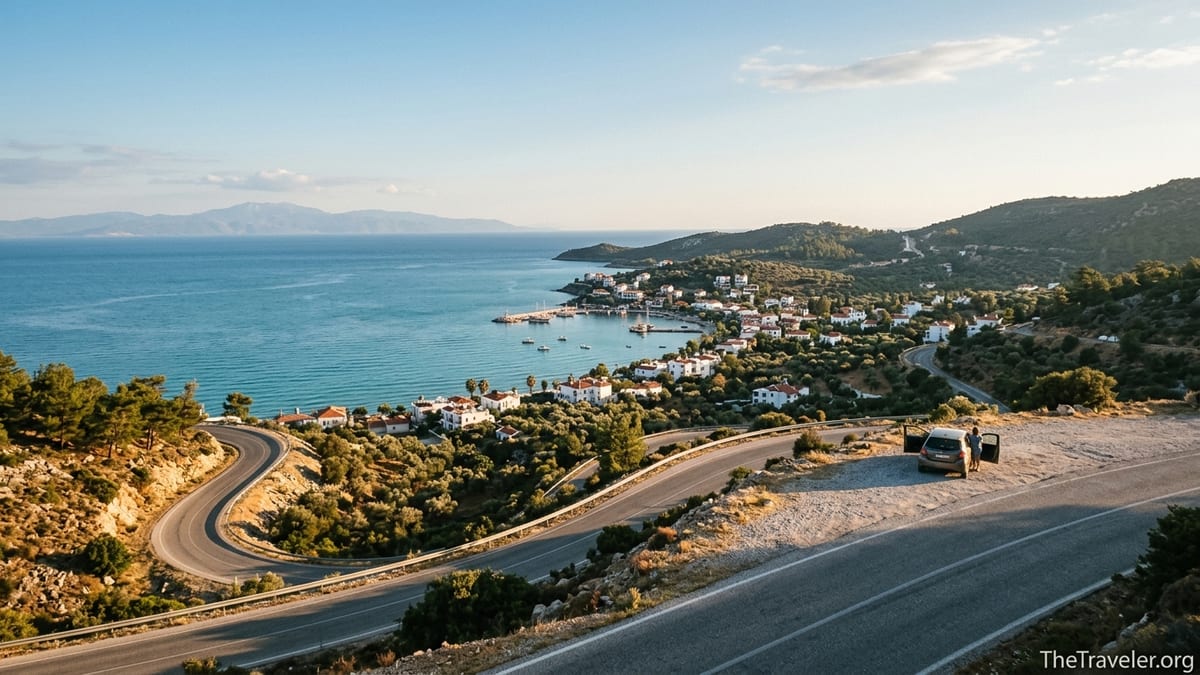
Why the Aegean Coast Works So Well as a Road Trip
The Aegean region combines good road infrastructure with a concentration of sights. From Ayvalık to Datça you are rarely more than two or three hours’ drive from the next major stop, which means you can keep daily drives to 150 to 250 kilometres and spend more time in villages, ruins and small coves rather than inside the car. Most routes follow state roads such as the D550 and D400, which link İzmir, Kuşadası, Bodrum and Marmaris, with smaller spurs to peninsulas like Çeşme and Datça.
Driving is generally straightforward compared with other parts of Turkey. The main coastal roads are paved and well signposted, and newer motorways north and south of İzmir allow you to bypass urban traffic if you prefer. For example, the toll motorway between İzmir and Aydın runs parallel to the older D550 and can cut journey times for those heading towards Kuşadası and Ephesus. Inland and on peninsulas such as Datça the roads become narrower and more winding, but they reward you with coastal views and quieter villages.
A road trip here also gives you flexibility to time your visits to popular sites. Having your own car lets you reach Ephesus at opening time before tour buses arrive, drop into wine villages such as Şirince for lunch, and then continue to a coastal base like Bodrum or Çeşme in the late afternoon. In practice, this means you can create a trip that balances ancient history, food stops at roadside lokantas and swims at family-run beach clubs, instead of moving on a fixed tour schedule.
Seasonality matters. July and August bring heavy traffic around İzmir, Çeşme and Bodrum, plus higher prices and more crowded parking. If you have a choice, late May to late June and September to early October offer calmer roads, warm sea temperatures and easier last-minute hotel and car rental availability, which significantly improves the road-trip experience.
Renting a Car: Practicalities, Costs and Pick-up Points
Most visitors start their Aegean road trip by flying into İzmir Adnan Menderes Airport or, if focusing on the southern section, Bodrum-Milas or Dalaman airports. At all three you will find major international rental brands alongside solid Turkish companies. It is common to pre-book a compact automatic or manual car and pick it up at the terminal, where the rental desks are clustered together and cars are parked a short walk away. One-way rentals are usually possible, for example collecting in İzmir and dropping in Bodrum, though this often adds a one-way fee.
Prices vary by season, but as a rough guide a compact car in shoulder season might cost the equivalent of 30 to 50 euros per day, rising in peak summer. Many travellers choose a compact SUV for better comfort on rougher stretches towards Datça and on village roads, which may cost slightly more but can be worth it for luggage space and ground clearance. When booking, check that unlimited or high-mileage packages are included because a two-week Aegean loop can easily cover 1,000 to 1,500 kilometres.
Having a credit card in the driver’s name is usually required for the security deposit. Third-party liability insurance is standard, but it is sensible to add collision damage waiver with a low excess. Windshield and tyre coverage is also useful if you plan to drive out to rural ruins or gravel parking areas. Make sure your rental company registers the car’s toll tag for motorways, as most Aegean toll roads operate electronically rather than with cash booths, and charges are then billed through the rental company after your trip.
In practical terms, collect the car after you have rested from any long-haul flights. Many travellers spend the first night in İzmir city or at a hotel near the airport, then pick up the car the next morning to start driving refreshed. This is particularly relevant if you plan to tackle the longer first leg from the northern town of Ayvalık down to İzmir or Kuşadası, which can take three to four hours depending on stops and traffic.
Driving Conditions, Parking and Safety Along the Coast
The Aegean coast offers a mix of dual carriageways, toll motorways and smaller two-lane roads. Between Ayvalık and İzmir you mainly follow north–south routes that parallel the Aegean, then around İzmir you can switch to ring roads to avoid the centre. South of the city, the drive towards Selçuk and Kuşadası passes olive groves and small towns, before branching again towards Bodrum, Marmaris and Fethiye. The sections closest to resort towns see more traffic, especially on Friday afternoons and Sundays in summer when locals head to and from the coast.
Within towns such as Ayvalık, Alaçatı, Bodrum and Marmaris, streets narrow and are often one-way. Many historic centres are pedestrianised or semi-pedestrian in the evenings. You will usually leave the car at a paid municipal car park just outside the old quarter, or at your hotel’s small guest parking area. For example, in central Bodrum a typical paid car park charges an hourly fee during the day with a capped daily rate, while many hotels on the peninsula offer on-site parking included in the room price.
In general, fuel stations are frequent on main roads, and many include basic cafes serving grilled meat, gözleme pancakes and tea. Buying fuel just off the highway inside towns can sometimes be slightly cheaper than at motorway service areas. Night driving on rural segments, especially between Marmaris and Datça or on back roads inland from Kuşadası, is less advisable due to sharp bends, unlit stretches and occasional stray animals. Plan to reach your overnight base before dark and enjoy sunset walks rather than being on the road.
Police and speed checks are common, particularly near İzmir and resort entrances. Respect local speed limits, wear seat belts and avoid using your phone while driving. Distances might look short on the map, but traffic lights through towns and winding sections can extend travel times. For instance, the drive from Marmaris to Datça is only around 70 to 75 kilometres yet often takes around 90 minutes or more because of curves and photo stops along bays and viewpoints.
Route Overview: From Ayvalık to İzmir and Çeşme
Many Aegean itineraries start in Ayvalık, a former Greek-Ottoman port town set amid olive groves. After collecting your car, you can spend a morning exploring the old quarter on foot, then drive up to the hilltop viewpoint on Cunda Island for sunset over the archipelago. When leaving Ayvalık, you head south towards İzmir following the main north–south road, passing farming towns and stretches of low coastline. With brief rest stops this drive typically takes around three hours.
İzmir itself is a large metropolis, but drivers can use the outer ring road to avoid dense urban traffic if they are not staying in the centre. Those who do pause in the city usually choose a hotel in districts such as Alsancak or Konak and park the car in an underground garage or hotel lot while they explore the seafront promenade and bazaar on foot. If you are continuing directly towards Çeşme, it is often quicker to skirt the city and join the westbound highway that crosses the Karaburun Peninsula to the resort town.
The İzmir to Çeşme drive is one of the easiest on this route, usually taking under 90 minutes on a modern dual carriageway. As you approach the Çeşme Peninsula, you can detour to Urla’s wine country for tastings and a vineyard lunch, or continue to the windsurfing town of Alaçatı, where many small hotels provide gated parking just outside the cobbled centre. From there it is a short hop to Çeşme town, with its castle, marina and beach clubs facing Chios island offshore.
If your schedule permits, spending two or three nights around Çeşme and Alaçatı allows you to use the car for short beach-hopping drives. In practice, this might mean a morning swim at Ilıca Beach, an afternoon at a quieter cove along the peninsula, and an evening return to Alaçatı for dinner, leaving the car in one of the small paid parking lots that ring the old streets.
South to Ephesus, Kuşadası and Bodrum
From İzmir or Çeşme, the next major historical stop is Ephesus. Drivers usually rejoin the southbound routes and head towards Selçuk, the town that serves as the gateway to the ancient city. The distance from İzmir city to Selçuk is roughly an hour, while from Çeşme you should allow closer to two hours depending on traffic around İzmir. Many travellers aim to reach Ephesus at opening time, so they stay overnight in Selçuk or Şirince and leave the car at their guesthouse, then move it to the main parking area at the Ephesus lower gate first thing in the morning.
Parking at Ephesus is in a large open-air lot near the site entrance, with attendants directing cars to rows. Fees are charged per vehicle, and you pay in cash or by card on exit. From here, you walk to the ticket booths and enter the site. Those who prefer a shorter walk can also drive to the upper entrance, but most road trippers find the standard parking convenient and use the time to gather water and sun protection from small shops beside the lot before entering the ruins.
After visiting Ephesus and nearby attractions such as the Basilica of St John, the House of the Virgin Mary and the hillside village of Şirince, it is an easy drive to the coastal resort of Kuşadası, which offers a wide choice of hotels with on-site parking. Many travellers break their journey here overnight before continuing to Bodrum. The Kuşadası to Bodrum drive takes several hours, following southbound highways and then turning west towards the Bodrum Peninsula, where the road narrows and winds through pine-covered hills.
On arrival in Bodrum you have two broad options for where to base yourself. Staying in Bodrum town puts you close to the castle, harbour and nightlife, but parking can be tight in peak season and you may rely on paid municipal car parks. Alternatively, staying in nearby bays such as Bitez, Gümüşlük or Yalıkavak gives easier parking and a more relaxed feel, with the car mainly used for day trips into town, to ancient sites like Pedasa or to boat trips departing from smaller harbours.
Continuing to Marmaris and the Datça Peninsula
From Bodrum, the route eastwards towards Marmaris is another highlight. Some travellers choose to drive inland via Milas and then south towards the coast, while others take a seasonal car ferry between Bodrum and Datça when available and then loop back via Marmaris. If you drive the full route, expect the Bodrum to Marmaris leg to take around three hours, with a mix of broad highways and curving coastal sections as you approach the bay of Marmaris.
Marmaris is a busy resort town set on a deep bay, with a long beachfront promenade. If you are driving in high season, it can be useful to book accommodation that specifically mentions on-site or reserved guest parking. Many mid-range hotels on the outskirts of the centre provide free parking, allowing you to walk or use local minibuses into town to avoid parking stress near the marina and bazaar. In the evenings, stretches of the seafront become pedestrian priority zones, making it more pleasant to explore on foot.
The drive from Marmaris to Datça is one of the most scenic in southwest Turkey. The road climbs from the coast into pine forest and then runs along the ridge of the narrow peninsula, with glimpses of coves to the north and south. At roughly 70 to 75 kilometres in length, it usually takes around 90 minutes, though you may want to allow longer to stop at viewpoints or small roadside stalls selling almonds and honey. The road is paved but has curves and occasional narrow segments, so daytime driving in clear weather is advisable.
Datça town acts as a laid-back base for exploring the peninsula. Many guesthouses sit a short walk from the harbour and provide small private parking areas or easy street parking. With your car you can spend a day driving west towards the ancient site of Knidos at the tip of the peninsula, stopping at small beaches on both the north and south coasts. Another day can focus on Eski Datça, the old stone village inland where parking is clustered at the village edge, leaving the narrow cobbled lanes car-free.
Sample 7-, 10- and 14-Day Aegean Road Trip Itineraries
A one-week trip typically focuses on a single stretch of the coast without rushing. A practical 7-day plan might start in İzmir, with one night in the city, then move to Çeşme or Alaçatı for two nights, continue to Selçuk for two nights to cover Ephesus and nearby sites, and finish with two nights in Bodrum. Daily drives on this schedule rarely exceed three hours, and you can return your rental car at Bodrum airport before flying onwards.
A 10-day itinerary allows you to extend further south or north. For example, you could start in Ayvalık with two nights and then drive to İzmir for one night. From there, spend two nights on the Çeşme Peninsula, two nights around Selçuk and Kuşadası and three nights split between Bodrum and Marmaris. This gives time for beach days, a boat trip from Bodrum or Marmaris and more leisurely visits to ancient sites such as Priene or Didyma, which you can reach by short detours from the main coastal roads.
If you have 14 days, you can comfortably cover the full arc from Ayvalık to Datça. One possible structure is: Ayvalık (2 nights), İzmir (1 night), Çeşme or Alaçatı (2 nights), Selçuk and Ephesus (2 nights), Bodrum (3 nights), Marmaris (2 nights) and Datça (2 nights). This pacing lets you keep some days completely free for coastal drives without luggage, such as a loop around the Bodrum Peninsula or a full day on the Datça Peninsula out to Knidos and back, returning to the same base in the evening.
These itineraries can also be adapted into one-way trips. For instance, some travellers collect their car in İzmir, follow the coast through Çeşme, Selçuk, Bodrum, Marmaris and Datça, then return by road to Marmaris and drop the car at Dalaman Airport before flying back to Istanbul. One-way rentals between major Aegean airports are relatively common, but you should still confirm drop-off locations and any additional fees when booking.
Ancient Sites and Scenic Stops Not to Miss
Beyond Ephesus, the Aegean coast offers a series of less crowded ancient sites, many of which are easier to reach with a car. From Ayvalık you can detour inland to the remains of Pergamon, set on a hilltop above Bergama town, parking near the lower cable car station or driving up to the upper parking area. South of Selçuk, the ruins of Priene sit above the plain with a small car park near the entrance, while Miletus and its theatre are also accessible by car along minor roads lined with fields and villages.
On the Bodrum Peninsula, the Castle of St Peter dominates the harbour, and nearby you can explore the sparse remains of the Mausoleum at Halicarnassus. There is no need to drive directly to the castle since central car parks are within walking distance of the waterfront. On the opposite side of the region, the Datça Peninsula culminates in Knidos, an atmospheric site of temples, theatres and harbours. The drive from Datça town to Knidos is around 35 to 40 kilometres on a narrower coastal road, and visitors usually return the same way in the afternoon.
Between these headline ruins are many smaller scenic stops ideal for drivers. Around Ayvalık, you might pause at roadside viewpoints over the island-studded bay at sunset. Near Çeşme, you can drive to wind-swept capes for views of the Greek island of Chios. South of Kuşadası, short detours lead to Dilek Peninsula National Park, where you leave the car at designated parking areas and continue on foot to beaches framed by pine forest. In the Marmaris region, drivers often include swimming breaks at coves near Akyaka or Hisarönü on the way to or from Datça.
Food is part of the enjoyment of an Aegean road trip. Simple roadside grills serve freshly caught fish, köfte meatballs and vegetable meze. Olive oil and wine from regions such as Urla and Bozburun feature heavily on menus, and in Datça you will see local almonds used in everything from pastries to ice cream. Being self-drive means you can stop spontaneously when you see a busy lokanta or a farm shop, rather than being limited to buffet lunches on big tour buses.
The Takeaway
An Aegean Turkey road trip between Ayvalık, İzmir, Çeşme, Ephesus, Bodrum, Marmaris and Datça offers a blend of ease and adventure that suits both first-time and repeat visitors. Roads are generally good, distances manageable and key sights strung like beads along the coast, so you spend more time swimming, wandering ruins and tasting olive oil than fighting traffic.
With sensible planning around car rental, parking and driving times, even a 7-day itinerary can feel relaxed rather than rushed, while 10 or 14 days allow for deeper detours and peninsula explorations. Choosing shoulder season, booking accommodations that clearly include guest parking and prioritising daytime driving on winding stretches such as the Datça road all contribute to a smoother experience.
Most importantly, having your own car turns the Aegean coast into a flexible landscape of options instead of a fixed circuit of resort hubs. You can decide on a whim to linger in a stone village like Eski Datça, detour to a viewpoint above Ayvalık’s islands or set off early to have Ephesus almost to yourself. For many travellers, those unplanned roadside moments become the most memorable part of the journey.
FAQ
Q1. Do I really need a car to explore the Aegean coast, or can I rely on buses?
Long-distance buses and minibuses connect most towns, but a car gives you far more flexibility for small coves, hill villages and ancient sites that are not on direct routes. If your priority is independent exploration and you are comfortable driving, a rental car significantly enhances the trip.
Q2. Where is the best place to start an Aegean road trip: İzmir, Bodrum or Dalaman?
For the classic Ayvalık to Datça route, İzmir is the most logical starting point, especially if you want to include Çeşme and Ephesus. If you are short on time and mainly interested in the southern stretch, starting in Bodrum or Dalaman and focusing on Bodrum, Marmaris and Datça also works well.
Q3. How difficult is the drive from Marmaris to Datça?
The road from Marmaris to Datça is fully paved but narrow and winding in places. It usually takes around 90 minutes for the 70 to 75 kilometre distance, and it is best driven in daylight so you can enjoy views and navigate bends more comfortably.
Q4. Is parking a problem in towns like Bodrum, Marmaris and Çeşme in summer?
In peak season, central car parks can fill up and on-street spaces are limited. Booking accommodation that offers on-site or reserved guest parking helps a lot, and you can then walk or use local taxis and minibuses instead of moving the car for every outing.
Q5. Can I visit Ephesus comfortably as a self-drive traveller?
Yes. You can drive to Selçuk, stay overnight, then use the car to reach the main Ephesus parking lot near the lower gate early in the morning. From there, it is a short walk to the ticket office, and you can continue by car to nearby sites such as the House of the Virgin Mary or Şirince village.
Q6. What kind of car is best for this route?
A compact or mid-size car is usually sufficient for paved coastal roads and town driving. Some travellers prefer a compact SUV for extra comfort and ground clearance on the Datça Peninsula and minor village roads, but a standard hatchback or sedan is enough if you drive carefully.
Q7. Are toll roads common on this route, and how do I pay?
There are toll motorways around İzmir and on some inland stretches, operating with electronic systems rather than cash booths. Most rental cars have a toll tag fitted, and charges are recorded automatically and later added to your rental bill, so you do not need to stop to pay during the journey.
Q8. Is it safe to drive at night along the Aegean coast?
In towns and on main dual carriageways you can drive after dark, but on winding rural roads and peninsulas it is safer and more enjoyable to drive in daylight. Stray animals, unlit bends and limited shoulder space make night driving less comfortable on those sections.
Q9. How much driving is involved in a typical 10-day Aegean itinerary?
A 10-day trip that covers Ayvalık, İzmir, Çeşme, Ephesus, Bodrum and Marmaris usually involves daily drives of one to three hours, with a few longer days of three to four hours when changing regions. Over the whole itinerary you might cover 1,000 to 1,300 kilometres depending on detours.
Q10. Can I take a car ferry between Bodrum and Datça instead of driving around?
Seasonal car ferries sometimes operate between Bodrum and Datça, which can save time and add variety to the route. Schedules, availability and whether rental companies allow their cars on the ferry can change, so you should check locally and with your rental provider before relying on this option.