


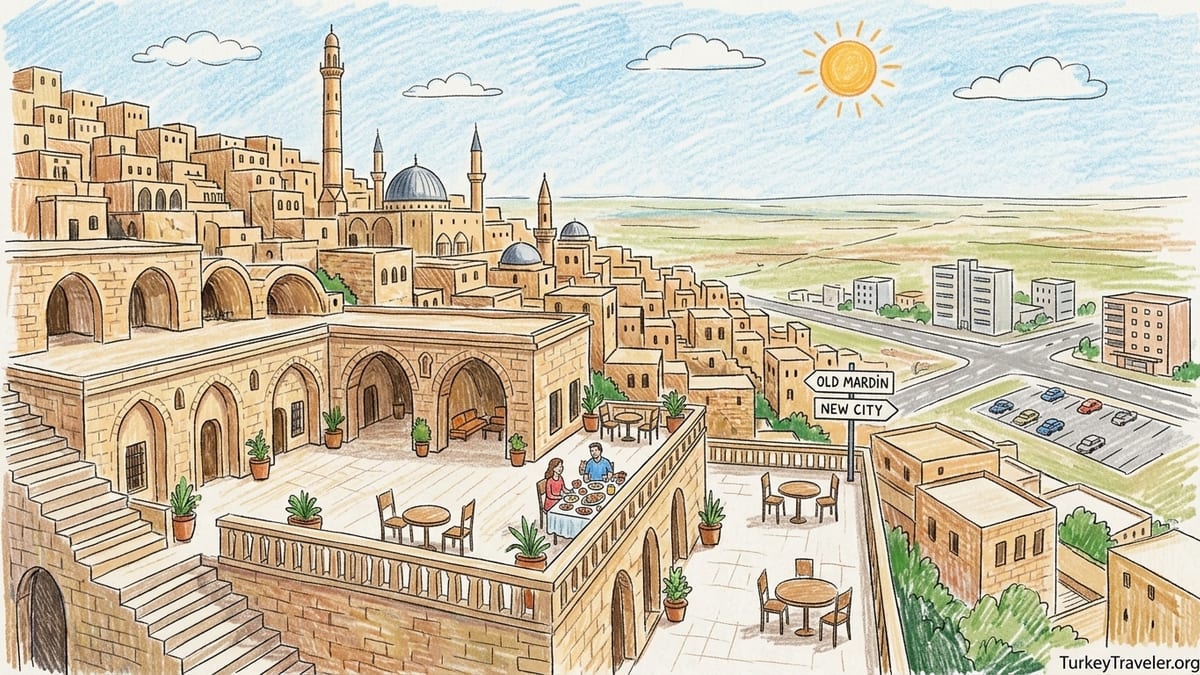
In Mardin, where honey-colored stone terraces stare out across the Mesopotamian plain, your hotel is not just a place to sleep. Choosing between a restored Old City konak and a modern Yeni Mardin hotel effectively decides what kind of trip you will have: one built around vaulted limestone rooms and sunrise terrace views, or one focused on easy parking, elevators and quick taxi connections. With roughly 90-plus properties listed on major booking platforms as of late 2026, Mardin now offers both in depth.
Why Mardin’s Stone Konaks Deserve Their Own Category
Mardin is one of the few cities in Turkey where the defining accommodation type is not the five-star tower or the beach resort but the restored stone house. These boutique konaks line the slope of the Old City ridge above the plains, many converted from 18th or 19th century merchant mansions. Guides and hotel specialists highlight them as the signature way to stay in Mardin, and recent booking search pages now group dozens of options under historic house or stone hotel categories.
The atmosphere is markedly different from a standard city hotel. Properties such as Mardius Tarihi Konak, Izala Boutique Hotel or Zinciriye Hotel occupy historic limestone buildings with inner courtyards, carved arches and barrel-vaulted ceilings. At Mardius, you sleep inside walls that are several centuries old, dine under stone domes and look across to Syria from broad terraces. Even smaller pensions and guesthouses in the Old City offer details that elsewhere would be stand-out features but here are simply normal: niches cut into stone walls, thick doors, and staircases worn smooth by generations.
This concentration of character means that for many travelers, staying in a stone konak is part of why they come to Mardin at all. The difference is strong enough that tour operators now distinguish “Old Mardin stone house stays” from “New City hotel stays” in their itineraries, with price ranges for quality Old City boutiques often starting around mid-range city hotel prices and running higher during festival periods or events such as the Mardin Biennial.
If you imagine your trip as a chance to live for a few days inside a historic streetscape, surrounded by sandstone facades and call to prayer echoing off the ridge, this is the category you should focus on first, even if it means accepting a few trade-offs in convenience.
Old City vs Yeni Mardin: Location, Views and Access
Old Mardin clings to a hillside, its main street following the ridge line and stone lanes dropping steeply away on the south side toward the Mesopotamian plain. Most boutique konaks sit on or just below this ridge, often within a 5 to 15 minute walk of the main monuments. Zinciriye Hotel, for example, is near the Zinciriye Medrese and has terraces that look across domes and minarets to the plains. Terrace Merdin Konak sits close to the city museum and Great Mosque, again combining walkable access with views.
Yeni Mardin, by contrast, spreads across flatter ground at the base of the hill, around the modern city center and main highway. Here you find brands like Hilton Garden Inn Mardin and Ramada Plaza by Wyndham Mardin, plus newer independent business hotels. Views tend to be of the city streets rather than the full plain, though some upper floors still catch a horizon line. What you gain instead is easier urban access, with wide roads, shopping centers, bus routes and taxis right outside.
Those staying in the Old City effectively live inside the postcard image of Mardin. Morning starts with light catching stone facades and the sound of footsteps in narrow alleys. You can walk to Zinciriye Medrese, the Great Mosque or the bazaar in minutes, and many konaks line up their roof terraces directly toward sunset, turning golden hour into a nightly event. In Yeni Mardin you are more likely to start the day in a contemporary lobby with a coffee bar, then take a short taxi ride up the hill for sightseeing.
The trade-off is practical mobility. Old City streets are often stepped, irregular and sometimes too narrow for vehicles. Taxis will usually drop you at a point on the main road, then you walk down a side lane or series of stairs to your hotel. In Yeni Mardin, you step from elevator to lobby to sidewalk or car without much effort. For travelers with bulky luggage or limited mobility, this distinction can easily outweigh the romance of staying in the historic core.
Stone Konaks: Terraces, Vaulted Rooms and the Breakfast Ritual
One of the key reasons people seek out a boutique konak is the promise of terraces. Properties like Mardius Tarihi Konak, Zinciriye Hotel, Artuklu Kervansaray and a growing list of smaller mansions have multi-level rooftop spaces opening directly onto the Mesopotamian view. In good weather, these terraces function as outdoor lounges from early morning until late at night, where guests watch changing light over the plains, distant storms or the glow of towns across the border.
Vaulted rooms are another hallmark. Many Old City hotels preserve their original stone barrel vaults, some of them windowed rooms facing inward to a courtyard, others opening to a balcony or shared terrace. Hotels such as Artuklu Kervansaray and various “tarihi konak” guesthouses lean into this, marketing the thick walls and high ceilings as a form of slow luxury, where rooms stay naturally cooler in summer and exude a sense of calm. Modern bathrooms and underfloor heating are typically discreetly added, but steps up and down within the room are common because the original floors rarely sat on a single level.
Breakfast in a stone konak is often an experience in itself. Larger addresses may lay out buffet-style spreads of local cheeses, olives, menemen, pastries and regional specialties, then invite guests to take their plates out to a terrace. Smaller guesthouses might serve a set “village breakfast” on low tables in a courtyard, sometimes cooked by the owner’s family. At properties like Alies Taş Konak, the marketing specifically highlights “courtyard life” and “breakfast in the morning light” as defining rhythms of a stay.
At night, the same terraces become lantern-lit meeting points where guests linger over tea or local wine. The view flips from golden to inky, pierced by minaret lights and the outlines of domes. For many visitors, this daily cycle of terrace breakfast, daytime wandering and evening skyline watching is what turns a Mardin stay into a memory that competes with more famous Turkish destinations.
Yeni Mardin Hotels: Parking, Elevators and Modern Comfort
If Old City konaks trade in atmosphere, Yeni Mardin hotels trade in practicality. Positioned along the main approach roads and in the modern center, they almost always offer on-site parking, usually free for guests, which removes a major stress point for anyone arriving in their own car or a rental. Multi-storey garages or large surface lots mean you can drive up, unload luggage at a covered entrance and hand over the keys or park yourself without worrying about tight alleys.
Accessibility is another key advantage. Modern properties, including familiar international chains, are built with elevators, ramps and wheelchair-friendly public areas. Brochures for some Yeni Mardin hotels emphasize 24-hour free indoor and outdoor parking and accessibility features as standard, alongside wi-fi and climate control. For travelers with mobility challenges, families with small children or simply those who do not want to manage flights of old stone stairs, this can make the difference between an enjoyable and a exhausting stay.
Inside the rooms, layouts tend to be more predictable, with consistent bathroom designs, soundproofing and air conditioning. There may be fewer original features to admire, but also fewer quirks: beds are at standard heights, floors are even, lighting is uniform. Breakfast is usually presented as a classic international buffet with some local touches, served in a larger dining room that can comfortably accommodate tour groups and business travelers alike.
Another practical benefit of Yeni Mardin is its position for onward travel. Being close to the main highway, intercity bus station or business districts simplifies early-morning departures, late-night arrivals or meetings across the region. Travelers who plan to spend days exploring places like Dara ruins, Midyat or Hasankeyf by car sometimes choose the New City for speed and road access, then head up the hill in the evenings for the historic atmosphere.
Stairs, Accessibility and Choosing the Right Neighborhood
The biggest functional gap between Old City konaks and New City hotels lies in vertical movement. In historic Mardin, everything is built on a slope. Stepped streets, terraced courtyards and multi-level houses mean that even a short walk can involve multiple flights of stairs. Many boutique konaks have no elevators at all, either because installation would compromise the building fabric or because regulations for historic structures are strict.
For travelers with mobility issues, bad knees or large prams, this reality requires honest planning. It is not uncommon to encounter guest reviews noting that reaching a beautiful room meant climbing steep courtyard steps or narrow stone staircases with low headroom. Some properties mitigate this by assigning lower-level rooms to guests who request them, or by placing reception on the street level and rooms only a level or two above, but genuinely step-free access in Old Mardin remains rare.
By comparison, Yeni Mardin’s modern grid of streets and hotel designs makes life markedly easier. Wide pavements, elevator access to all floors and level lobbies mean that moving from taxi to reception to bed can be almost entirely ramped or lift-based. For multi-generational family trips, or visits where someone expects to use a wheelchair or mobility aid, basing in the New City and visiting the Old City for specific, planned walks may be the most realistic strategy.
If you are set on a stone konak but worried about access, look carefully at property descriptions and recent guest comments. Phrases like “no elevator,” “set on a steep lane,” or “many stairs” should be taken literally. When in doubt, contact the hotel ahead of time to ask about room placement, luggage assistance and the distance, in steps or slopes, from the nearest point where a car can stop.
Parking, Arrival Logistics and Getting Around
Parking is often the decisive factor in where travelers choose to stay in Mardin, especially for road trips across southeastern Turkey. In Yeni Mardin, hotels typically advertise free on-site parking, sometimes both indoor and outdoor, available around the clock. That allows guests to arrive whenever their schedule permits, with the reassurance that a secure spot will be waiting and they will not need to navigate the warren of Old City streets by car.
In the Old City, the situation is more nuanced. A few boutique konaks provide limited on-site parking or a small private lot on the edge of the historic quarter, but most rely on city parking areas or street parking along the main road. Some hotels organize complimentary transfers from these points, meeting guests at a designated area and walking the last stretch together while porters carry luggage. Travelers should be prepared for the possibility that their taxi or car will have to stop a short distance from the front door, particularly during busy evenings or festival periods.
Once you have arrived and dropped bags, movement around Mardin is straightforward if you are comfortable with hills. From an Old City base, most major sights including Zinciriye Medrese, the Great Mosque, the bazaar and museum can be reached on foot. From Yeni Mardin, short taxi rides or minibuses carry you up the hill in about ten to fifteen minutes, with fares that remain modest by European or North American standards.
For day trips by car, some travelers adopt a hybrid approach: staying in a stone konak for a couple of nights to enjoy the atmosphere, then shifting base to a New City hotel with a large car park for the phase of their trip focused on regional exploration. This can also help manage luggage, as you only have to carry suitcases up Old City stairs once.
Breakfast Culture, Noise Levels and Proximity to Zinciriye and Kasımiye
Breakfast is a daily highlight in Mardin regardless of where you stay, but experiences do differ between Old and New sections of the city. In boutique konaks, breakfast tends to be more intimate and local-feeling, whether served in a vaulted room opening onto a courtyard or on a small terrace overlooking the plains. The spreads often include regional cheeses, homemade jams and dishes like eggs with sujuk or herbs, sometimes prepared to order. Guests linger, take photos of the view and plan their day with staff suggestions for hidden lanes or lesser-known churches.
In Yeni Mardin hotels, breakfast is usually built for volume and efficiency. Large buffet stations offer a mix of Turkish and international items, with ample seating and long opening hours to accommodate tour departures and business schedules. The atmosphere can be more functional than romantic, which many travelers appreciate when they need a fast coffee and a reliable selection before an early excursion.
Noise and ambience also diverge. Old City stone walls often absorb sound, but narrow lanes can amplify conversations and footsteps, especially during high season evenings. Some konaks are incredibly quiet, particularly in the lower quarters, while others near the main street or busy cafes may be lively late into the night. Yeni Mardin has its own urban sounds, from traffic to nearby venues, but modern double glazing in newer hotels tends to keep rooms relatively insulated.
In terms of proximity to headline monuments, Old City properties have a clear edge. Zinciriye Medrese, one of Mardin’s most important historic complexes, crowns the ridge above the town, and many boutique hotels sit within a short uphill or downhill walk. Kasımiye Medrese, another key monument, lies slightly further along the slope and is easiest to reach by short taxi ride or a longer walk from the Old City. From Yeni Mardin, reaching both usually involves a straightforward drive up the hill, followed by short walks across courtyards and terraces once at the sites.
The Takeaway
For Mardin, choosing accommodation is not a simple price and star-rating decision. Staying in a restored stone konak in the Old City immerses you in the very fabric that makes Mardin distinctive: terraced views over the Mesopotamian plain, vaulted rooms shaped by centuries of architecture and breakfasts that unfold in sunlit courtyards. It also brings unavoidable realities like stairs, stepped lanes, and more complex parking.
Yeni Mardin’s hotels offer a different kind of comfort. Elevators, broad parking lots, wheelchair-friendly layouts and predictable room standards make them practical bases for road trips, business travel or family groups where accessibility matters more than historic charm. Taxis and minibuses bridge the gap between the two halves of the city, so you can still spend most of your days and evenings in the historic core.
Most travelers will be happiest when they match their base to their priorities. If you dream of dawn on a terrace above a sea of stone roofs, choose an Old City boutique and accept the stairs as part of the story. If you want stress-free driving, smooth luggage handling and universal elevator access, look to Yeni Mardin and treat the Old City as your daily excursion destination. Either way, understanding the strengths and trade-offs of each area will help you turn Mardin’s layered skyline into the highlight of your southeastern Turkey journey.
FAQ
Q1. Is it better to stay in Old Mardin or Yeni Mardin for a first visit?
For most leisure travelers, Old Mardin is the better choice because the stone houses, terraces and proximity to main sights deliver the most atmospheric experience, as long as you are comfortable with hills and stairs.
Q2. Are Old City stone konaks suitable for travelers with mobility issues?
Often they are not ideal. Many historic konaks lack elevators and involve steep internal and external staircases, so travelers with significant mobility limitations usually find modern Yeni Mardin hotels more manageable.
Q3. Do Old City hotels in Mardin have parking?
Some do, but space is limited. A few konaks offer small private lots or valet-style arrangements from nearby parking areas, while many guests rely on public parking on the main road and then walk a short distance to the property.
Q4. How far are Old City hotels from Zinciriye Medrese?
Many boutique konaks are within a 5 to 15 minute walk of Zinciriye Medrese, although the route can be steep. From Yeni Mardin, expect a 10 to 15 minute taxi ride up the hill followed by a short walk.
Q5. Are vaulted stone rooms in Mardin cold or damp?
In well-maintained konaks, vaulted rooms tend to feel cool and stable rather than damp. Thick stone walls moderate temperature, and most hotels supplement this with modern heating and climate control during cooler months.
Q6. What are typical prices for boutique stone hotels in Mardin?
As of 2026, quality Old City boutiques often start in the mid-range bracket and rise into higher rates for premium mansions with top-tier terraces, while simpler guesthouses remain more affordable; exact prices vary by season and demand.
Q7. Can families with children comfortably stay in Old City konaks?
Yes, many families enjoy the experience, but parents should be prepared for stairs, uneven stone floors and terraces with low walls. Some konaks offer family rooms or connected suites, so checking layouts in advance is important.
Q8. Are breakfasts in Yeni Mardin hotels as good as in Old City konaks?
Breakfasts in Yeni Mardin hotels are generally abundant and efficient, with large buffets, while Old City konaks often offer more intimate, locally focused spreads. Which is “better” depends on whether you value atmosphere or variety and speed.
Q9. How many hotels are there in Mardin overall?
Major booking platforms currently list roughly ninety or slightly more properties across Mardin, including historic stone konaks, modern city hotels, small guesthouses and apartments.
Q10. Is it worth splitting a stay between Old Mardin and Yeni Mardin?
For many visitors, yes. Spending a few nights in a stone konak for atmosphere, then moving to a New City hotel for easier parking and regional day trips, offers the best of both worlds.