


Southeastern Anatolia has gone from a niche, archaeology-focused detour to one of Türkiye’s most talked-about regions. For first-time visitors, the real planning challenge is no longer whether to go, but where to base yourself. Gaziantep, Şanlıurfa and Mardin have emerged as the region’s three heavyweight lodging markets, each with distinct strengths, atmospheres and practical advantages. Choosing between them has become a genuine booking decision, not a theoretical comparison.
How These Three Cities Fit Into a First-Time Itinerary
Gaziantep, Şanlıurfa and Mardin sit along a loose west–east axis across Southeastern Anatolia, and most travelers coming from Istanbul, Cappadocia or the Mediterranean coast will naturally arrive from the west. Gaziantep usually comes first by air or long-distance bus, followed by Şanlıurfa a few hours east, and then Mardin further toward the Mesopotamian plain. Many domestic tour itineraries already follow this pattern, for example four-day circuits that visit Gaziantep, Zeugma, Şanlıurfa, Göbeklitepe and Halfeti in a loop.
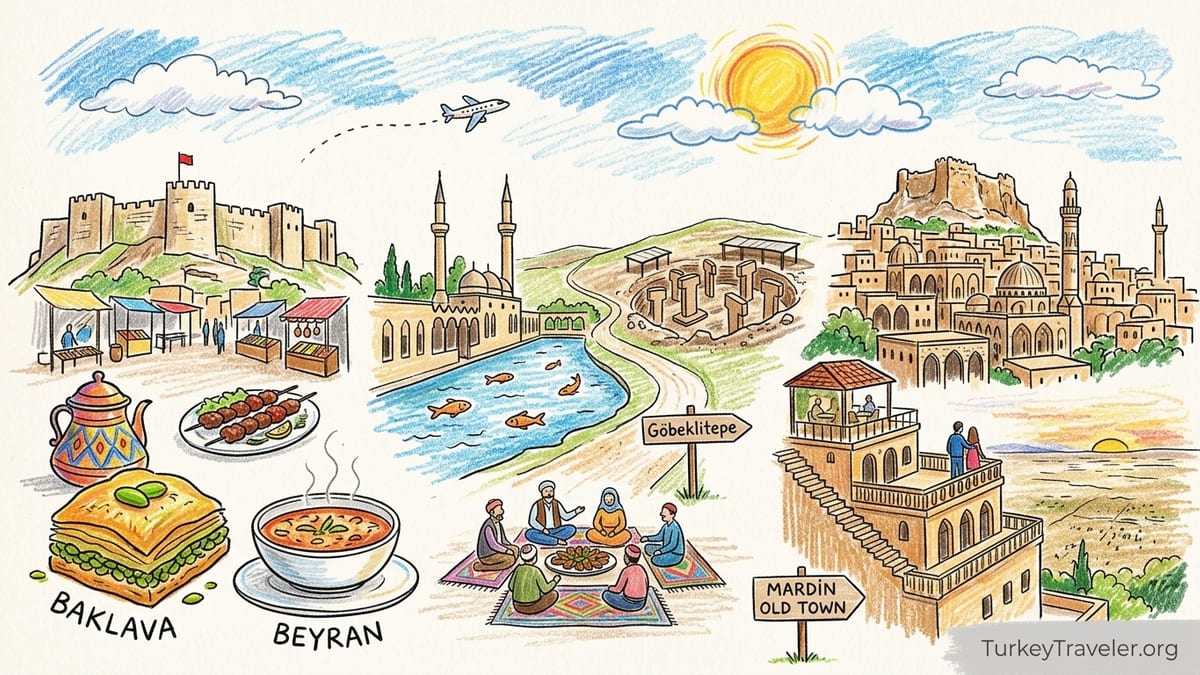
For a first visit, think of Gaziantep as the culinary and urban gateway, Şanlıurfa as the base for the world-changing Neolithic sites of Göbeklitepe and Karahantepe plus Harran and Halfeti, and Mardin as the atmospheric finale, with golden-stone architecture, Syriac monasteries, Dara’s Roman ruins and nearby Midyat. With five to seven nights, you can reasonably include all three; with fewer days, it becomes essential to choose one or two bases that fit your interests and travel style.
Flight schedules and road conditions shift, but in practice you are looking at roughly 2.5 to 3 hours by road between Gaziantep and Şanlıurfa, and a similar journey between Şanlıurfa and Mardin. This means day trips between pairs of cities are possible but tiring. For most travelers, basing in each city for at least two nights, rather than attempting everything from a single hub, will feel far more relaxed and rewarding.
Current hotel development and booking data show that these three cities now account for the bulk of quality accommodation in the region. That concentration of beds, from international chains to intimate cave-like mansions, is exactly why the decision of where to stay has become central to planning a Southeastern Anatolia trip.
Gaziantep: Food Capital and Easiest Western Access
Gaziantep is officially a UNESCO City of Gastronomy, and locals will tell you this is where you should “forget everything you ate in Türkiye and start again.” Think of the city as an open-air tasting menu: pistachio baklava that has its own protected geographical indication, dawn bowls of rich beyran soup, smoky ali nazik kebab, pistachio-studded katmer and lahmacun that redefines what flatbread can be. Around institutions like İmam Çağdaş or Güllüoğlu, queues of domestic food pilgrims are a sign of how central eating is to any stay here.
The city’s other anchor is the Zeugma Mosaic Museum, widely considered one of the finest collections of Roman mosaics anywhere. The iconic “Gypsy Girl” mosaic, rescued from the ancient city of Zeugma, has become the city’s unofficial logo. Pair this with wandering the Coppersmith Bazaar, where artisans still hammer copper trays and coffee pots in tiny workshops, and you have a city break that feels more like southeast Europe and the Levant than western Türkiye.
Gaziantep’s airport, Gaziantep Oğuzeli (GZT), is the main international gateway for the region and typically has frequent daily flights from Istanbul and Ankara. For many travelers, that combination of air access, big-city infrastructure and excellent food justifies spending two or even three nights here at the start or end of an itinerary. It also works well as a hub if you are nervous about venturing deeper east on your first visit.
Hotel-wise, Gaziantep has the greatest range of mainstream options: international chains near the modern center, business-style four-stars along Atatürk Boulevard, and a growing number of boutique conversions around the old quarter. Prices fluctuate seasonally, but it is common to find comfortable midrange rooms in restored caravanserai-style properties for roughly the cost of a mid-range Istanbul hotel, often including a breakfast spread that could pass for a full lunch buffet.
Şanlıurfa: Göbeklitepe, Harran and Halfeti on Your Doorstep
Şanlıurfa, usually shortened to Urfa, is where the region’s deep history becomes almost overwhelming. Just 18 to 20 kilometers from the city center lies Göbeklitepe, the Neolithic ritual site often described as the world’s oldest known temple complex. Day-trippers now arrive on museum shuttles or private tours, but staying in Şanlıurfa lets you time your visit for the quieter early-morning or late-afternoon slots, when the carved T-shaped pillars and animal reliefs emerge dramatically in shifting light and shadows.
From the same base you can visit Harran, known for its beehive-shaped mud-brick houses and layers of Assyrian, Islamic and scholarly history, and the village of Halfeti, partially submerged by the Birecik Dam. In Halfeti, slow boat rides along the Euphrates drift past half-drowned minarets and ruined stone houses, turning what could be an abstract “GAP project” statistic into a very tangible landscape memory. Many domestic itineraries now package these three destinations together out of Şanlıurfa, often in a long but doable day.
Within the city, the area around Balıklıgöl (the sacred pool of fish) and the historic bazaar is the most atmospheric place to stay. Narrow alleys lead to stone courtyards where traditional sıra gecesi evenings combine live music, shared plates of local dishes and crowds of Turkish families on pilgrimage-style visits. Compared with Gaziantep, Şanlıurfa’s restaurant scene is less about polished gastronomy and more about hearty, affordable kebab houses and local dessert shops, with kunefe and liver kebab at the top of many visitors’ lists.
Accommodation ranges from modern chains such as business-style hotels near the newer boulevards to smaller boutique hotels housed in restored stone mansions near Balıklıgöl. Recent university and conference listings show room-only rates at simple Göbeklitepe-themed hotels starting around modest local prices, while better-located boutique properties in the old town typically price in line with midrange Istanbul hotels. Two or three nights here allow one full day for Göbeklitepe and Karahantepe, another for Harran and Halfeti, and still leave time to wander the old bazaar and museums.
Mardin: Golden-stone Atmosphere, Monasteries, Dara and Midyat
Mardin is where the region’s steppe landscape meets one of Türkiye’s most photogenic skylines. The old city climbs a steep hillside in terraces, its honey-colored stone houses stacked like theatre seating above the wide Mesopotamian plain. From the main terrace streets at sunset, you look out over a seemingly endless expanse of fields, with the minarets and domes of the town silhouetted above. It is a city where simply walking and looking can feel like the main activity.
Many of the region’s finest boutique hotels are found in Mardin’s old town. Restored stone mansions such as Maridin Hotel and similar properties feature vaulted ceilings, carved arches and multi-level courtyards, often with breakfast served on roof terraces that command panoramic views. Local guides and recent visitors consistently recommend splurging on an old-town stay here rather than saving money in the modern lower city, precisely because waking up in those stone rooms and stepping directly into the alleys is such a big part of the experience.
Mardin also works extremely well as a base for day trips into Tur Abdin, the historic Syriac Christian heartland. Just outside the city, Mor Hananyo (Deyrulzafaran) Monastery offers insight into the Syriac Orthodox tradition and liturgy. Slightly further afield, around an hour or so by car, lie Mor Gabriel Monastery and villages like Midyat and Anıtlı, where stone churches and Assyrian-owned craft shops line the streets. Many visitors hire a driver for a loop that includes Midyat’s old town guesthouse, Mor Gabriel and then Dara Ancient City, whose underground cisterns and city walls give a stark Roman contrast to Mardin’s Islamic-and-Christian skyline.
The practical trade-off is that Mardin’s airport is smaller and flights somewhat less frequent than Gaziantep’s. Nevertheless, regular domestic connections make it relatively straightforward to fly in from Istanbul or via Şanlıurfa GAP Airport, where some schedules are designed to connect onward to Mardin. Because so many day trips radiate from the city, three nights here rarely feels excessive; with a fourth night you can slow down, linger over terrace breakfasts and add a sunset walk or a second monastery visit without rushing.
Hotel Styles and Lodging Markets Compared
Although all three cities are now considered the core lodging markets of Southeastern Anatolia, the style of accommodation they offer differs noticeably. Gaziantep’s hotel scene is dominated by structured, business-oriented properties: multi-story buildings with conference halls, fitness centers and reliable but unremarkable rooms. There are characterful options like converted caravanserais with central courtyards, but many visitors end up in well-known chains close to shopping malls or the main modern boulevards, valuing consistency over atmosphere after a long travel day.
Şanlıurfa occupies a middle ground. Near Balıklıgöl, small-scale boutique hotels and restored mansions have emerged, offering thick stone walls that stay cool in summer and intimate courtyards where breakfast tables spill into shaded corners. At the same time, new-build hotels on the outskirts, including familiar global brands, cater to conferences and local tourism. For travelers, that means you can choose between character and convenience: stay by the holy pool and bazaar if you want to wander out on foot at night, or opt for a modern property if you prefer on-site parking and straightforward taxi access.
Mardin is where the architectural romance peaks. Many old-city hotels are essentially living museums: original carved doors, stone staircases, inlaid wooden ceilings and tiny alcoves converted into reading nooks. Rooms can be idiosyncratic, with odd levels, narrow bathrooms and occasional street noise, but they reward with sunrise views across the plain and photogenic courtyards. Down in the modern lower city, more standard hotels provide predictable layouts and easier vehicle access but lose the visual drama that makes Mardin unforgettable.
From a value perspective, all three cities generally price below Istanbul and Cappadocia for similar quality, though the gap narrows for the most atmospheric boutique properties in Mardin’s old city. Because demand spikes during religious holidays, school breaks and spring and autumn weekends, advance booking is increasingly important, especially if you want a particular style of room such as a family suite with terrace or a courtyard-facing stone room.
Food, Restaurants and Evening Atmosphere
If your primary passion is food, Gaziantep should be your default base. Here, almost every street in the center seems to hold a specialist: one kebab shop devoted almost entirely to eggplant kebab, another known for lamb shank, a breakfast place famous for beyran and mercimek soup, baklava houses that export their pistachio pastries across Türkiye. Locals might advise you to plan your days around meals, fitting the Mosaic Museum and bazaars into the gaps between breakfast, lunch and late-night dessert.
Şanlıurfa’s food scene leans toward religious-pilgrimage and family travel. Around Balıklıgöl and the historic streets you will find large, courtyard-style restaurants where big groups share platters of kebabs, meze and flatbreads under fairy lights. The city’s signature is liver kebab, often eaten for breakfast or brunch, and nights can end at sıra gecesi events where live music, soft drinks and shared plates create a social, non-clubby atmosphere. Prices for a hearty kebab meal here are typically lower than in Istanbul, making it an easy city for budget-conscious travelers.
In Mardin and Midyat, food is inseparable from the mixed cultural backdrop. Menus often combine standard southeastern dishes with Syriac and local Christian specialties; in some villages, Assyrian-run cafes serve thin-crust pizzas next to stone churches, while in the old town of Mardin you might order stuffed grape leaves and lamb dishes infused with spices from nearby bazaars. Evenings are quieter than in Gaziantep or Şanlıurfa, especially on weeknights, with many visitors content to linger over tea and desserts on hotel terraces, watching the lights spread across the plain.
Across all three cities, alcohol is less visible than in western Türkiye but not absent. Gaziantep’s larger hotels and some restaurants serve wine and beer, as do a small number of establishments in Mardin and Midyat. Şanlıurfa is more conservative; many visitors forego alcohol entirely there and focus instead on strong tea, Turkish coffee and sugary desserts. If having a glass of wine with dinner matters, leaning toward Mardin’s boutique hotels or certain Gaziantep venues will give you more options.
Getting In, Getting Around and Day Trip Logistics
In practical terms, Gaziantep is the easiest city for arrival and departure. Gaziantep Oğuzeli Airport has long had frequent domestic flights to Istanbul and Ankara and periodic international links. Taxis from the airport to the city center are straightforward, and intercity buses fan out across the region, making it a logical first or last stop on a broader Turkish itinerary. Once in town, most sights are within a compact area; you can walk between the Mosaic Museum, Coppersmith Bazaar and main food streets, using taxis only for outlying neighborhoods.
Şanlıurfa GAP Airport serves the broader province and increasingly acts as a connecting hub, with routes linking not only Istanbul and Ankara but also other Anatolian cities. From the airport, shuttles and taxis head into the city, and many tours to Göbeklitepe and Karahantepe depart from the archaeology museum or central hotels. Organized day trips commonly combine Göbeklitepe with Harran in one long day, while Halfeti is usually treated as a separate outing that includes a boat tour and meal on the riverbank. While it is technically possible to overnight in Halfeti, most travelers return to Şanlıurfa for the deeper restaurant and hotel choices.
Mardin has its own small airport to the west of town, with domestic flights that often interlink with Şanlıurfa’s schedule. From the terminal, taxis or pre-arranged transfers take about 20 to 30 minutes to reach the old city on the hillside. Because many of the key day trips from Mardin involve minor roads and multiple stops, hiring a local driver for one or two full days is common. A typical loop might include Mor Hananyo Monastery in the morning, Midyat and Mor Gabriel by midday and Dara Ancient City in the afternoon, returning to Mardin for dinner on a terrace as the lights come on.
If you are combining all three cities, one efficient pattern is to fly into Gaziantep, travel by road to Şanlıurfa for a two or three-night stay, continue by road to Mardin for the final days and then fly out of Mardin or back through Gaziantep or Şanlıurfa depending on flight options. Travel agencies in all three cities, as well as hotel front desks, are accustomed to arranging these transfers, often bundling them with guided tours at competitive per-person costs, especially if you are two or more travelers sharing a car.
How Many Nights in Each, and Who Should Stay Where
For travelers with one week in Southeastern Anatolia, a balanced split might be two nights in Gaziantep, two or three in Şanlıurfa and two or three in Mardin. This allows time to experience each city’s character without constant packing and moving. With five nights total, you might choose to drop one city; with 10 or more nights, you can linger, add extra archaeological sites like Karahantepe or Mount Nemrut, or build in slower days of cafe-hopping and terrace reading.
If your priority is food and you prefer a softer cultural landing, Gaziantep is the most natural base, perhaps combined with just one of the others. You could, for example, fly into Gaziantep, spend three nights focused on eating and urban exploring, then add two nights in Şanlıurfa purely to see Göbeklitepe and Harran before returning west. This suits travelers who are curious about the region but cautious about moving around too much or venturing further east.
History and archaeology enthusiasts will likely feel short-changed without at least two nights in Şanlıurfa and three in Mardin. Urfa delivers the groundbreaking Neolithic narrative, while Mardin and its hinterland showcase late Roman, medieval Islamic and Syriac Christian layers. Mardin in particular rewards slow exploration: an extra night can mean another monastery visit, a detour to Dara or simply more time talking with local artisans in Midyat’s old town.
For many first-time visitors, the key decision is not which single city to choose, but whether to commit to visiting all three. Given current transport links and the concentration of good accommodation, including them all is realistic if you have at least six nights. If you are limited to three or four nights in total, choose based on your interests: Gaziantep plus Şanlıurfa for food and world-class archaeology, or Şanlıurfa plus Mardin for a more atmospheric, architecture-and-landscape-driven route.
The Takeaway
Choosing between Gaziantep, Şanlıurfa and Mardin is no longer an abstract exercise in guidebook reading. These three cities now host the region’s most developed hotel markets and serve as gateways to many of Türkiye’s most compelling new and old attractions, from Göbeklitepe’s Neolithic pillars to Dara’s Roman ruins and the living monasteries of Tur Abdin.
As a rule of thumb, pick Gaziantep if you want big-city comforts, serious food and easy flights from western Türkiye; choose Şanlıurfa if your main goal is standing at Göbeklitepe and tracing the earliest known religious architecture on earth; and opt for Mardin if you crave a visually unforgettable old town, Syriac monasteries, and day trips that feel like stepping into a living history atlas.
With a week or more, you do not have to choose at all. String the three together, watching the landscape flatten and the architecture shift as you travel east, and you will come away with a layered understanding of Southeastern Anatolia that a single-city stay cannot match. In a country rich with blockbuster destinations, this corner of Türkiye now offers one of the most rewarding itineraries for travelers willing to look beyond the usual classics.
FAQ
Q1. For a first-time visitor to Southeastern Anatolia, which city should I stay in if I only have three nights?
Şanlıurfa is usually the best single base for three nights, because it gives you access to Göbeklitepe, Harran and Halfeti while still offering a lively historic center and a decent spread of midrange hotels.
Q2. Is Gaziantep worth visiting if I am not a serious foodie?
Yes. While food is the main draw, Gaziantep also has the excellent Zeugma Mosaic Museum, atmospheric bazaars and the best flight connections in the region, making it a comfortable and culturally rich gateway city.
Q3. How many nights should I spend in Mardin to see the monasteries, Dara and Midyat?
Plan on at least three nights in Mardin. That gives you one full day for the old city, one for a monastery and Midyat loop, and one for Dara plus extra wandering or a second monastery visit.
Q4. Can I visit Göbeklitepe, Harran and Halfeti as day trips from Gaziantep instead of staying in Şanlıurfa?
It is technically possible on long organized tours, but it makes for rushed days. Staying in Şanlıurfa lets you break these into more comfortable separate outings and enjoy the city’s evening atmosphere.
Q5. Which city has the most atmospheric hotels?
Mardin clearly wins for atmosphere. Its old-town boutique hotels, housed in terraced stone mansions with courtyards and rooftop terraces, deliver the strongest sense of place, especially at sunrise and sunset.
Q6. Are these cities safe to visit at the moment?
Conditions can change, but under normal circumstances all three see a steady flow of domestic and foreign visitors. As with any trip, check current travel advisories, register your plans if advised by your government and follow local guidance.
Q7. Is it easy to travel between Gaziantep, Şanlıurfa and Mardin without renting a car?
Yes, though you may trade some flexibility. Intercity buses and shared minibuses connect the cities, and local agencies or hotels can arrange private transfers and day-trip drivers for sites like Göbeklitepe, Midyat and Dara.
Q8. What is the best time of year to visit these three cities?
Spring and autumn are ideal, typically from April to early June and late September to early November, when daytime temperatures are more comfortable for walking archaeological sites and hilltop towns.
Q9. Can I find international hotel brands in all three cities?
Gaziantep and Şanlıurfa both have a selection of international or international-style chain hotels. Mardin has fewer global brands but offers many high-quality local boutique properties instead.
Q10. If I am on a tight budget, which city gives the best value for accommodation and food?
Şanlıurfa generally offers the best combination of lower hotel rates and inexpensive, filling local meals. Gaziantep is slightly pricier but still good value, while Mardin’s most atmospheric old-town hotels can cost a bit more.