

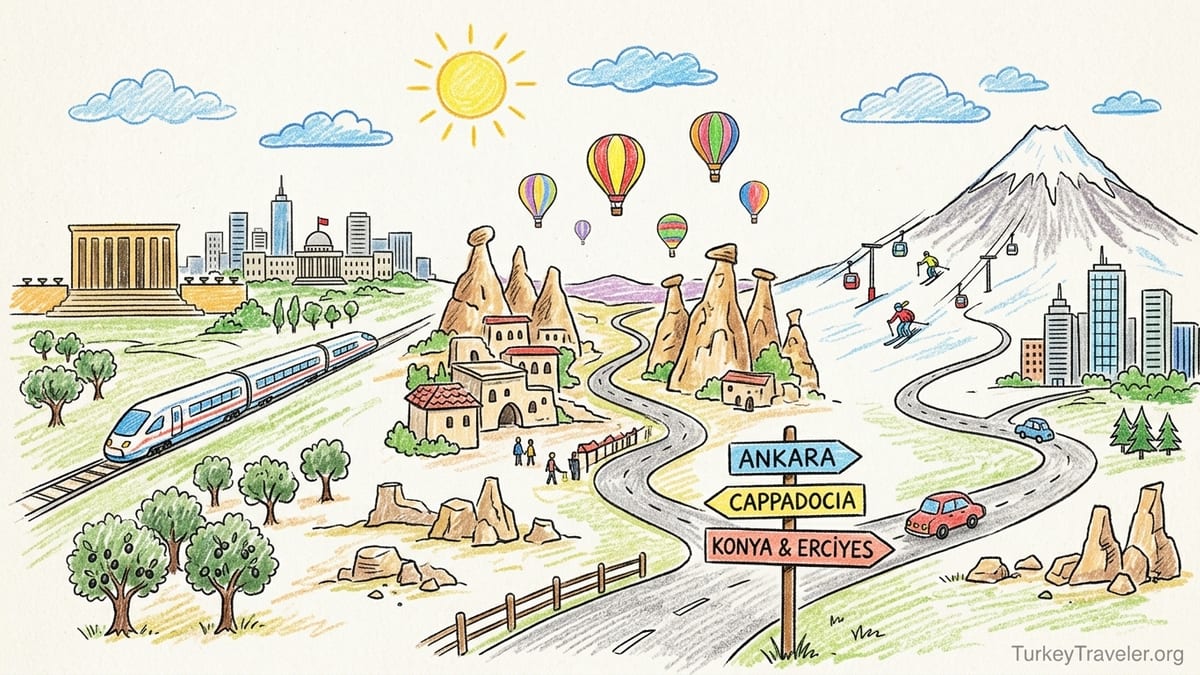
Central Anatolia is more than a quick stop between Istanbul and the Mediterranean. It is a region of capital-city culture in Ankara, otherworldly cave hotels in Cappadocia, winter-sports slopes around Kayseri, and spiritual journeys in Konya. Choosing the right base, or knowing when to change bases, can dramatically shape how your trip feels and how much you actually see. This guide compares Ankara, Göreme, Uçhisar, Ürgüp, Kayseri/Erciyes and Konya to help you build a realistic, rewarding itinerary.
How to Think About Bases in Central Anatolia
Distances in Central Anatolia look small on the map but feel large on the ground, especially when you factor in early balloon starts, winding valley roads and winter conditions. Many travelers try to “do everything from Cappadocia” and end up spending more time in transit than in the places they came to see. As a rule of thumb, Ankara and Konya work best as separate bases for urban and Mevlana-focused days, while Cappadocia and Erciyes demand at least one dedicated base each if you want more than a cursory taste.
A typical first-time itinerary might use Ankara as a one- or two-night arrival hub, shift to Göreme or Uçhisar for three nights in Cappadocia, then continue to Konya for one or two nights before moving on by train or plane. If you also want to ski at Erciyes near Kayseri, that usually adds at least two nights with a base in Kayseri city or at the mountain hotels. Trying to day trip to Konya from Cappadocia, or to Erciyes from Göreme on a tight schedule, often means leaving in the dark and returning in the dark.
Another way to think about bases is by the “feel” of your evenings. In Ankara you might finish the day with a meze spread in the Kızılay district. In Göreme you are on a rooftop terrace watching balloons glow at dawn. In Ürgüp you are in a stone-arched dining room sampling Cappadocian wine, while in Konya your night might end quietly after an evening sema ceremony. This guide will walk through how each of the main bases supports those different kinds of days and nights.
Ankara: Capital-City Culture and Transport Hub
Ankara is the practical and cultural entry point to Central Anatolia. It is the country’s political capital, a university city, and a major transport hub with frequent domestic flights and high-speed trains linking it to Istanbul, Konya and beyond. For many itineraries, it makes sense to spend the first or last night here rather than racing straight through. Hotels cluster around Kızılay, Ulus and the main railway station, which makes it simple to connect an evening arrival with a morning train south.
The city’s main sights are compact enough that one full day is usually sufficient. Many visitors start at Anıtkabir, the mausoleum of Mustafa Kemal Atatürk, then continue to the Museum of Anatolian Civilizations above Ulus, where Bronze Age artifacts and Hittite reliefs give context to the ruins they will later encounter elsewhere in Turkey. The Ankara Citadel quarter and nearby older streets around Ulus show a different side of the city, with traditional shops and older houses surviving among the modern government blocks.
In practical terms, Ankara is also where you can run errands before heading into more rural areas. Kızılay has chain hotels from brands such as Radisson Blu and notched-up business hotels, alongside guesthouses and apart-hotels that suit longer stays. Prices are generally lower than in Istanbul for a similar standard. If you are landing on a late international flight, spending a night near the railway station or in Kızılay before continuing to Cappadocia on a morning bus or train can dramatically reduce travel fatigue.
When To Base In Ankara Rather Than Cappadocia: If your main goals are museums, urban food and nightlife, or if you are arriving late and want a soft landing with easy public transport, Ankara is your logical base. It is not a substitute for Cappadocia’s landscapes, but it is an efficient introduction to modern Turkey and a pivot point for moving deeper into Central Anatolia.
Göreme: Walkable Heart of Cappadocia and Balloon Central
Göreme is the most popular base in Cappadocia and, for many first-time visitors, the easiest choice. The village sits in the middle of the main valleys, with Göreme Open-Air Museum just outside town and the common hot air balloon launch fields a short drive away. Most tour operators collect guests directly from Göreme hotels at no extra cost, which is why so many travelers choose to stay here when a dawn balloon flight is the highlight of their trip.
The town is highly walkable. Within ten minutes on foot from most hotels you can reach cafes, ATMs, small supermarkets, tour agencies and trailheads for hikes into Rose Valley, Love Valley or Pigeon Valley. Many cave hotels line the slopes above the center, with rooftop terraces that essentially serve as grandstands at sunrise. It is common to see guests in robes and slippers on terraces of places like Mithra Cave Hotel or Sultan Cave Suites, watching balloons drift past at eye level as they have breakfast.
Accommodation in Göreme ranges from budget hostels in simple stone buildings to mid-range and upper-mid-range cave hotels where a nicely carved double room can often be found for a mid-level nightly rate, depending on season. True ultra-luxury is rarer here than in Uçhisar or Ürgüp, but the density of atmospheric, mid-range cave stays is unmatched. Because the town is busy and built around tourism, evenings can feel lively: music from rooftop restaurants, busy kebab houses, and a noticeable concentration of tour groups in high season.
When To Stay In Göreme vs Commuting From Elsewhere: If you are visiting Cappadocia for the first time, especially without a rental car, Göreme is usually the best base. It minimizes pickup times for balloon flights and day tours, reduces your reliance on taxis, and lets different members of a group do their own thing without complex logistics. Travelers who value quiet nights, more space or a less touristy feel may prefer to sleep in Uçhisar or Ürgüp and visit Göreme for a half-day museum stop and dinner.
Uçhisar: Quiet Luxury and Big-Sky Valley Views
Perched at the highest point in Cappadocia, Uçhisar feels more like a clifftop village than a tourist hub. Its rock citadel, Uçhisar Castle, rises above a cluster of stone houses and cave structures with sweeping views over Pigeon Valley toward Göreme and, on a clear day, out to Mount Erciyes. Boutique hotels here lean toward the luxurious, with design-led suites built into the rock and generous terraces positioned to drink in the panoramas.
Stays in Uçhisar often center on the hotel itself. Properties with refined cave suites, heated floors and on-site spa facilities appeal to honeymooners, couples and relaxed travelers who want to savor the scenery rather than rush from sight to sight. Rooftop terraces tend to be spacious, and the village is much quieter at night than Göreme. You may dine in-house at a restaurant with tasting menus based on regional produce, or stroll to a handful of atmospheric local restaurants clustered near the castle.
Practicalities are different from Göreme. Uçhisar is only about a 10 to 15 minute drive from Göreme, and many tours and balloon companies offer hotel pickup here, but you will rely more on transfers and taxis if you do not have a car. The small main street has a few shops and cafes, but for a full range of services, including banks and larger supermarkets, you will likely head down to Göreme or Nevşehir. Hotel prices are often a little higher than comparable quality in Göreme, reflecting the premium views and quieter location.
When To Base In Uçhisar Rather Than Göreme: Choose Uçhisar if you want a luxurious, calm stay with big-sky views and are comfortable using taxis or pre-arranged transfers to reach hikes and museums. It suits trips where the hotel is part of the destination. If your priority is to walk out the door to a cluster of backpacker cafes and spontaneous tours, you are better off staying in Göreme and visiting Uçhisar as a half-day trip for the castle and views.
Ürgüp: Upscale Cave Hotels, Dining and Wine
Ürgüp feels more like a lived-in Anatolian town than a purpose-built resort village. Located roughly twenty minutes by road from Göreme, it has long stone streets, restored mansions and a reputation for wine and dining. Many of Cappadocia’s most stylish cave and stone hotels occupy old Greek or Ottoman houses here, their courtyards reimagined as boutique retreats with cellar bars and carefully lit terraces. It is a favorite base for travelers who want both characterful accommodation and a calmer evening atmosphere than Göreme’s.
Because Ürgüp is a larger town, services are more local-feeling. Supermarkets, bakeries and everyday shops serve residents as much as visitors. Restaurants range from simple kebab houses to sophisticated dining rooms offering multi-course menus, often with local Turasan wines from the nearby rock-carved winery. After dark, the mood is more subdued than in Göreme: you might linger over a slow dinner and a glass of red in a stone-arched room rather than hop between rooftop bars.
In terms of logistics, Ürgüp works particularly well if you have a rental car or are happy to book private transfers. Standard group tours and balloon operators will still collect here, though pickup can be a little earlier than for Göreme guests because shuttles often pass through Göreme on the way to launch sites or valley entrances. Many travelers stay three or four nights in Ürgüp and use it as a comfortable base for day trips to Göreme Open-Air Museum, Pasabag, underground cities and the valleys, returning in the evenings for unhurried dinners.
When To Base In Ürgüp Rather Than Göreme: Choose Ürgüp if you want upscale cave or stone hotels, a real-town feel and a restaurant scene that leans more toward slow evenings than backpacker bustle. It is an especially good fit for couples, longer stays and repeat visitors who already know the main Göreme sights and now care more about comfort and dining. First-time travelers on short visits without a car may still find Göreme more convenient.
Kayseri & Erciyes: Winter Sports Meets City Comfort
Kayseri sits to the east of Cappadocia and, for most visitors, is known for two things: its modern city amenities and its proximity to Mount Erciyes, one of Turkey’s major ski areas. The city has a wide range of business-class hotels, including international chains such as Hilton, Radisson Blu, Novotel, Holiday Inn and ibis, many clustered near the city center and main roads. This makes Kayseri a practical base if you are combining an Erciyes ski trip with flights in and out of the region.
Mount Erciyes itself, visible on the horizon from parts of Cappadocia, is home to a growing network of lifts and pistes. Winter visitors often stay in ski-in/ski-out style mountain hotels around the main Erciyes gates, which offer equipment rental and package deals, then come down to Kayseri city for a night or two of urban comforts and shopping. Others base entirely in Kayseri and use shuttle buses or transfers to reach the slopes in the morning, returning in the late afternoon. In good conditions the drive is straightforward, but winter weather can slow travel and shorten your ski day if you rely on same-day transfers.
Prices for accommodation in Kayseri are generally lower than in Istanbul’s central districts and can compare favorably with Cappadocia’s most popular cave hotels, especially outside peak ski weeks. A modern double room in a branded hotel may cost less than a mid-range cave room in Göreme during balloon-friendly seasons. Dining in Kayseri is also geared toward residents, with hearty mantı dumplings and local pastırma featuring on many menus, which can make a stay here feel pleasantly untouristic.
When To Base In Kayseri/Erciyes Rather Than Cappadocia: If skiing or snowboarding is a priority, it is worth dedicating at least two nights either at Erciyes mountain hotels or in Kayseri itself instead of trying to commute from Göreme. The drive between central Cappadocia and Erciyes is typically around ninety minutes or more each way, which cuts deeply into ski time. A sensible winter itinerary might include three nights in Cappadocia for balloons and valleys, followed by two or three nights focused on Erciyes, rather than shuttling back and forth.
Konya: Mevlana Museum and Spiritual Stays
Konya draws travelers for a different reason: it is closely associated with the 13th-century Sufi poet and mystic Jalaluddin Rumi, known in Turkey as Mevlana. The Mevlana Museum, which includes Rumi’s tomb and a collection of manuscripts and artifacts, anchors most visits here. Many travelers also attend sema ceremonies performed by whirling dervishes, usually in dedicated cultural centers or historic venues, which tend to be scheduled on specific evenings rather than every night.
Accommodation in Konya is more about location than novelty architecture. Mid-range city hotels and guesthouses line the streets around the Mevlana Museum and Alaeddin Hill. Staying within walking distance of the museum allows you to visit in the quieter early morning or just before closing, when day-tripping tour groups have thinned out. Prices are often lower than in Cappadocia for similar standards, reflecting Konya’s identity as a working city with a constant flow of domestic business travelers and pilgrims.
Konya’s atmosphere is more conservative than coastal resort towns or Göreme. Dress codes are informal but modest, and nightlife is low-key. Instead of rooftop bars, you are more likely to end your day with tea in a traditional cafe or a simple dinner near the museum square. For many visitors, that quieter mood is part of Konya’s appeal, allowing time for reflection after engaging with Rumi’s writings and the symbolism of the sema.
When To Base In Konya Rather Than Day Tripping: Day trips from Cappadocia to Konya exist, but the journey by road typically takes several hours each way. For travelers who care deeply about Mevlana, Rumi’s legacy and the sema, staying at least one night in Konya is preferable. It allows enough time to visit the museum without rushing, attend an evening ceremony if dates align, and explore landmarks such as Alaeddin Mosque or the old bazaar streets. Treat Konya as its own base, positioned between Cappadocia and the Mediterranean or Aegean, rather than trying to wedge it into a single long day from Göreme.
When You Should Change Bases Instead of Commuting
Because Central Anatolia’s highlights are spread out, it is useful to decide early where it makes sense to change bases. As a rough guide, anything that regularly requires more than ninety minutes each way by road is better served by a new base. This is why Ankara, Cappadocia, Erciyes and Konya usually appear as separate stops on a well-paced itinerary rather than as day trips from a single base in Göreme or Ürgüp.
Consider a traveler with seven or eight nights in the region. Trying to stay all eight nights in Göreme and tick off Erciyes skiing, Konya’s Mevlana Museum and Ankara’s museums will quickly turn the trip into a sequence of dawn departures. A more balanced plan might be one night in Ankara on arrival, three nights in Göreme or Uçhisar for balloons and valleys, two nights in Kayseri or at Erciyes for snow, and one or two nights in Konya en route to the coast or back to Istanbul. Each base then anchors a different theme: capital city culture, landscapes and cave hotels, winter sports, and spiritual heritage.
Within Cappadocia itself, changing bases can also make sense for certain travelers. Some visitors split their stay between two nights in Göreme and two nights in Uçhisar or Ürgüp. The first half puts them in the middle of the action for balloon flights and classic tours; the second half gives them quieter evenings, a new set of views and often an upgrade in room style. Because transfers between these towns are only 15 to 25 minutes, hotel moves are easy to arrange, and luggage can be transferred during the day while you are on a tour.
When Not To Change Bases: If you have only two or three nights in Cappadocia, changing bases inside the region usually adds more friction than it is worth. In that case it is better to choose the town whose compromises you can live with: Göreme for convenience and energy, Uçhisar for views and quiet, Ürgüp for upscale stays and dining. Day tours can then fill in the gaps, taking you to villages like Avanos, Ortahisar or Çavuşin without requiring hotel moves.
The Takeaway
Central Anatolia rewards trips that respect its scale and diversity. Ankara delivers an efficient entry into Turkish urban life and national history. Göreme, Uçhisar and Ürgüp each show a different face of Cappadocia, from rooftop balloon panoramas to discreet cave luxury and wine-focused evenings. Kayseri and Erciyes add winter sports and city comforts to the mix, while Konya offers a quieter, spiritually oriented pause around Mevlana’s legacy.
Instead of asking whether you can “do it all from Cappadocia,” it is more useful to decide where you want to wake up and what you want to see from your window. Do you want balloons floating past stone chimneys at dawn, a castle silhouetted against the sky, a snow-covered volcano outside your ski lodge, or the green dome of the Mevlana Museum on your walk to breakfast? Once you answer that, the logic of when to change bases, and how long to spend in each one, tends to fall into place.
FAQ
Q1. Is Göreme really the best place to stay in Cappadocia for first-time visitors?
For most first-time visitors without a rental car, yes. Göreme is central, very walkable, and most balloon flights and tours pick up directly from its hotels, which keeps logistics simple on short trips.
Q2. How many nights should I spend in Cappadocia if I also want to see Ankara and Konya?
With about a week in Central Anatolia, a common pattern is one night in Ankara, three nights in Cappadocia, and one or two nights in Konya, leaving room for travel days between bases.
Q3. Is it worth changing bases between Göreme, Uçhisar and Ürgüp?
It can be, especially on trips of four nights or more. Some travelers enjoy two nights in lively Göreme for balloon flights, then two nights in quieter Uçhisar or Ürgüp for upscale hotels and calmer evenings.
Q4. Can I visit Konya as a day trip from Cappadocia?
It is technically possible but involves several hours of driving each way. If the Mevlana Museum or a sema ceremony is important to you, staying at least one night in Konya gives a far more relaxed experience.
Q5. Should I stay in Kayseri city or on Mount Erciyes for skiing?
If your main goal is to ski as much as possible, mountain hotels at Erciyes maximize time on the slopes. Kayseri city suits travelers who want a mix of skiing with urban restaurants and a wider range of hotel styles.
Q6. Are cave hotels only in Göreme?
No. While Göreme has the densest cluster of cave hotels across all budgets, Uçhisar and Ürgüp also have excellent cave and stone properties, often in restored historic mansions with a more upscale, design-driven feel.
Q7. Is Ankara worth a night, or should I go straight to Cappadocia?
If flight or train times line up perfectly, you can continue straight to Cappadocia. However, many travelers appreciate a night in Ankara to recover from travel, see the key museums, and then head onward without rushing.
Q8. What is the best base in Cappadocia for luxury stays?
Uçhisar and Ürgüp tend to concentrate more luxury and design-led boutique hotels, often with larger suites, extensive terraces and in-house restaurants that focus on long, slow dinners.
Q9. Do I need a car to enjoy Cappadocia from Uçhisar or Ürgüp?
You do not strictly need one, as tour and balloon operators will usually collect you from these towns, but having a car provides more flexibility for independent valley walks and restaurant choices.
Q10. When is it better to add Erciyes to a Cappadocia trip?
Erciyes makes the most sense in winter or early spring when ski conditions are good. In that season, adding two or three nights in Kayseri or at Erciyes after Cappadocia creates a natural snow-and-stone contrast.