


Cappadocia’s sunrise balloons are one of Turkey’s most in-demand experiences, and in 2026 the market is more dynamic and confusing than ever. Prices jump by week, basket type and even exact date, with September seeing some of the sharpest rises. This guide breaks down real 2026 ticket prices for standard, comfort and private flights, how Göreme compares with alternative launch zones, and the rules that actually matter around cancellations and weather. The goal is simple: help you book the right flight, on the right morning, at a fair price.
How Cappadocia Balloon Pricing Really Works in 2026
Balloon flights in Cappadocia no longer follow simple “high season vs low season” pricing. In 2026, operators use airline-style dynamic pricing, adjusting per person rates by date, remaining seats, weather history and global demand. Real listings for Göreme standard flights this year show base prices as low as about €65 in the quietest winter weeks and up to around €180 on popular spring and early autumn dates. Comfort and deluxe flights with fewer people in the basket typically list at roughly €250 to €330, with occasional spikes above that on prime dates.
September in particular has become a pressure month. One major Göreme operator’s September 2026 calendar shows a standard shared sunrise flight at roughly €140 per person in the first days of the month, climbing to around €270 for similar dates just three weeks later. That is almost a 100 percent jump for the same basic product, driven purely by demand and remaining seat inventory. Similar movement appears across comparison platforms, where standard one-hour flights across the year fall in a broad range of about €150 to €450 depending on timing, flight type and how late you book.
Comfort and smaller-basket products sit firmly above this. Guides that track 2026 prices across Cappadocia place typical comfort or deluxe seats in the €200 to €320 range for much of the year, with private baskets starting around the low four figures and quickly rising toward €2,000 and beyond for exclusive charters. That gap exists because every reduction in basket capacity raises the cost per seat. A standard basket can spread operating costs across 20 or more passengers, while a semi-private basket might carry 12 or fewer.
Because prices move daily, any price you see should be treated as a snapshot, not a guarantee. Booking engines may show one fare for a Tuesday and another for the Wednesday next to it, even in the same week. For travellers, this means two things: book early for busy months such as April, May, September and October, and do not assume tomorrow’s price will match what you see today.
Standard vs Comfort vs Private Flights: What You Actually Get
Most travellers start by comparing three main categories: standard (sometimes called classic), comfort or deluxe (often smaller baskets and fewer people) and fully private flights. The basic promise is the same across all three: a licensed pilot, pre-dawn hotel pickup, a shared or private basket, sunrise views over Cappadocia’s valleys and a celebratory landing. The differences come in basket density, personal space, how easy it is to move for photos, and the way the overall experience feels.
A standard flight is the entry-level option and still the most commonly booked. In 2026, it usually means a rectangular basket divided into compartments, with a total capacity somewhere in the range of about 20 to 28 passengers, depending on the operator and the specific balloon. Prices this year often fall between roughly €100 and €200 in shoulder months such as March, June and November, and higher in peak weeks. Flight time is usually advertised around 60 minutes, though the envelope can be 50 to 75 minutes depending on wind and traffic conditions.
Comfort, deluxe or smaller-basket products aim to reduce the number of people per compartment, typically capping the total at somewhere around 12 to 16 passengers. The layout might be similar to a standard basket but with fewer people per section, or a custom design that favours better sightlines. In practice this means more room at the edge of the basket to lean and take photographs without having to rotate as often with your neighbours. Travellers regularly report that this upgrade costs roughly €50 to €100 more per person than the cheapest standard seat available on the same date, but delivers a noticeably calmer, more spacious experience, especially for keen photographers and couples.
Private flights group the cost across one travel party only. In 2026, smaller private balloons for two to four people often start in the region of €2,200 to €2,400 total and can run to several thousand euros for larger groups, proposals or wedding shoots. The advantages are obvious: you have the pilot’s full attention, complete freedom to move around the basket, and the flexibility to frame photos or special moments without strangers in the background. For milestone trips and honeymoons, a small private or ultra-low-capacity comfort basket is often the sweet spot between cost and intimacy.
Göreme vs Alternative Flight Zones
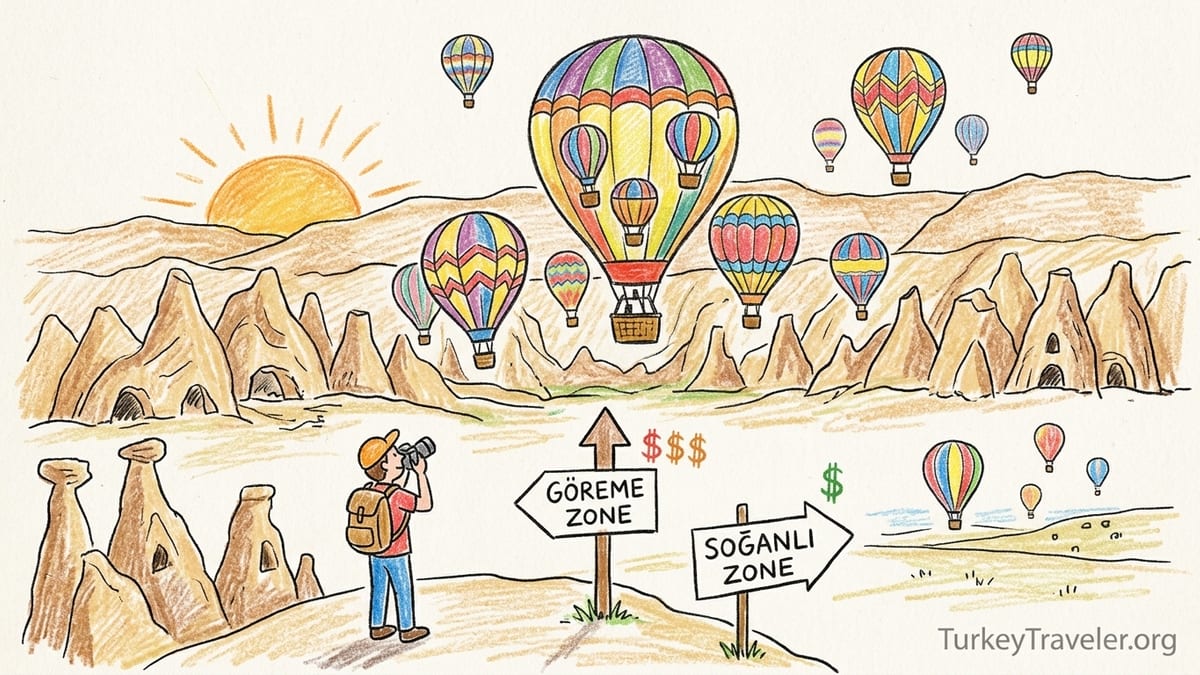
When travellers talk about “flying in Cappadocia,” they usually mean launching near Göreme, the heart of the national park and the area where you see those classic images of dozens of balloons rising above fairy chimney formations. Göreme sits among the valleys of Love, Rose and Pigeon, and most standard and comfort flights take off from fields that allow pilots to drift over or alongside these landscapes depending on wind direction. If this might be your only balloon flight in life, Göreme is usually the safest choice for postcard views.
Alternative flight zones exist, and they matter for both price and atmosphere. Soğanlı, a quieter valley to the southeast of the main Cappadocia cluster, has become a notable lower-cost alternative. Real 2026 examples show Soğanlı flights selling around €80 per person with a maximum of roughly 16 people in the basket, compared with Göreme listings in the €100 to €200 band for similar dates where baskets can hold up to about 28 passengers. For budget-conscious travellers who have already booked a couple of nights in Göreme and do not mind a transfer, Soğanlı can be appealing.
However, alternative zones offer different scenery and a different density of balloons in the sky. In Soğanlı or more remote valleys toward Ihlara, you might see only a handful of balloons, compared with the busy sunrise sky above Göreme. Some travellers love the quieter, more contemplative feel, while others feel they missed the iconic massed-balloon panorama. Towns such as Uçhisar, Ürgüp, Ortahisar and Avanos offer excellent cave hotels and hilltop viewpoints, and many Göreme-based operators include these areas in their transfer radius so you can still fly the central valleys even if you are not sleeping in Göreme itself.
For a first or only visit, a solid working rule is to prioritise a Göreme-zone launch if the price difference is manageable. If you return to Cappadocia or if budget is tight, exploring a secondary zone such as Soğanlı or the lesser-known take-off areas on the fringes of the region can be a rewarding way to see a different side of the landscape. Just confirm with the operator exactly which valley they fly over and what the typical views include.
Typical Inclusions: Hotel Transfers, Duration and Onboard Experience
Across reputable operators, hotel pickup and drop-off are now effectively standard for Göreme-area flights. In 2026, most companies include shared minibus transfers from popular bases such as Göreme, Ürgüp, Uçhisar, Çavuşin, Avanos, Ortahisar and sometimes Mustafapaşa and Nevşehir. For example, some operators list inclusive transfers from all these towns within their main ticket price, treating it as a core part of the service rather than an add-on. If you are staying at a remote boutique property, especially toward the edge of the region, expect either a small surcharge or a request to meet at a centrally located hotel.
Flight duration is another area where packages differ. The most common product is marketed as a 60-minute sunrise flight, with take-off just before or around first light. In practice, many standard and comfort rides last approximately 50 to 75 minutes depending on conditions. Some operators sell shorter “budget” flights of around 45 minutes at a lower per person cost, while others advertise 75 or 90-minute deluxe flights at the top end of the price spectrum. When comparing offers, take note of the advertised time in the air rather than only the pick-up time window, which usually spans three to four hours from hotel pickup to return.
Onboard, the experience is surprisingly quiet once the burner is off. Operators usually include basic insurance and a safety briefing before take-off. Breakfast offerings range from a simple pre-flight snack and tea at the launch site to a more elaborate spread at the operator’s office. After landing, many companies host a short celebration with non-alcoholic sparkling drinks and certificates. These details can vary, but they rarely justify a large price difference. When you see a significant price gap between two listings, basket capacity and flight date are far more likely to be the reasons than the quality of the snacks.
Price Volatility and When to Book
One of the defining features of the 2026 Cappadocia balloon market is price volatility. The early-September-to-late-September jump from around €140 to €270 with a single operator is not an anomaly. It is a visible example of broader patterns: peak months such as April, May, September and October routinely sit at the top of the price range, while winter months can be far cheaper but more vulnerable to weather disruptions. Comparison tools and agency guides now quote wide annual ranges because it is common to see standard flights at about €150 on one date and €350 or more a few days later when demand peaks.
Several factors feed into this volatility. International demand has grown steadily, with Cappadocia ballooning featured heavily in airline magazines, social media and 2026 destination lists. Operators face rising fuel costs, maintenance expenses and staffing requirements, all of which push baseline prices up. On top of that, there is a finite number of licensed balloons allowed in the sky each morning. Once a particular date starts filling up, prices rise like airline tickets on a busy route. If you wait until the week of travel to book a prime morning in September, you are essentially paying a last-minute premium.
For travellers planning ahead, the most practical strategy is to decide your travel dates early, then book the earliest possible morning of your Cappadocia stay as soon as your accommodation is fixed. That might mean locking in a Wednesday flight in mid-September three or four months ahead. If your chosen operator offers a best-price guarantee within a certain window, you get cost protection. If not, you still lock in a known price on a day that is likely to sell out. Trying to “time the market” usually backfires outside of low season; more often than not, tomorrow’s price for a popular date will be higher, not lower.
Be especially cautious with offers that seem dramatically cheaper than the prevailing market rate for the same date and category. A standard Göreme flight advertised at €70 in the heart of September, when most competitors are closer to €200 or more, deserves extra scrutiny. The operator might be flying from a different zone, using larger baskets than advertised, selling a very short flight, or operating through a long chain of middlemen with limited support in case of problems. In such a dynamic market, value rarely means the absolute lowest sticker price.
Why You Should Always Book the First Morning
Weather is the single biggest wild card in any balloon plan. Flights in Cappadocia are licensed and regulated, and the regional civil aviation authority assesses conditions such as wind speed, visibility and thermal activity before issuing clearance for sunrise flights. Decisions are often made the afternoon before, but the final call can still shift early in the morning if conditions change. Even in stable months, it is common to see several cancelled mornings in a row each season, and clusters of cancellations are more likely in spring and winter.
Because of this, experienced guides strongly recommend booking your balloon for the first possible morning of your stay. For example, if you arrive on a Tuesday and plan to stay until Friday, book for Wednesday morning. If that flight is cancelled because of weather, you have Thursday and possibly Friday as backup days to rebook. Trying to schedule a flight for your last morning in Cappadocia leaves no room for error. Many travellers leave the region never having flown simply because they gambled on the final day.
Booking the earliest morning also makes it easier to handle price volatility. If you secure a seat three or four months ahead for your first available day, you are less vulnerable to last-minute surges. Should your first morning be cancelled and you move to a later date, most reputable operators will honour the original price you paid rather than charging the higher rate that might now be listed for your new flight date. That kind of informal price protection is easier to negotiate when you have booked directly and early.
There is a second, smaller advantage: energy levels. The balloon pick-up usually happens around 4:30 to 5:30 in the morning depending on the time of year. Doing the flight on your first full day means you are often running on travel adrenaline, which makes the early wake-up less of a burden. Leaving it to your last morning after several dawn photography sessions and long touring days can make the experience feel more tiring than it needs to be.
Cancellation Rules and What Happens After Weather Cancellations
Cancellation policies in Cappadocia are not fully standardized, but there are clear patterns across professional operators. Most have two distinct layers: guest-initiated cancellations and weather or safety cancellations. For guest cancellations, a common model in 2026 is full refund for cancellations more than 48 hours before the flight, a partial refund or credit within 24 to 48 hours, and a non-refundable window inside 24 hours before pick-up. Some premium or private flights may require longer notice because the operator blocks a basket or entire balloon for your group.
Weather cancellations are treated very differently. When the authorities do not grant permission to fly, or when the company decides conditions are unsafe, your flight is cancelled and you are typically offered either a full refund or the option to rebook for the next available morning. Many operators state clearly that there is no penalty in this situation and that any deposit or full payment is returned in full if you choose not to reschedule. This is important in a region where wind and visibility can change quickly, especially in spring and winter.
In practice, what happens after a weather cancellation depends on both the operator and your schedule. If you still have nights remaining in Cappadocia, the company will often prioritise you for the next morning’s flight, slotting you in ahead of new bookings. If you are already fully booked for that date, you can usually choose a full refund instead. If it is your last morning and you are leaving later that day, a reputable operator will not try to move you to a future date you cannot use. They should process a straightforward refund.
Where travellers run into trouble is with third-party resellers or vague agency vouchers that pass your booking through several hands. In those cases, it can be less clear who holds your money and who is responsible for processing refunds. This is one reason to read cancellation policies carefully and, where possible, book directly with an operator or a well-established agency that clearly states “100 percent refund for weather cancellations” in its terms. In a volatile price environment, the peace of mind of a clean refund policy is worth paying slightly more for.
Choosing the Right Flight for Your Trip Type
Because Cappadocia flights span such a wide price range, the “best” ticket depends heavily on why you are flying. For solo travellers or small groups on a general Turkey itinerary, a standard Göreme-area flight with a reputable operator is usually the smartest choice. You get the essential experience at the most accessible price point, and with good timing you can still secure a spot for under or around €200 in many months. Paying extra for comfort might not feel necessary if you are mainly interested in simply being in the sky and seeing the landscape once.
For photography-focused travellers, the calculus changes. The extra space in a smaller-basket or comfort flight can be worth the additional €50 to €100 per person, particularly during peak months when standard baskets are more likely to be full. Fewer people per compartment mean you spend more of your flight at the edge of the basket, with unobstructed angles on Love Valley, Rose Valley and the clusters of other balloons. If you are carrying larger cameras or shooting video, that comfort upgrade often translates directly into better images.
Couples celebrating honeymoons, anniversaries or proposals sit somewhere between these two extremes. A fully private balloon, starting from the low thousands of euros, delivers maximum exclusivity but can feel disproportionate to the rest of a mid-range trip. Instead, many couples in 2026 are opting for low-capacity comfort flights that cap the basket around 12 to 16 passengers. Real-world reports from recent seasons suggest that this strikes a good balance of intimacy and cost, avoiding the sense of crowding that can occur in a maxed-out standard basket while staying far below private-flight budgets.
Families with children or multigenerational groups should pay extra attention to height and age restrictions, as well as total basket load limits. Most operators require children to be tall enough to see over the basket edge and may set a minimum age, often around six years. Heavier adults may incur surcharges if they exceed a stated weight allowance, as total payload affects fuel consumption and safety margins. In such cases, discussing your group profile with the operator when you book can prevent surprises at check-in.
The Takeaway
Cappadocia’s balloon market in 2026 is defined by two words: unforgettable and unpredictable. Unforgettable because a sunrise flight over Göreme’s valleys remains one of the world’s great travel experiences, and unpredictable because prices and weather both move in ways that can catch visitors off guard. Standard flights remain the value backbone of the market, comfort and smaller-basket options deliver added space and serenity at a premium, and private charters sit at the aspirational end of the spectrum.
If there is one practical rule to anchor your planning, it is to book the first possible morning of your stay. Doing so gives you at least one extra day to recover from weather cancellations and helps you lock in a price before demand pushes it higher. Combine that with a clear understanding of basket type, launch zone, inclusions and refund rules, and you can navigate the volatile pricing environment with confidence.
Whether you choose a classic Göreme standard flight, a compact comfort basket or a once-in-a-lifetime private charter, the fundamentals are the same: a pre-dawn start, the roar of burners, the moment your basket lifts clear of the ground and the sudden quiet as Cappadocia’s volcanic landscape unfolds beneath you. With realistic expectations and a smart booking strategy, you can make that moment the highlight of your Turkey journey rather than a source of stress.
FAQ
Q1. How much does a standard hot air balloon flight in Cappadocia cost in 2026?
In 2026, a standard shared sunrise flight in the main Göreme area typically runs from about €100 to €200 per person in shoulder months, with prices higher in peak weeks and occasionally exceeding €250 to €300 on very popular dates. Winter dates and last-minute deals can be cheaper, while last seats in September and October can be significantly more expensive.
Q2. What is the real difference between standard and comfort or deluxe flights?
The main difference is space. Standard baskets often carry around 20 to 28 people, while comfort or deluxe baskets are usually capped around 12 to 16, meaning fewer people per compartment and better access to the basket edge for views and photos. Flight time and route are often similar, so you are paying primarily for reduced crowding and a more relaxed feel rather than a completely different flight.
Q3. Are private hot air balloon flights in Cappadocia worth the cost?
Private flights are worth considering for major occasions such as proposals or milestone anniversaries, especially if you value privacy and tailored photo opportunities. Prices commonly start in the low thousands of euros for small private baskets, so they are a luxury purchase rather than a standard trip expense. For many couples, a low-capacity comfort flight offers a similar sense of intimacy at a much lower cost.
Q4. Should I book a Göreme flight or choose a cheaper alternative zone like Soğanlı?
If this is your first and possibly only Cappadocia balloon flight, Göreme is usually the best choice because it combines the famous fairy chimneys with a sky full of other balloons. Cheaper zones such as Soğanlı can be excellent for repeat visitors or tight budgets, offering quieter skies and lower prices, but the scenery and overall atmosphere differ from the classic Göreme panorama.
Q5. Is hotel pickup included in Cappadocia balloon ticket prices?
With reputable operators, shared hotel pickup and drop-off from key towns such as Göreme, Ürgüp, Uçhisar, Avanos and Ortahisar are usually included in the ticket price. If you are staying in a remote village or outside the main cluster, you may be asked to meet at a central point or pay a small extra fee. Always confirm transfer details at the time of booking.
Q6. How long does a Cappadocia balloon flight last?
Most standard and comfort flights are marketed as 60 minutes in the air, though actual flight times commonly range between about 50 and 75 minutes depending on wind and traffic. Some operators offer shorter budget flights around 45 minutes and longer deluxe flights of up to 90 minutes. When comparing prices, check the advertised air time rather than just the overall tour duration.
Q7. What happens if my balloon flight is cancelled due to weather?
If your flight is cancelled because conditions are unsafe or the authorities do not grant permission to fly, reputable operators will either move you to the next available morning or issue a full refund, at your choice. If you have additional days in Cappadocia, you are typically given priority on the next flight. If it is your last day and you cannot reschedule, you should receive your money back in full.
Q8. Can I get a refund if I cancel my balloon booking?
Refunds for guest cancellations depend on the specific company. Many operators offer full refunds for cancellations made more than 48 hours before the flight, partial refunds or credits within 24 to 48 hours, and no refund inside 24 hours. Private or charter flights often have stricter terms. Always read the cancellation policy carefully before paying a deposit.
Q9. When is the best time of year to book a Cappadocia balloon ride?
April, May, September and October offer a strong balance of comfortable temperatures and relatively stable flying conditions, but they are also the most expensive and busiest months. Winter can be beautiful and cheaper but carries a higher risk of weather cancellations. Whatever month you choose, book the first possible morning of your stay so you have backup days in case of bad weather.
Q10. How far in advance should I book a hot air balloon in Cappadocia?
For peak months such as April, May, September and October, booking several weeks to a few months ahead is wise, especially if you want a specific operator or a comfort or private basket. In quieter months you may find availability closer to the date, but prices can still rise as seats fill. As soon as your Cappadocia accommodation is fixed, it is sensible to secure your balloon ticket for the first morning you are in town.