


Central Anatolia rarely tops first-time Turkey itineraries, yet it is where the country’s political heart, early Christian cave sanctuaries, whirling dervish culture and student-filled river cities intersect. Using GoTürkiye’s official Central Anatolia route as a backbone, this guide builds a selective loop through Ankara, Cappadocia, Ihlara Valley, Tuz Gölü, Kayseri and Mount Erciyes, Konya and Eskişehir, with side trips to Gordion or Çatalhöyük where they add real depth. It is designed for independent travelers who like concrete details: what you actually see, rough prices, how long journeys take, and how to string it all together in a week to ten days.
How to Structure a Central Anatolia Journey
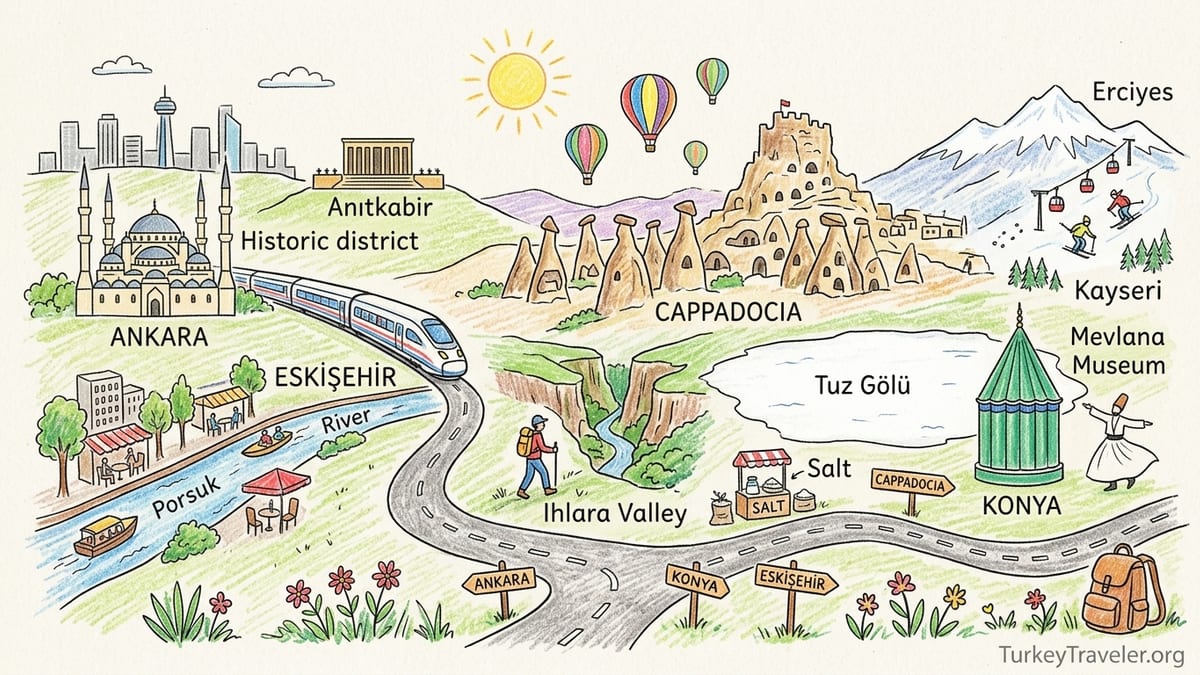
Central Anatolia is best approached as a hub-and-spoke route between major cities, with Ankara and Kayseri as practical gateways. Many international travelers fly into Istanbul and then connect to Ankara Esenboğa or Kayseri Erkilet; from there, buses and domestic flights make it realistic to cover Ankara, Cappadocia, Konya and Eskişehir in around 8 to 10 days. High-speed trains already link Ankara and Eskişehir in about 1.5 hours and extend onward to Konya, which makes combining urban and spiritual stops much smoother than in the past.
A classic loop starts in Ankara for museums and republican history, continues to Cappadocia for landscapes and cave churches, then dips into Ihlara Valley before swinging past Tuz Gölü toward Konya. From Konya, many travelers either head south to the Mediterranean or turn north to Eskişehir for an urban pause, then continue back toward Ankara. Add Kayseri and nearby Erciyes Ski Resort in winter, or as a convenient airport and city break any time of year.
Distances look intimidating on the map, but express coaches and modern highways keep travel manageable. Ankara to Göreme or Ürgüp by bus typically takes around 4.5 to 5 hours, while Konya to Cappadocia is roughly 3 hours by road. Point-to-point bus tickets on reputable operators like Kamil Koç or Metro Turizm are often in the range of what many travelers would consider budget-friendly for 2026, especially if bought a few days in advance.
To avoid burnout, give Ankara 1 to 2 days, Cappadocia 3 days, Ihlara and Tuz Gölü as day trips or short overnights, Erciyes 2 to 3 ski days in winter, Konya 1 to 2 nights, and Eskişehir 1 or 2 nights. That balance lets each place play its specific role: capital city, volcanic wonderland, canyon hike, salt lake photography stop, alpine playground, spiritual center and lively university town.
Ankara: Museums, Castles and Republican History
Ankara is more than a bureaucratic capital; it is where modern Turkey was negotiated into existence. Start at Anıtkabir, the hilltop mausoleum of Mustafa Kemal Atatürk. The complex combines a ceremonial plaza with a museum that traces the War of Independence through original documents, uniforms and dioramas. Entry is free, and visiting hours follow a seasonal schedule, so it is wise to check times ahead of a morning or late-afternoon visit. Most travelers spend 2 to 3 hours wandering the museum galleries and watching the changing of the guard on the plaza.
From there, shift centuries back in time at the Museum of Anatolian Civilizations below Ankara Castle. Housed in restored Ottoman buildings, the collection walks you chronologically from Neolithic Çatalhöyük finds to Hittite imperial treasures and Phrygian artifacts associated with King Midas. It is one of the few museums in Turkey where exhibits are clearly grouped and labelled by era, so you can connect dots before seeing similar motifs later on in Cappadocia’s rock churches or at Gordion. Expect to pay a moderate entrance fee comparable to other national museums and budget at least two hours to do it justice.
Ankara Castle itself crowns the old quarter of Kale. Its origins likely date back to late Roman or early Byzantine times, with Seljuk and Ottoman additions on top. Walking up Depo Sokak to the ramparts takes you through narrow streets, small antiques shops and family-run tea houses. From the walls, you get a wide view over Ankara’s tiled roofs and modern skyline, which neatly illustrates how the republic grew up around an older Anatolian town. For a small extra dose of industrial and transport history, the Rahmi Koç Museum near the castle displays vintage cars, locomotives and household technology in a compact complex that is open Tuesday to Sunday with daytime hours.
If you have an extra day, consider a side trip to Gordion, about 90 kilometers southwest of Ankara. The archaeological site and museum introduce the Iron Age Phrygian kingdom in a landscape of grassy tumuli. It is a peaceful contrast to the capital, and the story of the so-called Gordian Knot gives extra resonance to inscriptions and objects you will encounter later in regional museums.
Cappadocia: Fairy Chimneys and Early Christian Heritage
Cappadocia is Central Anatolia’s visual signature, with honeycombed cliffs, fairy chimneys and hot air balloons rising over the valleys at dawn. Most visitors base themselves around Göreme, Ürgüp or Uçhisar, which are within 40 to 60 minutes of Nevşehir or Kayseri airports by shuttle. Boutique cave hotels line the slopes of Göreme and Uçhisar; mid-range double rooms in 2026 often fall into a range that many travelers consider accessible compared with western European capitals, including breakfast and terrace views of the balloon-filled sky.
The Göreme Open-Air Museum, a short walk or taxi ride from Göreme center, anchors the early Christian side of the region. This UNESCO World Heritage site preserves rock-cut churches and refectories that formed part of a monastic education system. Inside, frescoes depict biblical scenes in vivid reds and blues, especially in highlights like the Dark Church, which usually requires an extra ticket. Current entrance fees hover around what you might pay for a major museum in a European city, and a focused visit of 2 to 3 hours gives enough time to understand how these cave communities functioned.
Beyond Göreme, small valleys radiate outward, each with a different personality. Love Valley and Zemi Valley deliver classic fairy chimney landscapes on half-day hikes, while Pigeon Valley runs between Göreme and Uçhisar, whose hilltop castle provides one of Cappadocia’s best sunset panoramas. Organized day tours labeled “Red Tour” or “Green Tour” bundle several highlights, from underground cities like Derinkuyu to panoramic viewpoints and pottery workshops in Avanos. Prices vary by season and inclusions, but as a rule they tend to be cheaper when booked directly in town than through international resellers.
Balloon flights remain Cappadocia’s splurge experience. While prices fluctuate with demand, they are often in the low hundreds of euros per person, including hotel pickup before sunrise, one hour in the air and a simple post-flight celebration. To keep costs down, some travelers instead watch from a terrace or a viewpoint above Göreme, where dozens of balloons drift overhead against the pink morning light. However you experience it, Cappadocia firmly fills the “landscape and early Christian heritage” role in a Central Anatolia itinerary.
Ihlara Valley and Tuz Gölü: Canyon Hikes and Salt Horizons
Southwest of Cappadocia proper, Ihlara Valley provides a green, river-cut canyon that surprises anyone expecting only arid plateaus. Formed by lava from Mount Hasan and carved by the Melendiz River, the valley hides churches such as Ağaçaltı and Yılanlı high in its cliffs. A common way to visit is on a day tour from Göreme or Ürgüp, combining the valley with Selime Monastery at the far end. Independent travelers can also rent a car and reach Ihlara in roughly 1.5 hours from Göreme, then descend about 300 steps from the main viewpoint to the valley floor.
The most popular hiking section, from the main entrance to Belisırma village, is about 4 to 5 kilometers and generally flat once you reach the bottom. It typically takes 2 to 3 hours with stops to explore frescoed chapels and photograph the willow trees draped over the river. At Belisırma, simple riverside restaurants offer grilled trout, gözleme and tea on low platforms above the water, making it easy to linger. The full trail from Ihlara to Selime is closer to 14 kilometers and suits trekkers comfortable with a 5 to 6 hour walk.
On the western side of the region, Tuz Gölü, or Salt Lake, offers something completely different: a shimmering white expanse that, in late spring and summer, often turns pinkish with algae and shallow water. It is one of Turkey’s largest lakes and a major source of domestic salt. From Ankara, long-distance buses heading south toward Aksaray or Konya frequently pass near the lake and stop in the small town of Şereflikoçhisar, from where local taxis or minibuses cover the last stretch. The lack of shade and facilities on the shore means you should bring water, a hat and footwear suitable for walking on crusty salt.
Travelers often time their Tuz Gölü stop for late afternoon, when the light softens and reflections become more vivid. You may share the shoreline with domestic day-trippers taking wedding photos, families letting children stomp through the shallow brine and small roadside shops selling jars of mineral-rich salt products. For photographers, this is an ideal counterpoint to Cappadocia’s rocky forms, confirming the variety of landscapes Central Anatolia packs into relatively short distances.
Kayseri and Mount Erciyes: Winter Sports in Central Anatolia
Kayseri, a historic trade city on the eastern side of Cappadocia, doubles as the gateway to one of Turkey’s most modern ski areas. Erciyes Ski Resort spreads across the northern and western flanks of Mount Erciyes, a 3,917 meter stratovolcano whose snow-capped cone dominates the skyline. The resort has grown rapidly in the last decade and now offers around 112 kilometers of marked runs served by roughly 18 to 19 lifts, including gondolas and chairlifts. Official sources and local authorities emphasize its extensive artificial snowmaking network, which helps extend the season from late November to late April in typical winters.
The ski base at Tekir Plateau sits about 25 to 30 minutes by road from Kayseri city center and around 40 minutes from the airport. This makes it feasible to stay in the city, enjoy broader restaurant options and commute daily to the mountain on hotel shuttles or shared minibuses, which many budget-conscious skiers prefer. Accommodation at the resort base includes mid-range ski-in/ski-out hotels, while Kayseri itself offers everything from simple guesthouses to international chains, often at prices lower than equivalent alpine destinations.
Lift ticket systems have evolved in recent seasons. Instead of traditional day passes, the resort has used rechargeable cards where you load a certain amount or number of rides, with discounts for multi-day packages sold through local rental shops and hotels. Equipment rentals at Erciyes are widely available near the main lift stations, with daily rates for skis, boots and poles typically far below Western European averages, making Erciyes particularly appealing for families or those trying skiing for the first time.
Outside ski season, Erciyes remains a hiking and mountain-biking area, but you should be realistic about conditions: snow can linger on the upper slopes into late spring, and afternoon clouds sometimes cloak the summit. If you are building a winter Central Anatolia itinerary, a practical pattern is to ski in Erciyes for two or three days, then transfer to Cappadocia for hot air balloons and valley walks, taking advantage of the short drive of roughly one hour between Kayseri and Göreme.
Konya: Rumi, Mevlevis and Seljuk Echoes
Konya carries the spiritual and cultural thread of this route. Once a capital of the Seljuk Sultanate of Rum, it is best known today as the city of Jalal ad-Din Rumi and the Mevlevi order, whose whirling dervish ceremonies are among Turkey’s most recognized cultural icons. Most travelers start at the Mevlana Museum, a former lodge that houses the tomb of Rumi under a fluted green dome. Inside, glass cases hold illuminated manuscripts, musical instruments and robes associated with the order, while visitors shuffle quietly around the tomb chamber, reading translated verses.
On certain evenings, official sema ceremonies take place in Konya’s cultural centers, where Mevlevi dervishes in tall felt hats and white skirts perform their turning ritual to live ney flute and drum. Tickets are often reasonably priced and can be purchased on the day from the venue or through hotels that arrange seating. Non-flash photography is usually tolerated, but it is polite to watch the first segments without filming, treating the ceremony as a spiritual performance rather than a tourist show.
Konya’s Seljuk architecture adds another layer. The Karatay Medrese, now a museum of tiles, displays turquoise and black motifs that echo later Ottoman designs, while the İnce Minare Medrese showcases stone carving around a famously slender minaret. Both are easily reached on foot or via tram from the city center and charge modest entrance fees. Wandering between them, you pass through pedestrianized streets with pide ovens, pastry shops and tea houses that stay open late, especially during university term time.
For day trips, Çatalhöyük lies about 40 kilometers southeast of Konya on the Konya Plain. This Neolithic site, with its densely packed mudbrick houses and rooftop access, pushes the time frame of your journey back to roughly 7000 BC. The visitor center presents reconstructions and interpretive panels that tie together the finds you have seen in Ankara’s Museum of Anatolian Civilizations and other collections, making Central Anatolia’s deep past feel less abstract.
Eskişehir: Riverside Culture and Creative Urbanism
Eskişehir is the place where Central Anatolia feels most like a progressive European university town. Two major universities feed a youthful population, while the Porsuk River and its Adalar district create a surprisingly lively waterfront scene. In the evenings, locals stroll along the embankment, ride small tourist boats, and fill café terraces that serve everything from third-wave coffee to simple beer and meze. For travelers who have spent days among ruins and rural landscapes, Eskişehir’s energy can be a welcome reset.
The historical Odunpazarı quarter climbs a low hill south of the river. Here, restored Ottoman houses painted in ochre, blue and terracotta line narrow lanes, sheltering boutique hotels, meerschaum workshops and small museums. Meerschaum, locally called “Eskişehir stone,” is carved into pipes and jewelry, with galleries showing hundreds of intricate pieces. The city also hosts the Odunpazarı Modern Museum, a contemporary art space in a striking timber-framed building, and several specialized museums such as a glass art museum and a wax museum, all within walking distance.
Parks are another of Eskişehir’s strengths. Large green spaces like Sazova Science, Art and Culture Park and Kent Park attract families with playgrounds, ponds and lakeside cafés. Sazova combines whimsical architectural replicas with science exhibits and an aquarium, while Kent Park is known for its artificial beach and long walking paths. For many visitors, however, the simple pleasure is joining students in Kanlıkavak Park or along the Hamamyolu pedestrian zone, grabbing street food such as çibörek or simit and watching daily life unfold.
Given Eskişehir’s location, it works well at the beginning or end of a Central Anatolia route. High-speed trains link it to Ankara in roughly 1.5 hours and to Istanbul in around 3 to 4 hours, depending on the service. Hotel prices span from basic pensions to well-rated business hotels, frequently at rates beneath Istanbul averages, which makes Eskişehir an affordable base for exploring both the historic Odunpazarı quarter and the surrounding countryside.
Practical Tips: When to Go and How to Connect the Dots
Timing your Central Anatolia trip depends on whether you want to ski or focus on hiking and open-air sites. For general sightseeing, April to early June and late September to October balance comfortable daytime temperatures with relatively clear skies. Cappadocia’s balloon flights and Ihlara hikes are particularly pleasant in these shoulder seasons. July and August can be very hot on exposed plateaus and around Tuz Gölü, with little shade, so early starts and long midday breaks become important.
For Erciyes, the main ski season usually runs from late November until late April, when the combination of natural snowfall and artificial snowmaking covers most pistes. Conditions in early season and late season can vary from year to year, so skiers should check lift status and snow reports close to their travel dates rather than relying on averages. On stormy winter days, high winds can close parts of the lift system; building a buffer day into your schedule reduces the risk of disappointment.
Public transport is reliable between major cities but more limited for natural sites. High-speed and conventional trains are ideal for Ankara–Eskişehir–Konya, while intercity buses connect Ankara, Kayseri and Nevşehir with smaller hubs near Cappadocia and Tuz Gölü. For Ihlara Valley, Tuz Gölü shore access and flexible exploration between Cappadocia villages, renting a car for a few days gives the most freedom. Fuel prices change frequently, so it is sensible to factor in a healthy buffer when comparing car rental with guided tours.
Costs across Central Anatolia are generally lower than in Istanbul’s most touristed districts or along the Mediterranean coast. A typical mid-range dinner for two in Ankara, Konya or Eskişehir might fall into what many visitors view as an affordable bracket by European standards, including main courses, salads and non-alcoholic drinks. In Cappadocia, prices climb closer to international tourist norms, especially for cave hotels and balloon flights, but everyday expenses like bakery breakfasts, intercity bus tickets and museum entries remain reasonable enough to keep a 10-day Central Anatolia itinerary within reach for budget-conscious travelers.
The Takeaway
Central Anatolia rewards travelers who look beyond Turkey’s coasts. Ankara contextualizes the republic with museums and a hilltop castle; Cappadocia stages pre-modern Christian monastic life in sculpted volcanic rock; Ihlara Valley and Tuz Gölü test how varied a single plateau can be, from canyon greenery to glimmering salt flats. Kayseri and Erciyes add a full-fledged winter sports dimension, Konya ties the route together through Rumi and the Mevlevi tradition, and Eskişehir proves that Anatolian cities can be as creative and river-focused as any in Western Europe.
By treating each destination as a specialist stop rather than another generic “place to see,” you can build an itinerary that feels coherent instead of rushed. A morning at Anıtkabir informs an afternoon at the Museum of Anatolian Civilizations; frescoes in Göreme echo in cliff chapels in Ihlara; Seljuk tiles in Konya resonate with mosaics and artifacts back in Ankara. Even a short detour to Gordion or Çatalhöyük shifts the story from modern politics and tourism back to the deep Neolithic and Iron Age past.
Whether you are catching the first lift at Erciyes, watching balloons rise over Uçhisar from a cave hotel terrace, or sipping tea in an Odunpazarı courtyard in Eskişehir, Central Anatolia has the capacity to surprise. With thoughtful planning, it becomes not just a corridor between Istanbul and the coasts, but a journey through the layers that make Turkey what it is today.
FAQ
Q1. How many days do I need for a Central Anatolia route including all these stops?
Most travelers are comfortable with 8 to 10 days: 1 to 2 nights in Ankara, 3 in Cappadocia, 1 day each for Ihlara Valley and Tuz Gölü, 2 to 3 ski days at Erciyes in winter, and 1 to 2 nights each in Konya and Eskişehir, adjusting up or down depending on how much hiking or skiing you want to include.
Q2. Is it better to rent a car or rely on public transport in Central Anatolia?
Between major cities like Ankara, Konya, Kayseri and Eskişehir, trains and intercity buses work well. For flexible access to Cappadocia valleys, Ihlara trailheads and Tuz Gölü viewpoints, a short car rental of 3 to 4 days is very helpful, especially if you prefer sunrise and sunset visits away from group tour schedules.
Q3. When is the best time to combine Cappadocia and Erciyes for skiing and sightseeing?
Late January to early March often offers the most reliable snow at Erciyes while still giving crisp, clear days in Cappadocia. You can ski for two or three days based in Kayseri, then transfer about one hour to Göreme for balloons and valley walks, bearing in mind that winter nights in Cappadocia are cold.
Q4. Can I visit Tuz Gölü as a simple stop between Ankara and Cappadocia?
Yes, but you will need to plan the logistics. Long-distance buses from Ankara toward Aksaray or Konya often pass near the lake and stop at towns like Şereflikoçhisar, from where you can continue by taxi. If you are renting a car, you can drive directly and time your visit for late afternoon light before continuing on to Cappadocia or returning to Ankara.
Q5. Are the cave churches in Göreme and Ihlara suitable for travelers with limited mobility?
Both areas involve uneven paths and some steep steps. Göreme Open-Air Museum has a compact core where several churches can be seen with moderate walking, but some sections and the Dark Church require climbing. In Ihlara, reaching the valley floor from the main entrance means descending and later climbing a long staircase, so travelers with limited mobility may prefer shorter strolls near the entrance instead of the full hike.
Q6. Is Konya a conservative city, and how should visitors dress?
Konya is more conservative than Cappadocia’s resort towns or Eskişehir’s student neighborhoods, but visitors in modest casual clothing are welcomed. Long trousers or skirts and covered shoulders are advisable, especially when visiting the Mevlana Museum or mosques, where women may also want to bring a light scarf to cover their hair.
Q7. What kind of budget should I plan for hot air ballooning in Cappadocia?
Prices vary by season, demand and operator, but in recent years standard balloon flights with reputable companies have often fallen in the low hundreds of euros per person, including hotel pickup, roughly one hour in the air and a simple post-flight drink. Booking a few weeks ahead in peak periods like spring and autumn increases your chances of securing a fair rate and preferred date.
Q8. Is Eskişehir worth adding if I am short on time?
If you enjoy cafés, riverside walks and museums in lively university districts, Eskişehir is an excellent addition. It is particularly easy to include if you are already traveling by high-speed train between Ankara and Istanbul, since it lies directly on that line and can reward even a one-night stop with Odunpazarı’s old houses and an evening along the Porsuk River.
Q9. How cold does it get in Central Anatolia in winter?
Winter temperatures across Central Anatolia frequently drop below freezing at night, especially in Cappadocia, Erciyes and higher sections of the plateau. Daytime highs vary widely, but you should be prepared with layered clothing, a warm hat and gloves, and proper waterproof footwear, particularly if you plan to ski or visit open-air sites like Tuz Gölü in midwinter.
Q10. Do I need to book accommodation and tours in advance for this region?
In peak seasons such as late spring, autumn and the heart of the ski season, it is wise to book cave hotels in Cappadocia, Erciyes ski hotels and popular balloon flights at least a few weeks ahead. In larger cities like Ankara, Konya and Eskişehir, same-week bookings are usually possible outside major holidays, but reserving in advance often secures better locations and prices.