


The Marmara region of northwestern Turkey is often treated as a blur between Istanbul and the Aegean coast, a place you cross rather than explore. Yet just a few hours from Istanbul you can stitch together a remarkably varied journey that combines Ottoman heritage, alpine skiing, lakeside retreats, thermal spas, monumental mosques, and some of the most significant battlefields and archaeological sites in the country. This guide builds a selective route around Bursa, Uludağ, İznik, Sapanca, Yalova, Edirne, Çanakkale, Troy and Gallipoli, giving each destination a clear role so you can design an itinerary that feels coherent rather than rushed.
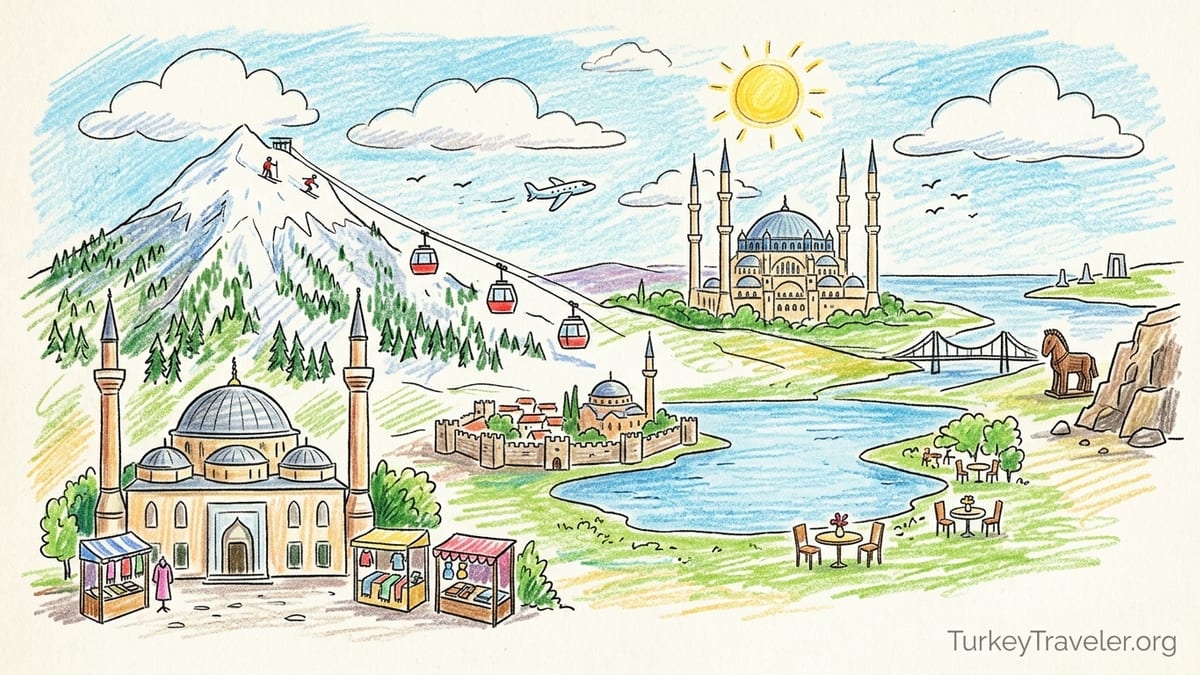
Bursa: Living Museum of Early Ottoman Power
Bursa was the first major capital of the Ottomans and it remains one of the best places in Turkey to understand how the empire took shape in stone, tile and trade. For a traveler, that history reveals itself in walkable layers. You might start your day at the Ulu Cami, the Grand Mosque completed in the late 14th century, where calligraphic panels cover the walls and a fountain anchors the prayer hall. Step outside and you are immediately in the old bazaar district, where covered market streets still sell silk scarves, copperware and wedding fabrics much as they did when Bursa was a Silk Road hub.
Concrete details bring the city’s story into focus. Around Koza Han, the historic silk caravansary, you can still buy handwoven silk ties and shawls at prices that range from modest souvenirs to luxury pieces costing the equivalent of several hundred euros. In the nearby Tophane district, the tombs of Osman Gazi and Orhan Gazi, founders of the Ottoman dynasty, sit above the city in a landscaped park. Many visitors pair this with a ride up to the historic Cumalıkızık village on the city’s edge, where 700 year old timber and stone houses line cobbled streets, now filled with small guesthouses and family run breakfast gardens.
From a practical perspective, Bursa is also one of the easiest Marmara bases to reach from Istanbul. Intercity buses and direct ferries from Istanbul’s Yenikapı and Eminönü piers usually take around two to three hours door to door, depending on traffic. Once in the city, the tram system and plentiful taxis make it realistic to stay in the modern Çekirge hotel zone yet spend your days exploring the historic center. This mix of living city and concentrated Ottoman heritage makes Bursa a logical first stop and narrative anchor for a Marmara itinerary.
Uludağ: Mountain Escape and Ski Playground Above the City
Uludağ rises directly behind Bursa, turning what could be a purely historic city break into a mountain escape in less than an hour. In winter, this is one of Turkey’s most popular ski areas, with a compact resort zone between roughly 1,800 and 2,300 meters. Even if you are not a committed skier, a couple of nights on the mountain can fundamentally change the feel of your Marmara journey, counterbalancing mosques and museums with snowfields, forest air and cable car rides.
Most travelers access Uludağ via the modern Bursa Teleferik, a cable car whose lower station is a short taxi ride from central Bursa. The journey takes about 25 minutes each way and climbs through dense forest to panoramic viewpoints and hotel clusters. In the main ski season, typically from late December through March depending on snowfall, you can rent skis or snowboards at the resort and buy half day or full day lift passes. For budget planning, gear rental and a lift ticket together often work out cheaper than in major Alpine resorts, making Uludağ particularly appealing to first time skiers or families who want to try the sport without a huge financial commitment.
Outside winter, Uludağ functions more as a national park than a ski resort, with marked hiking trails, picnic areas and cool temperatures that offer real relief from Istanbul or Bursa’s summer heat. Local tour agencies in Bursa sell day trips that combine short walks through the forest, visits to high altitude meadows, and simple grill lunches at mountain restaurants. If you have limited time, even a same day up and down ride on the cable car is worth building into your Bursa stay, because it vividly illustrates how tightly the city, mountain and surrounding forests are woven together.
İznik: Quiet Lakeside Town with Deep Religious History
İznik sits on the eastern shore of Lake İznik and is best understood as a quiet place with an outsized past. Known as Nicaea in antiquity, it hosted important early Christian councils, then became an Ottoman ceramics center famed for blue and white tiles. Today it is a compact lakeside town where you can walk along surviving Byzantine walls in the morning, stroll the lakefront at sunset, and sample simple fish dinners in between.
In practical terms, İznik works well as a day trip from Bursa or as a one night stop to slow the pace of your journey. The city’s main square holds the Hagia Sophia of İznik, a church turned mosque that gives a concrete sense of how religious and political shifts played out in architecture. A short walk away, small workshops sell contemporary İznik style ceramics, from budget friendly coffee cups to one of a kind wall panels that can cost as much as a midrange hotel stay. The town’s atmosphere is low key, and outside summer weekends you are likely to share the lakeside promenade largely with local families.
Because İznik remains relatively under the radar compared with the better known coastal resorts, accommodation is limited to a handful of small hotels and guesthouses. That scarcity can be a strength. Staying in a simple lakeside pension, waking to the sound of fishing boats and ending the day with grilled levrek at a family run restaurant by the water, often feels more like visiting friends than ticking off a checklist of sights. For travelers who want to balance the intensity of Istanbul and Bursa with a more contemplative stop, İznik fills that role neatly.
Sapanca: Easy Lake Escape from Istanbul
If İznik is about history, Sapanca is about the contemporary habit of escape. Less than two hours from Istanbul by car or intercity bus in light traffic, this lakeside town in Sakarya province has become a favored weekend retreat for Istanbul residents. It is an ideal place to add one or two nights of air, water and slow mornings to a Marmara itinerary built around heavier heritage stops.
Sapanca Lake anchors everything. Many new style boutique hotels and rental villas sit directly above the water or on hillsides facing the lake, with terraces designed around long breakfasts and sunset tea. You can rent bicycles to follow sections of the lakeside path, book short boat rides in summer, or simply walk among reed beds and picnic areas used by local families. Small cafes along the shore serve standard Turkish breakfast spreads, where a table for two might fill with eggs, cheeses, olives, honey, kaymak clotted cream and fresh bread for a price that still feels modest compared with major European resort towns.
For travelers passing through rather than dedicating a full holiday to Sapanca, the main appeal is how little planning is required. Many Istanbul based tour operators offer same day excursions that combine Sapanca with nearby Maşukiye for forest walks and simple trout lunches. Independent travelers can just as easily take an early intercity bus to Sapanca’s small station, check into a lakeside hotel, and spend the afternoon doing very little. In an itinerary that might already include skiing, battlefield visits and UNESCO listed sites, Sapanca fills the role of gentle pause.
Yalova: Thermal Waters and Green Valleys
Yalova sits directly across the Sea of Marmara from Istanbul and has long been associated with thermal water. The Termal district, about a dozen kilometers inland from the city center, is the real destination. Here, hot springs feed historic bath complexes tucked into a forested valley that was a favored escape of early republican leaders. The combination of thermal culture and greenery makes Yalova an effective wellness stop between city focused days.
Visitors typically reach Yalova by high speed ferry from Istanbul’s central piers, a journey that can take around one to one and a half hours depending on the route. From Yalova port, frequent minibuses or taxis run up to Termal, where several spa hotels, public bathhouses and landscaped walking paths surround the springs. You can opt for a simple public soak, paying a modest entrance fee to access gender segregated pools, or reserve a private family room with its own hot tub style basin and marble relaxation area.
Yalova also offers more than baths. The surrounding hills hold walking routes and picnic gardens, and in spring and early summer the region is known for its greenery and mild temperatures compared with central Istanbul. Many travelers combine a half day at the thermal baths with a short hike or a barbecue lunch in nearby Sudüşen Waterfall area, arranged via local drivers or hotel staff. For those planning a route that moves from Bursa toward Istanbul or vice versa, Yalova neatly slots in as a half or full day of deliberate unwinding.
Edirne: Ottoman Architecture at its Peak
Edirne, near the borders with Greece and Bulgaria, was an Ottoman capital before Istanbul and remains a showcase for classical Ottoman architecture. The city’s skyline is dominated by the Selimiye Mosque complex, designed by the architect Sinan and inscribed on the UNESCO World Heritage List. Its single great dome and four slender minarets can be seen from many parts of the city, and the mosque’s interior uses light and İznik tiles in a way that architecture students and casual visitors alike find memorable.
Beyond Selimiye, Edirne’s historic center holds several significant mosques, bridges and caravanserais that illustrate how an imperial city functioned. The Eski Camii, or Old Mosque, has heavy stone walls and bold black calligraphy that feel markedly different from later, lighter structures. Nearby, the Üç Şerefeli Mosque experiments with different minaret forms and a more open courtyard, giving a sense of architectural evolution. Many of these sites lie within walking distance of each other, making Edirne well suited to a full day of slow exploration rather than a quick photo stop.
From a traveler’s point of view, Edirne is a straightforward yet rewarding detour from Istanbul. Intercity buses and private transfers usually cover the roughly 230 kilometer journey in around three hours, and the city’s compact center makes it easy to stay in a small hotel and explore on foot. Meal breaks can be as memorable as the monuments. Edirne is famed for its fried liver, often served in thin slices with peppers and bread, and for sweet treats like almond paste and syrupy pastries. Spending at least one night allows you to see Selimiye both in bright daytime and softly illuminated after dark, which many travelers consider essential to understanding its scale and atmosphere.
Çanakkale: Base Camp for Troy, Assos and Gallipoli
Çanakkale occupies a strategic position on the Dardanelles and functions today as a lively university and port city, but for travelers its main value is as a base for exploring three distinct routes: Troy, Assos and the Gallipoli Peninsula. Tourism authorities highlight these as separate experiences that together can easily fill three or more days. Using Çanakkale as your hub keeps logistics simple while allowing you to focus each day on one theme, whether archaeology, coastal villages or 20th century military history.
In the city itself, the waterfront promenade offers a glimpse of Çanakkale’s character. Ferries move constantly across the strait, connecting the Asian and European shores, and the harbor is lined with cafes, casual seafood restaurants and the replica wooden horse used in a recent film adaptation of the Trojan War story. Accommodation ranges from budget pensions in older streets to modern chain hotels with sea views. Prices tend to be more moderate than Istanbul’s, especially outside peak summer, which makes Çanakkale a practical place to linger.
Transport options fan out from the city center. Buses and organized tours run south along the coast to Assos, where an ancient hilltop acropolis overlooks the Aegean and small stone built villages now operate boutique hotels and simple beach clubs. In another direction, local operators sell half day or full day trips to Troy, usually timed to avoid the hottest midday sun in summer. Meanwhile, several agencies run dedicated Gallipoli tours that depart from Çanakkale in the morning, cross the strait by ferry and spend a full day visiting key battlefields and memorials.
Troy and Gallipoli: Archaeology and Memory on the Dardanelles
The ancient city of Troy and the Gallipoli battlefields are geographically close yet emotionally distinct. Troy, a UNESCO World Heritage archaeological site south of Çanakkale, is best experienced with context. The layered ruins themselves can seem modest to visitors expecting intact temples, but on a guided walk you literally step through centuries of occupation stacked on top of each other. The adjacent museum displays artifacts and reconstructions that help connect the visible foundations and walls to the literary and historical narratives that made Troy famous.
Most Troy excursions from Çanakkale last around half a day, which leaves time to explore the city or add a relaxed seaside stop afterward. Travel agencies in Çanakkale typically include transport, guiding and entrance fees in a single ticket, allowing independent travelers to avoid renting a car. Those with a strong interest in archaeology might choose to rent a vehicle or hire a private driver in order to spend more time at the museum, which many visitors rate as the highlight of the experience.
Gallipoli, on the opposite side of the strait, is programmed very differently. Travel recommendations commonly suggest devoting at least two full days to the peninsula if you want to move beyond the main memorials. Organized routes usually begin at the major Allied landing sites and cemeteries, including Anzac Cove and Lone Pine, then continue to Turkish positions and viewpoints that explain how the peninsula’s ridges and gullies shaped the campaign. For visitors from Australia, New Zealand, the United Kingdom and Turkey, the names on the graves and the landscape itself carry a personal and national weight that makes unhurried time on the peninsula important.
Because Gallipoli sites are spread over a wide area with limited public transport, most travelers join a structured tour or hire a driver from Çanakkale. Tours often include ferry crossings, lunch and commentary that places individual memorials in the wider context of the First World War. Even if you are not traveling from a country directly involved in the campaign, walking the trenches, reading the letters carved into stone and looking back across the Dardanelles toward Çanakkale can be one of the most affecting days of a Marmara journey.
The Takeaway
Seen from a highway window, the Marmara region can appear as an anonymous blur of fields, apartment blocks and service stations between Istanbul and the Aegean. Seen up close through a focused itinerary, it becomes a sequence of distinct moods: Bursa’s layered Ottoman streets, Uludağ’s mountain air, İznik’s quiet lakeside walls, Sapanca’s breakfasts by the water, Yalova’s steaming baths, Edirne’s soaring domes and Çanakkale’s mix of student energy, myth and memory. By assigning each stop a clear role, you avoid the temptation to chase dozens of small towns and instead build a route that feels purposeful.
In practice, many travelers weave these destinations into a loop. One common pattern begins in Istanbul, continues to Bursa and Uludağ, then arcs through İznik, Sapanca and Yalova before turning west to Edirne or south to Çanakkale, Troy and Gallipoli. The exact order matters less than the balance between movement and rest, history and landscape, reflection and simple pleasure. With realistic travel times, at least two or three nights in key hubs and openness to local advice, the Marmara region can shift from an afterthought to the quiet highlight of a longer Turkey journey.
FAQ
Q1. How many days do I need to see Bursa, Uludağ and İznik properly?
Allow at least three full days: one full day for Bursa’s historic center, one for Uludağ including the cable car, and one shared between İznik and travel time. Adding an extra night gives you more flexibility for weather on the mountain.
Q2. Can I visit Sapanca, Yalova and Bursa as day trips from Istanbul?
It is possible to do each as a long day trip, but travel times and traffic can make that tiring. Many travelers prefer to base themselves for one or two nights in Bursa or Sapanca and then add Yalova as a half day stop on the way back toward Istanbul.
Q3. Is Uludağ suitable for beginners who have never skied before?
Yes. Uludağ has rental shops, gentle beginner slopes and instructors who regularly work with first time skiers, including children. Conditions and lesson availability vary by season, so checking snow reports and making advance inquiries with your hotel or a local agency is sensible.
Q4. When is the best time of year to visit Edirne for architecture and sightseeing?
Spring and autumn are usually the most comfortable, with mild temperatures for walking between mosques and markets. In high summer the city can be hot, so plan early morning and late afternoon sightseeing and use midday hours for long lunches or rest.
Q5. Do I need to join an organized tour to see Troy and the Gallipoli battlefields?
You can visit independently with a rental car, but many travelers find organized tours from Çanakkale more convenient. Tours provide transport between dispersed sites, handle ferry crossings and offer historical context that can be hard to piece together on your own.
Q6. Is it realistic to combine Troy and Gallipoli in one day from Çanakkale?
It is technically possible but not ideal. Each area deserves at least a dedicated day, and many visitors prefer a two day program for Gallipoli alone. Combining them risks turning both into rushed checklists.
Q7. Are the thermal baths in Yalova suitable for families with children?
Yes, many facilities offer family rooms or mixed areas where parents and children can bathe together. Water temperatures can be high, so short sessions and careful supervision are important, especially for younger children.
Q8. What is the easiest way to reach Sapanca without renting a car?
Intercity buses from Istanbul’s main bus terminals stop in Sapanca, and the town also has a railway station served by some regional trains. Many hotels can arrange pick up from the bus or train stop, making car free travel straightforward.
Q9. Can I use Bursa or Sapanca as a base to visit both İznik and Yalova?
Yes. Bursa in particular works well as a hub, with road connections to İznik in one direction and ferries or buses toward Yalova in another. Sapanca can also be used as a base, though reaching Yalova requires longer transfers or private arrangements.
Q10. Is it safe to travel independently in the Marmara region as a solo traveler?
Most solo travelers report feeling comfortable in Marmara cities and towns, especially in busy areas and during normal daytime and evening hours. Standard precautions apply: choose reputable accommodation, use licensed taxis or known bus companies, and follow local advice about any areas to avoid late at night.