


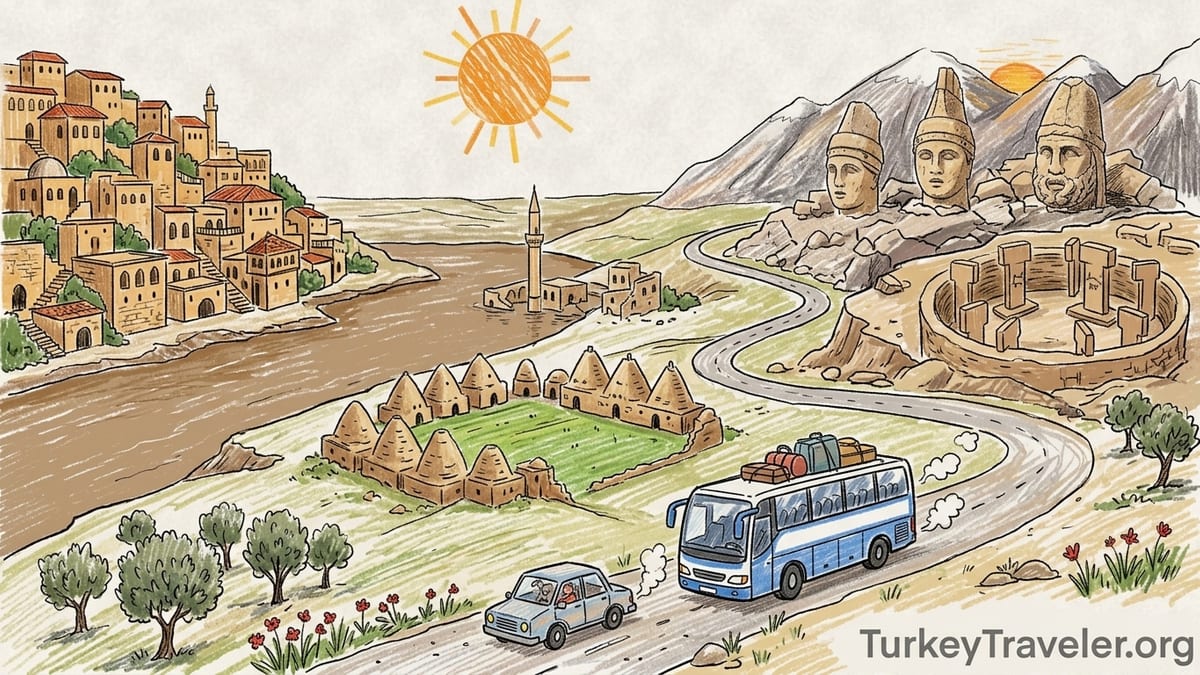
Southeastern Anatolia is where Turkey feels closest to Mesopotamia: Roman fortresses loom over the Euphrates, Neolithic temples rise from dry hills, and stone towns glow honey-gold at sunset. This is a region of big distances and big stories, so planning a trip means choosing a few strong bases and treating the rest as well-timed excursions. The following guide focuses on Gaziantep and Halfeti, Şanlıurfa with Göbeklitepe and Harran, Mount Nemrut, Mardin with Dara and Midyat, and the UNESCO-listed cityscape of Diyarbakır, with practical examples of how travelers actually move, eat and sleep here in 2026.
How to Structure a Trip Through Southeastern Anatolia
The classic mistake in Southeastern Anatolia is trying to “collect” too many sites in one go. Distances are longer than they look on the map, roads are generally good but slow in and out of city centers, and summer heat can make midday sightseeing punishing. Rather than chasing a list of 40 or 50 attractions, it is far more rewarding to anchor your route around a few overnight bases and then add targeted excursions. In practice most independent travelers choose two to four hubs, then allow at least two nights in each.
For this itinerary, the natural bases are Gaziantep, Şanlıurfa, Mardin and Diyarbakır. Each of these cities has a functioning airport or strong long-distance bus connections, a range of mid-range hotels and guesthouses, and enough evening life to fill several nights. From Gaziantep, travelers typically visit the Zeugma Mosaic Museum in the city and take a day trip to Halfeti on the Euphrates. From Şanlıurfa, it is realistic to see Göbeklitepe and Harran on separate half-days or folded into a single long day with a driver.
Mardin works well as a base for Dara and Midyat, both of which are within roughly an hour’s drive on paved roads. Travelers commonly negotiate a day rate with a local driver in Mardin’s old town to combine the two with a stop at a Syriac monastery. Diyarbakır itself is more than a stopover: the monumental black basalt walls and Hevsel Gardens are listed as a UNESCO World Heritage Site, and the city increasingly serves as a base for visiting Zerzevan Castle on a half- or full-day trip.
Mount Nemrut is the main outlier. The colossal stone heads and funerary mound sit at over 2,000 meters in the Taurus foothills, and the approach from Kahta or Adıyaman involves mountain roads and pre-dawn wakeups. Most visitors break the journey with an overnight in Kahta or Adıyaman specifically to catch sunrise or sunset on the summit, rather than using Nemrut as a casual side-trip from another city. In other words, Nemrut is not a base, but it justifies its own dedicated stop on almost any Southeastern Anatolia route.
Gaziantep and Halfeti: Food Capital and Euphrates Excursion
Gaziantep is the obvious starting point for many itineraries. Its airport has regular flights from Istanbul and Ankara, and despite damage from the February 2023 earthquakes, the city’s core attractions and food culture are operating again in 2026. Gaziantep is a UNESCO City of Gastronomy, and you feel that as soon as you walk into institutions such as İmam Çağdaş or Koçak for pistachio baklava or a plate of beyran soup at breakfast. Expect to pay in the region of the equivalent of a few euros for a generous portion of baklava and a strong Turkish tea, far less than you would in Istanbul for similar quality.
The single most important cultural sight in Gaziantep is the Zeugma Mosaic Museum, regarded as the largest mosaic museum in the world by floor area, with around 1,700 square meters of Roman mosaics recovered from the ancient city of Zeugma on the Euphrates. Many travelers allow two to three hours here, renting the audio guide on arrival and focusing on the “Gypsy Girl” mosaic and the reconstructed Roman villas. Ticket prices remain modest for a world-class museum by European standards, often around the cost of a simple lunch. It makes sense to visit in the morning and then wander the nearby copper bazaar in the cooler late afternoon.
Gaziantep is a true overnight base: you can comfortably spend two or three nights in a central hotel or renovated stone guesthouse, walk to dinner in the old bazaar district, and still fit in a half-day excursion. A common pattern is to spend one full day on food and the city museums, then one day traveling out to Halfeti on the Euphrates, known for its partly submerged old town and the minaret rising from the dam lake. Shared boat tours typically depart from the new Halfeti harbor and last one to two hours, cruising past the submerged village of Savaşan and the ruins of Rumkale. Prices vary by season, but small-group cruises are widely available at on-the-spot rates that are still relatively affordable by Western standards.
Halfeti itself is better treated as an excursion rather than an overnight base for most travelers. Accommodation options in the new town and by the water exist, including small family-run hotels and simple pensions, but evening food and transport choices are limited compared with Gaziantep. A realistic day looks like renting a car in Gaziantep or joining a small tour, driving the roughly 90 minutes to Halfeti, taking a boat trip, having a riverside lunch of grilled fish or kebabs, then returning to Gaziantep in time for a late baklava run and a final walk through the coppersmiths’ alley.
Şanlıurfa, Göbeklitepe and Harran: Cradle of Neolithic Religion
Şanlıurfa, often shortened to Urfa, makes a powerful second base after Gaziantep. Buses between the two cities commonly take around three to four hours, and there are also direct flights from Istanbul into Şanlıurfa GAP Airport. Within the city you can explore the sacred carp pools of Balıklıgöl, the covered bazaar and the castle hill in a single day, but most archaeology-minded travelers stay at least two nights to allow time for Göbeklitepe, Harran and the excellent Şanlıurfa Archaeology Museum.
Göbeklitepe, added to the UNESCO World Heritage List for its exceptional Neolithic ritual architecture, lies on a low ridge roughly a 25–30 minute drive from Şanlıurfa city. The site dates to around the 10th millennium BCE and consists of circular stone enclosures with T-shaped pillars carved with animals. In 2026 the standard pattern is to travel there by pre-booked driver, organized either through your hotel or a local agency, often as part of a half-day tour that may also include the new excavations at Karahantepe. Prices for a private driver and guide can be surprisingly high relative to other local costs, with some travelers reporting quotes of several hundred euros for a full archaeological day out, so many budget travelers opt instead for a simple driver only or rent a car to keep control over time and cost.
Harran, on the flat plain south of Şanlıurfa near the Syrian border, is best known for its beehive houses and its long history as a Mesopotamian and later Islamic learning center. In practice most visitors organize Harran as a separate half-day trip, often in the afternoon when the light is softer on the mud-brick architecture, or combine it with Göbeklitepe in a long day with a car and driver. Harran village has a few basic guesthouses where travelers occasionally spend a night for the atmosphere and stargazing, but facilities are simple and public transport sparse, so for most itineraries Şanlıurfa remains the safer overnight base.
Şanlıurfa’s appeal as a base lies in the combination of infrastructure and atmosphere. The city has a growing selection of mid-range hotels in the center, some converted from traditional stone houses with inner courtyards, and evening life focuses around tea gardens, kebab houses and families strolling around Balıklıgöl. You can visit the vast Şanlıurfa Archaeology Museum and the nearby Haleplibahçe Mosaic Museum in a single morning, seeing artifacts from Göbeklitepe and other Neolithic sites before, or after, visiting the actual hillsides where they were found. This combination of first-rate museum context and access to living excavation areas is what makes the Şanlıurfa base uniquely compelling.
Mount Nemrut: Remote Colossi and Mountain Overnight
Mount Nemrut, inscribed on the UNESCO World Heritage List for its first-century BCE funerary tumulus and colossal statues, sits in a remote highland area of Adıyaman Province. You cannot realistically visit Nemrut as a day trip from Gaziantep or Şanlıurfa without an exhausting amount of driving. Instead, most itineraries fold Nemrut into an overnight in Adıyaman city or the smaller town of Kahta, which both cater specifically to Nemrut visitors with simple hotels and pension-style lodging.
A typical Nemrut visit works like this: you arrive in Adıyaman or Kahta by mid-afternoon, check into a basic hotel, and arrange with the receptionist or a local agency for either an evening sunset or pre-dawn sunrise drive to the summit. Shared minibus tours are still reasonably priced by European standards and often bundle in nearby sights such as the Cendere Bridge and the ruins of Arsemia. Private jeep or minivan hire costs more but allows for quieter moments at the summit terraces and flexible timing, which is useful given that summer sunrises can be very early and winter conditions can close the summit road entirely.
Because the stone heads and seated figures sit at over 2,000 meters, the temperature drops sharply compared with the plains. Travelers routinely report needing thick jackets, hats and gloves for sunrise in May or September even when the lower valleys are warm. Simple refreshments such as tea and snacks are sometimes available from small stands or at the summit car park, but you should not rely on buying proper clothing or gear locally. Nemrut itself is not an overnight base: you arrive, climb the last stretch from the car park on foot, spend an hour or two admiring the eastern and western terraces, and then descend back to Kahta or Adıyaman for breakfast or dinner.
Many tour operators now offer multi-day “Mesopotamia” circuits that link Göbeklitepe, Harran, Nemrut, Mardin and Diyarbakır, typically including Nemrut as a single night between Şanlıurfa and Mardin. Even if you are traveling independently, thinking in these terms can help: Nemrut is a high-impact, short-duration stop that breaks the journey between cities and delivers some of the most surreal mountain scenery in Turkey, providing you treat it as a focused excursion anchored by a nearby town rather than as a standalone hub.
Mardin, Dara and Midyat: Stone Balconies Above the Mesopotamian Plain
Mardin may be the most visually distinctive of all Southeastern Anatolia’s cities, with its steep hillside of honey-colored stone houses and church towers cascading toward the Mesopotamian plain. Old Mardin has enough small hotels, cafes and boutique guesthouses to make it a comfortable base for three or four nights, especially now that more historic mansions have been converted into accommodation. Many have rooftop terraces where you can eat a breakfast of flatbreads, olives and local cheeses while watching the first light strike the plain, which stretches into Syria.
Dara Ancient City, about 30 to 40 minutes by car from Mardin, is one of the region’s most surprising archaeological sites and is heavily promoted by GoTürkiye. The village itself looks like a sleepy settlement at first glance, but just beyond the houses lie rock-cut tombs, walls and vast underground cisterns accessible by stairways. Entry remains inexpensive, and guides often cluster near the parking area offering short, informal tours for small tips or modest fees. Because public transport is minimal, most travelers visit Dara by hiring a driver in Mardin for a half-day, commonly combining it with one or two other stops such as a monastery or countryside viewpoint.
Midyat, around an hour east of Mardin on the main highway, is another rewarding excursion and occasionally a secondary base. While the modern town is spread out, the old quarter has restored stone mansions, churches and filming locations from Turkish TV dramas. Some travelers choose to spend a night in a renovated Midyat konak, particularly if they intend to visit the Syriac Orthodox Mor Gabriel Monastery or continue farther east the next day. In practice, though, most short trips keep Mardin as the overnight base and treat Midyat as a long day out, returning in the evening for dinner in one of Mardin’s terrace restaurants.
What makes Mardin such an effective hub is the mix of heritage and logistics. The town is connected by regular buses to both Şanlıurfa and Diyarbakır, and its small airport serves domestic flights to Istanbul and Ankara. At the same time, it is compact enough that you can walk from your hotel to restaurants, churches and viewpoints without taxis, and drivers for longer excursions to Dara and Midyat are easy to arrange through hotels or in the main square. This means you can wake in the same stone-walled room each morning while experiencing very different landscapes and communities on each day trip.
Diyarbakır and Zerzevan Castle: Basalt Walls on the Tigris
Diyarbakır, straddling the banks of the Tigris River, is one of the most historically layered cities in Turkey. Its imposing black basalt walls and the fertile Hevsel Gardens below are inscribed together as the Diyarbakır Fortress and Hevsel Gardens Cultural Landscape on the UNESCO World Heritage List, reflecting continuous occupation and strategic importance from Hellenistic through Roman, Byzantine, Islamic and Ottoman periods to the present. For travelers, this means you can spend an entire day simply walking the walls, ducking into gates and mosques, and descending toward the gardens.
The walled Sur district has seen conflict and subsequent reconstruction, so you will notice areas where historic buildings have been heavily restored or replaced. At the same time, sections of the walls and towers retain their original fabric, with inscriptions and reliefs visible in the stone. Cafes and tea houses on and near the walls provide good vantage points over the Tigris valley, and prices remain noticeably lower than in Istanbul or the Aegean. Diyarbakır has a range of accommodation from budget pensions to modern business hotels, making it a sensible base for at least one or two nights if your route runs this far east.
Zerzevan Castle, promoted by GoTürkiye and increasingly common on tour itineraries, lies roughly midway between Diyarbakır and Mardin on the main highway. The late Roman-Byzantine fortress sits on a ridge with expansive views over the surrounding steppe and has attracted attention for its excavated Mithraic temple. Practically, travelers most often visit Zerzevan as a stop on a transfer day between Mardin and Diyarbakır, arranging with a private driver or intercity taxi to pause at the site for an hour or two before continuing. A smaller number of visitors organize it as a standalone half-day excursion from Diyarbakır, which is easier if you have a rental car.
Diyarbakır is thus a genuine base if you want deeper engagement with Kurdish and multi-ethnic urban culture, markets and local cuisine, and it anchors access to Zerzevan Castle. However, it is also where security advisories tend to be more cautious, particularly for some foreign institutions, given the city’s political history. Independent travelers who decide to include Diyarbakır in 2026 typically keep an eye on current advisories, stay in central well-reviewed hotels, and rely on licensed taxis or reputable drivers for movement after dark or on day trips.
Choosing Bases and Excursions: Practical Itineraries
When you combine these cities and sites into an actual trip, patterns quickly emerge. A compact one-week route might look like this: three nights in Gaziantep with a day in Halfeti; three nights in Şanlıurfa with visits to Göbeklitepe, Harran and the city museums; and one night around Mount Nemrut in Kahta before returning by bus or onward flight. This pattern keeps travel time manageable while hitting some of the region’s most important UNESCO-listed and tentatively listed heritage sites.
With ten days, you can layer in Mardin as a fourth base. One realistic version runs: Gaziantep (two or three nights), Şanlıurfa (two or three nights), Kahta or Adıyaman for Nemrut (one night), then Mardin (three nights) with day trips to Dara and Midyat. Travelers with a strong interest in urban history can then extend to Diyarbakır for one or two nights, using either Mardin or Diyarbakır as the jumping-off point to stop at Zerzevan Castle along the highway. In each case the logic is the same: you sleep in cities with enough hotels and evening life, and you keep archaeological and rural sites as focused, daylight excursions.
Budget expectations are also important. In 2026, domestic flight prices between Istanbul and regional airports such as Gaziantep, Şanlıurfa and Mardin fluctuate but are typically comparable to intercity high-speed train fares in Western Europe if booked in advance, while long-distance buses remain cheaper but slower. A mid-range double room in a restored stone hotel in Mardin or Şanlıurfa often costs significantly less than a similar boutique stay in Cappadocia or along the Turquoise Coast. Museum entry fees and archaeological site tickets in this region tend to be low by international standards, which is why transportation and guided excursions, especially to more remote sites like Göbeklitepe and Nemrut, often form the largest line items in a traveler’s budget.
Seasonality is another practical consideration. Summers can be intensely hot across Southeastern Anatolia, with daytime temperatures on the plains frequently climbing well above 30 degrees Celsius. In those months, planning early-morning and late-afternoon excursions from your base city becomes essential, with long midday breaks in shaded cafes or back at your hotel. Spring and autumn bring more comfortable temperatures and clearer views from hillside cities like Mardin and from Nemrut’s summit, but nights in higher elevations can be unexpectedly cold, especially in April and October.
The Takeaway
Southeastern Anatolia rewards travelers who think in terms of bases and stories rather than lists and pins. Gaziantep tells a Roman and culinary story centered on Zeugma’s mosaics and pistachio-studded baklava, with Halfeti adding a day of Euphrates landscapes. Şanlıurfa, Göbeklitepe and Harran anchor a much older narrative, stretching deep into the Neolithic and early urban Mesopotamian world. Mount Nemrut offers a short, intense mountain interlude among scattered stone colossi, while Mardin, Dara and Midyat layer Syriac, Arab and Turkish histories onto a single honey-colored hillside. Diyarbakır and Zerzevan Castle close the arc with their vast walls and late Roman frontiers on the Tigris.
The key is to recognize which places are best suited to overnight stays and which shine as excursions. Gaziantep, Şanlıurfa, Mardin and Diyarbakır all work as strong bases, with enough beds, buses and evening restaurants to support several nights. Halfeti, Göbeklitepe, Harran, Dara, Midyat, Zerzevan Castle and Mount Nemrut itself function better as journeys out from those hubs, whether by rented car, shared tour or hired driver. With this structure in mind, you can build a route that feels selective rather than rushed, allowing time to sit for tea in a bazaar, pause at sunset on a city wall, and let the depth of Southeastern Anatolia’s history sink in.
FAQ
Q1. How many days do I need for a first trip to Southeastern Anatolia?
Most travelers find that 7 to 10 days is enough for a first trip that includes Gaziantep, Şanlıurfa, Mount Nemrut and Mardin without feeling rushed, while two full weeks allow you to add Diyarbakır and move at a more relaxed pace.
Q2. Which cities make the best overnight bases?
The most practical bases are Gaziantep, Şanlıurfa, Mardin and Diyarbakır, all of which have airports or strong bus connections, a range of hotels, evening dining options and easy access to nearby sites by car or organized excursion.
Q3. Is Halfeti worth an overnight stay or just a day trip from Gaziantep?
For most itineraries Halfeti works best as a day trip from Gaziantep: you can take a Euphrates boat tour, have a riverside lunch and return to better accommodation and dining choices in the city the same evening.
Q4. How should I visit Göbeklitepe and Harran from Şanlıurfa?
Many visitors arrange private drivers or small group tours through their Şanlıurfa hotel, visiting Göbeklitepe as a morning or afternoon half-day and Harran as a separate outing, or combining both in a long day with an early start.
Q5. Do I need to stay near Mount Nemrut or can I visit from another city?
You realistically need an overnight in Kahta or Adıyaman to visit Mount Nemrut, because sunrise or sunset trips involve early departures and mountain roads that make same-day returns to cities like Gaziantep or Şanlıurfa impractical.
Q6. Is Mardin better as a base than Midyat?
For most travelers Mardin is the better base thanks to its wider choice of hotels, restaurants and transport links, while Midyat is usually visited as a day trip or, at most, a single overnight in a restored stone mansion.
Q7. How do travelers typically include Diyarbakır and Zerzevan Castle?
Many itineraries add one or two nights in Diyarbakır to explore the city’s UNESCO-listed walls, then stop at Zerzevan Castle on the highway when traveling between Diyarbakır and Mardin, using a private driver or rental car.
Q8. What is the best season to visit this region?
Spring and autumn are generally the most comfortable, with milder temperatures for walking city hills and archaeological sites; summer can be extremely hot, while winter may bring snow and occasional closures around Mount Nemrut.
Q9. Is it easy to travel independently without joining a tour?
Yes, many travelers move independently using domestic flights, intercity buses and occasional rental cars or local drivers, joining organized tours only for more remote sites like Nemrut or for convenient combined Göbeklitepe and Harran days.
Q10. Are prices in Southeastern Anatolia lower than in Western Turkey?
On the whole accommodation, food and museum tickets in Gaziantep, Şanlıurfa, Mardin and Diyarbakır are noticeably cheaper than in Istanbul or coastal resort areas, although private drivers and specialized archaeological tours can still be relatively expensive.