


Eastern Anatolia has quietly become one of Turkey’s most compelling ski regions. At its heart are two destinations that now feature heavily in GoTürkiye’s winter marketing: Palandöken above the city of Erzurum, and Sarıkamış in the forests of Kars province. Both promise long seasons, modern lifts and dedicated ski-in/ski-out accommodation, but the on-snow experience and resort atmosphere are strikingly different. Understanding those differences is the key to choosing the right base for your trip.
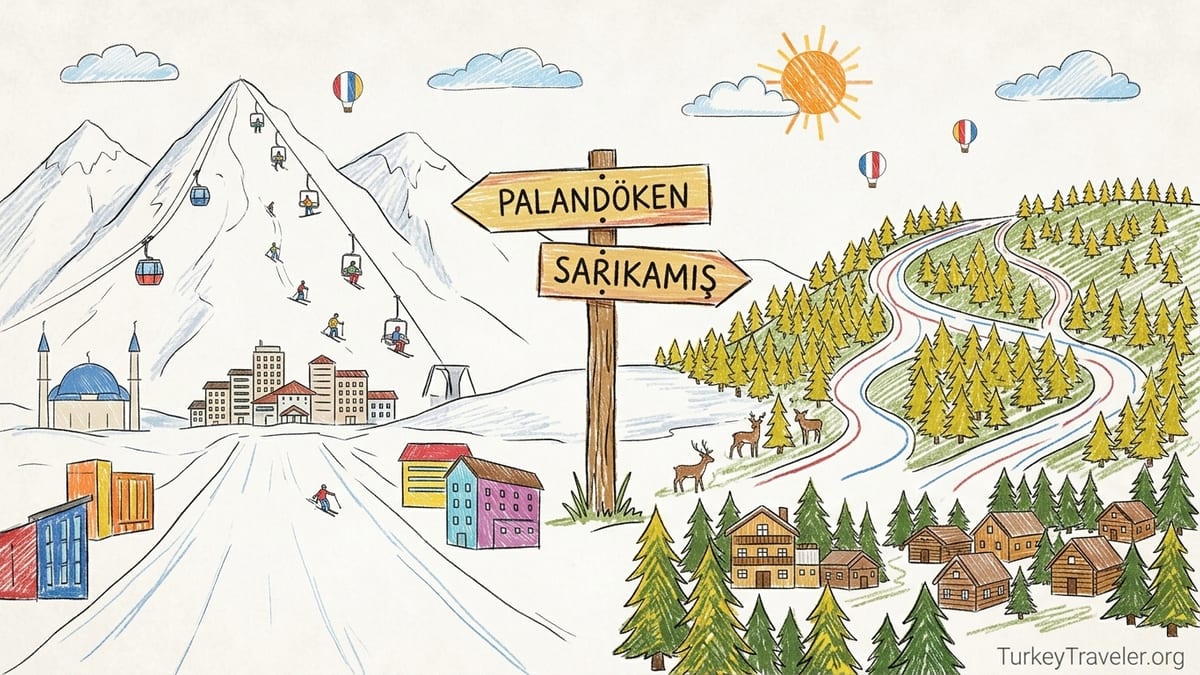
Palandöken vs Sarıkamış: How the Two Eastern Giants Compare
Palandöken is about vertical and terrain. Rising from roughly 2,200 meters to more than 3,100 meters above Erzurum, it offers some of the steepest and longest pistes in Turkey, including the Ejder 3200 area that attracts advanced skiers and boarders. The mountainside feels big and open, with wide bowls and direct fall-line runs that drop toward the city. The overall impression is closer to a compact Alpine resort than a local hill, and it has hosted international events such as the Winter Universiade, which helped drive investment in lifts and snow management.
Sarıkamış, by contrast, is about atmosphere. The ski area spreads across the flanks of Bayraktepe and Cıbıltepe at around 2,100 to 2,600 meters, threading through dense yellow-pine forest. Runs are gentler and more enclosed, and the resort is widely known in Turkey for its “crystal snow,” a dry, powdery texture locals like to compare to certain Alpine resorts. The setting is softer and more scenic than Palandöken’s treeless slopes, with pistes disappearing into forest and occasional clearings that open toward the Eastern Anatolian plateau.
When you compare the two, Palandöken is the better choice for skiers who want challenging terrain, fast laps and a sense of ski-mountain scale. Sarıkamış suits travelers who care as much about scenery and a calm, woodsy ambience as about maximum vertical. Both now have proper ski hotels at the base, but their character is very different: Palandöken feels like a mountain above a city, while Sarıkamış feels like a self-contained alpine village in the woods.
Ski Season, Snow and Weather: Reliability in the Eastern Highlands
Eastern Anatolia’s high, continental climate gives both Palandöken and Sarıkamış reliably cold winters. In practice, Palandöken generally enjoys one of the longest seasons in Turkey, often opening in December and running into April, with locals noting that some years skiing has continued well into spring. High altitude and north-facing slopes help preserve snow, and the resort backs this up with snowmaking on key runs, which adds resilience in lean winters.
Sarıkamış usually has a slightly shorter but still solid season, commonly mid-December to late March, with peak conditions from January through early March. Its calling card is snow quality rather than depth. The low humidity and cold temperatures in the Kars highlands help create small, dry crystals that skiers describe as very light underfoot and forgiving in turns. Because most pistes are protected by forest, wind scouring is less of a problem than on exposed high-alpine faces, and visibility often remains manageable even in bad weather.
For advanced skiers chasing big vertical and late-season turns, Palandöken has the edge. For intermediates and families happy to ski mainly in the core months on forgiving surfaces, Sarıkamış’s combination of regular snowfall and sheltered, tree-lined pistes is hard to beat. In either case, snow reliability in January and February is generally strong enough that most domestic operators confidently sell packages for these periods year after year.
Getting There: Airports, Trains and Transfers
Access is an area where Eastern Anatolia has improved dramatically. For Palandöken, most international visitors fly into Erzurum Airport, which has regular winter-season flights from Istanbul and other major Turkish cities. The drive from the terminal to the main hotel zone on Palandöken typically takes around 20 to 30 minutes under normal winter road conditions. Many ski hotels, from long-established properties like Dedeman Palandöken to larger convention-style hotels such as Palan Hotel Ski & Convention Resort, offer private transfers or can arrange a car and driver on request.
Sarıkamış is usually reached via Kars Harakani Airport. The drive from the airport to the Sarıkamış ski area takes roughly 40 to 50 minutes, following a quiet road into the pine forests. Some travelers combine Sarıkamış with an overnight stay in Kars city, using hotels such as DoubleTree by Hilton Kars before heading on to the slopes. Another option, popular with domestic skiers seeking a more scenic journey, is the Eastern Express train from Ankara to Kars, then a road transfer from Kars town to Sarıkamış.
If you are planning a multi-resort trip, it is realistic to ski both Palandöken and Sarıkamış in a single week. Buses and private transfers run between Erzurum and Sarıkamış, typically taking 3 to 4 hours depending on winter conditions. Itineraries often start in Erzurum for steeper terrain, then move on to Sarıkamış for a few quieter, more relaxed days in the forest.
Pistes, Terrain and On-Mountain Experience
Palandöken’s piste map reflects its reputation as a serious ski mountain. The resort lists around 20-plus marked runs of varying difficulty, with black-rated descents from the Ejder summit, long red cruisers dropping back toward the base area and shorter blue sections near beginner zones and hotel-front lifts. A gondola and multiple chairlifts serve a skiable domain of several hundred hectares, and confident intermediates can ski top-to-bottom laps that feel long by Turkish standards. Off-piste enthusiasts value Palandöken for its wide, untreed faces that allow for freeride-style lines when avalanche conditions are stable.
Sarıkamış offers a different feel. Runs are typically long blues and easy reds that weave through forest, with only a handful of steeper sections. This makes it particularly suitable for intermediates polishing technique and for snowboarders who enjoy rolling terrain with natural side hits among the trees. Because pistes are more sheltered, wind closures tend to be less frequent than at open, high-alpine resorts, and visibility is often better in snowy weather. The tree cover also contributes to a sense of scale; even though the vertical drop is smaller than Palandöken’s, the skiing feels extensive because of the varied glades and connecting paths.
For first-timers and nervous skiers, Sarıkamış’s gentle forest runs are usually the better introduction. For those who are already comfortable on European reds and looking for steeper challenges, Palandöken is more likely to keep you entertained over several days. Many mixed-ability groups end up choosing Palandöken but dedicating one or two days to Sarıkamış if time permits, to experience its famed snow quality and atmosphere.
Ski Hotels, Village Atmosphere and Après-Ski
Both resorts now have clear, dedicated ski accommodation markets. At Palandöken, the ski-in/ski-out offering is concentrated along the main base area near Ejder 3200. Hotels such as Dedeman Palandöken Ski Lodge and Palan Hotel sit practically on the piste, allowing guests to click into skis just outside the door. Large properties like Xanadu Snow White tend to offer full-board or all-inclusive formulas, with buffets, indoor pools, kids’ clubs and organized evening entertainment that appeal to domestic families and groups booking seasonal packages.
Just down the hill, Erzurum city broadens the hotel choice. Travelers who prefer to split time between skiing and urban sightseeing often stay in modern city hotels such as The Erzurum Hotel, which provide easy shuttle access to the lifts combined with Erzurum’s restaurants, cafes and historic sites. This “city-plus-ski” model gives Palandöken a different flavor from purpose-built resorts: après-ski is less about bars at the base station and more about heading into town for local dishes like cağ kebab and kadayıf dolması.
Sarıkamış, on the other hand, feels more like a compact, self-contained resort village. Around the base area, pine-surrounded ski hotels and boutique lodges form a small cluster where everything revolves around the slopes. Properties such as Crystal Snow Hotel, Lion Hill Resort and Duja Chalet Ski Center cater to skiers with on-site rental shops, spa areas with Turkish baths and saunas, and packages that typically include breakfast and dinner. Because there is no large city right below the mountain, evenings tend to be quieter, with most guests staying in to enjoy hotel lounges and family-friendly entertainment.
For travelers valuing a lively city nearby and a choice of restaurants, Palandöken has the advantage. For those who picture a classic mountain village, walking between hotel, lift and forest in snow boots without ever seeing heavy traffic, Sarıkamış delivers a more traditional alpine-resort mood.
Families, Beginners and Package Value
Eastern Anatolia’s ski resorts have competitively priced packages compared with many European destinations, and both Palandöken and Sarıkamış market heavily to domestic families. In a typical high-season week, it is often possible to find package deals from major Turkish cities that include flights, transfers, half-board accommodation in a ski hotel and lift passes for a price that would barely cover lodging alone in a Western European resort. Direct online bookings through hotel sites or Turkish travel agencies frequently feature “early booking” discounts and school-holiday promotions.
Palandöken can work very well for families who want everything on-site. Many of its large piste-side hotels offer kids’ clubs, supervised playrooms and beginner ski areas just outside the building, allowing parents to ski a few hours on steeper terrain while children take lessons or use the magic carpets. Because the city of Erzurum is close, it is easy to visit a shopping mall or medical facility if needed, which some parents find reassuring.
Sarıkamış, however, is arguably the more relaxed option for young or less confident skiers. The gentle forest runs and forgiving snow texture make falls less intimidating, and the resort’s quieter evenings help keep the focus on family time rather than nightlife. Family rooms and interconnected doubles are common in the base-area hotels, and many offer in-house ski schools used to working with Turkish-speaking and international children alike. For multigenerational groups that include grandparents who prefer short walks in the snow and spa time to full days on the slopes, Sarıkamış’s compact layout is particularly convenient.
In terms of pure value, both resorts offer strong price-to-skiing ratios, especially when booked outside of Turkish school holiday peaks. Travelers willing to be flexible on dates can often secure midweek stays at well-rated ski hotels in either Palandöken or Sarıkamış for nightly rates that undercut comparable Alpine lodging, while still enjoying modern facilities, rental shops on site and hearty buffet meals suited to a full day outdoors.
Smaller Eastern Ski Areas: When Do They Make Sense?
Beyond Palandöken and Sarıkamış, Eastern Anatolia has several smaller or emerging ski centers that appear on regional tourism maps, such as Bingöl’s Hesarek Ski Center or Erzincan’s Ergan Dağı. These hills tend to feature one or two main chairlifts, a handful of pistes and a limited number of accommodation options, often including a small hotel or university-run guesthouse. They mainly serve local and regional visitors rather than international skiers planning a dedicated holiday.
For most readers planning a first Eastern Anatolia ski trip, these smaller areas work best as add-ons rather than primary destinations. For example, travelers driving between Erzurum and Diyarbakır or Elazığ might stop at Hesarek for a day’s skiing, enjoying uncrowded slopes and basic but friendly facilities. Experienced ski travelers who enjoy exploring little-known resorts may appreciate the authenticity and lack of crowds, but should be prepared for modest infrastructure and variable information availability in foreign languages.
On the other hand, Palandöken and Sarıkamış clearly occupy the top tier of Eastern Anatolia’s ski offerings in terms of lift capacity, piste mileage, hotel quality and package availability. This is reflected not only in tourism-board messaging but also in how major Turkish booking platforms present winter options: both are listed among the primary national ski destinations, with dedicated hotel pages and filters for ski-in/ski-out or “near lift” properties. Unless you already know you prefer off-the-beaten-track experiences, focusing your time and budget on one or both of these flagship resorts is usually the more straightforward choice.
The Takeaway
Choosing between Palandöken and Sarıkamış is less about which resort is “better” and more about the kind of winter experience you want in Eastern Anatolia. If you imagine long, steep runs, big-mountain feel and the ability to combine serious skiing with a stay in a regional city full of historic mosques, bazaars and hearty cuisine, then Palandöken above Erzurum should be your first stop. Its modern lifts, extensive steeps and concentration of ski-in/ski-out hotels give it a distinctly international flavor while still feeling unmistakably Turkish once you step off the slopes.
If, instead, you picture yourself gliding through pine forests on soft, dry snow, waking up to quiet views of frosted trees and spending evenings in a cozy hotel lounge rather than a busy town, Sarıkamış may be the better fit. The resort’s crystal-like snow quality, sheltered pistes and compact village atmosphere lend it a serenity that many repeat visitors prize, particularly families and intermediates who value comfort and scenery as much as technical challenge.
For travelers with enough time, combining the two is ideal. Begin with high-alpine laps at Palandöken, then travel east to wind down in Sarıkamış’s forests, perhaps adding a cultural stop in Kars or a winter train ride on the Eastern Express. Together, they showcase the best of Eastern Anatolia’s emerging ski offer: reliable snow, distinctive landscapes, and a level of value that remains hard to match in more famous European resorts.
FAQ
Q1. Which resort is better for advanced skiers, Palandöken or Sarıkamış?
Palandöken is generally better for advanced skiers thanks to its steeper terrain, higher summit elevation and long top-to-bottom runs, especially around the Ejder 3200 area.
Q2. Is Sarıkamış suitable for complete beginners and children?
Yes. Sarıkamış has gentle, tree-sheltered blue runs, soft crystal-like snow and a compact base area, which together create a forgiving environment for first-timers and kids.
Q3. How long is the ski season in Palandöken?
Palandöken typically operates from December into April, with the most reliable conditions from January through March, although exact opening and closing dates vary each winter.
Q4. How do I reach Sarıkamış from abroad?
Most international visitors connect via Istanbul to Kars Harakani Airport, then take a 40 to 50 minute road transfer to the Sarıkamış ski area, arranged either by hotel or local agency.
Q5. Are there true ski-in/ski-out hotels at Palandöken?
Yes. Several hotels at the Palandöken base area, including long-established ski lodges and larger resorts, sit directly beside the pistes so guests can ski from the door.
Q6. Does Sarıkamış have nightlife or après-ski?
Sarıkamış is quiet by design. Evenings focus on hotel restaurants, lounges and spa facilities rather than late-night bars or clubs, which many families and couples appreciate.
Q7. Can I ski both Palandöken and Sarıkamış in one trip?
It is possible. The resorts are connected by road, and many travelers spend three or four days in Palandöken before transferring to Sarıkamış for a couple of quieter days in the forest.
Q8. How do prices compare with European ski resorts?
Package prices in Palandöken and Sarıkamış are generally lower than in major Alpine resorts, especially for half-board ski hotels and domestic flight-plus-hotel deals from Turkish cities.
Q9. Are English-speaking ski instructors available?
Yes. While Turkish is dominant, both resorts have ski schools and independent instructors who can offer lessons in English, particularly during busy holiday periods.
Q10. Are smaller Eastern Anatolia ski areas worth visiting?
Smaller centers like Hesarek or Ergan Dağı are most appealing as day-trip additions for experienced travelers seeking quiet slopes, but they lack the extensive facilities of Palandöken and Sarıkamış.