


The Turkish Black Sea is one of the country’s most rewarding self-drive regions, where a single road can take you from crowded tea-growing cities to cool alpine plateaus. Yet maps can be misleading. The coast highway between Trabzon and Amasra looks like an easy line on the screen, but in reality it is a slow, frequently wet and very curvy drive. Planning the right length and shape of your road trip is the key decision that will determine whether you spend your week parking in the rain beside busy highways, or sipping hot tea in a wooden mountain lodge in Ayder while the clouds roll through the forest.
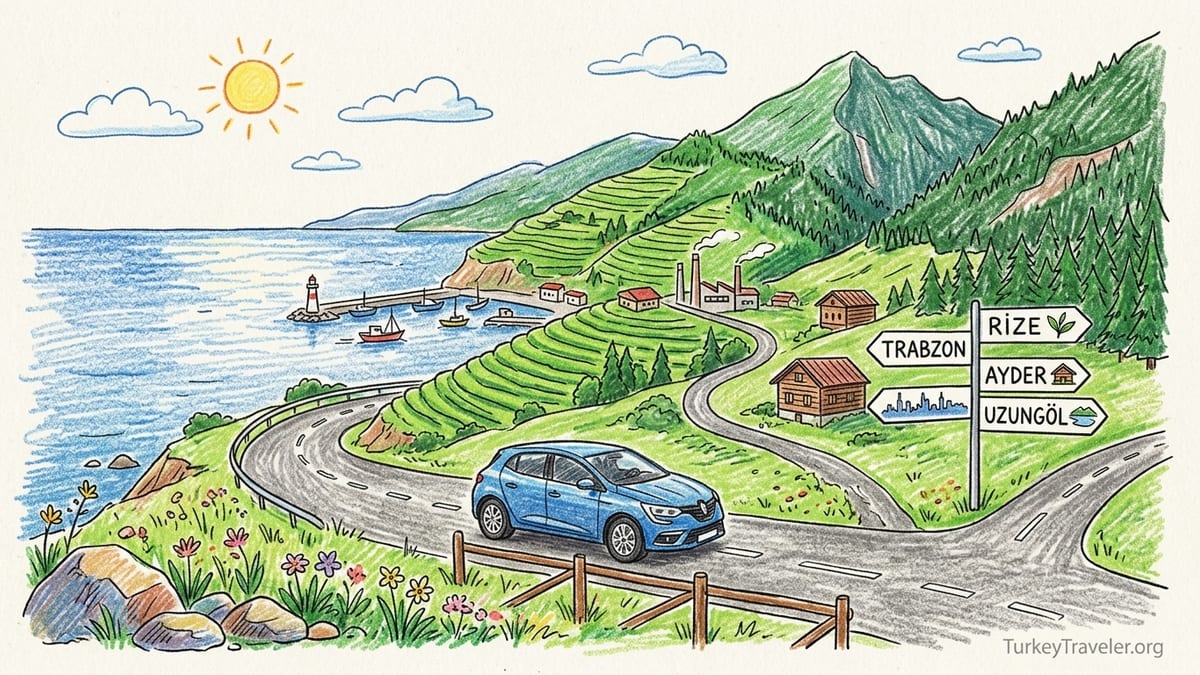
Why the Black Sea Coast Is Perfect for a Self-Drive Trip
The Black Sea coast is one of Turkey’s great driving routes, yet it still sees a fraction of the foreign rental cars that flock to the Aegean and Mediterranean. The main coastal highway, designated D010, threads along cliffs, fishing harbors and hazelnut groves from near Istanbul all the way past Trabzon and Rize toward the Georgian border. GoTürkiye, the national tourism office, highlights this highway as one of the country’s most scenic road journeys, and Turkish rental companies increasingly promote it as a classic week-long drive. In practice, this means a modern, well-maintained asphalt road for most of the way, with frequent service stations and plenty of places to pull off for tea or a simple plate of grilled fish.
What makes the Black Sea particularly rewarding for a self-drive trip is the combination of an easy coastal spine and dramatic mountain detours. In less than two hours’ driving you can leave central Trabzon, pass tea factories near Rize and then climb up twisting valley roads to the cool highlands of Ayder or the alpine lake at Uzungöl. This mix of city, sea and high plateau is difficult to experience comfortably without your own wheels. Public buses do reach most hubs like Trabzon, Rize and Samsun, but they are slower, less flexible and rarely connect directly with the smaller yayla villages and viewpoints that make this region special.
At the same time, travelers should understand that “coastal highway” in the Black Sea does not mean a fast expressway with long straight sections. Much of D010 is only two lanes, often with sharp bends where rivers meet the sea. Between Sinop and Amasra, for instance, the road slices into forests and climbs over headlands, which is part of its charm but also slows average speeds dramatically. Even in the more developed eastern section, trucks, rain and local traffic can easily cut your real-world pace down to 60 kilometers per hour or less. Planning your itinerary with this in mind will keep expectations realistic and days enjoyable rather than exhausting.
Choosing Your Route: Focused Eastern Loop vs Long Coastal Crossing
Most independent travelers considering the Black Sea face a choice: concentrate on the eastern section around Trabzon, Rize, Uzungöl and Ayder, or attempt a long drive that covers a big slice of the coast, adding cities such as Ordu, Samsun, Sinop and possibly as far west as Amasra. Travel blogs and recent route descriptions show both as viable options. A popular pattern is a five to seven day loop centered on Trabzon and Rize, while some road trip planners outline 10 to 14 day routes that eventually link Istanbul to the Georgian border via the coast. The right choice depends on how many days you actually have in Turkey, your tolerance for long days behind the wheel, and the type of scenery you value most.
If you have only a week in total, concentrating on the eastern loop is usually the smarter decision. With flights into Trabzon or Rize–Artvin Airport from Istanbul running several times a day, it makes sense to step off the plane directly into the greenest, most mountainous section of the Black Sea and pick up a rental car there. A realistic one-week plan might look like two nights in Trabzon for Sumela Monastery and the city, one night at Uzungöl, two nights between Rize and Ayder to explore tea terraces and highlands, plus a final night back near the airport. This structure keeps daily drives mostly under three hours while still allowing you to experience both coast and mountains.
The long coastal crossing, on the other hand, makes sense when you have at least 10 to 12 days and a strong wish to see how the Black Sea changes as you move west. In that case, you might start near Istanbul or the Western Black Sea town of Amasra and gradually work your way east via Sinop, Samsun, Ordu, Giresun and Trabzon, possibly ending near Rize or Hopa. This route delivers an impressive variety of port cities, fishing villages and forested headlands, but the trade-off is that every extra town adds hours of driving and frequent one-night stays. Attempting to push from Trabzon all the way to Amasra and then on to Istanbul in the same week will leave little time for walking in tea fields or relaxing in a hot spring.
The One-Week Eastern Itinerary: Trabzon, Uzungöl, Rize and Ayder
For many travelers, a one-week self-drive focused on the Trabzon–Rize section hits the sweet spot between variety and depth. You get the full flavor of the Eastern Black Sea’s mountains and culture without spending every day in the car. A classic structure is to fly into Trabzon, collect a compact rental car at the airport and spend your first two nights in the city. Trabzon offers a mix of modern shopping streets and historic sights such as the restored Hagia Sophia church and the cliff-hugging Sumela Monastery in nearby Altındere Valley National Park. Reaching Sumela involves a one-hour drive on paved mountain roads, then a short walk or shuttle ride from the parking area. In peak summer, parking fills early, so it pays to arrive before mid-morning.
From Trabzon you can drive inland toward Uzungöl, an alpine-style lake surrounded by pine forests and chalet-style hotels. The distance is around 100 kilometers and typically takes around two hours because of valley traffic and occasional roadworks. In high season, day-trippers in minibuses can cause congestion in the final approach to the lake, and parking immediately by the waterfront may be restricted or expensive. Many visitors now choose to stay in a guesthouse or wooden bungalow a few minutes’ walk or drive above the lake, where parking is easier and nights are quieter once the day crowds leave.
Continuing east, the highway leads through Rize, the capital of Turkey’s tea industry. Between Trabzon and Rize you will pass large tea-processing plants and see the “Çaykur” logo on warehouses and factories. A practical stop near Rize is the Ziraat Botanik Çay Bahçesi, a hilltop tea garden where you can park by the entrance for a small fee and sip a glass of strong, dark tea while looking back along the coastline. From Rize, the inland road to Ayder follows the Fırtına Valley toward the highlands. This is a fully paved road, but it is narrow in places and often wet, with frequent trucks, river rafters’ minibuses and tour coaches in summer. Expect the roughly 85 kilometer drive from Rize center to Ayder to take around two hours with photo stops.
Ayder itself sits in a steep-sided valley framed by thick beech and spruce forests, with traditional wooden houses and modern pensions climbing the slopes. Parking is tightly controlled inside the village core, especially in summer and during holiday weekends. In recent years authorities have pushed most parking to designated lots at the entrance to the village, sometimes including shuttle buses into the central area. Drivers should be prepared to park once and explore on foot rather than trying to navigate narrow alleys in their rental car. On the practical side, Ayder offers a good range of small hotels and guesthouses, some with on-site parking and others relying on the public lots. Booking ahead in July and August is wise, especially for weekends when domestic tourism is intense.
The Longer Coast Route: Giresun, Ordu, Samsun, Sinop and Amasra
Travelers who extend their Black Sea drive westward from Trabzon experience a gradual change in landscape and pace. After leaving the tea terraces of Rize behind, you pass Giresun and Ordu, both mid-sized cities where hazelnut production dominates the surrounding countryside. Between these towns the coastal highway often runs very close to the shore, with frequent petrol stations, Turkish-style service areas and small family-run motels. Near Ordu, a popular diversion is to take the cable car from the city center up to Boztepe hill for a panoramic view of the sea, leaving your rental car parked in a paid lot near the cable station.
Continuing to Samsun, the coastline feels broader and more urban. Samsun itself is the largest city on the central Black Sea and a practical overnight stop when covering distance. The seafront features long promenades, public sculptures and large hotels, but the surrounding landscape is less dramatic than in the far east. Many road trip reports treat Samsun as a convenient transit stop rather than a destination, suggesting one night is usually enough unless you have specific reasons to linger, such as visiting museums related to the Turkish War of Independence or meeting local friends.
West of Samsun, the drive to Sinop becomes more scenic again as the road curves around bays and headlands. Sinop sits on a small peninsula projecting into the Black Sea, with an old fortress, a compact harbor and a relaxed waterfront lined with fish restaurants. Parking in the center is competitive in high season, but there are several municipal car parks a short walk from the harbor that charge moderate hourly rates. Many travelers enjoy spending at least one full day here to wander the old streets, take a short boat trip, or simply watch fishing boats come and go while drinking tea at a harbor café.
Between Sinop and Amasra, the character of the road changes again. Rather than a straight coastal boulevard, it often climbs over dense, forested hills and then drops back toward the sea. Older guidebooks and recent trip accounts alike describe this section as one of the most beautiful coastal roads in Turkey, but also one of the slowest. Simple guesthouses and small pensions dotted along the way offer parking in front yards or small gravel lots, and you should expect to average much less than 70 kilometers per hour. Amasra itself rewards the effort: a compact town on a small peninsula with Ottoman houses, two small bays and remains of Genoese fortifications. Parking here is largely in pay-and-display lots as you approach the historic center, and spaces can be scarce on summer weekends when domestic tourists arrive from Ankara and Istanbul.
Road Conditions, Weather and Seasonal Driving Tips
Driving conditions along the Black Sea coast are generally good, with a modern paved highway and regular signage, but the region’s climate and topography add challenges that first-time visitors should factor into their plans. This is Turkey’s wettest region, and rain is common in every season, especially from autumn through spring. On a practical level, this means wet roads, reduced visibility and a greater chance of rockfalls or minor landslides on some of the mountain detours. Rental car companies in Trabzon, Rize and Samsun typically provide modern vehicles with working wipers and good tires, yet it is wise to inspect the tread and brakes when you collect your car and to request a model with modern stability control features if possible.
Mountain roads such as those leading to Ayder, the plateaus above Çamlıhemşin or secondary routes like D915 toward Bayburt can be particularly demanding in poor weather. Even though main highland routes like the Rize–Ayder road are asphalted, they hug the sides of deep valleys and include narrow bridges, tight bends and steep gradients. Fog is common in the mornings and evenings, especially at higher elevations, and in winter snow and ice can make some roads temporarily impassable. Local drivers are accustomed to these conditions, but visitors should be prepared to slow down, use low gears on descents and avoid driving long mountain sections after dark.
On the coast itself, the biggest safety concern is usually driver behavior rather than the road surface. Expect trucks moving slowly uphill, occasional aggressive overtaking and sudden stops near village markets or bus stops. Speed cameras are increasingly common around city entrances and junctions. A realistic and comfortable daily distance on the Black Sea coast is often around 150 to 200 kilometers, less if you plan to add a mountain detour. For example, driving from Trabzon to Rize and then up to Ayder plus photo stops and a lunch break can easily occupy most of a day, even though the total distance looks short on a map.
Seasonally, late spring and early autumn offer a good balance of greenery, moderate temperatures and slightly lighter traffic. In July and August, popular spots like Uzungöl and Ayder fill with domestic tourism, especially families from other parts of Turkey and the Middle East escaping the heat. Car parks overflow, and hotel prices rise accordingly. Winter has a different charm, with snow in the highlands and quieter coastal towns, but you must be comfortable driving in potentially icy conditions and with some sights, such as high plateaus beyond Ayder, not always accessible.
Car Rental, Parking and Overnight Strategy
For a focused eastern route, the simplest strategy is to fly into Trabzon Airport or Rize–Artvin Airport and rent a car on arrival. Both airports are served by multiple daily flights from Istanbul operated by Turkish Airlines and low-cost carriers, and rental agencies range from major international brands to local companies with a handful of vehicles. Prices fluctuate, but as a ballpark figure a compact automatic car might cost somewhere in the region of 35 to 60 euros per day in high season, including basic insurance. Booking ahead gives you a better chance of securing an automatic transmission if you are not comfortable with manual.
Parking habits and costs vary by town. In Trabzon, expect to use multi-story municipal car parks or open pay-and-display lots in the center, often charging by the hour with a daily maximum that is still modest by Western European standards. Many mid-range hotels include basement or courtyard parking, though spaces can be tight. At Uzungöl, you will find a mix of lakeside pay lots and private hotel parking; it is worth confirming with your accommodation whether they guarantee a spot, particularly in peak summer. In Ayder, as mentioned earlier, cars are generally kept in large public lots near the entrance to the village, and some hotels arrange transfers for guests with luggage.
On the longer coastal route, overnight strategy becomes more important. Because the scenery between major towns is often better than the towns themselves, one option is to base yourself for two nights in a few key hubs while allowing time for slower drives on the intervening days. For example, you might sleep in Ordu, then Sinop, then Amasra, spending the days between them exploring smaller coves or viewpoints. In many of these smaller places, guesthouses and family-run pensions will simply direct you to park along the roadside in front of the property. This is common practice and generally safe, though you should avoid leaving valuables visible in the car.
If you are starting from Istanbul and aiming to reach the Black Sea by car, consider whether it is more efficient to drive to a western gateway like Amasra or Sinop and then loop back inland, rather than committing to a multi-day one-way journey all the way to Trabzon. For many visitors, a smarter use of time is to fly to Trabzon, rent a car for a week in the east, then return the vehicle there and fly back to Istanbul, instead of trying to combine a western Black Sea road trip with an eastern highland loop in a single short holiday.
When a One-Week Eastern Loop Beats the Full Coast
With unlimited time, a drive along most of Turkey’s Black Sea coast would be a dream journey. In reality, most travelers have 7 to 10 days and are juggling this region with Istanbul, Cappadocia or the Aegean. In that context, sticking to a compact eastern loop often results in a more satisfying trip. The reason is simple: the density of highlights is greater around Trabzon and Rize. Within a radius of about 150 kilometers you can reach cliff monasteries, lakeside resorts, tea fields, raging mountain rivers and cool forest plateaus. Each of these rewards a half or full day on foot as well as the scenic drive to reach it.
By contrast, the long coastal crossing spreads the points of interest over hundreds of kilometers. There are beautiful sections, like the forested landscape between Sinop and Amasra, but there are also more functional stretches of highway through urban areas and industrial zones. Covering Trabzon to Amasra comfortably takes at least two long driving days, more if you want to stop properly in Ordu, Samsun or Sinop. When you add the return or onward legs, it becomes clear that in a short trip you would be trading away many hours that could have been spent walking to waterfalls above Ayder or sitting in a riverside tea garden in Fırtına Valley.
Another argument in favor of the eastern loop is weather flexibility. Because mountain conditions can change quickly, it is helpful to have multiple days based within easy reach of the highlands. If fog covers the plateaus one morning, you can shift plans and spend that day exploring Rize’s tea gardens or the Trabzon waterfront, then try again the next day when the sky clears. If you are committed to moving along the coast every day to cover the distance between major cities, you lose that flexibility and may miss chances to see highland scenery in its best light.
Finally, focusing on the east simplifies your airport and hotel logistics. Flying in and out of Trabzon or combining Trabzon with Rize–Artvin Airport allows a straightforward loop with a single rental contract, minimal one-way drop fees and a smaller number of hotel changes. That in turn makes the trip feel more like a holiday and less like a continuous relocation. You still gain the satisfaction of a real road trip, driving yourself up winding mountain roads and along stretches of the D010 coast road, but within a manageable area that rewards slower travel.
The Takeaway
A road trip along Turkey’s Black Sea coast can be anything from a compact week-long loop through Trabzon and Rize to a two-week odyssey from near Istanbul all the way to the Georgian border. The essential decision is not whether to drive at all, but how far to try to go in the time you have. For most first-time visitors with around seven days, a focused eastern itinerary built around Trabzon, Uzungöl, Rize and Ayder delivers the richest mix of landscapes and experiences with the least time spent in traffic. It keeps daily drives at human scale and maximizes your chances to actually walk in the forests and sit beside mountain rivers rather than just glimpsing them through the windshield.
If you have the luxury of 10 to 14 days and relish long drives, extending westward via Giresun, Ordu, Samsun and Sinop toward Amasra opens up a satisfying slow journey where the changing coastline is the main attraction. Whichever route you choose, planning around realistic driving times, understanding parking norms and respecting the region’s wet, often misty weather will go a long way toward ensuring that your Black Sea adventure feels like a highlight of Turkey rather than a logistical challenge. Start with a clean windscreen, a full tank and time in your schedule to pull over whenever the road reveals a new headland or hillside tea garden, and the region will do the rest.
FAQ
Q1. Is it realistic to drive the whole Black Sea coast from Istanbul to Trabzon in one week? It is technically possible, but not advisable if you want to enjoy the region. Distances are long, traffic can be heavy near cities, and scenic sections like Sinop to Amasra are slow. With only a week, most travelers are better off flying to Trabzon and focusing on the eastern loop around Uzungöl, Rize and Ayder.
Q2. What type of car is best for a Black Sea road trip? A compact or mid-size car with a modern engine and good brakes is usually enough. You do not need a full 4x4 for main roads and popular highland routes like Ayder, but slightly higher ground clearance and automatic transmission can make steep, narrow streets and frequent stops more comfortable.
Q3. How difficult are the mountain roads around Ayder and Uzungöl for nervous drivers? The roads are fully paved but narrow and winding, with steep sections and occasional tight bends. If you are a nervous driver, plan to drive these stretches in daylight, avoid rushing, use low gears on descents and be prepared to pull over to let faster local vehicles pass when safe.
Q4. When is the best time of year to drive the Black Sea coast? Late May to early July and September to early October usually offer a good combination of green landscapes, relatively stable weather and slightly lighter traffic. July and August can be very busy around Uzungöl and Ayder, while winter brings snow and ice to the highlands, making some routes more challenging.
Q5. Are there enough petrol stations and services along the D010 coastal highway? Yes. Between major cities such as Trabzon, Rize, Ordu, Samsun and Sinop, petrol stations and simple roadside restaurants appear regularly. In more remote highland areas, stations are less frequent, so it is sensible to fill up before climbing into the mountains.
Q6. Is parking safe overnight in smaller Black Sea towns and villages? In most cases, yes. It is common to leave cars parked on the street or in small hotel lots overnight, and serious theft from vehicles is rare in rural areas. Normal precautions still apply: remove valuables from sight, lock the car and follow any advice from your accommodation about where to park.
Q7. Should I book accommodation in advance or find places as I go? In peak summer and during Turkish public holidays, booking ahead for popular spots like Uzungöl, Ayder and Amasra is strongly recommended, as rooms can sell out and prices rise. Outside those peak periods, you can often be more flexible, but it still helps to book at least your first and last nights so you have a clear structure.
Q8. Can I do the eastern Black Sea loop without renting a car? It is possible using a mix of intercity buses, local minibuses and occasional taxis or private transfers, but it is slower and less flexible. Many of the most rewarding viewpoints and highland villages are not served by regular public transport, which is why most visitors who want to explore beyond the main towns choose to rent a car.
Q9. How much should I budget per day for a self-drive Black Sea trip? Costs vary by season and travel style, but a moderate daily budget might include car rental, fuel, mid-range accommodation and meals in simple restaurants. This could work out somewhat lower than equivalent driving holidays in Western Europe, especially if you choose locally run guesthouses and eat in family-owned lokantas rather than upscale hotel restaurants.
Q10. Is it safe to drive in the Black Sea region as a foreign visitor? For most visitors, driving in the Black Sea region is safe as long as you follow local rules, stay alert and allow extra time. Roads are generally in good condition, mobile coverage is widespread along the coast and locals are used to visitors. The main risks come from wet weather, occasional aggressive overtaking and fatigue on long days, so planning conservative distances and taking regular breaks is important.