


Trabzon Airport has quietly become one of the best gateways for exploring Turkey’s lush eastern Black Sea region by road. With big-name rental brands lined up in the terminal and a mix of coastal highways and mountain roads starting almost at the runway, it is an ideal base to pick up a car and head for Uzungöl, Ayder, or the alpine plateaus beyond. This guide focuses on practical decisions travelers face at Trabzon Airport: choosing between compact cars and SUVs, manual and automatic gearboxes, sorting out insurance, and understanding which roads really justify a 4WD.
Why Start Your Black Sea Road Trip at Trabzon Airport
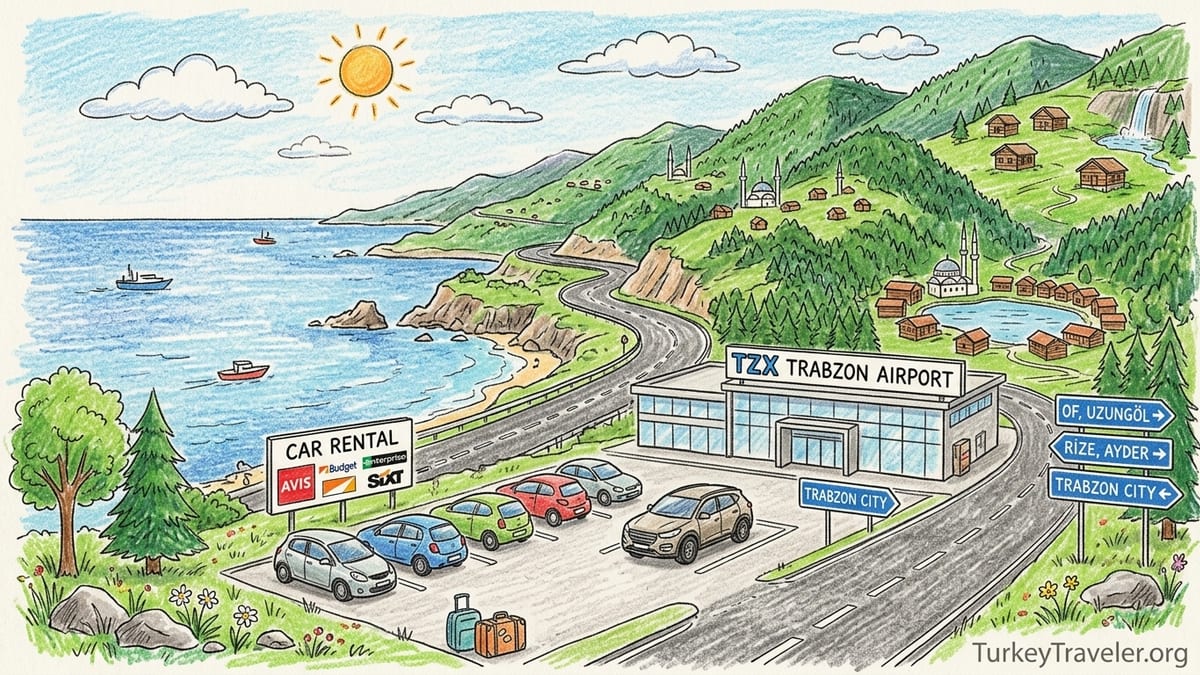
Trabzon Airport (TZX) sits almost directly on the Black Sea coast, a short taxi ride from the city center and right beside the D010 Black Sea Coastal Highway. For road-trippers, this matters: as soon as you exit the airport parking lot you can either turn east toward Rize and Artvin or west toward Giresun and Ordu without navigating a large, stressful city first. For travelers planning to visit Uzungöl, Ayder, or the Fırtına Valley, Trabzon is the most logical air gateway.
The airport has a dense cluster of on-airport rental desks that currently include major international names such as Sixt, Alamo, Avis, Budget, Enterprise, National, Hertz and Europcar, along with several Turkish brands. These companies operate counters in or just next to the arrivals area and maintain parking slots in front of the terminal, so pick-up and drop-off are straightforward compared with some larger hubs where rental facilities are several kilometers away.
Because Trabzon has become a popular summer destination for Gulf and European visitors, as well as Istanbul-based domestic tourists, car rental is a busy business. Around peak months such as July and August, the airport typically offers everything from small hatchbacks to 7-seater vans and crossovers, and comparison sites regularly list dozens of available cars on a given day. At quieter times like early spring or late autumn, choice is still good but you may see fewer specialty vehicles such as full-size SUVs or premium models.
This competition benefits travelers: prices tend to be more moderate than in Turkish hotspots like Antalya or Bodrum, and you can compare like-for-like between different global brands. By understanding local road conditions and typical pricing, you can choose a car that matches your itinerary instead of simply defaulting to the biggest vehicle on offer.
Compact Car, Automatic or SUV: What Really Works Here
For the majority of visitors who plan a classic itinerary of Trabzon city, Uzungöl, Rize, Fırtına Valley and Ayder, a compact car is not only adequate but often the most sensible choice. Recent listings for Trabzon Airport show small or compact models as the cheapest options, with basic manual hatchbacks sometimes starting in the equivalent of the mid-20s to mid-30s US dollars per day outside peak season and climbing higher in summer. These cars are easier to maneuver and park in tight village streets, and they are more forgiving on narrow mountain sections where meeting oncoming traffic is common.
Automatic transmissions are increasingly common in the fleets of Avis, Budget, Enterprise, Sixt and others at Trabzon Airport, though manuals still dominate the very lowest price tiers. Car search aggregators frequently show compact automatics, such as a Hyundai i20, Renault Clio or similar, priced slightly above a manual model but still significantly below a midsize SUV. For many travelers who are unfamiliar with mountain driving, paying extra for an automatic can make climbing to Uzungöl or Ayder less stressful, as you are not constantly working the clutch on steep, winding sections.
SUVs and crossovers are widely available from brands such as Alamo, Hertz, Europcar and Sixt at Trabzon Airport. Typical examples include models in the Dacia Duster or Hyundai Tucson category, with recent price samples on comparison platforms putting them roughly 20 to 30 percent more expensive than the average compact. While that premium may be manageable on a two-day outing, it adds up on a week-long road trip. The real question is whether the extra ground clearance and perceived security justify the cost for your specific route.
For travelers who plan to stick to main asphalt roads to Uzungöl, Ayder and the more popular valleys, the answer is usually no: a regular compact or compact SUV with front-wheel drive is generally fine in summer and early autumn. However, if you are traveling with three or four adults plus luggage, or you know you will seek out rougher side roads toward lesser-known plateaus, paying more for a larger crossover can be worth it for comfort and suspension travel alone, even if you do not strictly need a 4WD system.
Do You Really Need 4WD for Uzungöl and Ayder
Uzungöl and Ayder are the two names that most visitors associate with the Eastern Black Sea’s green landscapes, and they are often the reason travelers assume they need a full 4WD. In reality, the paved approach routes from the coast to both Uzungöl and Ayder are standard two-lane asphalt roads, not off-road tracks, and in dry or mildly wet conditions a regular car is sufficient. The greater challenge is not traction but concentration: the roads are narrow in places, full of bends, and can be busy with minibuses and local traffic.
The usual route from Trabzon to Uzungöl involves following the D010 coastal highway east to the town of Of, then turning inland through Çaykara and up the Solaklı Valley. Travel guides and local rental companies describe this as a winding but well-maintained mountain road, with a typical driving time of around 1.5 to 2 hours from Trabzon depending on traffic. Standard rental compacts and sedans manage this stretch daily in all seasons aside from heavy snow events, which are more common in mid-winter than in the main tourist months.
Ayder is reached by driving from Trabzon along D010 toward Rize, then turning inland near Ardeşen into the Fırtına Valley and climbing up through Çamlıhemşin. Again, the surface is paved, with some narrower sections, tight bends and occasional ongoing roadworks. Local voices often point out that you do not need an SUV for Ayder and Fırtına Valley in normal conditions, as long as you are not attempting to continue onto higher, rougher plateaus from there. Travelers in standard compact rentals frequently report reaching Ayder without any special equipment.
True 4WD becomes more relevant if your plans include remote high plateaus like Huser or other unpaved tracks above Ayder and Çamlıhemşin. Local tourism information for places like Huser Plateau explicitly warns that the final approach road is very steep, rough, and unsuitable for standard cars, recommending either a 4x4 with an experienced driver or local shared minibuses that are built for those conditions. Unless you are specifically targeting such demanding tracks, you can safely book a regular front-wheel-drive car or a basic crossover at Trabzon Airport.
D010 Coastal Highway vs Mountain Roads: What to Expect
The D010 Black Sea Coastal Highway, which passes right by Trabzon and connects to Rize and beyond, is one of Turkey’s major east–west arteries. Much of the section between Trabzon and Rize is a divided multi-lane road that forms part of a European route and is designed to handle heavy bus and truck traffic. For drivers used to European or North American highways, this part of the journey feels familiar: wide lanes, guardrails, tunnels that bypass old cliff roads, and regular service stations for fuel and snacks.
Because it is engineered as a major transport corridor, D010 is generally the least stressful part of any Black Sea road trip. Visibility is good, gradients are modest, and the road is rarely as tight as the inland mountain routes. It is entirely possible to drive a compact car loaded with luggage comfortably along this section, and fuel-efficient small engines are often a benefit given the distances between coastal cities.
The character of the drive changes when you leave D010 and turn inland toward places like Uzungöl, Çaykara, Fırtına Valley or Ayder. These mountain roads are typically narrower, sometimes without full shoulders, and often follow river valleys with frequent bends, short tunnels and occasional rockfall or minor landslides after heavy rain. Passing trucks or buses on tight corners can be intimidating for inexperienced drivers, especially when roadworks reduce the usable width.
Despite this, these routes remain fully paved and are used by local passenger cars, taxis and minibuses every day. The main challenge is pacing yourself: allow generous time, keep speeds modest, and plan for pauses at viewpoints or small tea houses rather than trying to keep up with local drivers. A compact, easy-to-place car can feel more reassuring on these roads than a bulky SUV, which may leave you more anxious about clearance when squeezing past oncoming vehicles.
Insurance, Deposits and Fuel Policies at Trabzon Airport
Rental desks for brands like Avis, Budget, Enterprise, National, Hertz, Sixt and Europcar at Trabzon Airport usually present three main insurance concepts: the standard package that includes collision damage waiver and third-party liability with an excess, an optional reduced-excess or “medium” coverage, and a full or “super” insurance that sharply lowers or eliminates the amount you would pay in case of damage. The exact naming and details differ between brands and brokers, but the structure is broadly similar.
Standard packages at Trabzon Airport often come with an excess that can run into several hundred or even over a thousand US dollars equivalent, depending on the vehicle class. This is the amount the company can charge you if the car returns with damage not covered by exclusions. Because mountain driving increases exposure to minor scrapes, gravel chips or bumper damage, many travelers opt for a higher coverage tier sold at the desk or via the booking site, especially when renting higher-value SUVs.
Full insurance packages with minimal excess can noticeably raise the daily price but give peace of mind to drivers who want to treat the car as a sunk cost and avoid stress about every stone chip. A common pattern is a compact car that might cost relatively little per day on a basic package but increases by 30 to 50 percent when full coverage from the rental firm or broker is added. As a middle ground, some travelers prefer relying on a credit card’s collision coverage and taking only the legally required local insurance, though this often involves leaving a larger security deposit on the card and handling any claims directly with the card issuer.
Fuel and mileage policies are usually straightforward at Trabzon Airport’s international brands: most contracts are full-to-full, meaning you collect the car with a full tank and return it full, and mileage is typically unlimited for standard tourist rentals. Security deposits can be higher for larger SUVs and premium vehicles, so compact and mid-size categories are sometimes preferable if you want to limit how much of your credit limit is held during the trip.
One-Way Rentals and Regional Itineraries
Many visitors use Trabzon as both the starting and ending point for a loop through the eastern Black Sea before flying out again, but increasingly travelers consider one-way rentals that end in another city. International brands such as Avis, Budget, Enterprise, Sixt and Europcar usually support domestic one-way rentals between major Turkish airports and city branches, though availability and fees vary. When you price a car online, be sure to toggle the “return to different location” option early to see if the one-way fee makes sense for your budget.
One common pattern is to pick up a car at Trabzon Airport, drive east along D010 with detours inland to Uzungöl and Ayder, then continue to Rize or Artvin and finally drop the car in a larger city like Erzurum or even back west along the coast. Some companies charge a flat one-way fee for such routes, while others build it into the daily rate, so a deal that looks only slightly more expensive per day might in fact include a significant relocation cost.
The flip side of one-way rentals is that they sometimes restrict your choice of car category. At busy times, compact cars may be authorized for one-way drops while specific SUV models are restricted or come with higher fees because relocating them is more costly for the company. If your heart is set on a particular category like a compact automatic for hairpin-filled mountain roads, it is worth checking multiple brands at Trabzon Airport to see who offers the most flexible one-way terms.
For many itineraries, however, returning the car to Trabzon Airport remains practical. The airport is small enough that drop-off is quick, and the concentration of competing rental brands means you can shop around for a deal without being locked into a single company’s one-way policy. If your flights in and out are from Trabzon, a round-trip rental will almost always be the simplest and most economical option.
Driving Conditions, Seasons and Safety Tips
Season has a strong influence on how you perceive the roads around Trabzon, Uzungöl and Ayder. In late spring, summer and early autumn, rain showers are common but snow is generally absent from the main tourist routes, and visibility is good. This is when most visitors pick up compact cars at Trabzon Airport and head for the mountains with little more than normal highway caution. The biggest hazards are wet bends, occasional fog in the higher valleys, and fast-moving local traffic that is used to the roads.
In winter, conditions can change rapidly, especially on routes that climb above 1,000 meters. Snow and ice are more likely, and some higher minor roads may be temporarily closed or require chains. Rental companies at Trabzon Airport often supply winter tires as standard during the coldest months, but it is still wise to ask specifically at the counter whether your car is equipped and whether there are any restrictions on taking it to certain high plateaus during severe weather.
Regardless of season, a few habits improve safety on Black Sea mountain roads. Plan shorter daily driving distances than you might in flatter regions, allowing time for tea breaks and photo stops rather than pushing to cover too many valleys in one day. Use engine braking on descents, particularly in a manual car, to avoid overheating the brakes. In an automatic, familiarize yourself with manual or low-gear modes for long downhill stretches.
Parking requires some attention as well. In Uzungöl, spaces along the lakeside fill quickly at midday in high season, and you may end up parking on sloped side streets. An automatic car can reduce the stress of hill starts in such spots. In Ayder, hotel and bungalow properties often have small, uneven parking areas; here again, compact cars are easier to thread into tight spaces than wide SUVs, even if the latter feel more imposing on the highway.
The Takeaway
Trabzon Airport is an excellent starting point for a self-drive exploration of Turkey’s eastern Black Sea coast and nearby mountains. With a full roster of international rental brands on site and direct access to the D010 coastal highway, travelers can land, pick up a car and be en route to Uzungöl or Ayder within an hour. The key to a smooth trip lies in matching your car choice and insurance level to the reality of the roads you will actually drive, rather than to an exaggerated idea of off-road conditions.
For standard sightseeing that covers Trabzon, Uzungöl, Fırtına Valley and Ayder in late spring through early autumn, a compact or compact automatic car from a company like Avis, Budget, Enterprise, Sixt, Hertz, Alamo, National or Europcar is usually more than enough. A true 4WD becomes relevant only if you venture onto rough, high-altitude plateaus beyond the main villages or if you travel in mid-winter and anticipate snow on secondary roads. Full insurance and reasonable driving habits will do more for your peace of mind than upgrading to the largest possible SUV.
By understanding the difference between the forgiving D010 coastal highway and the narrower but still paved mountain roads, you can set realistic expectations, stay within budget, and focus on the region’s strengths: forested valleys, cool mountain air, and the flexibility to stop wherever the scenery tempts you. Trabzon Airport’s competitive rental market means you have genuine choice; use it to build a Black Sea road trip that suits your comfort level behind the wheel as well as your appetite for adventure.
FAQ
Q1. Is a compact car really enough for driving from Trabzon Airport to Uzungöl and Ayder?
A compact car is generally enough for the main paved routes to Uzungöl and Ayder in normal weather, especially from late spring to early autumn, as the roads are asphalt and used daily by standard passenger cars.
Q2. Do I need a 4WD or SUV for high plateaus like Huser near Ayder?
For demanding high plateaus such as Huser, a true 4WD and experienced driving are strongly recommended, and many visitors instead use local minibuses designed for those steep, rough tracks.
Q3. How much more expensive are SUVs compared with compact cars at Trabzon Airport?
Recent price samples at Trabzon Airport suggest SUVs can cost roughly 20 to 30 percent more per day than compact cars, with the gap widening in peak summer months.
Q4. Are automatics widely available from brands like Avis, Budget or Sixt at Trabzon Airport?
Yes, automatic cars are widely available across major international brands at Trabzon Airport, particularly in compact and compact SUV categories, though the very cheapest offers are often manual.
Q5. Is the D010 coastal highway between Trabzon and Rize difficult to drive?
The D010 coastal highway is a modern, multi-lane route along the Black Sea, generally easier to drive than mountain roads, with gentle gradients and good surfaces, although traffic can be brisk.
Q6. What kind of insurance should I choose for a Black Sea road trip from Trabzon?
Most travelers choose at least standard coverage with collision damage waiver and consider adding reduced-excess or full coverage, as mountain driving can increase the risk of minor damage.
Q7. Can I arrange a one-way rental from Trabzon Airport to another Turkish city?
International brands at Trabzon Airport often allow domestic one-way rentals to other major cities, but availability, fees and eligible car categories vary, so it is important to check terms before booking.
Q8. Are winter driving conditions around Trabzon and Uzungöl challenging?
In winter, snow and ice can make mountain routes more demanding, and while main roads are usually kept open, travelers should expect slower progress and confirm winter equipment with the rental company.
Q9. Is parking difficult in Uzungöl and Ayder with a rental car?
Parking can be tight at midday in high season, especially near Uzungöl’s lakeside and around Ayder’s hotels, so smaller cars are often easier to maneuver and park than large SUVs.
Q10. Which rental brands are currently present at Trabzon Airport itself?
Trabzon Airport hosts a range of on-airport brands including Sixt, Alamo, Avis, Budget, Enterprise, National, Hertz and Europcar, alongside several local companies, giving travelers a broad choice of vehicles.