


The Black Sea coast of Turkey feels like a different country compared with Istanbul, Cappadocia or the Aegean. Here dense forests drop straight to pebbly coves, tea terraces climb into cloud, fishing harbors still set the daily rhythm, and summers stay cool enough that Istanbulites come here to escape the heat. For first-time visitors it can be confusing to understand how the western, central and eastern stretches differ, and how to build a realistic itinerary around headline names like Trabzon, Sümela, Uzungöl, Rize, Çamlıhemşin, Ayder and the Kaçkar Mountains. This guide lays out the region, then walks through concrete trip plans, transport options, weather patterns and the food and landscapes you can expect on the ground.
Understanding Western, Central and Eastern Black Sea
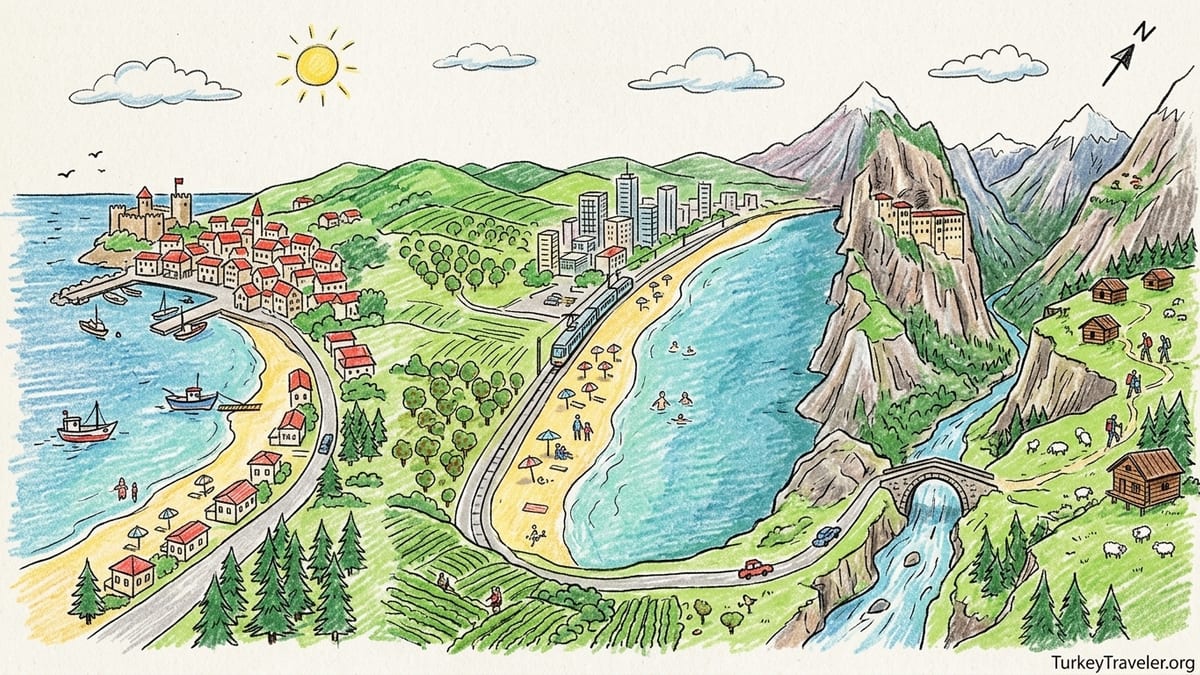
On a map, the Turkish Black Sea is one long arc, but for travelers it breaks naturally into three zones. The western Black Sea, from roughly the Bosphorus region toward Amasra and Sinop, is closest to Istanbul and mixes small resort towns with forested headlands and historic ports. The central section, around Samsun and Ordu, is flatter and more agricultural, with long city beaches and hazelnut groves behind them. The eastern Black Sea, from Giresun through Trabzon, Rize and Artvin to the Georgian border, is the most dramatic: mountains rise almost straight from the sea and narrow valleys lead quickly into alpine highlands.
The climate shifts as you move east. Overall the Black Sea coast is humid and temperate, but rainfall increases significantly toward Rize and Artvin while summers stay relatively mild. Around Samsun, average summer highs hover in the upper 20s Celsius, warm but comfortable; further east in Trabzon and Rize you can expect similarly warm but damper conditions, with frequent showers even in July and August. Inland highlands such as Ayder and the Kaçkar passes are much cooler, which is part of their appeal in mid-summer but makes them less practical in late autumn and winter when snow and road closures are common.
The feeling of the towns changes too. Western hubs like Amasra and Sinop have a lived-in, small-town seaside charm, with promenades, pensions and simple fish restaurants built for weekenders from Ankara and Istanbul. Central cities like Samsun and Ordu function as regional capitals, with modern shopping streets, tram lines and long, urban beaches such as Atakum in Samsun or the waterfront in Ordu. In the east, Trabzon and Rize are compact, busy and more conservative, with ports, bazaars and tea warehouses pressed between the sea and steep hillsides. For many first-timers, the sweetest spot is to pass quickly through the industrial sprawl and focus time on the western coves and the eastern mountain valleys.
For planning purposes, imagine driving the D010 coastal highway, the main Black Sea road, in sections. From Amasra to Sinop the road is slower and more scenic, winding above undeveloped coves and small villages. From Sinop through Samsun and Ordu it straightens into a faster, modern highway with long urban stretches. East of Giresun the scenery ramps up again as the road squeezes under cliffs and past rivers running down from the Kaçkar Mountains. This west-to-east rhythm is what shapes most overland itineraries.
Key Gateways, Airports and Getting Around
Most international visitors reach the Black Sea via Istanbul, then continue by plane or long-distance bus. The main coastal airports are Samsun Çarşamba, Ordu–Giresun, Trabzon, and Rize–Artvin. Samsun and Trabzon handle the highest traffic, with frequent domestic flights from Istanbul and Ankara and a rotating mix of seasonal international routes. From Istanbul Airport it is common to find multiple daily flights to Trabzon; in high season these can be under 2 hours and, if booked early, often cost roughly what a mid-range Istanbul hotel charges for one night.
Flying into one airport and out of another makes a linear trip along the coast much more efficient. A typical pattern is to fly into Samsun or Ordu–Giresun, rent a car, then drive east along the coast road to Trabzon and Rize–Artvin before flying back to Istanbul. For those who prefer public transport, long-distance buses connect all the main cities, but reaching highland areas like Uzungöl, Çamlıhemşin and Ayder usually requires at least one change to a minibus or dolmuş. Travelers often find that at least a few days of car rental in the eastern section dramatically expand what they can see.
Self-driving on the Black Sea is generally straightforward on the main D010 highway, which is modern and well maintained from Samsun eastward. Where it becomes more challenging is on narrow, winding side roads climbing into the valleys. The road from Trabzon up to Sümela Monastery involves sharp bends and, in bad weather, low visibility. The access roads from Çamlıhemşin up to Ayder or further to small highland plateaus like Pokut and Huser are even steeper and can be rough or muddy after rain. First-time visitors comfortable with mountain driving will find these routes rewarding, but others may prefer hiring a local driver in Çamlıhemşin or joining a small group day tour from Trabzon or Rize.
If you plan to rely on buses, build in extra time and flexibility. For example, to reach Uzungöl without a car, many travelers first take a bus to Of on the coast, then transfer to a minibus up the valley. Similarly, reaching Çamlıhemşin and Ayder typically means first traveling to Rize, then using local minibuses into the Fırtına Valley. Schedules can be informal and may vary off-season, so it is wise to confirm times at bus offices a day in advance and to avoid very tight same-day connections with flights.
Western Black Sea Highlights: Amasra, Sinop and Quiet Beaches
The western Black Sea is where Istanbul residents often go when they want a cool, green escape within a day’s journey. Amasra, on a small peninsula west of Sinop, combines a compact Genoese-era old quarter, sea views from low cliffs and easy access to undeveloped beaches. Just east of town the coastal road runs past coves and long sandy stretches like Bozköy and Çakraz, where dense forest begins almost immediately behind the sand. In summer you can expect a mix of small family-run pensions and simple seafood restaurants set above the shore, far less built up than Mediterranean resorts.
Further east, Sinop sits on a natural peninsula that has been a port for millennia. The town’s harborfront is lined with cafes and fish restaurants, while the old city walls, a former prison and a small museum give enough interest for a full day. Sinop’s surrounding beaches such as Ayancık and Gerze are popular with Turkish holidaymakers but remain low-rise and relatively quiet, with a few beachside tea gardens, umbrellas and simple guesthouses. Here the sea can be surprisingly clear on calm days, though currents and waves can be strong when storms roll in, so lifeguard flags and local advice matter more than on sheltered Mediterranean coasts.
Compared to the east, western Black Sea weather is a little less rainy, but showers are still common outside the main summer months. Water temperatures lag behind the air; by August locals and visitors swim comfortably, but in June it can still feel cool. Many travelers combine Amasra and Sinop with Safranbolu, a UNESCO-listed Ottoman town inland, making a compact 4 to 5 day loop by rental car from Istanbul or Ankara. This western stretch offers a gentle introduction to the Black Sea’s mix of forest, fishing and low-key beaches before you tackle the more rugged east.
From a practical perspective, Amasra and Sinop work best with a car. While intercity buses connect nearby hubs, the most beautiful viewpoints and undeveloped coves sit between stops. A realistic pattern is to base for two nights in Amasra, day-trip to nearby beaches, then drive half a day along the winding coast to Sinop, stopping spontaneously at village markets, roadside gözleme stalls and scenic pullouts that would be difficult to reach by bus.
Eastern Focus: Trabzon, Sümela and Uzungöl
Trabzon is the natural base for exploring the eastern Black Sea. The city has a busy port, a compact old town centered on Meydan Park, and a spread of modern neighborhoods up the surrounding slopes. For visitors, its main draws are access to the mountains and the chance to experience a working Black Sea city rather than a purpose-built resort. Domestic chain hotels cluster around the center, while small family-run pansiyons line streets above the harbor, giving options from budget to comfortable mid-range.
Sümela Monastery, carved dramatically into a sheer cliff face above the Altındere Valley, is the single most famous sight in the region. After a long period of restoration, it is fully open to visitors, with timed hours that adjust seasonally. From central Trabzon it is roughly a 45 to 60 minute drive inland, first on a highway then on a narrower mountain road. Many travelers take a half-day or full-day tour that combines Sümela with short walks in Altındere National Park and lunch at a riverside restaurant serving grilled trout and kuymak, the rich local cornmeal and cheese dish.
Uzungöl, a lake hemmed in by steep forested slopes, lies southeast of Trabzon and has become one of the most photographed spots in the eastern Black Sea. The road up from the coastal town of Of follows a river valley dotted with small villages and tea fields. Around the lake itself, development has grown quickly, with hotels, souvenir shops and restaurants lining the shore. It is still a beautiful setting, especially if you walk a little way up the trails behind the lake for a wider view, but visitors seeking solitude will want to stay in smaller pensions above the main strip or treat Uzungöl as a short stop en route to quieter valleys.
For a first visit, a minimum of three nights in Trabzon allows a balanced mix: one full day for Sümela and the Altındere Valley, one for Uzungöl, and one for exploring Trabzon’s own sights such as the restored Hagia Sophia church, the city walls and the hilltop Boztepe viewpoint. With four or five nights you can add a free day for unscripted wandering, coffee in neighborhood cafes, or a boat ride from nearby harbors. Planning in this way respects the reality that mountain drives are slower than they look on a map and that frequent rain showers can easily delay a rigid schedule.
Rize, Çamlıhemşin, Ayder and the Kaçkar Highlands
East of Trabzon, the scenery tightens as the coast road threads between the sea and steep hillsides planted in tea. Rize, the symbolic capital of Turkish tea, works as a practical stop or base for exploring the nearby valleys. The city itself is functional rather than pretty, with a port, tea factories and a compact center, but the hinterland is what draws visitors. Within an hour or two’s drive you can be walking among tea terraces, crossing stone Ottoman bridges over rushing rivers and climbing into alpine meadows dotted with wooden chalets.
Çamlıhemşin and the Fırtına Valley are the main gateways to some of the most striking highlands in Turkey. From Rize you follow the Fırtına River inland past rafting outfits, roadside tea gardens and small guesthouses. Çamlıhemşin town is small, essentially a cluster of services and pensions, but from here roads and tracks branch toward sights like Zilkale, a castle perched on a rocky outcrop above the forest, and toward upland plateaus such as Pokut, Huser, Gito and Elevit. Many of these are accessible only on rough roads, often best tackled in a high-clearance vehicle or by hiring local drivers who know current conditions.
Ayder, a developed plateau at around 1300 meters, sits at the head of a valley inland from Çamlıhemşin and is the easiest highland stop for first-timers. The settlement is a strip of wooden hotels, guesthouses, honey shops and restaurants along a rushing river, with forested slopes rising sharply on either side. In July and August it can be very busy, particularly on weekends and public holidays, with Turkish families escaping the heat of the interior. Outside peak times, though, you can still find quiet trails, simple picnic spots and guesthouses with balconies looking out over mist rolling in and out of the trees.
The Kaçkar Mountains themselves, rising to almost 4000 meters, appeal to hikers and trekkers willing to invest more time. From bases such as Ayder or the Yaylalar area on the eastern side, multi-day routes connect high passes, glacial lakes and remote plateaus. Conditions are very weather dependent and snow lingers on high passes into early summer, so most first-time visitors with limited days focus on day hikes from places like Ayder and Pokut. In practical terms, spending two nights in Rize city or along the coast, then two or three nights split between Çamlıhemşin and Ayder, gives a realistic taste of the valleys and highlands without committing to full-on trekking logistics.
Weather, Best Seasons, Beaches and Coastal Villages
The Black Sea’s climate is one of its defining characteristics. Compared with the Mediterranean, summers are cooler and more humid, winters milder but wetter. The wettest conditions are typically found in the eastern section around Rize and the foothills of the Kaçkar Mountains, where annual rainfall can be several times that of central Anatolia. Coastal cities such as Samsun, Ordu, Trabzon and Rize generally see average January temperatures in the mid single digits Celsius, rising to low 20s in August. Inland highlands are significantly cooler, with snow common in winter and often lingering on shaded slopes well into spring.
For most travelers, the sweet spot is from late May through September. In June you will find the hills vividly green, rivers full and wildflowers in the highlands, though the sea may still feel cool for long swims. July and August bring the warmest sea temperatures and the most reliable access to high passes, but also the largest crowds in places like Uzungöl and Ayder, particularly from domestic tourists and visitors from the Gulf states. September is often an excellent compromise, with warm sea water, slightly quieter roads and, in many years, more stable weather for hiking than the thundery peaks of midsummer.
Beach culture on the Black Sea is very different from the Aegean or Mediterranean. The coastline mixes pebbly coves and darker-sand beaches with rocky headlands; the water can shift quickly from mirror calm to heavy surf when weather fronts move in. Official lifeguarded city beaches such as Atakum in Samsun, urban stretches in Ordu, and designated swimming areas near Trabzon and Rize are where most locals choose to swim, backed by changing cabins, showers and small kiosks selling tea and grilled corn. Beyond the cities, undeveloped stretches abound, from the coves east of Amasra to long, relatively wild sands between Sinop and Samsun or between smaller towns in Ordu and Giresun provinces.
GoTürkiye and regional tourism boards highlight these undeveloped beaches and traditional coastal villages as key Black Sea experiences. Concrete examples include spending a slow afternoon on a largely empty beach east of Amasra, with forest reaching almost to the tide line, or stopping at a fishing harbor between Ordu and Giresun where small boats land anchovies and bonito in season. Many travelers combine a day of beach-hopping along the coast road with an overnight in a small family-run pension that serves fresh fish, local corn bread and salads made with garden greens. The appeal lies less in sun-lounger infrastructure and more in the feeling of being on a working, lived-in coast.
Food, Culture and Everyday Costs
The Black Sea has a distinct culinary identity within Turkey. Along the coast, fish is central. In autumn and winter, anchovies (hamsi) dominate menus, served fried, baked with rice or cooked into a cornmeal pie. Year-round, simple grilled fish such as sea bream or trout appears on most restaurant menus, typically accompanied by green salads, pickles and local corn bread. In mountain areas like Çamlıhemşin and Ayder, you will often find trout restaurants built directly over rivers, where fish are kept in holding pools and cooked to order.
Maize and dairy are other pillars of local food culture. Dishes like mıhlama or kuymak, a rich, stretchy mix of cornmeal, local cheese and butter, are standard at village breakfast tables and in many small eateries. In inland towns and rural areas, thick yogurt, village cheeses and honey made from highland flowers are common; Ayder and the wider Kaçkar region are especially known for their honey, which you will see for sale in jars along the roadside. In Sinop and parts of the central coast, a regional style of mantı, small dumplings often served in a looser, creamier sauce, is a favorite, while towns like Bafra are known for sweets such as special ice creams and pastries.
Culturally, the region is a mix of conservative coastal cities and more easygoing rural valleys. Tea is the social fuel; in towns you will see men gathered in tea gardens playing backgammon, while in villages it is common to be invited for a glass just by stopping to ask directions. Music and dance traditions are strong, particularly the horon, a fast-paced circle dance often accompanied by the shrill sound of the kemençe, a local fiddle. Travelers who time their visits for summer village festivals or plateau gatherings may stumble onto performances and communal meals, though schedules are often set locally and may not be widely advertised.
In terms of everyday costs, the Black Sea is generally a little cheaper than Istanbul and major coastal resorts, though prices fluctuate with exchange rates and inflation. Simple fish restaurants along the coast frequently offer set plates with salad and tea for less than what a comparable meal would cost in central Istanbul, while village pensions in places like Çamlıhemşin and Ayder often include breakfast in the room rate. Renting a car will be one of your higher fixed costs, but splitting a compact car between two or three travelers can be comparable to taking multiple private transfers, especially when you factor in the flexibility to reach remote highlands and beaches.
Practical Itineraries and Realistic Trip Structure
For first-time visitors with 7 to 10 days, combining the eastern Black Sea with a taste of the west or center is realistic without feeling rushed. One common pattern is to fly from Istanbul to Samsun, spend a night walking the Atakum seafront and visiting the city’s independence memorials, then drive or bus east via Ordu and Giresun to Trabzon. You might break the journey with a night in Ordu, taking the cable car up Boztepe hill for views of the coast, before continuing to Trabzon for 3 or 4 nights focused on Sümela, Uzungöl and the city itself.
From Trabzon, continue along the scenic coast road into Rize province. Spending 2 or 3 nights divided between Rize or a nearby coastal town and Çamlıhemşin or Ayder gives you time for the Fırtına Valley, Zilkale and one or two highland plateaus, choosing according to your comfort with rough roads and hiking. You can then fly out of Rize–Artvin Airport, dramatically set on land reclaimed from the sea, back to Istanbul or onward to another Turkish destination. This kind of linear route makes the most of limited days while allowing flexibility if weather closes in on the mountains for a day or two.
Travelers with closer to two weeks can add the western section. A possible structure is to start in Istanbul, travel by bus or car to Safranbolu and Amasra for 3 nights, continue along the coast to Sinop for 2 nights, then connect via Samsun and Ordu to Trabzon for 3 or 4 nights, and finish with 3 or 4 nights in Rize, Çamlıhemşin and Ayder. Along the way you can stop in smaller places like Giresun, where a short boat trip to Giresun Island and an evening walk up to the hilltop castle provide low-key diversions, or in Artvin, where deep valleys and reservoirs cut between forested slopes near the Georgian border.
Even on longer trips, it is wise to structure your days with the Black Sea’s fickle weather in mind. Schedule more weather-dependent activities like long hikes, high passes or boat trips early in your stay in each region, keeping museum visits, city walks and short valley drives as backup for rainy days. Build in buffer time for delays on mountain roads, especially after heavy rain, when minor landslides or rockfalls can temporarily close sections while they are cleared. Being realistic about distances is key: a drive that looks like 100 kilometers on a map may still take several hours once you factor in slow mountain curves, roadworks and unplanned photo stops.
FAQ
Q1. When is the best time of year to visit Turkey’s Black Sea coast?
Late May to September is generally the most comfortable window, with June and September offering a good balance of greenery, open highland routes and fewer crowds. July and August are warmest and best for swimming but also the busiest in popular spots like Uzungöl and Ayder, while outside this window rain and cloud increase and higher trails may be blocked by snow.
Q2. Is it necessary to rent a car, or can I rely on public transport?
It is possible to travel the main coastal cities using long-distance buses and local minibuses, but reaching valleys and highlands such as Uzungöl, Çamlıhemşin and Pokut is far easier with a car or by hiring local drivers. For first-time visitors, a hybrid approach often works best: use flights and buses between major hubs, then rent a car for a few days in the eastern section around Trabzon and Rize.
Q3. How many days do I need for a first trip focused on Trabzon and the eastern Black Sea?
A compact but satisfying trip can be done in about 6 to 7 days: 3 or 4 nights in Trabzon for Sümela, Uzungöl and the city, plus 2 or 3 nights split between Rize, Çamlıhemşin and Ayder. With 10 days or more you can add western highlights like Amasra and Sinop or spend extra time in the Kaçkar highlands.
Q4. Are the Black Sea beaches good for swimming?
Yes, but conditions are more variable than on the Mediterranean. In calm summer weather, city beaches such as Atakum in Samsun or smaller coves near Amasra and Sinop can offer pleasant swimming, though the water is cooler. When storms or strong winds blow in, waves and currents increase quickly, so it is important to follow lifeguard flags and local advice, and to avoid swimming alone on remote, unsupervised stretches.
Q5. What should I pack for a trip that includes both coast and highlands?
Plan for layers. Even in midsummer, evenings in highland areas like Ayder and Pokut can feel chilly, especially when clouds roll in, while the coast remains warm and humid. A lightweight waterproof jacket, quick-drying trousers, a fleece or sweater, sturdy walking shoes and a small umbrella are practical additions alongside standard warm-weather clothing and swimwear.
Q6. Is Sümela Monastery fully open, and how long do I need to visit?
After several years of restoration and safety work, Sümela Monastery is open to visitors with defined seasonal opening hours. From Trabzon, allow a half day for the round-trip drive, walking from the parking area and exploring the complex itself. Many organized tours combine Sümela with brief walks or a meal in Altındere Valley, turning it into a relaxed full-day excursion.
Q7. Can I visit Uzungöl, Çamlıhemşin and Ayder in one or two days?
In strict logistical terms it is possible to see all three quickly, especially with a car, but it will feel rushed and weather-dependent. A more enjoyable approach is to dedicate at least one full day to Uzungöl from Trabzon, and another 2 or 3 days for the Fırtına Valley, Çamlıhemşin and Ayder, giving time for short walks, tea stops and side trips to castles or highland plateaus.
Q8. How safe is driving on the coastal and mountain roads?
The main coastal highway is modern and generally safe, though you should expect trucks, tunnels and variable weather. Mountain roads to places like Sümela, Ayder and the smaller highland plateaus are narrow, steep and can be slippery after rain. Experienced drivers who take their time and avoid night driving usually manage well, but nervous drivers may prefer guided tours or local drivers for the most challenging sections.
Q9. What kind of accommodation will I find in the Black Sea region?
Accommodation ranges from business-style city hotels in hubs like Samsun, Trabzon and Rize to simple family-run pensions and wooden guesthouses in villages and highlands. In places like Uzungöl and Ayder there are also chalet-style hotels and small apartment rentals. Standards vary, so reading recent guest feedback and confirming essentials such as heating, parking and breakfast is advisable, especially outside peak season.
Q10. Are English and card payments widely accepted?
In larger cities and at airports, some staff in hotels, car rental offices and better-known restaurants speak English, and card payments are common. In smaller towns, villages and mountain areas, English is less widely spoken and it is safer to carry cash in Turkish lira for small eateries, pensions and local drivers. Having key details like your accommodation address written in Turkish and using translation apps can smooth many everyday interactions.