


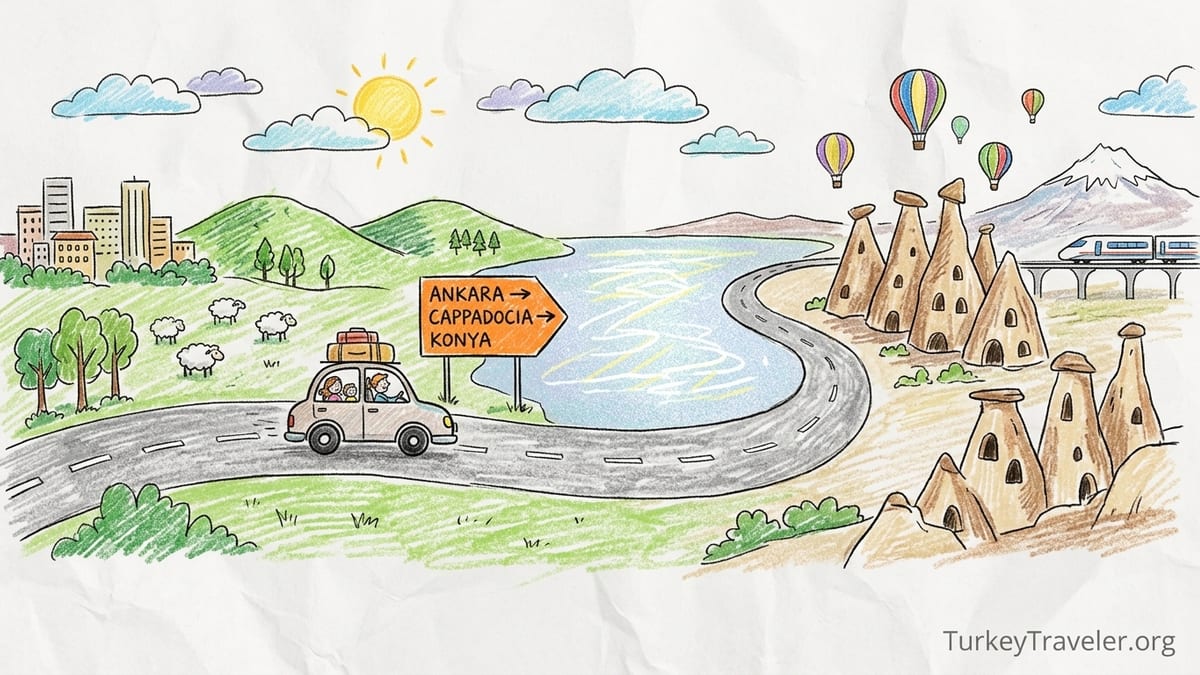
Central Anatolia is one of Turkey’s most rewarding regions for an open-road adventure, where salt flats, volcanic landscapes, Seljuk caravanserais and lively university cities sit only a few hours apart. Using Ankara as your launchpad, you can link Tuz Gölü, Cappadocia, Kayseri, Mount Erciyes and Konya into a coherent loop, add Eskişehir as a western flourish, or focus on a compact Cappadocia-centered circuit that trades long highway days for slow, immersive travel.
Understanding Central Anatolia as a Road Trip Region
Official GoTürkiye material already frames Ankara as the natural gateway into Cappadocia, Konya, Kayseri and the wider Anatolian heritage routes, and it makes practical sense. Ankara Esenboğa Airport is well served by domestic and international flights, and rental depots in the city and at the airport carry familiar brands like Avis, Enterprise and Garenta. From here, most key sights in Central Anatolia sit within a 2 to 4 hour drive on good-quality highways, which means you can design manageable travel days even if you are new to driving in Turkey.
Distances are moderate but the landscapes change quickly. In a single day you might leave Ankara’s government quarter, pass wind farms and wheat fields on the way to the shimmering salt crust of Tuz Gölü, then continue to the rock cones of Cappadocia in time for dinner in Göreme. Another day might take you from cave churches and hot air balloons to the commercial bustle of Kayseri, and on to the ski lifts of Mount Erciyes. The region is also well integrated by high-speed rail, so you can mix self-drive stages with fast, predictable journeys on YHT services between Ankara, Eskişehir and Konya when it makes more sense to leave the car behind.
Road conditions in Central Anatolia are generally good, with divided highways on most intercity stretches, clear signage and plenty of fuel stations that also sell snacks, SIM cards and basic car supplies. Winter brings additional considerations around Erciyes and some higher plateaus, but in most seasons the bigger challenge is not the road itself but pacing your days so you are not rushing from one headline sight to the next. Building in two or three-night stays, especially in Cappadocia, will make the route far more enjoyable.
The Core Route: Ankara → Tuz Gölü → Cappadocia → Kayseri / Erciyes → Konya
A practical backbone for a Central Anatolia journey starts in Ankara, then swings southeast to Tuz Gölü before dropping into Cappadocia, curving around to Kayseri and Mount Erciyes, then finishing in Konya. In total, you are looking at roughly 900 to 1,000 kilometers depending on detours, best tackled over at least 7 to 10 days so you have real time on the ground.
From central Ankara to Tuz Gölü’s popular Şereflikoçhisar access point is roughly 150 to 180 kilometers. Recent local coverage notes that the drive usually takes around 1.5 to 2 hours by private car on well-maintained highways, making it an easy half-day excursion. Many travelers stop for an hour or two to walk on the salt flats and take photos of the mirror-like surface in spring, then continue toward Cappadocia in the same day.
The onward drive from Tuz Gölü or Şereflikoçhisar to the heart of Cappadocia around Göreme or Ürgüp adds another 170 to 200 kilometers, so the full Ankara to Cappadocia journey typically totals about 300 kilometers and 3 to 4 hours of driving in normal traffic. Several route planners and road-trip sites put the Ankara to Göreme distance around 280 to 320 kilometers, which aligns with real-world experiences. If you detour via Aksaray for a lunch stop near Ihlara Valley, expect an extra hour.
From Cappadocia to Kayseri, distances shorten again. Göreme to Kayseri city center is about 75 kilometers, usually under 1.5 hours. From Kayseri up to the main Erciyes Ski Center base area is a further 25 to 30 kilometers, roughly a 30 to 40 minute climb on a paved mountain road. After your time in Kayseri and at Erciyes, the Kayseri to Konya leg is one of the longer days at approximately 300 kilometers, often 4 hours or a little more, but the road is straightforward, with long straight sections across the plateau. Many travelers schedule a coffee stop in a roadside town like Niğde or Bor to break up the drive.
Driving Times, Conditions and Seasonal Planning
Most of the route between Ankara, Tuz Gölü, Cappadocia, Kayseri and Konya runs on dual carriageways or well-marked single carriageways. Speed limits on Turkish highways typically hover around 90 to 120 km/h outside towns, dropping sharply near settlements and cameras. In practice, you can plan on average speeds of 80 to 90 km/h on the open road, slightly lower if you habitually stop for photos or village bakeries selling warm simit and gözleme.
In spring and autumn, driving conditions are usually mild, with daytime temperatures ranging from the low teens to mid-twenties Celsius. Rain showers are possible around Ankara and the plateau, and Cappadocia can see cool evenings, but road closures are rare. Summer brings heat, especially in inland cities like Konya and Kayseri, where afternoon highs can exceed 30 degrees Celsius. Air conditioning in your rental car is essential, and carrying extra water is wise for roadside breaks and short hikes to viewpoints.
Winter planning matters most around Mount Erciyes and, to a lesser degree, in Cappadocia’s higher villages. Erciyes is one of Turkey’s major ski centers, with lifts and pistes typically operating from December through March. Road-trip accounts from skiers describe the 30 minute drive from Kayseri city to the ski area as generally well-plowed, but note that snowstorms and strong winds can temporarily close access roads or lifts. Rental cars serving Kayseri in winter usually come with winter tires as standard, but you should confirm this at the counter and check whether chains are available or needed on peak-snow days.
Even outside the ski slopes, cold snaps can bring ice to shaded stretches of road and overnight snow to Cappadocian towns like Uçhisar or Ortahisar. If you plan a January or February trip that links Cappadocia with Erciyes, build flexibility into your schedule: for example, spend three nights in Cappadocia and two in Kayseri so that if winds shut down the resort for a day, you can switch your ski day or focus on museums and Seljuk monuments in the city instead. In contrast, summer visitors can treat Erciyes as an alpine hiking and mountain biking area, when the same access roads feel more like a quick scenic detour than a weather gamble.
When to Drive and When to Take High-Speed Rail
Turkey’s high-speed rail network, branded YHT, connects Ankara with Eskişehir, Konya, Istanbul and other major hubs. On this particular itinerary, high-speed trains are most relevant for travelers who want to avoid long highway days between Ankara and Konya or Ankara and Eskişehir, or who plan a one-way drop-off and then switch to rail. Typical Ankara to Konya YHT services take about 1 hour 45 minutes, with several departures daily, turning what would be a 4 to 4.5 hour highway drive into a much shorter and more predictable rail segment.
For example, one common pattern is to fly into Ankara, pick up a car for the Ankara to Tuz Gölü to Cappadocia to Kayseri / Erciyes section, then drop the car in Kayseri and continue to Konya and Istanbul by train and plane. Another is to travel Istanbul to Eskişehir or Ankara by YHT, explore Eskişehir on foot for a night or two, then collect a car in Eskişehir or Ankara for the Cappadocia loop. Rail sites and official timetables list Ankara to Eskişehir journey times at around 1.5 hours, making Eskişehir an easy side step rather than an all-day diversion.
High-speed rail also shines in poor winter weather, when you might not want to drive long distances on potentially icy roads. If a storm is sweeping the plateau, you could, for instance, return a rental car in Ankara after Cappadocia, then ride the YHT to Konya the next morning instead of gambling on snowy highways. Ticket prices usually compare favorably with intercity buses and can be similar to or slightly below the cost of driving once fuel and tolls are factored in, especially for solo travelers. Families or groups of three or four people will often find that a rental car remains more economical over a week or more.
One factor to keep in mind is that YHT routes run between specific city stations. If your accommodation in Cappadocia is deep in a village like Avanos or Mustafapaşa, it may not make sense to return to a rail hub and then backtrack by bus or transfer. In those cases, self-drive or private transfers arranged through your cave hotel will be more practical. For Ankara, Konya and Eskişehir themselves, which have compact centers and pedestrian-friendly old quarters, arriving by train and walking or using local taxis can be more relaxing than searching for parking with a rental car.
Car Rental, One-Way Fees and Practicalities
Major Turkish and international rental brands offer vehicles from Ankara Airport, Ankara city, Kayseri Airport and Konya, often with the option of one-way drops. In practice, you might collect your car in Ankara and drop it in Kayseri or Konya, then continue by train or plane. Companies such as Avis, Budget, Enterprise and local chains like Garenta or Circular commonly permit these one-way itineraries, but they usually add a drop-off fee that can range from modest to significant depending on distance and demand.
As a rule of thumb, one-way fees within the same region, such as Ankara to Kayseri, tend to be lower than cross-country drops like Antalya to Kayseri. Checking several booking platforms and the direct site of at least one Turkish brand can help you understand current pricing. For a 7 to 10 day Central Anatolia loop starting and ending in Ankara, renting and returning in the same city is usually the best-value option. If you decide to end in Konya instead, compare the car cost plus drop-off fee against the fuel and extra days you would pay to drive back to Ankara.
Most travelers find that a compact or mid-size car is sufficient for Central Anatolian roads. Unless you are visiting in deep winter with a plan to spend multiple days at Erciyes, an SUV or 4x4 is usually not essential, because main access roads to the ski resort are paved and plowed. Automatic transmissions are widely available but may carry a small premium compared with manuals. Fuel is typically purchased at full-service stations along major routes; attendants generally accept credit cards and can help check tire pressure or top up washer fluid if you are heading into dusty Cappadocian backroads.
Parking is relatively straightforward in smaller towns like Göreme, Ürgüp and Uçhisar, though streets can be narrow. Many cave hotels provide small parking areas or arrange nearby spaces for guests. In Ankara, Kayseri and Konya, underground garages and municipal car parks are safer bets than street parking for overnight stays. If you plan to cross from one region to another by rail at the end of the trip, choose accommodation in those cities within easy taxi distance of both your hotel and the main train station to simplify the handover.
Shorter Cappadocia-Centered Itineraries
Not every traveler has 10 days to crisscross Central Anatolia. A realistic alternative is to focus on Cappadocia as the centerpiece and bolt on one or two nearby highlights instead of trying to see everything in a single loop. For example, a 5 or 6 day trip might follow a pattern like Ankara to Tuz Gölü to Cappadocia, with three nights in a cave hotel, then a final night in Ankara or Kayseri depending on flight connections.
In this shorter version, you might drive from Ankara to Tuz Gölü for a midday walk on the salt crust, then arrive in Cappadocia by late afternoon. Over the next two full days you could schedule a sunrise balloon flight, a day exploring the Göreme Open Air Museum and Zelve, and a second day for Ihlara Valley or underground cities at Derinkuyu or Kaymaklı. From Cappadocia you could then return directly to Ankara, which is roughly a 3 to 4 hour drive, or head 1.5 hours to Kayseri for a city night and an early morning flight.
If you are visiting in winter and want a taste of skiing without reorienting your entire holiday around snow, a Cappadocia plus Erciyes mini-loop works well: base yourself in Cappadocia, then make a day trip or overnight to Kayseri and Erciyes. Many visitors report that leaving Göreme around 7 a.m. puts you at the base lifts of Erciyes by mid-morning for rental gear and a full day on the slopes, before returning to Cappadocia in the evening. This concentrates driving into two moderate days rather than scattering long highway segments across the trip.
Another compact strategy is to remove Ankara entirely and begin in Kayseri or Nevşehir if flight connections allow, dedicating nearly all your time to Cappadocia and its close surroundings. You could still visit Tuz Gölü or Konya on a subsequent trip or via rail, rather than compressing them into a single rushed holiday. For many first-time visitors, two bases over six nights, for example four nights in Cappadocia and two in Konya, feel more relaxed than bouncing through four or five cities in the same span.
Eskişehir as a Western Extension
Eskişehir sits northwest of Ankara and functions as a modern, youthful city that contrasts nicely with Cappadocia’s ancient landscapes and Konya’s religious heritage. It is a major YHT stop, with frequent fast trains from both Istanbul and Ankara, typically taking around 1.5 hours from Ankara. That makes it easier to add as a rail-based extension than to force it into a driving loop that already includes Tuz Gölü, Cappadocia, Kayseri and Konya.
One realistic pattern is to start in Istanbul, ride the YHT to Eskişehir for a two-night stay along the Porsuk River, then continue by YHT to Ankara to pick up a rental car. From there you follow the main road-trip route through Tuz Gölü and Cappadocia, finishing in Konya and either dropping the car there or looping back to Ankara. Another is to complete the Ankara-centered driving loop first, return the car in Ankara and then decompress with a rail trip and two car-free days in Eskişehir’s cafes, museums and parks.
Driving from Ankara to Eskişehir is also possible, at approximately 230 kilometers and 3 hours on the highway, but unless you specifically want flexibility for countryside detours, the high-speed rail is usually faster and less tiring. Eskişehir’s compact center and tram network make having a car more of a liability than an asset in the city itself. For that reason, many visitors sensibly reserve their self-drive days for the stretches between Ankara, Tuz Gölü, Cappadocia, Kayseri and Konya, where a car gives genuine independence, and rely on rail for the western leg.
Because Eskişehir is a student-heavy city with a lively bar and cafe scene, it works particularly well at the start or end of a trip, when you may be adjusting to Turkey’s pace or unwinding before a return flight. That flexibility is another reason not to over-pack your Central Anatolia plan. Leaving space to add or subtract a stop like Eskişehir according to weather, mood and transport options often results in a trip that feels more spontaneous and less scripted.
The Takeaway
Central Anatolia rewards travelers who embrace its mix of efficient infrastructure and big-sky landscapes. A well-paced route from Ankara to Tuz Gölü, Cappadocia, Kayseri, Erciyes and Konya can be stitched together in a week to ten days, with most individual drives falling in the 2 to 4 hour range. The key is to align your ambitions with your time, resisting the temptation to add every possible stop and instead choosing whether you want a broad circuit or a Cappadocia-centered deep dive.
High-speed trains between Ankara, Eskişehir and Konya give you the option of trimming out the least scenic highway days, while one-way car rentals make it possible to finish your journey in a different city from where you started. Winter visitors should pay special attention to conditions on the ascent to Erciyes and leave room in their plans to shuffle ski days, while summer travelers can lean into roadside picnic stops and late-evening golden hour drives.
Above all, think in terms of bases rather than a constant march of one-night stays. Two or three nights in Cappadocia, plus at least one full day in Konya and, if you have time, a city stop in Ankara, Kayseri or Eskişehir, will give you a sense of Central Anatolia’s variety without turning the journey into a race. With realistic driving times, a clear-eyed approach to winter conditions and smart use of high-speed rail, this part of Turkey becomes one of the easiest regions in the country to explore under your own steam.
FAQ
Q1. How long does it take to drive from Ankara to Cappadocia with a stop at Tuz Gölü?
The drive from Ankara to Tuz Gölü is roughly 1.5 to 2 hours, and from Tuz Gölü on to Cappadocia adds another 2 to 2.5 hours, so you should expect a total of around 4 to 5 hours on the road including a brief stop at the salt lake.
Q2. Is it safe to drive in Central Anatolia in winter, especially around Erciyes?
Main highways between Ankara, Cappadocia, Kayseri and Konya are generally kept clear, but the road up to Mount Erciyes can be snowy or icy during storms, so you should rent a car with winter tires, drive cautiously, and be prepared to delay your ski day if wind or heavy snow closes lifts or access roads.
Q3. When is high-speed rail a better option than driving on this route?
High-speed rail is usually better for long, relatively straight segments like Ankara to Konya or Ankara to Eskişehir, especially in winter or if you want to avoid highway fatigue, while driving is more useful between Ankara, Tuz Gölü, Cappadocia and Kayseri where attractions are spread across rural areas.
Q4. Can I do this trip as a one-way drive, for example Ankara to Konya, without returning the car?
Yes, many rental companies allow one-way bookings such as picking up a car in Ankara and dropping it in Kayseri or Konya, but they often charge an additional one-way fee, so it is important to compare the total cost against doing a round trip back to Ankara.
Q5. How many days do I really need for a Central Anatolia loop including Cappadocia and Konya?
A comfortable minimum is around 7 to 10 days, which allows two or three nights in Cappadocia, at least one full day in Konya, and travel time between Ankara, Tuz Gölü, Kayseri and Erciyes without excessively long drives every day.
Q6. What is a good shorter itinerary if I want to focus mainly on Cappadocia?
A practical shorter plan is 5 or 6 days with Ankara to Tuz Gölü to Cappadocia at the start, three nights in Cappadocia for ballooning and sightseeing, then either a final night in Ankara or Kayseri before flying onward, skipping Konya and Eskişehir for a future trip.
Q7. Do I need a 4x4 vehicle for this road trip?
No, a regular compact or mid-size car is sufficient for most travelers because the main roads between Ankara, Tuz Gölü, Cappadocia, Kayseri and Konya are paved and well maintained, although in deep winter you should prioritize a rental with winter tires rather than four-wheel drive.
Q8. Is Eskişehir worth adding if I already plan to visit Ankara and Konya?
Eskişehir offers a youthful, riverfront city atmosphere that contrasts nicely with more traditional Ankara and Konya, and because it sits on the high-speed rail line it is easy to include as a 1 or 2 night extension by train either at the start or end of your trip.
Q9. How early should I book accommodation in Cappadocia and near Erciyes?
For peak times such as summer holidays, autumn weekends and the main winter ski season, it is wise to book cave hotels in Cappadocia and lodgings in or near Kayseri several weeks in advance, as popular properties and ski-season weekends can sell out quickly.
Q10. Can I do this itinerary using only public transport instead of renting a car?
It is possible to link Ankara, Cappadocia, Kayseri and Konya by a mix of high-speed trains and intercity buses, and then use local tours or taxis for day trips, but you will lose some flexibility for spontaneous stops at Tuz Gölü or smaller viewpoints that are easy to reach with your own vehicle.