


The sea crossing between Istanbul and Bursa is one of Turkey’s classic short journeys: around two hours across the Sea of Marmara, then a quick hop by bus or taxi into the historic center of Bursa. As of September 2026, two main operators, BUDO and İDO, run fast catamaran services linking central Istanbul with Mudanya and Güzelyalı near Bursa. This guide walks you through the practical details of BUDO Kabataş → Mudanya and İDO Yenikapı/Kadıköy → Bursa/Mudanya routes, with concrete examples of prices, schedules and what to expect at each step.
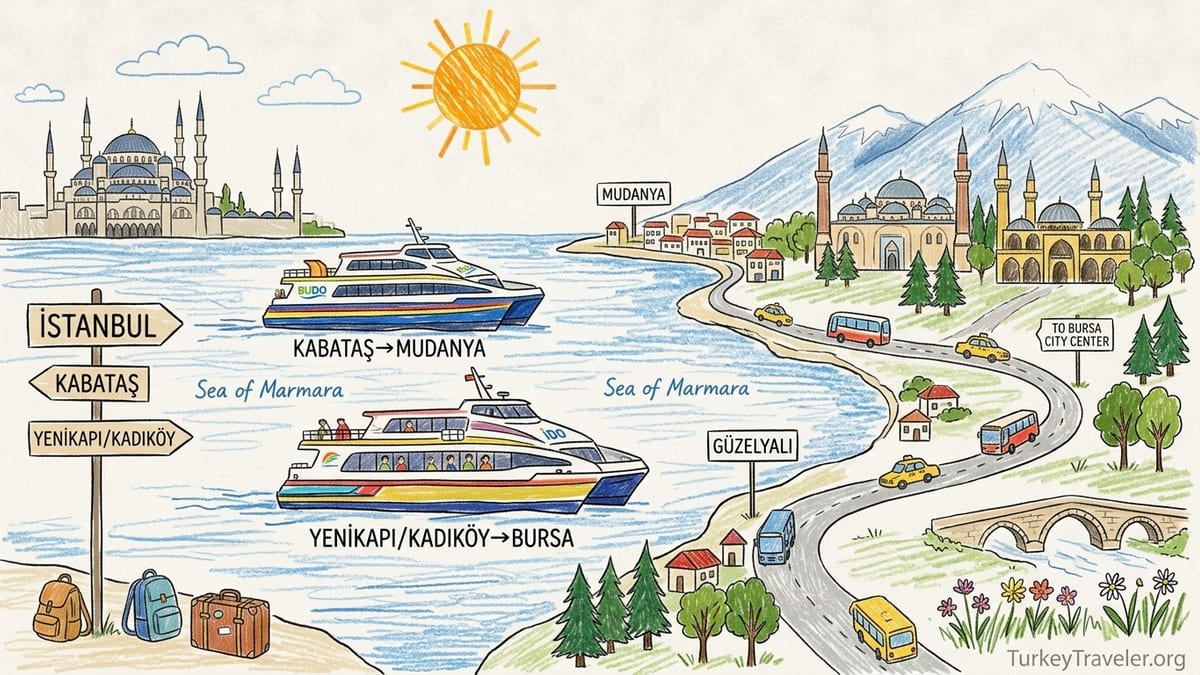
Overview of Istanbul to Bursa Ferry Options in 2026
Travelers heading from Istanbul to Bursa in 2026 typically face a simple choice: sail with BUDO from Kabataş to Mudanya, or with İDO from Yenikapı or Kadıköy to Güzelyalı or Mudanya. Both are fast passenger catamarans designed for comfortable crossings in roughly 1 hour 45 minutes to 2 hours, depending on the specific route and any intermediate stops. On most September 2026 dates, live aggregators show about seven daily departures in total when you combine BUDO and İDO options, spread across morning, midday and evening.
Pricing is currently broadly comparable. Sample searches for midweek departures in September 2026 show standard one-way adult fares around 720 lira for BUDO Kabataş → Mudanya and about 760 lira for comparable İDO services from Yenikapı to Bursa, with some slight variation by departure time and operator promotions. Discounts are often available for children, students and seniors, although the exact categories and documentation required can vary, so it is worth checking the operator’s own site or app before booking.
From a traveler’s point of view, both systems are mature and reliable. BUDO is run by Bursa’s municipal company and focuses specifically on the Istanbul–Bursa link, while İDO is a large private operator with a network that covers many Marmara Sea routes. In practice, your choice will usually come down to which Istanbul terminal is easier for you to reach, how the timings fit your schedule, and whether you prefer a direct sailing or do not mind an extra stop for a slightly different departure time.
In this guide, we focus on the two core flows many visitors use: BUDO’s Kabataş–Mudanya service and İDO’s departures from Yenikapı and Kadıköy toward Bursa-region piers such as Güzelyalı and Mudanya. We also look at how to continue from the ferry terminal to central Bursa, how luggage and cancellations are handled, and how the ferry compares with going by road.
Kabataş vs Yenikapı vs Kadıköy: Which Istanbul Terminal Is Easiest?
Each of the three key Istanbul terminals serves a different slice of the city, so “easiest” depends on where you are staying or arriving. Kabataş, on the European shore just north of Karaköy, is the departure point for BUDO. It is particularly convenient for travelers based in Taksim, Karaköy, Galata and the Bosphorus hotel strip. The F1 funicular from Taksim Square drops you right at Kabataş, as do multiple tram and bus lines. If, for example, you are staying near Taksim metro station, you can be at the BUDO pier in as little as 10 to 15 minutes by funicular, plus a short walk through the Kabataş transfer center.
Yenikapı, used by many İDO Bursa-bound services, is better placed for travelers staying in the Old City or connecting from Marmaray and metro lines. The major rail and metro hub at Yenikapı sits a short walk from the ferry terminal, so if you come in on the M1 or M2 metro or the Marmaray from the Asian side, you can connect to an İDO sailing to Bursa relatively quickly. As a concrete example, coming from Istanbul Airport on the M11 plus transfer to M2 and then down to Yenikapı typically takes around an hour, after which it is a 10 to 15 minute walk or short taxi ride to the terminal, depending on your luggage.
Kadıköy, İDO’s Asian-side base, is ideal if you are staying in the lively Kadıköy–Moda district or near Üsküdar and do not want to cross the Bosphorus first. Ferries, metro lines and buses converge here, and the terminal area is filled with cafes and food stands. For a traveler in a Kadıköy Airbnb, for example, it is often simpler to walk or take a brief bus ride to İDO Kadıköy and sail directly toward Bursa instead of first taking a commuter ferry over to Eminönü or Karaköy and then heading to Kabataş.
For visitors on short trips who are based around Sultanahmet or the Grand Bazaar, the choice is more finely balanced. A tram or taxi ride to Kabataş for BUDO is straightforward, while Yenikapı for İDO may require a short taxi or bus ride south along the Marmara shore. In such cases, many travelers choose the departure that offers the most suitable sailing time rather than focusing solely on the terminal.
Crossing Times and Onboard Experience
Across both operators, you should budget roughly 1 hour 50 minutes for the sea crossing itself. Many BUDO Kabataş → Mudanya sailings are scheduled around the 1 hour 45 to 2 hour mark, and ÎDO’s Yenikapı or Kadıköy routes to Güzelyalı or Mudanya show similar timings, though some services that make additional stops can stretch closer to 2 hours 15 or 2 hours 20. A typical mid-morning departure from Kabataş might leave at 10:30 and arrive in Mudanya just after 12:15, while an İDO departure from Yenikapı around the same time could reach the Bursa region a few minutes earlier or later depending on the exact route.
Onboard, both BUDO and İDO operate fast catamaran-style sea buses with multiple seating salons, air conditioning and small cafes. Most seats are airline-style recliners with tray tables, arranged in rows of two or three across. You can expect to find basic snacks such as simit, packaged pastries, chips, tea and Turkish coffee, along with soft drinks and bottled water. On busy Friday evenings and Sunday afternoons in summer, sailings can be crowded, so travelers with large luggage or a preference for quieter corners may prefer midweek or early morning departures.
Wi-Fi availability can vary by vessel and is not always reliable throughout the crossing. Many regular commuters and locals simply download podcasts or shows before boarding and enjoy the views of the Marmara Sea instead. Large panoramic windows allow plenty of light in, and on clear days you can see ships moving along the main maritime channels, as well as the outlines of the Princes’ Islands and the distant Bursa coastline. Although the ships are relatively stable, those prone to seasickness may still appreciate motion sickness tablets or wristbands, especially in windy weather.
Seating is typically unassigned, so boarding early gives you a wider choice of spots. Families often head for the rear areas with more open space, while solo travelers or couples tend to favor window seats midship for reduced motion. The atmosphere on these ferries is usually calm and practical rather than touristy, with a mix of Bursa commuters, Istanbul day-trippers, students and visitors touring Turkey.
Onward Transport: From Mudanya or Güzelyalı into Central Bursa
Both BUDO and İDO ferries land not in Bursa’s historic center but in coastal suburbs on the Sea of Marmara, from where you continue by bus, minibus, taxi or private transfer. BUDO ferries dock at Mudanya, a pleasant seaside town about 30 to 40 minutes’ drive from central Bursa in normal traffic. Municipal buses and private minibuses meet many of the BUDO sailings, and there are clear signs for services heading to Bursa city center and the main intercity bus terminal. On days with heavy traffic or during peak summer weekends, the journey time can stretch closer to 45 minutes or more.
İDO services often arrive at Güzelyalı, which is closer to Bursa’s urban sprawl. From Güzelyalı, frequent buses link to the city, and taxis are usually lined up at the terminal. For example, a late afternoon arrival into Güzelyalı might see you on a bus to Bursa’s central districts within 10 to 15 minutes of disembarking, with total travel time into the center roughly 30 to 40 minutes. Some İDO patterns or special sailings may also stop at or near Mudanya, but the majority of Bursa-region routings are optimized around Güzelyalı for shorter road transfers.
Once in Bursa proper, you can connect to the city’s light rail or bus network to reach popular tourism areas such as the Ulu Cami, Koza Han, the historic Hanlar district and the cable car up Uludağ. A common pattern is to ride a ferry to Mudanya via BUDO in the morning, take a municipal bus to Bursa’s Heykel or Kent Meydanı area, spend the day on foot exploring the mosques and bazaars, and then make the reverse trip in the evening.
For travelers with significant luggage or traveling in a group, pre-arranged private transfers or taxis can be cost-effective. For instance, a group of four arriving with large bags may find that a prebooked van from Güzelyalı ferry pier to a central Bursa hotel, splitting the cost per person, is comparable to four individual bus tickets plus a short taxi ride at the Bursa end.
Buying Tickets, Managing Luggage and Handling Cancellations
Tickets for both BUDO and İDO can be purchased through their official websites and mobile apps, as well as through major Turkish ticketing platforms and travel agencies. Many travelers also buy directly at the terminals on the day of travel, although on busy weekends and holidays, advance purchase is recommended. In September 2026 inventory snapshots, it is common to see some morning and late afternoon sailings nearly sold out a few days in advance, while mid-day crossings often have more availability and occasionally slightly lower prices.
BUDO and İDO both treat normal suitcases, backpacks and cabin-size bags as standard luggage with no extra fee, provided the items meet safety rules and can be stowed in racks or under seats. Very large or unusual items, such as surfboards, bicycles or bulky sports equipment, may be refused or incur additional fees, so travelers carrying anything beyond ordinary travel bags should check current terms before arrival. Hand luggage can be kept with you, while larger suitcases are often placed in shared racks at the entrance to the passenger salon.
Cancellations and changes depend on the fare rules selected at purchase. Flexible tariffs normally allow date or time changes up to a certain cut-off window, sometimes with a small fee, while the cheapest promotional fares can be nonrefundable. Weather is the main risk factor for cancellations. On days of high winds or storms in the Sea of Marmara, both BUDO and İDO occasionally suspend some or all of their Bursa-bound crossings. Local news outlets regularly report clusters of same-day cancellations during winter storms and strong northerly winds, and operators announce them via websites, apps and text messages to registered customers.
If your sailing is canceled, standard practice is to allow a free change to a later departure or a refund, but in busy periods seats on alternative sailings may be limited. Travelers connecting to flights or onward buses should allow a healthy buffer. For instance, if you have a same-evening bus from Bursa to İzmir, choosing a late-morning ferry from Istanbul rather than the last one of the day provides redundancy in case sea conditions deteriorate.
BUDO Kabataş → Mudanya vs İDO Yenikapı/Kadıköy → Bursa
The core comparison many travelers make is between BUDO’s direct Kabataş → Mudanya route and İDO’s services from Yenikapı or Kadıköy to Güzelyalı or Mudanya. In practice, both offer similar comfort, slightly different geography and subtly different timing patterns. BUDO’s big selling point is its location in Kabataş, with quick access to Taksim and the European-side tourist corridors, and its straightforward routing to Mudanya, which connects efficiently to Bursa by road.
On the other hand, İDO from Yenikapı is attractive for those arriving on intercity buses or metro lines that feed into the Yenikapı hub. The terminal area is functional rather than scenic, but it is designed for quick transfers and has parking, basic eateries and waiting lounges. Kadıköy departures are especially useful for visitors staying on the Asian side or in transit from Sabiha Gökçen Airport, where airport buses and taxis feed into Kadıköy’s central square. In that case, heading straight to an İDO catamaran rather than crossing to Europe first can shave significant time off your journey.
Crossing times and fares can differ slightly by day and by sailing. For example, on a sample Saturday in September 2026, you might see BUDO offering a mid-morning Kabataş → Mudanya departure in the 1 hour 50 minute range at around 720 lira, while İDO lists a Yenikapı → Bursa-region sailing of just over 2 hours for about 760 lira. In practice, the total door-to-door journey time from central Istanbul to central Bursa often ends up very similar, since any extra minutes spent on the water can be offset by a shorter or smoother bus transfer at the Bursa end.
Regular travelers tend to form preferences based on routine rather than big differences in quality. Someone who commutes frequently between Kadıköy and Bursa for business, for example, may be loyal to İDO because they can reach the terminal on foot and catch an early departure, while a traveler who always stays near Taksim might never consider anything other than walking down to the BUDO pier in Kabataş. For visitors, a good rule of thumb is to start with the terminal that is most convenient for your accommodation and then compare a couple of nearby sailing times and prices between operators.
Ferry vs Bus or Car: Which Is Better for You?
Beyond the sea routes, two main alternatives link Istanbul and Bursa: intercity buses and private car travel. Modern intercity coaches, including municipal services from Sabiha Gökçen Airport and private bus companies from main terminals, complete the trip in around 2.5 to 3.5 hours depending on traffic and route. Some buses still use vehicle ferries or bridges over the Marmara Sea, but with the opening of faster road links, many operate fully by road. Ticket prices on busy corridors can be competitive with ferry fares, particularly for last-minute bookings, and buses have the advantage of running later at night and in weather that might disrupt sea crossings.
For travelers prioritizing comfort, scenery and a break from traffic, however, the ferry remains a strong choice. The sea crossing splits the journey into distinct legs, with a calm period on the water and generally straightforward transfers on each end. On hot summer days, many find the breeze and views across the Marmara Sea far more pleasant than sitting in highway congestion at the edge of Istanbul. Environmentally, ferries that carry large passenger loads along a relatively direct route can also compare favorably with single-occupancy car travel, although the exact impact depends on load factors and vessel technology.
Driving your own car or a rental is attractive if you plan to explore Uludağ and rural parts of Bursa Province, or if you are traveling with a family and substantial luggage. You can either put the car on a vehicle ferry or drive via the Osman Gazi Bridge around the eastern side of the Marmara. This can be fast on uncongested days but tolls and fuel add up, and navigating out of Istanbul can be stressful for those not used to Turkish traffic. By contrast, a simple walk-on ferry ticket with BUDO or İDO, followed by local transport or a single taxi in Bursa, can feel much more relaxed.
When weather is unsettled, buses and cars gain a reliability edge because they are less exposed to sea conditions. Travelers with absolutely inflexible connections, such as early-morning flights from other cities, sometimes choose an overnight bus to Bursa the evening before rather than an early ferry on the day of travel. For most visitors, though, as long as they build some slack into their schedule, the ferry remains the most scenic and enjoyable way to move between Istanbul and Bursa.
The Takeaway
Choosing between BUDO Kabataş → Mudanya and İDO services from Yenikapı or Kadıköy to Bursa in 2026 is less about a dramatic difference in quality and more about tailoring the journey to your starting point and schedule. Both offer fast catamarans, broadly comparable fares and several departures per day, with total crossing times on the water of around 1 hour 45 minutes to 2 hours and onward bus or taxi links into Bursa that add another 30 to 45 minutes.
If you are based in or near Taksim, Karaköy or the Bosphorus hotel strip on the European side, BUDO from Kabataş is often the simplest option: an easy funicular or tram ride to the pier, a direct sailing to Mudanya and well-established bus connections into central Bursa. Meanwhile, visitors staying around Kadıköy or arriving via Sabiha Gökçen may find İDO from Kadıköy or Yenikapı more efficient, skipping a cross-Bosphorus transfer and connecting straight to Bursa-region piers like Güzelyalı.
Whichever route you choose, buying tickets a few days in advance for popular departure times, keeping your luggage manageable and checking weather-related announcements on your travel day will go a long way toward ensuring a smooth trip. Build in some buffer time for onward buses or flights, treat the sea crossing as part of the travel experience rather than just a transfer, and you will likely find that the ferry journey between Istanbul and Bursa becomes one of the most memorable segments of your itinerary in Turkey.
FAQ
Q1. How long does the ferry from Istanbul to Bursa take in 2026?
The sea crossing itself is usually about 1 hour 45 minutes to 2 hours on both BUDO and İDO, with an additional 30 to 45 minutes by bus or taxi from Mudanya or Güzelyalı into central Bursa.
Q2. Which is more convenient, BUDO from Kabataş or İDO from Yenikapı/Kadıköy?
If you are staying near Taksim, Karaköy or the Bosphorus hotel strip, BUDO from Kabataş is often easiest. If you are near the Old City transport hub at Yenikapı or on the Asian side around Kadıköy, İDO’s terminals may be more convenient.
Q3. How much do Istanbul to Bursa ferry tickets cost in September 2026?
Sample fares in September 2026 are roughly 720 lira one way for BUDO Kabataş → Mudanya and around 760 lira for similar İDO Bursa-bound crossings, with slight variations by day and departure time.
Q4. Do I need to book my ferry ticket in advance?
Advance booking is strongly recommended for weekends, public holidays and peak summer dates. On ordinary weekdays you can often buy tickets on the day, but popular morning and evening sailings can still sell out.
Q5. What is the best way to get from Mudanya or Güzelyalı to central Bursa?
Municipal buses and minibuses meet most BUDO and İDO ferries and run to central Bursa and the main bus terminal. Taxis and prebooked transfers are also widely available and can be economical for small groups with luggage.
Q6. Can I bring large luggage on the ferry?
Normal suitcases and backpacks are generally accepted at no extra charge, provided they fit in overhead racks or luggage areas. Very large, heavy or unusual items may be restricted or require approval under each operator’s luggage rules.
Q7. What happens if my ferry is canceled due to bad weather?
When sailings are canceled for safety reasons, operators typically offer free changes to another departure or refunds, subject to seat availability. It is wise to check your sailing status on the day and keep some flexibility in your onward plans.
Q8. Is the ferry faster than the bus or driving?
Door to door, travel times are broadly similar. The ferry crossing plus transfers often takes about three hours in total, comparable to intercity buses or a private car on a good day, but with a break from highway traffic and more pleasant sea views.
Q9. Are there food and drinks available on board?
Yes. Both BUDO and İDO ferries usually have small cafes selling snacks like pastries, chips, chocolate bars, tea, Turkish coffee and soft drinks. For special diets, you may prefer to bring your own food.
Q10. Is it better to travel to Bursa in the morning or evening?
Morning sailings are popular with day-trippers and are less affected by afternoon winds, while evening departures suit those checking out of Istanbul hotels and heading straight to Bursa overnight. Choosing based on your onward connections and personal schedule is usually the best approach.