

The Marmara region is often treated as a blur between Istanbul and the Aegean or Central Anatolia, but it deserves a road trip of its own. From Ottoman capitals and battlefields to lakeside resorts and mountain plateaus, Marmara rewards travelers who slow down and treat it as a cluster of short, modular routes rather than a frantic dash around the Sea of Marmara. With a dense motorway grid, electronic tolls, and an unusually rich network of ferries crossing the inland sea, this part of Turkey is ideal for mixing driving with boat rides, buses, and occasional train hops.
Why a Modular Marmara Road Trip Works Better
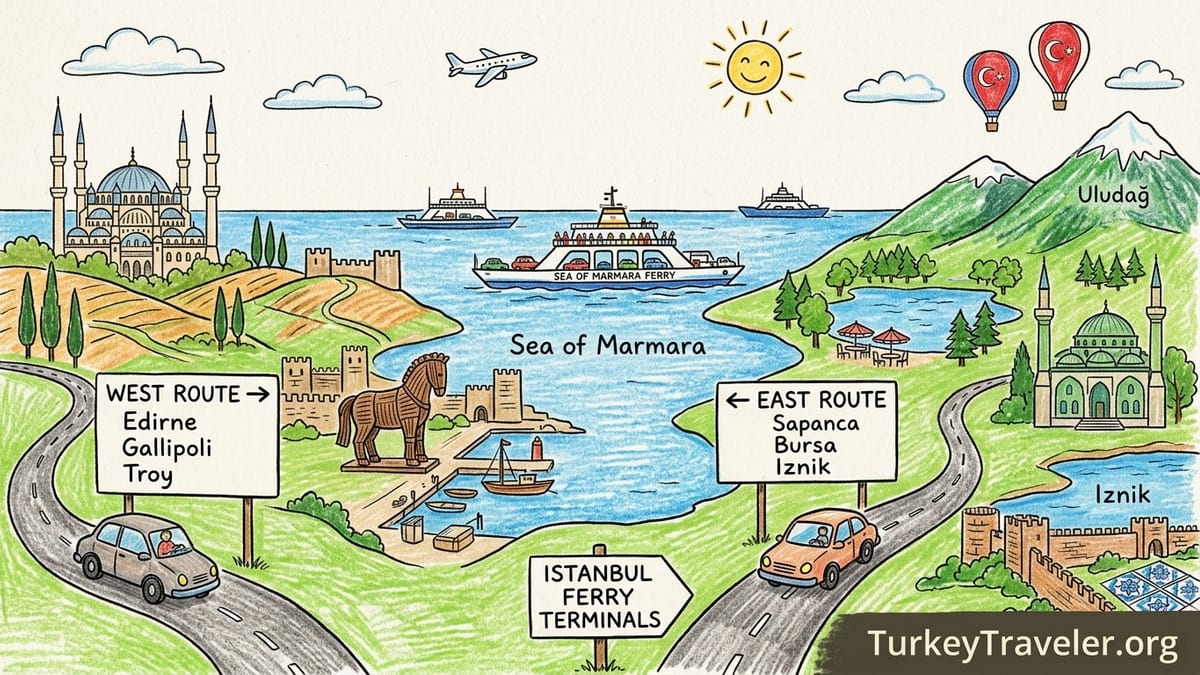
Trying to cram Edirne, Gallipoli, Troy, Bursa, Sapanca, Yalova and Iznik into a single loop from Istanbul in five or six days almost always leads to rushed sightseeing and long, tiring drives. Distances may look modest on a map, but traffic around Istanbul, summer heat, and frequent tolls add fatigue. A more satisfying approach is to break Marmara into two focused routes, then join them only if you have at least 8 to 10 days.
The western module runs from Istanbul to Edirne and down to the Gallipoli peninsula and Troy. It is history heavy, with Ottoman mosques, Balkan frontier towns, and First World War battlefields, ending in the harbor city of Canakkale opposite the legendary city of Troy. The eastern and southern module points toward Sapanca’s lakeside cafes, Yalova’s ferry port and hot springs, Bursa and Uludag’s mountain scenery, and the quieter lakeside of Iznik with its old city walls and tile workshops.
What makes this modular strategy work so well is the Sea of Marmara itself. Rather than retracing your steps on motorways, you can hop car ferries and fast ferries that criss-cross the inland sea between Istanbul, Yalova, Bursa’s coastal terminals and smaller ports like Eskihisar and Topcular. This lets you drive one way and sail back, or even park the car and continue by bus from a ferry terminal if city driving feels overwhelming.
By thinking in modules, you can realistically do the western route in 4 to 5 days and the eastern and southern route in a similar timeframe, then link them into a longer holiday if you have two weeks. This article explains those two main itineraries, how to stitch them together with ferries, and what to expect from Marmara’s toll roads, parking, and public transport options.
The Western Route: Istanbul to Edirne, Gallipoli and Troy
The classic western route begins on the European side of Istanbul and follows the main motorway toward the Bulgarian border. From central Istanbul to Edirne is roughly 240 kilometers by road, and with normal daytime traffic most drivers cover it in about 2.5 to 3 hours. The route is almost entirely on modern divided highway, signed for Edirne and the E80 or O-3, so it is straightforward even for first-time visitors.
Edirne itself justifies at least one overnight stop. The Selimiye Mosque dominates the skyline, and wandering from the riverside bridges to the old bazaar is a reminder that this was once the capital of the Ottoman Empire. Many travelers choose a midrange hotel with on-site parking near the old town, where a night for two might typically cost a moderate sum compared with Istanbul’s central districts. Leaving the car parked for a day, you can do most of Edirne’s sights on foot.
From Edirne, drivers generally head south on highways signposted for Tekirdag, then follow the D550 south to the Gallipoli peninsula. Depending on your exact route and stops, Edirne to Eceabat or Kabatepe on the peninsula is usually a 4 to 5 hour drive. Once on Gallipoli, distances shrink but roads narrow. The battlefields, cemeteries and viewpoints are spread along a long, hilly spine, so many travelers either join a local guided tour in Eceabat or Canakkale or dedicate a full day to self-driving with frequent pauses.
To reach Canakkale city and the Troy area, you drive to the ferry piers at Eceabat or Kilitbahir and board a short car ferry across the Dardanelles. Crossings typically take about 20 to 25 minutes, run frequently throughout the day and late into the evening, and you pay an all-in fare for car and passengers. From the Canakkale ferry terminal it is about 30 kilometers to the archaeological site of Troy, usually 35 to 45 minutes of driving on a mix of coastal and inland roads. Many visitors stay two nights in Canakkale, using one full day for Troy and the nearby villages, and another for a Gallipoli excursion if they did not already explore the peninsula on the way down.
The Eastern & Southern Route: Istanbul to Sapanca, Yalova, Bursa and Iznik
The eastern and southern module feels more relaxed and nature oriented, though there is no shortage of history. Most drivers start from Istanbul’s Asian side and head for Sapanca, a lakeside resort area roughly 130 kilometers away via the E80 motorway. Depending on traffic as you leave Istanbul, expect 1.5 to 2 hours of driving. Weekends and summer holidays can be significantly slower, especially heading east on Friday afternoons.
Sapanca Lake is ringed by cafes and small hotels that cater to Istanbul families escaping for the weekend. It is one of the easiest places in Marmara to simply stop driving for a day, walk along the lakeside promenade, or hire a pedalo or small boat. In high season, lakeside hotels with private parking and breakfast included are common, so you can arrive late from Istanbul and not worry about parking logistics in town.
From Sapanca, there are several ways to reach Yalova and Bursa. Many drivers cut back toward the Gulf of Izmit and either use the free state roads around the gulf or choose one of the ferries. A particularly practical option is the short car ferry between Eskihisar, southeast of Istanbul, and Topcular on the Yalova side of the gulf. This ferry lets you avoid heavy motorway traffic and provides a short sea crossing, often around 45 minutes pier to pier. Services run frequently, and you simply queue up, drive aboard, and pay the vehicle and passenger fare at the terminal or via an app.
Yalova itself has a compact center with a seafront promenade and easy access to hot spring resorts in Termal. From Yalova it is under 70 kilometers to Bursa by road, often around 1 to 1.5 hours of driving depending on congestion at the entrances to Bursa. Once in Bursa, you enter a much larger city with busier traffic and more complex one-way streets. Many travelers choose hotels that advertise on-site parking or valets in the central districts, or stay slightly outside the core in areas with easier access to the ring road and Uludag cable car station.
Iznik sits on the eastern shore of Lake Iznik and is reached from Bursa by a scenic inland road that typically takes about 1.5 hours. The town is quiet, with stretches of surviving city walls and a long tradition of tile-making that supplied Ottoman mosques across the empire. It makes a good final stop on the southern loop before circling back toward the Istanbul region, either by rejoining the motorways or cutting north toward the gulf and the ferries.
Ferries Across the Sea of Marmara: Not Just a Scenic Detour
The Sea of Marmara is criss-crossed by ferries that can save hours of driving and give variety to a road trip. Several operators run both fast passenger ferries and slower vehicle ferries connecting Istanbul with Yalova, Bursa’s coastal terminals, and smaller ports around the sea. Car ferries across the Gulf of Izmit, particularly the Eskihisar–Topcular line, are workhorses for local drivers and visitors alike, helping you bypass some of the busiest motorway sections.
On the Istanbul side, vehicle ferries commonly depart from terminals on the Asian shore, such as Pendik or Eskihisar, while high-speed passenger ferries and some car ferries leave from central terminals on the European side like Yenikapi or Kabatas. Routes change over time and timetables can shift seasonally, so it is wise to check current schedules and prices shortly before travel. As a rough reference, a car and two passengers on a medium-length Marmara crossing can cost a moderate sum that is still competitive with the petrol and tolls you would pay to drive the long way around.
One practical example is the connection between Istanbul’s Asian-side terminals and Yalova. You can drive to Pendik, board a car ferry to Yalova, and reach the Yalova city center in under an hour of sailing time plus loading and unloading. From Yalova you are well-positioned to reach Bursa, Termal or Iznik. Another is the longer fast ferry links that sometimes operate between Istanbul and Bursa’s coastal terminal at Mudanya or nearby Güzelyali, which connect you by bus or taxi to central Bursa without ever needing to drive into the city yourself.
For those combining the western and southern modules, it is possible in some seasons to pair the Dardanelles ferry from Gallipoli to Canakkale with a later Marmara ferry from Bandirma or other ports up toward Istanbul or the northern shore. This lets you create a loop that is part car, part sea voyage. Because some of these routes are more limited outside peak summer and holiday periods, it is important not to rely on a single specific crossing without checking up-to-date schedules in advance.
Toll Roads, Electronic Passes and When to Avoid the Motorways
Marmara’s road network is dense with both free state highways and toll motorways. Around Istanbul and across key crossings like the Bosphorus bridges, the Osmangazi Bridge over the Gulf of Izmit, and the 1915 Canakkale Bridge over the Dardanelles, tolls for cars are collected electronically. Cash is not accepted at toll booths. Instead, vehicles use a radio-frequency sticker system known as HGS, sold by Turkey’s postal service and many fuel stations, or similar electronic tags. Foreign-plated cars that pass through toll points without a tag are typically logged by camera and must settle the tolls, and any potential surcharges, before leaving the country.
For a short Marmara trip with a rental car, most major rental companies already equip vehicles with an HGS tag and bill tolls to your credit card after the rental. If you are driving your own car into Turkey, you can often rely on the system’s grace period, paying tolls within a set number of days using official channels, but many drivers prefer the simplicity of purchasing an HGS sticker and loading a moderate amount of credit at a post office or petrol station near the border.
Toll prices in Turkey are adjusted periodically and have risen in recent years. As of mid-2026, flagship structures like the Osmangazi Bridge and the 1915 Canakkale Bridge cost roughly more than a thousand lira one-way for a standard passenger car. This makes planning important. For instance, if you are driving the southern route between Istanbul and the Aegean, taking the Gulf of Izmit car ferry or the slower free roads around the gulf can save a significant amount of money at the cost of some extra time.
On shorter hops within Marmara, using free parallel highways is often reasonable. For example, between Istanbul and Edirne you can follow older state routes along the northern shore of the Sea of Marmara, passing through suburbs like Avcilar and Silivri before joining main roads toward Tekirdag and Edirne. These roads are slower and pass through more built-up areas but avoid motorway tolls and give a sense of everyday life beyond the service stations.
Parking, City Traffic and When Trains or Buses Make More Sense
Driving is rewarding between cities in Marmara, but within the major urban centers it often becomes a liability. Istanbul, Bursa and to a lesser extent Edirne and Canakkale all have busy traffic, numerous one-way streets, and limited curbside parking. In central Istanbul, parking garages are common but costly, and the stress of driving in dense, aggressive traffic can undercut the pleasure of the trip. Many travelers choose to pick up their rental car only when leaving the city, using Istanbul’s metro, tram and ferry system instead.
For Bursa, a popular strategy is to approach by ferry as a foot passenger and then continue by bus or taxi. Fast ferries from Istanbul to the Mudanya or Guzelyali area on the Marmara coast are usually matched with shuttle buses run by local operators or the municipality, connecting directly to Bursa’s main bus terminal or metro line. This means you can spend a day or two in Bursa without worrying about where to park near attractions like the Grand Mosque, the Green Tomb or the cable car station to Uludag.
Intercity buses are an excellent fallback when you want to cover a stretch quickly without driving. For example, if you have driven from Istanbul to Edirne and onward to Gallipoli but do not fancy a long drive back toward Istanbul, you can leave the car in Istanbul, or design the itinerary so that you return the car in one city and take a bus between others. Major bus companies operate frequent services between Istanbul, Edirne, Canakkale, Bursa and Yalova, typically with air-conditioned coaches, assigned seats and simple onboard refreshments.
Rail is less central to this particular itinerary but can still be useful. High-speed trains connect Istanbul’s Halkali and Söğütlüçeşme stations with cities like Eskisehir and Ankara, and regional trains reach some Marmara towns. However, for the specific combination of Sapanca, Yalova, Bursa, Edirne and Canakkale, buses and ferries usually offer more direct connections than trains. That said, you might, for instance, take a high-speed train from Istanbul toward the Sakarya region and then pick up a rental car in a less congested town before driving on to Sapanca.
Combining the Western and Eastern Routes Using Marmara Ferries
If you have more than a week, combining both Marmara modules into one extended trip becomes appealing. A common pattern is to begin with Istanbul, then drive or bus to Edirne, continue down to the Gallipoli peninsula and Canakkale, and finally cross back toward the eastern and southern loop by sea. Depending on which ferry routes are operating when you travel, you can sail from ports on the southern Marmara coast up to Istanbul or to coastal towns on the north or east shores.
One logical combination is to travel Istanbul to Edirne and Gallipoli, explore Canakkale and Troy, then continue east by road along the southern shore of the Sea of Marmara toward Bandirma and beyond. From coastal towns on this stretch, you can look for ferries back to Istanbul or across to the north shore, effectively turning your western history circuit into a coastal drive that feeds naturally into the Bursa and Yalova region. Even when direct ferries are limited, simply following the coast eases the transition between the Dardanelles region and the Bursa hinterland.
Another way to link the routes is to treat Yalova as a pivot point. After completing the western module and returning toward Istanbul by road or ferry, you can drive or take a bus across Istanbul’s Asian side to Pendik or Eskihisar, then cross by car ferry to Yalova. From there, the southern module unfolds through Bursa, Uludag, and Iznik before you eventually circle back toward the Istanbul region by motorway or local roads. Using Yalova as this hinge helps you avoid doubling back through central Istanbul.
When combining modules, the main constraints are ferry timetables and daylight hours. Summer offers longer days and more frequent departures, while winter schedules can be reduced, and rough weather may cause temporary cancellations. Build some flexibility into your plan and avoid routing yourself into a position where missing a single ferry would cause you to miss a flight out of Istanbul the same evening.
Seasonal Tips, Safety and Local Driving Culture
Marmara’s climate is milder than central Anatolia’s, but seasons still matter. July and August can be hot and humid, particularly in cities like Bursa and Edirne, making air-conditioning and shaded parking important. Late spring and early autumn, usually May to June and September to early October, are ideal for road trips: roads and ferries operate at full swing, but temperatures are more comfortable and lake and mountain areas like Sapanca and Uludag are especially pleasant.
Winter driving is generally manageable on the main motorways and around the coasts, but snow and ice are possible at higher elevations such as Uludag and even on some sections of the Thracian plateau around Edirne. If you plan to drive up to Uludag in winter, check whether your rental car comes with winter tyres or chains and listen to local advice about road conditions and avalanche risk. Alternatively, you can park in Bursa and use minibuses or cable cars up the mountain.
Turkish drivers are assertive and sometimes impatient, particularly around Istanbul and on busy holiday weekends. Expect frequent lane changes, close following distances, and variable adherence to speed limits. The safest approach is to keep to the right-hand lanes on motorways except when overtaking, maintain moderate speeds, and leave generous space ahead of you. Police and automated cameras increasingly enforce speed limits and red lights, and fines can be substantial, especially for foreign visitors who may need to settle them before exiting the country.
Basic precautions apply everywhere: avoid driving when very tired after a long flight, refuel before late-night stretches on less busy roads, and carry some cash for smaller local parking lots around sights in towns and at lakeside spots. Official motorway service areas usually accept cards, as do large chain fuel stations, but small rural cafes or family-run parking fields near beaches and picnic areas still often prefer cash payments.
The Takeaway
The Marmara region is more than a corridor between Istanbul and elsewhere. By treating it as two complementary routes, you can enjoy Edirne’s mosques, Gallipoli’s solemn hills and Troy’s ruins on one side, and Sapanca’s lakes, Yalova’s ferries, Bursa’s bazaars and Uludag’s forests on the other. Linking these with carefully chosen ferry crossings across the Sea of Marmara turns the road trip into a multi-modal journey that feels richer than a simple sequence of motorway exits.
Plan around tolls and electronic payments, choose when to embrace ferries and when to save time on motorways, and do not hesitate to leave the car behind for a day or two in big cities where public transport shines. With realistic driving days, a bit of flexibility for ferry schedules, and an eye on the seasons, a Marmara road trip can be one of the most varied and satisfying itineraries in Turkey, combining Ottoman history, modern infrastructure and sea views in a single loop.
FAQ
Q1. How many days do I need for a Marmara road trip from Istanbul?
For a relaxed pace, plan 4 to 5 days for the western route to Edirne, Gallipoli and Canakkale, and another 4 to 5 days for the eastern and southern route through Sapanca, Yalova, Bursa and Iznik. If you want to combine both into a single loop with rest days and ferry connections, 10 to 14 days is ideal.
Q2. Do I need an HGS toll sticker if I am renting a car in Turkey?
Most major rental companies include an electronic toll tag in their vehicles and will charge tolls to your credit card after the rental. It is still worth confirming at the desk that the car is equipped and asking how tolls are billed. You usually do not need to arrange your own HGS sticker for a standard rental.
Q3. Can I drive on free roads instead of paying tolls in Marmara?
Yes, almost all tolled motorways have parallel state roads that are free to use. For example, you can avoid parts of the main motorway between Istanbul and Edirne by following older coastal routes through towns like Silivri and Corlu. These roads are slower and less direct but can save toll costs and offer more local scenery.
Q4. How do I take a car ferry across the Gulf of Izmit?
The most common option is the Eskihisar–Topcular route. You drive to the terminal, follow the signs into the queue, and pay for the vehicle and passengers at the ticket office or with a mobile app if available. Staff guide you on and off the ship. Sailings are frequent in daytime and typically take under an hour including loading.
Q5. Is it difficult to park in Bursa and Edirne?
Edirne is relatively manageable, especially if you choose accommodation with on-site parking within walking distance of the old town. Bursa is larger and busier; central street parking can be crowded and involves navigating one-way systems. Many travelers either pick hotels with secure parking or arrive by ferry and use buses and taxis instead of driving into the historic core.
Q6. When is the best season to drive to Uludag and Sapanca?
Late spring and early autumn are the most comfortable, with mild temperatures and clear views. Winter brings snow to Uludag, which is attractive for skiing but can complicate driving. Sapanca is pleasant year-round, but summer weekends can be very busy with visitors from Istanbul, so midweek stays are calmer.
Q7. Can I visit Gallipoli and Troy in one day from Istanbul by car?
It is technically possible but not recommended. The drive each way takes several hours, and both Gallipoli and Troy deserve unhurried visits. A more comfortable plan is to overnight in Canakkale or Eceabat, dedicating at least one full day to Gallipoli and another half or full day to Troy and the surrounding villages.
Q8. Are there good public transport alternatives if I do not want to drive?
Yes. Long-distance buses connect Istanbul with Edirne, Canakkale, Bursa and Yalova, and ferries link Istanbul to Yalova and Bursa’s coastal terminals. You can combine buses and ferries to cover most of the routes described, using local taxis and minibuses for the final stretches to places like Gallipoli battlefields, Uludag or Iznik.
Q9. How early should I arrive at Marmara ferry terminals with a car?
Outside peak holiday periods, arriving 30 minutes before departure is often sufficient. During summer weekends, religious holidays or major events at places like Gallipoli, it is wise to arrive earlier, especially if you are boarding at a smaller terminal with fewer daily sailings. Always allow buffer time if you are catching a flight the same day.
Q10. Is driving in Turkey safe for foreign visitors in the Marmara region?
Most foreign visitors drive in Marmara without serious issues, provided they stay alert and drive defensively. Main roads and motorways are generally in good condition, but local driving style can be fast and assertive. Observing speed limits, avoiding night driving when tired, and planning city entries outside rush hour improve safety and comfort.