


In September, Doğubayazıt wakes early. Guides load gas canisters and tents into aging 4x4s, muleteers haggle over loads at the trailhead and international climbers sip last cups of strong Turkish tea before heading toward the broad volcanic cone of Mount Ararat, which rises to 5,137 meters above the plains of eastern Türkiye. For many, this remote border town is the launchpad to a once in a lifetime summit, and the details of permits, acclimatization days and airport transfers matter just as much as the dream of seeing the sunrise from Ararat’s icy summit ridge.
Why Mount Ararat and Why Base Yourself in Doğubayazıt
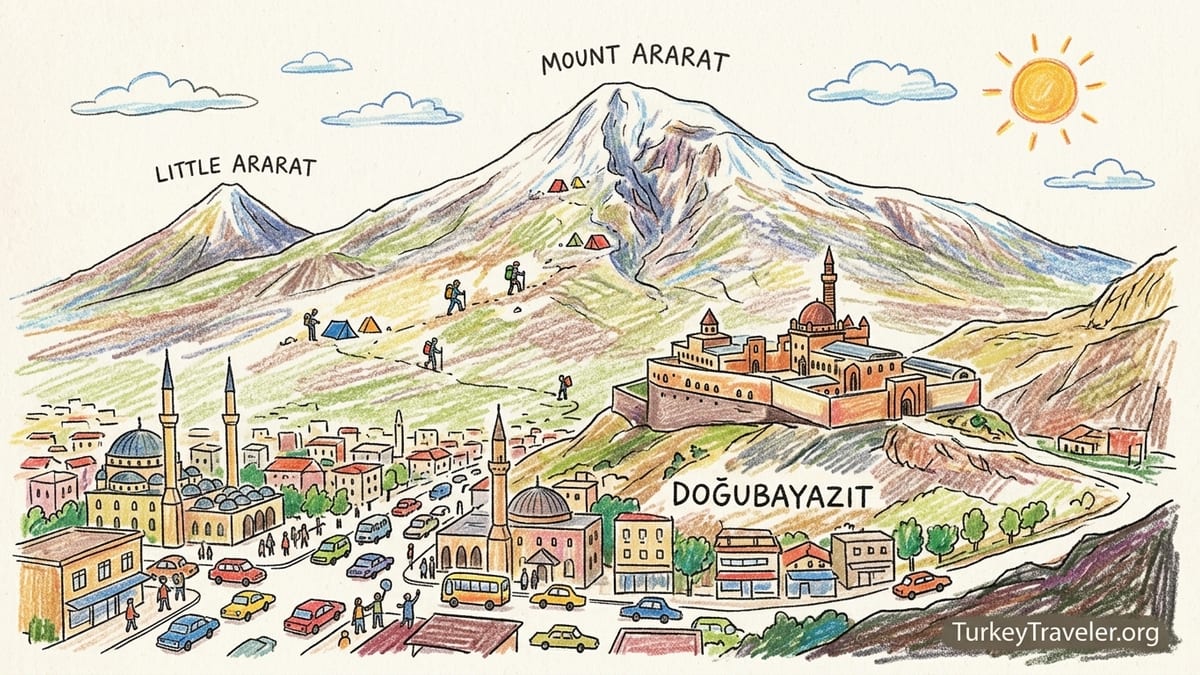
Mount Ararat, known locally as Ağrı Dağı, dominates the horizon above Doğubayazıt, a frontier town about 15 kilometers from the mountain’s western slopes. The dormant stratovolcano is Türkiye’s highest peak at roughly 5,137 meters, which makes it high enough to feel like a genuine expedition but still accessible to strong hikers who lack technical climbing experience. For most foreign climbers, Doğubayazıt is where the expedition really begins: guides, porters, food, camping gear and transport are all organized here, usually through a licensed local operator.
In practical terms, Doğubayazıt gives you straightforward logistics. Most Ararat itineraries include group transfers from Ağrı or Iğdır airports, and some international packages add a longer transfer from Van or Erzurum for travelers arriving on domestic flights. In September 2026, outfits such as Tamzara Turizm and Two Ararat are advertising scheduled 7 day open group programs using Doğubayazıt hotels as their base, with advertised prices for local style packages from about 350 to 450 euros for weeklong climbs and international marketplace products frequently exceeding 1,000 US dollars for similar durations.
Beyond logistics, the town offers a useful buffer between long travel days and the mountain. Many 6 and 7 day programs spend the first night in a simple hotel in Doğubayazıt, where climbers can repack gear, visit the Ishak Pasha Palace at sunset and pick up last essentials in local gear shops or supermarkets. For climbers arriving from sea level, even this low key first night at around 1,600 meters of elevation can help with the transition to higher camps on Ararat.
Permits, Regulations and Why You Must Go With a Licensed Guide
Unlike many other trekking peaks in the region, Mount Ararat sits in a militarily sensitive border zone near Iran and Armenia. Climbing is regulated by a protocol that requires foreign nationals to join an organized ascent with a registered “mountain host” and obtain special permission through the local authorities. In practice, this means you cannot simply show up in Doğubayazıt and walk onto the mountain on your own. Licensed Turkish agencies based in Doğubayazıt or major cities submit your passport details to the district governorship and gendarmerie, pay the required ascent fee and receive clearance for a specific set of dates and a designated route, usually the classic southern approach from the Eli plateau.
The permit fee itself is relatively modest, often quoted by local operators as the equivalent of around 50 US dollars per person, but the process is bureaucratic and can only be handled by authorized companies. Some local outfits stress in their marketing that they make the official payment to the Doğubayazıt district account one day before the tour start, to allow minor schedule changes without losing the fee. For the traveler, the practical takeaway is simple: always ensure your chosen operator holds a current Turkish travel agency license and has recent experience securing Ararat permits. Ask explicitly whether the ascent fee, insurance and any required registrations with the gendarmerie are included in the package price.
Because Ararat lies within a military restricted area, access policies can occasionally change due to security concerns, weather damage or exercises. That is one reason why 5 day summit pushes are usually structured with at least one contingency day built in and why many 6 or 7 day itineraries spend extra time in Doğubayazıt or at base camp. When you compare programs, look beyond the headline number of days and ask what flexibility exists if, for example, strong winds make a summit attempt impossible on your planned day.
Comparing 5, 6 and 7 Day Itineraries
Ararat climbs from Doğubayazıt fall broadly into three patterns: fast 5 day ascents, slightly expanded 6 day programs and the more relaxed 7 day summit packages that are common in September 2026 group departures. Local agencies marketing “classic” 5 day routes usually structure them as one night in Doğubayazıt and three nights on the mountain, with a summit push on day 4 and a full descent on day 5. For example, a typical 5 day program sold by regional operators combines arrival and briefing on day 1, a drive to the Eli plateau and hike to Camp 1 at around 3,200 meters on day 2, a move to Camp 2 at roughly 4,200 meters on day 3, summit and descent back to Camp 1 or directly to the trailhead on day 4, then transfer back to Doğubayazıt on day 5.
Six day itineraries usually add either an extra night in Doğubayazıt at the beginning or end of the trip, or more usefully an acclimatization hike from Camp 1 before moving higher. An example from European based agencies selling to international clients is a 6 day trip where day 1 is arrival in Van or Ağrı and transfer to Doğubayazıt, day 2 is the hike to Camp 1, day 3 is an acclimatization climb toward 3,700 or 3,800 meters before returning to Camp 1, day 4 is the move to Camp 2, day 5 is summit day and descent, and day 6 is the drive back to town and onward travel.
Seven day programs, which many Doğubayazıt operators are actively promoting for late August and September 2026, spread essentially the same vertical gain over more days and sometimes combine Little Ararat or regional sightseeing with the main climb. A typical 7 day open group itinerary marketed in 2026 includes arrival and hotel night in Doğubayazıt on day 1, ascent to Camp 1 on day 2, acclimatization hikes and a second night at Camp 1 on day 3, move to Camp 2 on day 4, summit push in the early hours of day 5 and descent to Camp 1, final descent to the trailhead and return to Doğubayazıt on day 6, and departure transfers on day 7. A few companies add a day trip to Ishak Pasha Palace or a visit to local hot springs into the final day, marketing the program as both an expedition and cultural tour.
The choice between 5, 6 and 7 days depends on your tolerance for altitude and your time constraints. If you live and train at higher elevation, a 5 day climb may be realistic. For most travelers arriving from low lying cities in Europe or North America, 6 or 7 day itineraries significantly improve acclimatization and increase the chance of standing on the summit, especially in September when the first autumn storms can bring wind and fresh snow.
Group vs Private Expeditions from Doğubayazıt
Most Doğubayazıt based operators offer two basic styles of Ararat climb: scheduled open group departures and custom private climbs. In 2026, local outfits list multiple 7 day group starts through late August and September with prices that start around 350 to 450 euros per person when booked directly in town or through their own websites. These prices usually assume a minimum group size, often six to eight climbers, and they include shared tents, meals, mule support for group equipment and bilingual guiding. International intermediaries or adventure marketplaces often resell similar itineraries for 800 to over 1,000 US dollars per person, bundling in additional services such as extra hotel nights in Van or Istanbul, equipment rental packages and more comprehensive travel insurance.
Private expeditions give you more control over pace, dates and the composition of your group. A small team of two or three friends can ask for a custom 6 day or 7 day program from Doğubayazıt, often with the option to add side trips like a day on Little Ararat or overnight in Van by Lake Van before or after the climb. The tradeoff is price: because the permit process, transport, cooks and muleteers cost roughly the same regardless of group size, a private climb for two will cost considerably more per person than joining an open group. It is common to see quotes in the 800 to 1,200 euro range for a fully private 7 day summit program for two people booked directly with a regional Turkish operator, and more if arranged through a Western agency that includes additional services.
For many climbers, a hybrid approach works well. You might, for example, join a 7 day group departure from a Doğubayazıt based company, then pay a supplement for a private tent, single hotel room or a dedicated assistant guide if you are unsure of your fitness. Some experienced mountaineers prefer to book a local guide only service, arranging their own transport to Doğubayazıt and bringing personal technical gear, but even in these leaner setups, the requirement for a registered agency and mountain host still applies.
Acclimatization, Fitness and Experience Level
Despite its biblical associations and long history of exploration, Ararat is fundamentally a high altitude trekking peak rather than a technical climb. The standard southern route from Doğubayazıt involves steep hiking on dirt, scree and, near the summit, snow and low angle glacier terrain. Crampons and sometimes trekking poles are required in the upper section, but rope and ice axe use is limited on the normal route in late summer for guided groups. Operators typically rate the climb as moderately difficult for fit hikers with strong legs and previous multi day trekking experience, but without a need for prior mountaineering background.
The true challenge on Ararat is altitude and weather. Camp 1 sits at around 3,200 meters, Camp 2 near 4,000 to 4,200 meters, and the summit at 5,137 meters. On a typical summit day, you may gain roughly 1,000 vertical meters between Camp 2 and the top, then descend more than 2,000 meters back to lower camp or the trailhead, often taking 10 or more hours on your feet. Acclimatization days built into 6 and especially 7 day itineraries allow your body to adapt gradually, reducing the risk of altitude sickness. Programs that offer an acclimatization hike from Camp 1 to 3,700 or 3,800 meters followed by a return to sleep lower, then a move to Camp 2 the next day, tend to produce better summit success rates and a more relaxed experience.
Reasonable pre trip preparation might include regular hill walking with a loaded backpack, stair climbing workouts or weekend hikes that simulate spending multiple days in a row on your feet. Operators often suggest that if you can comfortably hike for 6 to 8 hours on steep terrain at home, you are physically ready for Ararat. Altitude, of course, is harder to simulate, so if you have never been above 3,000 meters before, it makes sense to choose a 6 or 7 day program, keep your pack relatively light by using mule support, and be candid with your guide about symptoms like headache or nausea during the ascent.
Camping, Equipment and What Operators Provide
All summit oriented Ararat expeditions from Doğubayazıt are camping based, with no permanent huts on the mountain. Camp 1 at approximately 3,200 meters and Camp 2 around 4,000 to 4,200 meters are rough clusters of tents pitched on volcanic scree, with basic toilet trenches and sometimes stone windbreaks built by guides. Local operators generally provide expedition style dome tents, communal mess tents, gas stoves, cooking equipment and foam sleeping mats. Climbers are expected to bring personal sleeping bags rated for at least minus 10 degrees Celsius nighttime lows, along with headlamps, trekking boots, waterproof layers, and a midweight insulated jacket.
Many Doğubayazıt companies offer rental of key items such as sleeping bags, trekking poles, crampons and even boots, often for modest daily fees that can be paid in cash before departure. While this can be convenient for spontaneous travelers, it is worth remembering that rental inventory is finite and heavily used in peak August and September weeks. If you wear non standard shoe sizes or are particular about gear, bringing your own well fitting boots and a tested sleeping bag is strongly recommended, and using rentals only for hard items like crampons that see less individual fit variation.
Mules or horses carry group equipment and usually a portion of each climber’s personal gear from the Eli trailhead up to the camps. It is common for packages to include one shared pack animal per two climbers, with the expectation that each person carries a small daypack with water, layers and snacks while heavier duffels go on the animals. Some budget packages in the 350 to 450 euro range include only a limited luggage allowance, charging extra if you exceed a certain weight. Higher priced international packages tend to be more generous with included porterage but cost significantly more as a result.
Airport Transfers, Hotels and the Doğubayazıt Experience
Most Ararat climbers reach Doğubayazıt via domestic flights to Ağrı, Iğdır, Van or Erzurum. Local operators routinely include group transfers in minibuses or 4x4s from these airports to town. For example, a common pattern in 2026 itineraries is a pickup at Ağrı Ahmed-i Hani Airport, followed by a roughly 90 minute drive to Doğubayazıt, check in to a simple but comfortable hotel, welcome dinner and gear check with the guide team. Some packages offer the option to start in Van, combining the climb with a visit to Lake Van and the Armenian church on Akdamar Island before heading onward by road.
In town, accommodation ranges from basic pensions favored by budget climbers to mid range hotels on or near the main streets, which cater to both expedition groups and long distance truck drivers passing toward the Iranian border. Climbing packages often bundle one night in Doğubayazıt at the beginning and either one or two nights at the end of the climb, leaving free time to explore the bazaar, sample local Kurdish and Turkish food and visit Ishak Pasha Palace, which sits on a ridge with expansive views over the plains toward Ararat.
Transfers between Doğubayazıt and the Eli plateau trailhead are typically handled by rugged minibuses or pickup trucks, and are included in almost every summit package, whether group or private. The road is unpaved in sections and can be dusty in late summer, so keeping critical gear in sealed duffel bags is advisable. On the last day of the climb, after descending from the mountain, your group will usually be met by the same vehicles and driven back to town for hot showers, a celebratory dinner and a final night before onward travel or a long overnight bus ride east or west.
Typical Pricing in September 2026 and What Drives Costs
As of September 2026, Doğubayazıt based operators promote 7 day Ararat summit programs in the 350 to 450 euro range for open group departures, with some offering special late season discounts. These prices generally cover hotel nights in Doğubayazıt, full board on the mountain, tents and group equipment, permit fees, airport transfers from the nearest regional airport and the services of licensed local guides and cooks. Insurance and equipment rental may or may not be included, so it is crucial to read detailed inclusions carefully when comparing quotes.
International marketplace products and Western based adventure travel brands often sell similar length Ararat climbs for 800 to well over 1,000 US dollars per person. The higher prices reflect additional overhead such as international marketing, dedicated English speaking tour leaders who accompany groups from Istanbul or even from abroad, more comprehensive pre trip support and sometimes a larger buffer of extra hotel nights, sightseeing days and rest days away from the mountain. For independent travelers comfortable arranging their own domestic flights to Eastern Türkiye, booking directly with a reputable Doğubayazıt operator can significantly reduce costs while still maintaining safety and quality.
Several factors drive the final price for any given expedition: group size, length of itinerary, level of service, season and booking channel. Private climbs for two or three people on custom dates will nearly always cost more per person than a fixed departure with ten climbers. Six and seven day programs, while better for acclimatization, add hotel and staff days that increase costs compared to faster 5 day trips. Higher service levels, such as single tents, additional assistant guides, upgraded hotel categories in town and private transfers from more distant airports like Van or Erzurum, also push prices up. Knowing which aspects matter most to you helps keep the climb within budget without cutting corners on safety critical items like experienced guiding and reliable communication on the mountain.
The Takeaway
Planning a Mount Ararat climb from Doğubayazıt is less about chasing a mysterious biblical summit and more about making clear, grounded decisions on itinerary length, acclimatization, budget and logistics. For most travelers arriving from low altitude cities, a 6 or 7 day program offers the best balance between cost and comfort, spreading the ascent over enough days to adapt to 5,137 meters while leaving buffer time for weather. Fast 5 day itineraries suit fit and experienced hikers who have previously been to altitude and accept a smaller margin for error.
Choosing between group and private expeditions, and between a local Doğubayazıt based operator and an international reseller, comes down to personal preference. If you value cultural immersion, budget friendly pricing and are comfortable dealing directly with a Turkish or Kurdish agency, booking in Doğubayazıt or through a regional specialist can secure a solid 7 day summit package for around 350 to 450 euros. If you prefer comprehensive pre trip support and are willing to pay a premium, marketplace products and foreign tour operators can exceed 1,000 US dollars but package the climb within a broader holiday.
Whatever you choose, the non negotiables remain the same: a licensed operator who handles permits and coordinates with local authorities, a realistic acclimatization schedule, adequate personal equipment for cold and wind at over 5,000 meters and honest self assessment of your fitness. With those pieces in place, Doğubayazıt becomes not just a border town, but the start of a demanding and rewarding journey to the highest point in Türkiye.
FAQ
Q1. Do I really need a guide and permit to climb Mount Ararat from Doğubayazıt?
Yes. Mount Ararat lies in a restricted military zone, and foreign nationals are required to join an ascent organized by a licensed Turkish agency that secures the necessary permits and coordinates with local authorities in Doğubayazıt. Independent, unguided climbs are not allowed.
Q2. How many days should I plan for an Ararat climb if I am coming from sea level?
If you live at or near sea level, a 6 or 7 day itinerary from Doğubayazıt is recommended. This allows at least one acclimatization day at Camp 1 and spreads the ascent to 5,137 meters over more days, reducing the risk of altitude sickness compared with fast 5 day programs.
Q3. What fitness level is expected for a Mount Ararat expedition?
You should be able to hike for 6 to 8 hours a day on steep, uneven terrain while carrying a light daypack. Previous multi day trekking experience is strongly recommended, but most standard southern route itineraries do not require technical climbing skills if you join a guided expedition.
Q4. What is the typical price of a 7 day Ararat climb from Doğubayazıt in 2026?
Local Doğubayazıt based operators advertise 7 day open group summit packages from about 350 to 450 euros per person, while international marketplace products with similar durations can cost from around 800 to more than 1,000 US dollars per person, depending on inclusions and service level.
Q5. When is the best time of year to climb Mount Ararat?
The main season runs from late June through September, when conditions on the southern route are generally more stable. September is popular for 7 day group programs because daytime temperatures are slightly cooler, crowds thin somewhat compared with August and local operators still run regular departures from Doğubayazıt.
Q6. What camping and equipment are usually included in Ararat tour packages?
Most packages provide group tents, a mess tent, cooking gear, foam sleeping mats, mules or horses to carry group equipment, and full board on the mountain. Climbers bring their own boots, clothing layers, headlamps and sleeping bags, although many operators offer rental options for items like sleeping bags, crampons and trekking poles.
Q7. Which airports are most convenient for reaching Doğubayazıt?
The closest options are Ağrı and Iğdır airports, both served by domestic flights from major Turkish cities. Many Ararat packages include group transfers from these airports to Doğubayazıt, and some offer extended itineraries that begin or end in Van or Erzurum with longer overland transfers.
Q8. Is prior glacier or crampon experience necessary for the standard Ararat route?
For most late summer guided ascents on the normal southern route, prior glacier experience is not essential. Guides will show you how to use basic crampons on the upper snow slopes near the summit. However, you should be comfortable walking on steep, loose ground and prepared for cold, windy conditions at altitude.
Q9. Can I rent gear in Doğubayazıt instead of bringing everything from home?
Yes. Many local agencies rent sleeping bags, crampons, trekking poles and sometimes boots. Availability and quality vary, especially in peak periods, so it is wise to reserve in advance and bring your own well fitting boots and critical clothing layers whenever possible.
Q10. How do 5, 6 and 7 day programs differ in terms of acclimatization?
Five day programs compress the ascent, with one night at each camp and less contingency for weather. Six day trips often add an acclimatization hike from Camp 1 or an extra night in town, while seven day itineraries build in more gradual height gain and at least one dedicated acclimatization day, giving your body more time to adjust before the summit attempt.