


Eastern Anatolia is one of Turkey’s most rewarding regions to explore by road: high mountain passes, volcanic peaks, lake shores and empty steppe dotted with medieval ruins. This loop from Kars to Erzurum via Ani, Doğubayazıt, Van and Ahlat follows the same spine that most serious tour operators now use, but adapts it for independent travelers who want the freedom of a self-drive without underestimating winter weather, distances or logistics.
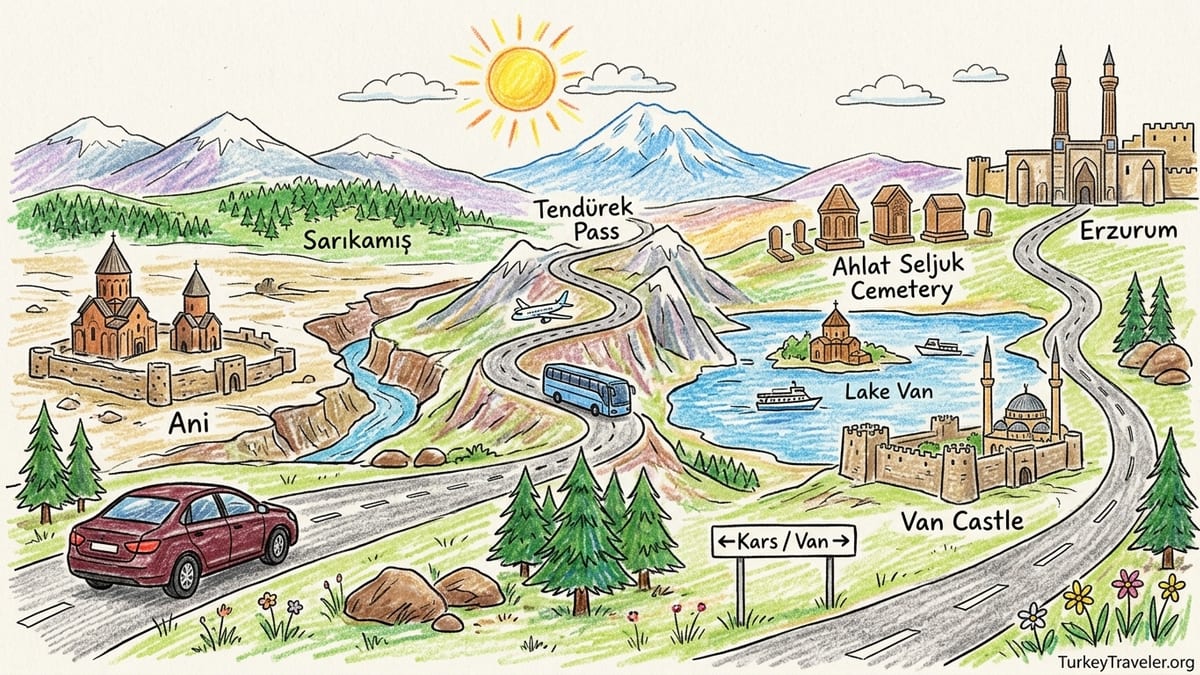
Why This Route Works: Kars to Erzurum via Van
The classic overland sequence in this part of Eastern Anatolia runs Van → Doğubayazıt → Kars → Erzurum, and many current agency itineraries still mirror this order. Reversing the loop to Kars → Ani → Doğubayazıt → Van → Ahlat/Bitlis → Erzurum keeps the same backbone but makes airport arrivals, one-way rentals and time in Ani a little easier to manage for independent travelers.
Kars and Erzurum both have busy domestic airports, usually with multiple daily flights from Istanbul and Ankara, and they anchor the north and west ends of the loop. Kars is roughly 42 to 47 kilometers from Ani by road, depending on where you measure the city limits, so you can comfortably base in Kars and dedicate a full day to Ani without changing hotels. Erzurum sits on the main highway and rail line west, making it a logical exit point when you are ready to fly back to the big cities.
In between, the D100 and D975 highways link Kars to Doğubayazıt over the high Tendürek Pass and then on to Van along the southern shore of Lake Van. The stretch between Doğubayazıt and Van is about 170 kilometers, and although the road is modern, several sections climb above 2,000 meters. These are real mountain distances: a 170-kilometer leg can easily take three hours or more, especially if you stop at viewpoints or cross in shoulder season when snowplows are still busy.
This route also strings together the region’s headline sites in a logical rhythm: Ani’s medieval Armenian ruins, İshak Paşa Palace and Ararat views above Doğubayazıt, Van Castle and Lake Van, Seljuk cemeteries around Ahlat and finally Ottoman and Russian-era architecture in Erzurum. If you have more time, side trips to Sarıkamış forests or Çıldır Lake fit naturally as short detours from the main loop.
Planning a Realistic Self-Drive Itinerary
A compact but realistic self-drive needs at least 7 full days on the ground, not counting flight days. One workable structure is: Kars (2 nights), Doğubayazıt (1 night), Van (2 or 3 nights with a day trip to Ahlat on the north shore of the lake), then Erzurum (1 or 2 nights). Attempting this in 4 or 5 days means long days in the car and little buffer for weather or roadworks.
From Kars, dedicate one full day to Ani. Driving the 42 to 47 kilometers out across the plateau takes roughly 40 to 50 minutes. Many travelers leave Kars around 9:00 or 10:00 in the morning, visit Ani for four or five hours, and return in late afternoon. That timing avoids the coldest early-morning winds and still leaves daylight for dinner back in Kars. It is also realistic if you are picking up a rental car at Kars Harakani Airport and only getting on the road mid-morning.
The next logical leg is Kars to Doğubayazıt, either via the more direct D080 / D100 to Ağrı and then south, or by cutting across smaller regional roads if conditions are good. Expect a solid 3 to 4 hours of driving, plus time for breaks and photo stops. From Doğubayazıt, you can tour İshak Paşa Palace and the surrounding viewpoints in a half day and then continue toward Van the following morning.
Van works well as a base for two reasons: there is a wider selection of mid-range hotels and car-rental desks than in Kars or Doğubayazıt, and day trips to Akdamar Island, Van Castle and Ahlat on the north shore are all feasible in a long day. For example, a self-driver might leave Van after breakfast, follow the highway along Lake Van’s northern shore to Ahlat, explore the medieval cemetery and lakeside villages, then loop back via Bitlis and Tatvan in the evening.
Road Conditions, Distances and Fuel on the Eastern Anatolia Loop
Most of the main highways on this loop are proper state roads, often dual carriageways near cities. Kars to Ani is a paved two-lane road that feels surprisingly engineered for such a remote endpoint, running through gentle farmland and steppe. The surface is generally good, but potholes and frost damage can appear after harsh winters, particularly on smaller village connectors.
The more challenging segments are the mountain passes. The road between Doğubayazıt and Van follows the D975 over Tendürek Pass and then across the high country around Lake Van. Here you are driving at altitudes above 2,000 meters for long stretches. In clear summer weather the road feels straightforward, but in late autumn, winter and early spring snow, fog and black ice can turn these distances into slow, tiring drives. It is not uncommon for trucks to crawl uphill, forcing overtakes you might skip if you are not used to mountain driving.
Fuel availability is generally reliable on the main legs. There are fuel stations on the Kars to Ani road before you leave town, in Doğubayazıt, and at regular intervals along the D100 and D975 corridors. However, it is still sensible to refill when you drop below half a tank, especially in winter or when driving at dusk. Prices fluctuate with the lira, but self-drivers report that filling a compact petrol car in Eastern Anatolia usually costs a little less than in Istanbul thanks to lower local demand and promotions.
Besides fuel, plan for your own snacks and water on long segments, particularly between Kars and Doğubayazıt and again between Doğubayazıt and Van. Roadside facilities exist, but they may be simple truckers’ lokantas and village tea houses rather than glossy service stations, especially outside high summer. Many travelers pack fruit, nuts and baked goods from Kars or Van to keep stops flexible.
Weather, Winter Driving and When to Reroute
Eastern Anatolia has a true continental climate: summers are warm, dry and often brilliantly clear, while winters are long, cold and snowy. Kars, Sarıkamış and Erzurum all sit on high plateaus where winter temperatures can dip well below freezing for weeks, and the ski resorts near Sarıkamış and Palandöken are known in Turkey for reliable snow. For drivers, that means that winter conditions are not a rare event but a defining feature of the season.
From roughly late November to March, expect snow and ice on shaded corners, drifted verges around passes and limited daylight. The Tendürek Pass section between Doğubayazıt and Van is particularly exposed, and high winds can build sudden snowdrifts. Snowplows keep the D975 open most of the time, but short-term closures or convoy controls can happen after heavy storms. Chains are sometimes mandatory on smaller side roads; even on main highways, rental companies may warn you against attempting night crossings immediately after snow.
Spring and autumn can be deceptive. In April or early May, Van and Lake Van’s shore may feel almost mild, with trees budding and cafés setting outdoor tables, while the mountains around Kars or Sarıkamış still have deep snowbanks. Similarly, October afternoons in Kars can be bright and crisp, but temperatures drop rapidly at dusk, and fog over high passes becomes more likely. Always check the local forecast in Turkish or through your hotel the night before long drives, and be ready to shuffle the order of your itinerary to prioritize lower passes or wait out a front.
If your main goal is smooth driving with minimal weather risk, late June through September is generally the easiest period for this loop. Days are long, the chances of snow on the road are low, and agricultural life around Kars, Ani and Ahlat gives the landscapes more texture. The trade-off is that the high plateau around Ani can feel hot and exposed at midday, so early starts and hats become important even though this is “the cool part of Turkey” by reputation.
Airport Pickups, One-Way Rentals and When a Driver Makes Sense
In practice, most independent travelers start this loop by flying into Kars Harakani Airport or Erzurum Airport. Domestic carriers frequently pack these routes with narrow-body jets rather than small props, and flights often arrive late morning or late at night. Airport car-rental desks in Kars are smaller than those in Erzurum or Van, but you can usually find at least one or two national brands plus a couple of local firms.
One-way rentals are technically possible between major Eastern Anatolia cities, but they can be expensive compared with coastal Turkey. Travelers pricing a car from, for example, Van with drop-off in Erzurum often report quotes that run several hundred euros for 7 to 10 days, versus well under 100 euros for the same dates in Antalya. The supplement reflects limited fleets and the cost of repositioning cars; it is not a glitch. If cost is a concern, compare a full loop that returns to the same airport against a one-way plan before committing.
For some travelers, especially those on very short itineraries or visiting in deep winter, hiring a private driver or joining a packaged tour can be easier than self-driving. A common example is someone flying into Van for a four-day break in February who wants to see Doğubayazıt and Kars. Rather than renting a car, fitting it with chains and watching the forecast obsessively, a practical alternative is to book a car with driver from a Van-based agency that regularly does Van–Doğubayazıt–Kars–Erzurum legs for small groups. They know where ice lingers, which petrol stations stay open late, and how to navigate any temporary police controls.
Organized tours also make sense if you are nervous about Turkish-only signage or do not want to negotiate city traffic in Van and Erzurum. While the highways are modern and well signposted, city centers can feel hectic, and parking near main attractions like Van Castle may not be intuitive. A driver or tour removes these frictions and lets you focus on views and photography. It is also a good choice if you are traveling solo and would feel more secure in remote areas around Ani or Tendürek Pass.
Optional Detours: Sarıkamış Forests and Lake Çıldır
Two worthwhile detours fit naturally into this loop if you have a couple of extra days: the pine forests and ski slopes of Sarıkamış, and the high-altitude waters of Lake Çıldır on the Kars–Ardahan road. Both are close enough to Kars to work as day trips or short overnights.
Sarıkamış lies roughly 55 to 60 kilometers from Kars, connected by both highway and rail. In winter, this is one of Turkey’s quieter ski centers, known for its dry, powdery snow and tree-lined runs. Many winter visitors land at Kars Harakani Airport, take a shuttle or pre-booked transfer to Sarıkamış in under an hour, and use the resort as a base for a few days before or after a broader Eastern Anatolia circuit. For self-drivers, the road is usually well cleared, but snow tires and an early start make the journey more comfortable.
Lake Çıldır, to the northeast of Kars, offers a very different kind of side trip. In summer its shores are green and pastoral, dotted with small lakeside restaurants serving grilled trout. In winter, the lake often freezes, and local families operate horse-drawn sled rides across sections of the ice whenever conditions allow. A realistic day trip from Kars involves driving toward Ardahan, spending a few hours on the lake and at village cafés, then returning to Kars before dark.
If you are short on time, it is better to pick just one of these detours rather than rush both. Sarıkamış pairs naturally with Erzurum and Palandöken for travelers focused on winter sports, while Çıldır is ideal if your interest leans more toward rural life and landscape photography than skiing.
When to Self-Drive and When to Join a Tour
Whether you should drive yourself or rely on local drivers depends less on your total travel experience and more on your comfort with three specific factors: mountain weather, long distances between services and the possibility of limited English support outside major towns. A confident driver from Colorado, Austria or New Zealand who is used to real winter conditions might feel perfectly at home on Tendürek Pass in March, while someone who has only driven in coastal or urban environments could find the same stretch exhausting.
Self-driving works best when you can give yourself time and flexibility. That means at least a week, a willingness to wait out a storm in Van or Kars and a buffer day before your onward flight. It also means choosing a vehicle classed as compact or mid-size with sound tires rather than chasing the cheapest possible small car. Many travelers find that simply paying a little extra for a car from a major national chain, even in Kars or Van, gives them more confidence about 24-hour support lines and clear insurance terms.
On the other hand, a private driver or small-group tour is almost always easier if your schedule is compressed. For example, if you only have three full days and want to cover Van, Doğubayazıt and Kars, a commonly marketed route by agencies, then trying to do the same as a self-driver means hours behind the wheel each day and little time at the sites. In that scenario, letting someone else handle the driving while you watch Mount Ararat slide by the window is simply more enjoyable.
Another time to consider organized options is if you are traveling with young children or elderly relatives. Long stretches on empty roads, toilet breaks at basic facilities and the need to carry snow gear in and out of a rental car can make days feel longer than the raw distances suggest. A driver who already knows where to stop for clean restrooms and warm meals can make the whole experience smoother for multi-generational groups.
The Takeaway
This Kars → Ani → Doğubayazıt → Van → Ahlat/Bitlis → Erzurum loop is not a fanciful line drawn on a map but a realistic self-drive based on the same backbone used by many packaged Van–Doğubayazıt–Kars–Erzurum itineraries. It strings together some of Eastern Anatolia’s strongest experiences: a walled medieval city on a windswept plateau, a palace above the plains of Ararat, a vast inland sea and quiet Seljuk graveyards, all connected by good roads that still cross genuine high country.
For travelers who enjoy long views, quiet roads and big skies, this route offers a rare mix of accessibility and remoteness. With a week or more, decent preparation and respect for winter weather, self-driving is not only possible but deeply rewarding. If your time is short or your trip falls in the heart of winter, handing the wheel to a local driver or joining a well-structured small-group itinerary can turn the same circuit into a more relaxed, low-stress experience.
Whichever version you choose, treat distances as mountain journeys rather than simple hours on a highway, keep your fuel and snacks topped up, and allow space in your schedule for unexpected village stops or weather delays. Eastern Anatolia’s appeal lies as much in these unscripted moments as in its marquee sights.
FAQ
Q1. How many days do I need for this Kars to Erzurum loop?
A1. Plan at least 7 full days on the ground for Kars, Ani, Doğubayazıt, Van, Ahlat and Erzurum, plus any extra time for Sarıkamış or Lake Çıldır side trips.
Q2. Is winter driving in Eastern Anatolia safe for visitors?
A2. It can be safe for experienced winter drivers, but snow, ice and high passes make conditions demanding. If you are unsure, consider a private driver or tour between November and March.
Q3. Do I need a 4x4 car for this route?
A3. In summer a regular compact or mid-size car is usually enough, as main roads are paved and well maintained. In winter, good tires and chains matter more than four-wheel drive for most travelers.
Q4. Can I see Ani as a day trip without changing hotels?
A4. Yes. Ani is around 42 to 47 kilometers from Kars by road, and most travelers visit as a relaxed day trip from a hotel in Kars rather than staying closer to the site.
Q5. Is one-way car rental between Van, Kars and Erzurum easy to arrange?
A5. It is usually possible through larger agencies but often comes with high one-way fees. Always compare a loop that returns to your arrival airport with a one-way rental before booking.
Q6. When is the best time of year for this road trip?
A6. Late June to September offers the most straightforward driving, long days and minimal snow risk. Spring and autumn are beautiful but can still bring sudden cold snaps at higher altitudes.
Q7. Are fuel and rest stops frequent on the route?
A7. Fuel stations and basic cafés appear at regular intervals on main highways, but long stretches feel remote. Topping up fuel at half a tank and carrying snacks is sensible, especially in winter.
Q8. Is it necessary to speak Turkish to self-drive here?
A8. It helps, but it is not essential. Road signs follow international standards, and many hotels can write addresses or instructions in Turkish for you. Patience and offline maps go a long way.
Q9. How does Lake Çıldır compare to Sarıkamış as a detour?
A9. Lake Çıldır suits travelers interested in landscapes, frozen-lake scenes and village life. Sarıkamış is better for those wanting skiing and forest walks plus easier connections to Erzurum.
Q10. Is it safe to park a rental car overnight in smaller towns?
A10. In most Eastern Anatolia towns it is common to park on the street or in front of hotels. Choosing central accommodation with its own small car park adds an extra layer of peace of mind.