


The Turkish Black Sea is one of the country’s most rewarding regions for independent travelers: green mountains dropping into a steel-blue sea, tea terraces climbing impossible slopes, and cool highland plateaus that feel a world away from the Mediterranean. Yet it is also a region where distances, weather and overtourism in a few hotspots mean you need a clear plan. This guide builds a selective route around Trabzon and the eastern highlands, then follows the coast west through Ordu, Sinop and Amasra, giving each stop a distinct role so you can match places to your time and travel style.
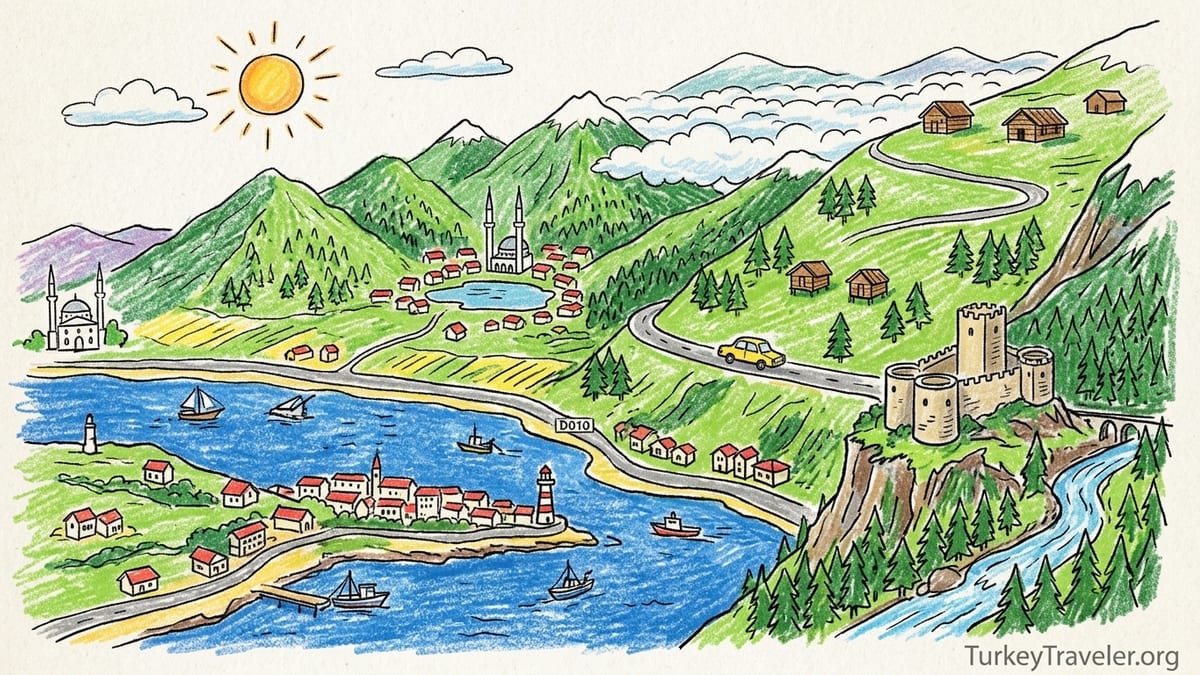
How to Structure a Black Sea Turkey Trip
Most travelers use Trabzon as a practical starting point. Its airport has frequent flights from Istanbul and Ankara, and from here you can reach Sümela Monastery in under an hour’s drive, Uzungöl in roughly two hours, and the Rize highlands in about three. That makes it the main city base for the eastern Black Sea. From Trabzon you can then either loop inland through the Kaçkar Mountains or follow the D010 coastal road west toward Ordu, Sinop and Amasra.
A realistic one-week itinerary might look like three nights in Trabzon (for the city and Sümela, plus a day trip to Uzungöl), two nights based in Rize or Çamlıhemşin for Fırtına Valley and the Ayder side plateaus, then two or three nights moving slowly along the coast, breaking the journey in Ordu and Sinop before ending in Amasra. With ten days you can add an extra highland stay around Pokut or Huser and spend more time in the Kaçkar interior.
Budget-wise, travelers report midrange city hotels in Trabzon starting around the equivalent of 60 to 90 US dollars per night in 2026 for a central double with breakfast, while simple wooden bungalows in Ayder or Uzungöl often range from 80 to 130 dollars in high summer, especially on weekends when domestic tourism peaks. Public buses and minibuses still make it possible to travel cheaply, but in practice many visitors either rent a car at Trabzon Airport or join local day tours for the more remote valleys and plateaus.
Weather shapes everything here. Even in July, coastal cities like Trabzon and Rize can be humid with passing showers, while plateaus such as Ayder sit at over 1,300 meters and can feel chilly in the evenings. Travelers swapping shorts for a fleece and waterproof jacket at the same time of year is entirely normal. Pack layers, and check forecasts a day ahead before committing to a long highland drive.
Trabzon: Essential City Base
Trabzon is not a resort town in the classic sense, but rather a working Black Sea port with an energetic center, waterfront parks and a scattering of historic sites that make it an effective and atmospheric base. The airport lies close to the city, so you can land and be checked into a hotel near Meydan Parkı, the main square, within 20 to 30 minutes by taxi or ride-hailing service. From this compact area you can walk to restaurants, simit bakeries, the bazaar and seafront promenade, and you are well placed for early starts to Sümela or Uzungöl.
In practical terms, staying in the city center gives you the widest choice of accommodation and tour options. Local agencies advertise daily departures to Sümela Monastery, Uzungöl and Ayder on signs around Meydan, while car rentals have counters both at the airport and in the downtown area. Travelers who have tried to stay exclusively in mountain villages often find it easier to keep Trabzon as a hub and visit highland spots on day trips or short overnight stays.
Within Trabzon itself, you can easily fill a spare afternoon exploring landmarks such as the Hagia Sophia of Trabzon, a small church-museum with Byzantine frescoes, or Atatürk Köşkü, a white villa in a hilltop garden that gives a sense of the city’s early 20th century history. Zağnos Valley Park cuts a surprising green corridor through the city beneath surviving sections of the old walls, and is a good place to stretch your legs after a long bus ride along the coast.
For food, Trabzon is where many travelers first encounter regional dishes like anchovy pilaf in season, kuymak (a stretchy cornmeal and cheese dish) and sütlaç rice pudding, especially if you take a side trip to nearby Hamsiköy, which is locally famous for its baked version. Prices in 2026 for a hearty local meal in a modest lokanta typically start from the equivalent of 8 to 12 dollars, with waterfront restaurants and cafes trending higher.
Sümela Monastery and Altındere Valley: Historical Stop in the Cliffs
South of Trabzon, in the forested Altındere Valley National Park near Maçka, Sümela Monastery clings to a sheer cliff around 1,200 meters above sea level. This former Greek Orthodox monastery, now a museum, is one of Turkey’s most photographed religious sites, and its position above a deep, wooded gorge is as much a draw as its frescoed interiors. Most visitors drive or join a tour from Trabzon, taking about 45 minutes along a winding road that follows the river into the national park.
Private cars and buses park at a designated area below the rock face, from where shuttle minibuses or a steep path lead up toward the complex, depending on current park regulations. On busy summer days, especially weekends and public holidays, queues for the shuttle can be long, so arriving early in the morning often makes for a calmer experience and better light on the cliff. Inside the monastery precinct, you can peer into rock-cut chapels and view weathered frescoes, but part of the experience is also simply standing on the terrace and looking back along the valley.
Entrance fees to both the national park and the monastery are collected at the gate, and change from year to year, so it is worth checking current prices as part of trip planning rather than relying on older blog posts. As a rough guide, by mid-2020s standards travelers should expect to pay a modest combined fee that is small compared with the cost of transport to reach the site. Simple cafes and tea houses cluster around the parking area near the river, serving gözleme pancakes and tea at prices similar to other rural tourist spots in Turkey.
Because Sümela lies on a separate road to Uzungöl and Rize, most itineraries treat it as its own half-day or day-long excursion from Trabzon, rather than combining it with another major destination. If you are driving, it is feasible to visit Sümela in the morning, return to Trabzon for a late lunch, and still have time for an evening stroll along the seafront or an onward drive west toward Ordu.
Uzungöl and the Haldizen Valley: Lake Stay and Mountain Gateway
Uzungöl, “the long lake,” sits in a steep-sided valley about 100 kilometers south of Trabzon, reached via Çaykara along a road that twists higher into the mountains. The classic image is of a mosque’s twin minarets reflected in still water, wooden hotels rising along the shore, and forested slopes enclosing everything in deep green. In reality, especially in July and August, it can feel more like a busy alpine resort, with souvenir stands, quad-bike rentals and crowded promenades. With expectations set accordingly, it still makes a memorable base to experience the Black Sea mountains.
Many travelers choose to stay at least one night around the lake rather than visiting as a quick photo stop. Simple family-run guesthouses and midrange hotels line the northern shore and the road that climbs to viewing terraces and artificial waterfalls above the village. A typical lakeside hotel with breakfast in high season can cost as much or more than equivalent city accommodation, reflecting strong domestic demand. Booking platforms often show availability, but last-minute walk-ins are common outside peak summer and major holidays.
What makes Uzungöl particularly valuable is its connection to the upper Haldizen Valley and a cluster of glacial lakes often referred to collectively as Yedigöller. From the settlement, a rough road extends up the valley toward mountain pastures and, with a combination of vehicle transfers and hiking, visitors can reach high-altitude lakes like Aygır and Balıklı, where temperatures drop sharply and the air feels clear even on hot coastal days. Organized tours and local drivers based in Uzungöl increasingly promote these upper valley excursions as a way to escape the crowds and see a wilder side of the region.
Concerns about overtourism and environmental pressure around the lake itself have grown in recent years, and local authorities have designated Uzungöl and surrounding plateaus as a special protected area while planning new facilities to spread tourism more evenly across the year. For travelers, the most practical response is to visit outside peak weekends if possible, respect local rules on noise and driving near the lake, and consider allocating more of your time to the higher, less developed sections of the valley.
Rize Tea Country, Fırtına Valley and Ayder: Highland Circuit
East of Trabzon, the province of Rize is synonymous with Turkish tea. Driving the coastal road toward Rize city, then turning inland near Çamlıhemşin, you quickly move from sea-level humidity into a labyrinth of narrow valleys lined with tea terraces, stone arch bridges and wooden houses. GoTürkiye’s own promotional routes cluster Fırtına Valley, Ayder Plateau, Huser, Avusor, Pokut, Zilkale and Palovit Waterfall together, reflecting how this compact region functions as a single highland circuit rather than a scatter of isolated destinations.
Fırtına Valley itself works best as a nature destination and base for short adventures. The Fırtına River has become a hub for rafting and zipline operators, with roadside bases renting helmets and life jackets to groups who want an hour or two on the water. Above the river, old Ottoman-era stone bridges arc across side streams, and small pensions, bungalows and eco-lodges dot the slopes. Prices in 2026 for a basic riverside bungalow with breakfast typically sit below what you might pay in Uzungöl or Ayder, making it attractive for longer stays.
Ayder Plateau, at roughly 1,350 meters, is the most established highland stay in the area. Its main street runs parallel to a fast-flowing stream, with hotels, guesthouses, bakeries and kebab houses lining the slope. In summer it comes alive with families escaping heat from Istanbul or the Middle East, while in shoulder seasons it can feel closer to a sleepy village surrounded by cloud forests. Travelers often use Ayder as a jumping-off point for higher plateaus like Huser and Avusor, which offer wider panoramas over the Kaçkar range and, on clear days, the famous sea of clouds at sunrise and sunset.
Pokut and nearby Sal plateau, overlooking deep valleys and ridges of spruce, embody the classic postcard view of the eastern Black Sea highlands: wooden chalets scattered along a grassy ridge, mountains fading into blue distance. Access, however, is via steep, sometimes rutted tracks, so many visitors tackle them in 4x4 vehicles arranged through local guesthouses or tours rather than driving their own rental cars. Zilkale, a restored stone fortress perched on a rocky outcrop above the forest, and Palovit Waterfall, which plunges into a misty pool in a narrow gorge, add historical and scenic variety to a Fırtına-based stay.
Kaçkar Mountains: Serious Nature Destination
The Kaçkar Mountains rise above the eastern Black Sea coast, reaching close to 4,000 meters in their highest peaks and forming one of Turkey’s most important alpine hiking regions. For most travelers, the Kaçkar is less about summiting major peaks and more about experiencing multi-day trekking routes between plateaus, glacier-fed lakes and shepherds’ camps. Towns such as Çamlıhemşin in Rize province and Yusufeli in neighboring Artvin act as gateways, with local guides, transport options and basic gear rentals available in season.
Weather in the Kaçkar can be unpredictable even in midsummer. Afternoon fog rolling in to cover a previously clear ridge, sudden showers and cold nights at higher campsites are all common. This is a region where it pays to carry proper boots, waterproofs and warm layers, and not to rely solely on the light clothing that may feel appropriate in coastal cities. Local guide services can advise on realistic daily distances given trail conditions, your fitness and the time of year, and can help arrange transfers between trailheads where public transport is limited.
Classic trekking routes link plateaus such as Yukarı Kavrun, Dilberdüzü and the lakes beneath Kaçkar summit, as well as connecting the Rize side of the range with Artvin valleys to the east. For travelers who do not have several days to commit, it is still possible to get a taste of the Kaçkar environment on long day hikes from Ayder or from high roadheads reached by shared minibus or hired vehicle. In recent years, regional tourism planners have also begun highlighting winter sports and ski-touring potential on some slopes, though facilities remain modest compared with established European resorts.
Because services, signage and emergency support thin out quickly once you leave the main plateaus, independent hikers should treat the Kaçkar with the same caution they would any serious mountain area. Inform your accommodation of planned routes, watch local weather forecasts rather than national averages, and do not hesitate to turn back if cloud or rain threaten to close in on an exposed ridge. A few days here can be the highlight of a Black Sea trip, but only with realistic planning.
Ordu, Sinop and Amasra: Coastal Stops to Slow Down
West of Trabzon, the Black Sea coast gradually becomes less dominated by steep, forested valleys and more open to gentler hills and sandy coves. Ordu, a mid-sized city built around a broad bay, works well as a first coastal stop when heading west. A cable car glides from the seafront up to Boztepe hill, giving a wide view back over the city and shoreline, and there are several urban beaches where locals swim on warm days. Accommodation prices here tend to be lower than in the eastern highland hotspots, and the atmosphere more relaxed.
Continuing along the coastal highway, Sinop occupies a small peninsula that juts into the Black Sea and feels undeniably maritime, with fishing boats, a small harbor and an old fortress. Several sandy beaches lie within easy reach of town, and some travelers choose to base themselves in simple pensions or small hotels that look directly onto quiet bays. For couples or solo travelers who find Trabzon busy but still want an authentic Black Sea city experience, Sinop can be a good compromise, combining walkable streets with easy access to nature.
Further southwest, Amasra is one of the most charming small towns on Turkey’s Black Sea coast, wrapped around twin bays and backed by green hills. Recent traveler reports consistently mention strolling the waterfront in the evening, watching fishing boats come and go, and lingering over grilled fish dinners at open-air restaurants. The town’s compact size makes it ideal for two or three nights of slower travel at the end of a longer itinerary, when you may want to exchange highland drives for simple beach walks and quiet mornings.
Because Ordu, Sinop and Amasra lie well west of the Trabzon and Rize cluster, not everyone will have time to include them on the same trip. Travelers flying in and out of Istanbul sometimes choose to start in Trabzon and finish in Samsun or Ordu before flying back, while road trippers with ten days or more can realistically link Trabzon, the eastern highlands and these coastal stops in a single loop.
Practical Tips for Moving Between City Bases, Highlands and Coast
Transport along Turkey’s Black Sea coast is dominated by the D010 highway, with frequent intercity coaches and smaller buses connecting major cities such as Trabzon, Rize, Ordu and Sinop. For example, you might pay a modest fare equivalent to under 20 dollars for a several-hour bus ride between Trabzon and Sinop, depending on company and season. These buses are comfortable, with reserved seats and tea or coffee service, but they mostly stay on the main coastal road rather than venturing into mountain valleys.
To reach Sümela, Uzungöl, Ayder or plateaus like Pokut and Huser, your choices narrow to rental cars, local minibuses that run at fixed times, private transfers and organized tours. Hiring a car from Trabzon Airport for a few days gives maximum flexibility, but you should be prepared for narrow, winding roads, frequent rain and fog, and limited parking in small villages during high season. Travelers who are not comfortable driving in such conditions often find that joining a locally run day tour for around 40 to 80 dollars per person, depending on inclusions, offers a reasonable balance of cost and convenience.
Cash and cards are widely accepted in cities, but smaller highland guesthouses and village shops sometimes prefer cash, especially for small transactions. Mobile coverage is generally good along major roads and in larger towns, but can drop out in deep valleys or at higher elevations in the Kaçkar. Downloading offline maps, including alternative routes back to the coast, is a sensible precaution if you plan to drive yourself between plateaus.
Seasonality affects not just weather but also what is open. Many highland bungalows and small eateries in Ayder, Pokut or around Haldizen Valley close outside the main summer and early autumn months. When traveling in May, October or later, it is worth confirming that your intended accommodation is operating, and checking whether plateaus like Huser are accessible without snow or road closures. In contrast, coastal cities like Trabzon, Rize and Sinop remain active year-round, making them safer bases in shoulder seasons.
FAQ
Q1. How many days do I need to see Trabzon, Sümela and Uzungöl?
Most travelers are comfortable with three full days: one focused on Trabzon city sights, one for Sümela Monastery and Altındere Valley, and one for Uzungöl and the upper Haldizen Valley.
Q2. Is Uzungöl still worth visiting given the crowds and development?
Yes, if you treat it as a lively mountain resort rather than a remote lake. Staying overnight, visiting on weekdays, and exploring higher into Haldizen Valley can help you escape the heaviest crowds.
Q3. Where should I base myself for the Rize highlands and Fırtına Valley?
Many visitors choose Ayder Plateau for easy services, while others prefer riverside lodgings in Fırtına Valley or small guesthouses in Çamlıhemşin for a quieter, more nature-focused base.
Q4. Do I need a car to explore the Kaçkar Mountains and eastern plateaus?
A car offers flexibility, but it is not essential. You can combine intercity buses with local minibuses, private transfers and guided tours to reach plateaus like Pokut, Huser or Avusor.
Q5. What is the best time of year to visit Black Sea Turkey?
Late June through September generally offers the most reliable conditions for highland roads and hiking, though showers are possible year-round and evenings in the mountains remain cool.
Q6. Are Ordu, Sinop and Amasra good alternatives to staying longer in Trabzon?
They are good complements rather than strict alternatives. Ordu and Sinop provide relaxed city beaches, while Amasra is ideal for a slower, scenic finale after the more intense eastern highlands.
Q7. How expensive are accommodation and food compared with Istanbul?
City hotels and meals in Trabzon or Rize are often slightly cheaper than in central Istanbul, while high-demand lake and plateau areas like Uzungöl and Ayder can be similar or higher in peak season.
Q8. Is it safe to drive in the Black Sea region’s mountains?
Roads are generally well maintained but narrow, winding and often wet. Confident drivers manage fine with caution, but nervous drivers should consider tours or private transfers for highland sections.
Q9. Can I swim in the Black Sea at these destinations?
Yes, especially around Ordu, Sinop and Amasra, where there are established beaches. The coast near Trabzon and Rize has fewer classic swimming spots but some local beaches and swimming areas exist.
Q10. How can I avoid overtourism impacts when visiting these places?
Travel outside peak weekends, choose locally owned stays, keep noise and litter to a minimum, favor less crowded plateaus, and respect signposted restrictions around lakes, forests and religious sites.