

The Aegean coast of Turkey offers one of the most concentrated stretches of classical history in the Mediterranean. Within a day’s drive of İzmir you can stand in the theatre where Saint Paul preached at Ephesus, ride a cable car up to Pergamon’s cliffside acropolis and watch the sun set over the Doric columns of Assos. With smart route planning, a rental car or targeted guided tours, it is possible to link these sites into a coherent cultural journey without turning your holiday into a frantic tick‑box chase.
Choosing Your Base: İzmir, Kuşadası or On the Road
Most travelers begin an Aegean archaeology trip by flying into İzmir’s Adnan Menderes Airport, which has frequent domestic links from Istanbul and seasonal international services. From here you have two main base strategies. One is to stay in İzmir itself for urban dining and nightlife, then take day trips or overnight loops to the ruins. The other is to head straight to the resort town of Kuşadası or to small inland hubs such as Selçuk or Bergama that sit closer to the major sites.
İzmir works well if you want a big city atmosphere, seafront promenades and an easy arrival day. The city is about 80 kilometers from Ephesus by road, typically a 1 to 1.5 hour drive depending on traffic. That makes a long but doable day trip if you join a group tour or hire a private driver. Several large Turkish and international agencies offer İzmir hotel pickups that include transport, guiding and entrance fees to Ephesus and nearby House of the Virgin Mary, though you will pay a premium for the extra distance compared with starting from Kuşadası or Selçuk.
Kuşadası is the classic base for cruise passengers and holidaymakers focused on Ephesus. The resort sits roughly 18 kilometers from the ancient city, about a 15 to 20 minute drive on modern roads, which means you can easily be at the lower gate shortly after opening time even with a relaxed breakfast. The town has a huge range of midrange all‑inclusive hotels, small pensions and apartment rentals, and you can walk from many properties to the port or minibus stands. For budget travelers, Kuşadası also offers competitive car rental rates and frequent minibuses to Selçuk.
For a broader circuit that includes Pergamon and Assos, many independent travelers choose a moving base rather than returning to one hub each night. A common pattern is one or two nights in İzmir, two nights around Selçuk or Kuşadası for Ephesus and nearby sites, one or two nights in Bergama to explore Pergamon, then one night in Behramkale (modern village above Assos) before looping back. This approach shortens daily driving and lets you experience evenings in smaller Aegean towns that most cruise visitors never see.
Self‑Drive vs Guided Tours on the Aegean Archaeological Route
Deciding between self‑drive and guided tours comes down to your comfort with Turkish roads and how deeply you want to interpret what you see. The main highways between İzmir, Selçuk, Kuşadası and Bergama are modern, well signposted and generally easier to navigate than many expect. Recent trip reports describe the Aegean coastal roads as wide and comparatively quiet outside İzmir’s urban sprawl. Fuel prices are significant, but rental car rates remain attractive, especially if you are sharing costs between two or more people.
Major rental brands such as Avis, Enterprise and Sixt operate at İzmir airport alongside Turkish companies; compact automatic cars often price in the range that makes four or five days of rental comparable to two full‑day private tours. There are also local agencies in Kuşadası and Selçuk which can be convenient if you want to spend the first day on a guided Ephesus tour and then pick up a car afterward. When comparing, check excess amounts and whether cross‑province one‑way rentals carry surcharges if you are dropping the car in Istanbul or another city.
On the guided side, Ephesus is exceptionally well served. From Kuşadası cruise port, shared group excursions are widely available that include transport, a professional guide and timed visits to the main site, the Terrace Houses and the House of the Virgin Mary. These can be good value for solo travelers, and they remove the stress of parking and navigation on a tight cruise schedule. Independent travelers often book a private English‑speaking guide who meets them at the site entrance, which is particularly useful for understanding the crowded Terrace Houses and the religious context of early Christian remains.
Pergamon and Assos see fewer day‑trip buses, so here a car or at least prearranged driver becomes more useful. Pergamon’s sights are spread between the hilltop Acropolis, the lower Asclepion healing sanctuary and the Red Basilica in modern Bergama. Local taxis can shuttle you between these points for modest fares, but having your own car allows more flexibility to time the Acropolis for early morning or late afternoon light. Assos, reached by narrow winding roads in the Çanakkale province, is easiest with a rental car; organized tours from İzmir or Kuşadası exist but often involve long hours in a coach for limited time on site.
Ephesus and Surroundings: A Full Day from Selçuk or Kuşadası
Ephesus, inscribed on the UNESCO World Heritage list, is the anchor of almost every Aegean itinerary. The archaeological site lies a short drive from Selçuk town and about 18 kilometers from Kuşadası. The classic visiting strategy is to be at the Upper Gate shortly before the 08:00 opening, then work downhill through the site to the Lower Gate over three to four hours. If you are driving, a practical trick is to park at the lower car park, take a quick taxi up to the upper entrance and then walk slowly back to your vehicle, avoiding a hot uphill slog at the end of your visit.
Entrance prices at Turkish state museums and ruins change frequently, but recent schedules from the Ministry of Culture indicate that headline sites such as Ephesus are among the more expensive in the country and are sold on a per‑site basis. Budget for the main site ticket plus an additional fee for the Terrace Houses, which are housed under a modern protective roof and require around 45 minutes to see properly. Many visitors consider the Terrace Houses, with their mosaics and frescoes, the most atmospheric part of Ephesus and worth adjusting your daily budget to include.
From Kuşadası, you can visit Ephesus comfortably in a half day, but a richer program uses a full day in the area. After the main site, many travelers continue up into the hills to the House of the Virgin Mary, a small chapel and pilgrimage spot in a shaded setting, before returning via Selçuk. In town you can visit the excellent Ephesus Museum, the Basilica of Saint John and the remains of the Temple of Artemis. Staying overnight in Selçuk or in the nearby wine village of Şirince allows you to break up the sightseeing with an unrushed dinner and wander through Old Town streets once the day‑trip coaches have gone.
Getting to Ephesus without a car is straightforward. Regular minibuses run between Kuşadası and Selçuk, dropping passengers within easy reach of the site access road. From İzmir, you can combine commuter trains and taxis: suburban services link city stations with Selçuk in around an hour, and from there short taxi rides cover the last few kilometers. Tour operators can also organize private transfers from İzmir hotels or airport, which can make sense if you are tight on time and plan to fly onward the same evening.
Pergamon: Hilltop Drama Above Bergama
Pergamon, near the modern town of Bergama north of İzmir, provides a striking contrast to Ephesus. While Ephesus spreads across a valley floor, Pergamon’s Acropolis clings to a steep ridge with sweeping views over the Bakırçay Plain. The site is known for its dramatically steep ancient theatre, long colonnades and the foundations of the Great Altar, elements that give a sense of the city’s former power even though many sculptural details now reside in museums abroad.
Visiting Pergamon is usually a full‑day excursion even with a car. From İzmir the drive is around 2.5 hours each way, mostly along multi‑lane highways. Many travelers break the journey by staying a night in Bergama’s small guesthouses, which are often converted Ottoman houses in pedestrian lanes below the Red Basilica. A cable car now connects the lower town with the Acropolis, providing an easier ascent and a scenic approach for those who prefer not to drive up the narrow, winding access road.
Tickets for Pergamon’s different zones are sold separately, typically one for the Acropolis and another for the Asclepion healing center outside town. Because official prices can change seasonally, it is wise to check current rates on the state museum information pages shortly before travel and to allow for modest increases when setting your budget. Audio guides are sometimes available at the gate, but hiring a local guide or using a well‑researched guidebook can greatly enhance your understanding of features that are less self‑explanatory than Ephesus’s marble streets.
Logistically, Pergamon fits well between İzmir and Assos on a northbound route. One popular pattern is to leave İzmir in the morning, spend the afternoon on the Acropolis, stay overnight in Bergama, then visit the Asclepion for an hour or two the next morning before continuing toward the Gulf of Edremit and Assos. Drivers should plan fuel and daylight carefully, as rural sections north of Bergama are slower and more winding than the main highway south.
Assos and the North Aegean: Ruins with Sea Views
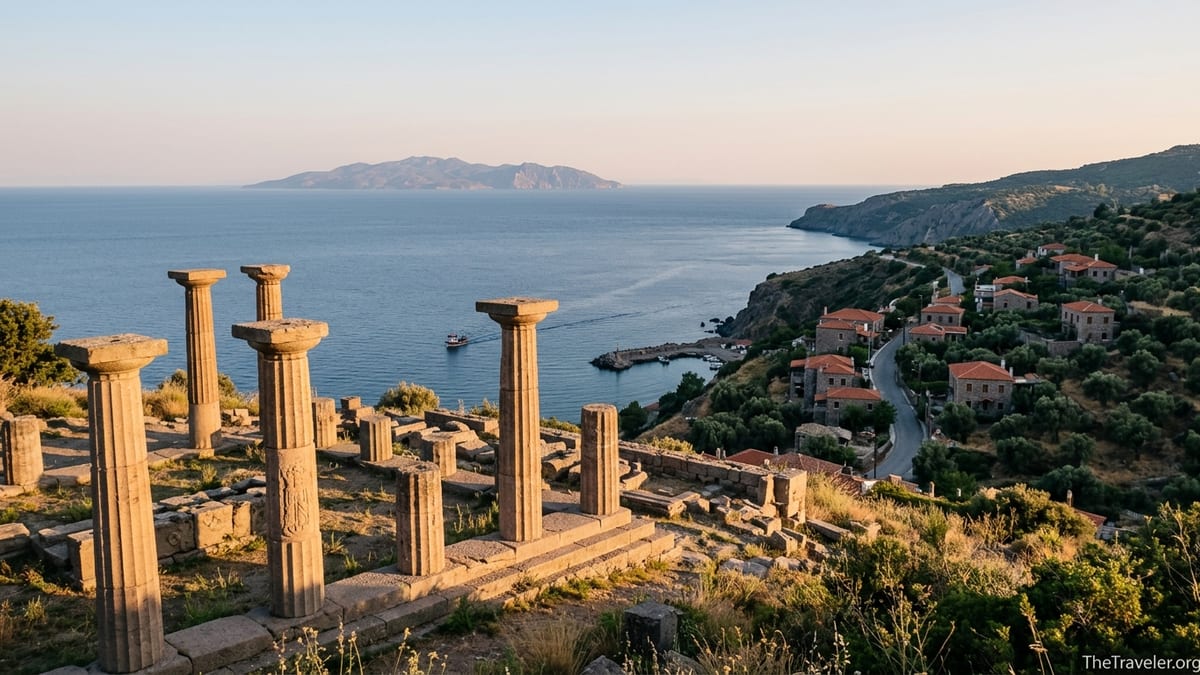
Assos, near today’s tiny village of Behramkale in Çanakkale province, is a smaller site than Ephesus or Pergamon but wins many hearts with its setting. The ruins of the Doric Temple of Athena sit at the highest point of a rocky promontory, with open views over the Aegean toward the Greek island of Lesbos. Below, an old stone harbor is lined with small hotels and seafood restaurants where you can stay right by the water.
Reaching Assos by public transport from İzmir or Kuşadası is possible but involves bus changes; for most travelers it is a natural stop on a road trip heading toward Troy or the Dardanelles. The main archaeological zone, often referred to as Assos Örenyeri, has a ticketed entrance near Behramkale village. Recent information from the Ministry of Culture lists standard opening hours beginning around 08:30 in season, with closing times shifting earlier outside summer. Because the hilltop is exposed and can be very hot at midday, early morning or the hour before sunset are the most pleasant times to visit.
Accommodation choices cluster in two areas: simple pensions in Behramkale itself, often in old stone houses with views toward the sea, and boutique hotels down at the harbor, which is connected to the upper village by a steep road. In practice, many travelers choose to arrive in the afternoon, stroll through the village, visit the acropolis at sunset and then have dinner of grilled fish or meze by the waterfront. The next morning can be reserved for a swim and a relaxed breakfast before driving on.
Historically minded travelers might link Assos with a wider north Aegean loop including the ruins of Troy near Çanakkale and the less‑visited coastal towns along the Gulf of Edremit. For those on tighter schedules, however, even a single night in Assos adds a very different flavor to an itinerary built mainly around larger sites. The combined experience of sea, small‑village life and Greek‑era ruins helps balance the more monumental urban remains of Ephesus and Pergamon.
Building a Realistic Multi‑Day Aegean Itinerary
For first‑time visitors combining Ephesus, Pergamon and Assos, a week is an ideal minimum, though it can be compressed to five nights if needed. A balanced seven‑night itinerary might begin with one or two nights in İzmir to recover from flights and explore the city’s waterfront, bazaar and local restaurants. From there you could either join a long guided day trip to Ephesus or, more comfortably, travel south to Selçuk or Kuşadası for two nights dedicated to the Ephesus area.
Using Selçuk or Kuşadası as a base, devote one full day to Ephesus and the Terrace Houses, plus nearby sites such as the House of the Virgin Mary and the Ephesus Museum. A second day might include an excursion into the hills to Şirince or a coastal drive, leaving the evening free for dinner by the sea. If you are self‑driving, this is a good point to pick up or drop off the rental car depending on your broader route; some travelers prefer to use public transport to Ephesus and only start driving when they set out toward Pergamon and Assos.
From the south, you can return through İzmir and continue to Bergama for one or two nights. This gives you time for a half‑day at the Pergamon Acropolis, a few hours at the Asclepion and perhaps a visit to the Red Basilica in town. After Bergama, another half‑day drive takes you along rural roads and coastal stretches to Assos, where a final night by the sea makes a satisfying conclusion before looping back toward İzmir or continuing north to Çanakkale and Istanbul.
Travelers with only five nights might adopt a more concentrated version: fly into İzmir, head directly to Selçuk or Kuşadası for two nights, then drive or take a tour to Bergama for a night, continue to Assos for one night and finally return to İzmir for a last evening before departure. The key to avoiding burnout is to limit yourself to one major archaeological site per day, even if distances look short on the map, because summer heat and uneven stone surfaces can be tiring.
Costs, Practicalities and Seasonal Considerations
Turkey remains relatively good value for cultural travelers, but costs have risen quickly in recent years, especially in euro‑ and dollar‑denominated terms. Entrance fees at marquee sites such as Ephesus and Pergamon are now aligned more closely with Mediterranean peers; combined with the separate charge for Ephesus Terrace Houses, two people can easily spend the equivalent of a modest hotel night on site tickets in a single day. To manage this, many travelers prioritize a handful of top‑tier sites and complement them with lower‑cost village walks, free coastal viewpoints and local markets.
Accommodation in İzmir, Kuşadası, Bergama and Assos spans everything from basic guesthouses to boutique hotels. In İzmir, neighborhoods around Alsancak and Konak put you close to the seafront promenade and tram lines, with midrange hotel rooms commonly priced in a band that compares favorably with Western Europe but more expensive than small‑town stays. Kuşadası has a wide spectrum that includes budget pensions a few streets back from the water and larger resorts with pools and included breakfast. In Bergama and Behramkale, characterful stone houses and family‑run pensions dominate; while facilities are simpler, the chance to eat home‑cooked Aegean meals in a courtyard is part of the appeal.
Seasonality is crucial. From late June through August, daytime temperatures at exposed ruins often exceed 30 degrees Celsius, making early starts and long midday breaks almost essential. Spring and autumn, roughly April to early June and late September to October, offer milder weather and thinner crowds. Many official archaeological sites operate on extended summer hours, typically opening around 08:00 and closing closer to sunset, then shorten their days in winter. Because specific hours can change with little notice, it is wise to confirm a day or two ahead using current local information and to avoid planning last‑light arrivals at lesser‑visited sites.
Payment systems are modern across the region. Major museum and site ticket offices accept credit and debit cards, although it is still sensible to carry some Turkish lira for smaller parking lots, local cafés and rural petrol stations. Mobile connectivity is generally good on main roads and in towns, but can drop along some coastal stretches; downloading offline maps for İzmir province and Çanakkale province before you drive will reduce stress when navigating to trailheads and minor viewpoints.
The Takeaway
Planning an Aegean Turkey ancient sites itinerary that links Ephesus, Pergamon, Assos and the coastal hubs of İzmir and Kuşadası is entirely feasible without rushing, provided you align your ambitions with the realities of distance, heat and site opening hours. Using İzmir for a soft landing, Kuşadası or Selçuk as a base for Ephesus, and one‑night stops in Bergama and Assos allows you to experience both headline ruins and quieter corners of the coast.
Whether you choose guided tours, a rental car or a mix of both, the key is to limit each day to one major archaeological visit, start early and leave space for the simple pleasures that define the region: an evening walk on the seafront, coffee in a shaded square, or dinner of fresh fish beside a harbor that has seen travelers come and go for millennia. With a realistic multi‑day plan, the Aegean’s layers of Greek, Roman and early Christian history become not just a checklist of sites, but a coherent story that unfolds at a manageable pace.
FAQ
Q1. How many days do I need to visit Ephesus, Pergamon and Assos comfortably?
Most travelers find that seven nights allows a relaxed pace with one or two nights each in İzmir, the Ephesus area, Bergama and Assos, though a tighter five‑night version is possible if you accept some longer driving days.
Q2. Is it better to base myself in İzmir or Kuşadası for visiting Ephesus?
Kuşadası and nearby Selçuk are closer to Ephesus and make for shorter, less tiring days, while İzmir suits travelers who want big‑city amenities and do not mind a longer day trip or an overnight loop.
Q3. Do I need a rental car to follow this Aegean archaeological route?
No, but a car adds flexibility, especially for Pergamon and Assos. Ephesus is easy by tour, train plus taxi or minibus, while Pergamon and Assos are more convenient and time‑efficient with self‑drive or a hired driver.
Q4. Are guided tours worth the extra cost at Ephesus and Pergamon?
At Ephesus many visitors feel a guide or detailed audio guide is worthwhile, particularly for the Terrace Houses. At Pergamon, where the remains are more fragmented, a knowledgeable guide can help you visualize the ancient city and understand the significance of each zone.
Q5. What is the best time of year to travel this route?
Spring and autumn, roughly April to early June and late September to October, offer cooler temperatures, softer light and more manageable crowds. High summer is still possible but requires early starts and generous water and sun protection.
Q6. How expensive are entrance fees to the main archaeological sites?
Entrance fees for Ephesus and Pergamon are now comparable to major Mediterranean sites elsewhere, and Ephesus Terrace Houses carry a separate charge, so two people can easily spend the equivalent of a modest hotel night on tickets in a single busy sightseeing day.
Q7. Can I visit Ephesus as a half‑day trip from a cruise stop in Kuşadası?
Yes. With an early disembarkation you can reach Ephesus in 20 minutes, spend three to four hours at the site including the Terrace Houses, and still return to Kuşadası for a late lunch or shopping before your ship departs.
Q8. Are the sites suitable for travelers with limited mobility?
Sections of Ephesus and Pergamon have uneven stone surfaces, slopes and steps, which can be challenging. Some viewing areas near the entrances are more accessible, but travelers with mobility issues should plan shorter visits, allow extra time and consider private guiding for tailored pacing.
Q9. Is it safe to drive between İzmir, Bergama and Assos?
Main highways are modern and generally well maintained, and recent visitor reports describe driving conditions as straightforward. Caution is needed on rural stretches, around livestock and in village centers, and it is wise to avoid long drives after dark on unfamiliar roads.
Q10. How should I handle money and payments on this route?
Credit and debit cards are widely accepted at official ticket offices, fuel stations and larger hotels, but carrying some Turkish lira is important for smaller guesthouses, parking lots, local cafés and village shops, especially around Assos and rural areas.