


Eastern Anatolia rewards travelers who like their landscapes vast, their history layered and their tourism infrastructure just developed enough to be comfortable without feeling overrun. This selective guide focuses on how to structure a trip around four practical bases Kars, Van, Doğubayazıt and Erzurum and the standout excursions that orbit them, from the ruined medieval capital of Ani to the island church of Akdamar and the frozen expanse of Lake Çıldır.
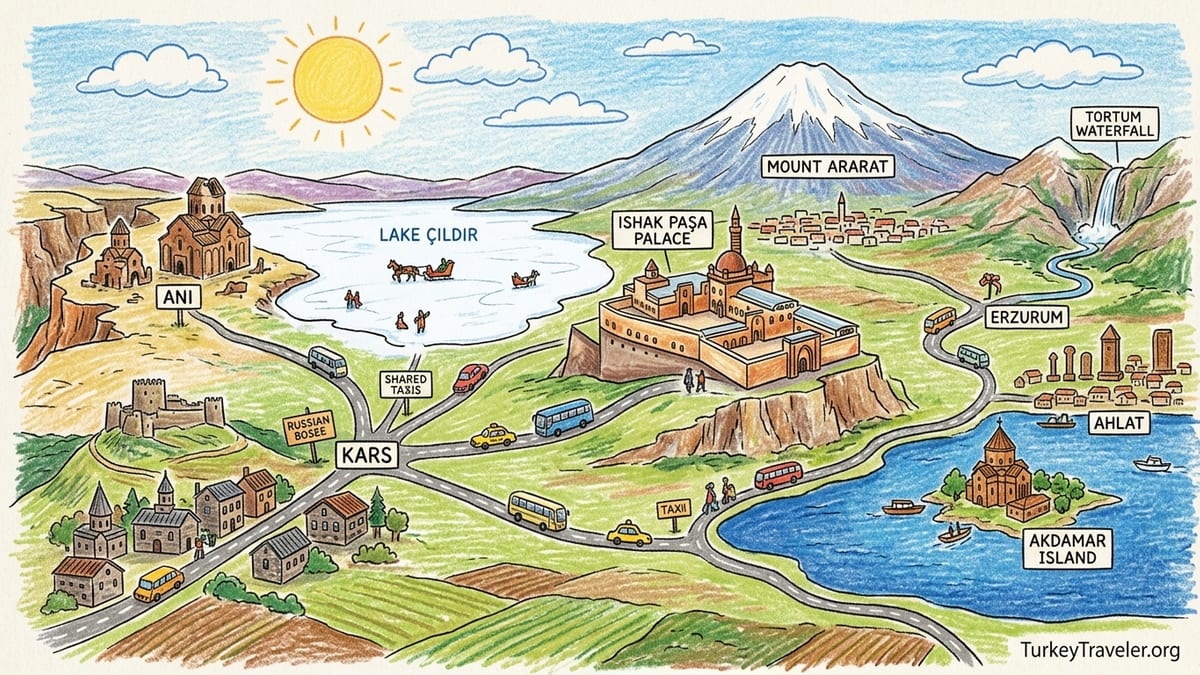
How to Structure an Eastern Anatolia Itinerary
The key to enjoying Eastern Anatolia is to treat a few compact cities as bases and then radiate out on day trips. Distances look intimidating on the map, but many headline sites sit within 40 to 90 minutes of a main town by car. Rather than sleeping somewhere new every night, most travelers will be happier booking two or three nights in each base, using local drivers, rental cars or regional buses for excursions.
In practical terms, Kars works best as your entry point and hub for Ani and Lake Çıldır. Van anchors a contrasting cluster of sites that showcase Urartian and Armenian heritage, including Van Castle and Akdamar Island. Doğubayazıt is the obvious staging post for the remote east, combining the romantic Ishak Paşa Palace with wide views of Mount Ararat. Erzurum, finally, is a higher-altitude city with a more conservative, university-town feel and easy access to Tortum’s waterfall and valleys. Many travelers link the region west to east, beginning in Erzurum and finishing at Van’s airport, or vice versa.
Public transport exists between the main towns, but for reaching Ani, Lake Çıldır or Tortum Waterfall, shared taxis and private drivers are more realistic than relying on sparse village buses. As of 2026, hiring a licensed driver for a day out of Kars or Van typically costs something in the range of what a midrange city hotel room might cost per night, depending on negotiation and fuel prices, and is usually arranged through your guesthouse or hotel. Rental cars are available in all four hubs, but winter conditions around Ararat and Lake Çıldır can be severe, so self-drive in snow and ice is only for confident drivers used to mountain roads.
Kars: Atmospheric Base for Ani and Lake Çıldır
Once a Tsarist outpost, Kars feels markedly different from western Turkish cities of a similar size. Wide, grid-planned streets are lined with late 19th century Russian stone houses, many converted into boutique hotels and cafes. This makes Kars one of the most atmospheric bases in Eastern Anatolia, with just enough infrastructure to be comfortable: a handful of good-value hotels in repurposed mansions, several bakeries selling local gravy-filled pastries and a compact center that is walkable in 15 minutes.
Travelers typically allow at least two full days in Kars. One day is reserved almost entirely for Ani, the UNESCO-listed archaeological site that is the main reason many make the journey this far east. A second day can be split between exploring the town on foot and heading out to Lake Çıldır, especially in winter when the lake’s frozen surface becomes a stage for local life. Because Ani lies about 42 kilometers east of town, on a plateau overlooking the Arpaçay River and the Armenian border, most visitors negotiate a flat rate with a taxi driver at their Kars hotel. Tour desks and smaller agencies in town also run shared minivan trips when there is enough demand.
Kars itself rewards slow wandering. The castle on the hill above town makes a simple late-afternoon climb for wide views over the plateau, and the converted church-mosque complex at the base illustrates the region’s layered religious history in a single building. In practical terms, expect midrange hotel prices that are generally lower than big-name tourist towns on Turkey’s Mediterranean coast, with simple, clean doubles in restored stone houses often including breakfast of local cheeses sourced from surrounding villages.
Ani: UNESCO-listed City of 1001 Churches
Ani deserves more than the quick photo stop it sometimes receives. This medieval city, located on a triangular plateau about 42 kilometers from Kars, sits above a ravine that now marks the boundary with Armenia. Spread across the windy grassland are the remains of cathedrals, churches, a mosque, fortifications and city walls that once guarded a thriving hub on a branch of the Silk Roads. Walking through Ani can easily take four to six hours if you follow the paths along the walls and detour down to viewpoints over the Arpaçay River.
The on-site experience is fairly low-key. There are basic facilities near the entrance, including a small ticket booth, simple toilets and a modest cafe or tea stand, but you should not expect the dense signposting, eateries and shops found at Turkey’s western hotspots. Many travelers bring water, snacks and a hat, as summer sun on the plateau can be intense and there is little shade. In shoulder seasons, strong winds make a light jacket and scarf useful even on days that feel warm in Kars.
Guiding options range from printed pamphlets and audioguides to hiring a local guide through agencies in Kars. Hiring a private guide for Ani typically costs somewhere between the price of a good restaurant dinner and a midrange hotel night, depending on group size and language. A guide can contextualize the city’s changing control under Armenian, Byzantine, Seljuk and other powers, point out half-ruined frescoes inside churches that are easy to overlook, and lead you to quieter vantage points along the ravine that casual visitors often miss.
Because public transport is limited, Ani is best treated as a day trip out of Kars rather than a standalone overnight destination. Organized excursions usually leave Kars in the mid-morning, spend three to four hours wandering the ruins and then return via Ocaklı village. Independent travelers with a hired car can linger until closing time and photograph the cathedral and city walls catching the low late-afternoon light over the steppe, often with only a handful of other visitors in sight.
Lake Çıldır: Winter Adventures on the Ice
Lake Çıldır sits roughly between Kars and Ardahan and makes one of Eastern Anatolia’s most memorable winter excursions. At around 1,959 meters above sea level, it freezes solid most winters from about December onwards, with local reports often noting ice thickness reaching well over ten centimeters at peak season. When the lake has frozen sufficiently, villagers set up temporary stalls on the snow, fishermen cut neat rectangular holes through the ice and horse-drawn sleighs criss-cross the surface, creating an impromptu winter playground.
From Kars, most visitors reach the lake by arranging a taxi for a half or full day, or by joining an organized excursion that combines village visits with time on the ice. In recent years, enterprising locals have added ice-biking and snowmobile rides on the frozen lake, charging per lap or per ten-minute session. Visitor numbers fluctuate with weather and social media exposure, but in peak conditions you can expect a small crowd of domestic tourists, particularly on weekends, bundled in thick coats and posing for photos beside the colorful sleighs.
Prices for activities are usually negotiated on the spot and are modest by Western European standards, but they can feel high compared with everyday costs elsewhere in Eastern Anatolia. It is common, for instance, to pay roughly what you might spend on a lunchtime pide and tea in Kars for a short sleigh ride. Bringing cash is essential, as card payments are rarely possible at lakeside stalls. In mild winters or during thaws, authorities sometimes restrict access to the ice for safety reasons, so it is wise to check conditions with your Kars hotel before setting out and to follow local guidance about where it is safe to walk.
Outside winter, Lake Çıldır becomes a quieter, windswept place. Travelers visit for the birdlife, lakeside picnics and wide panoramas rather than for organized activities. A single lakeside restaurant or two typically stays open, serving fresh-caught fish and simple grilled dishes. Although summer lacks the drama of horse-drawn sleighs, the relative emptiness of the shoreline and the sweeping views towards distant mountains appeal to travelers who prefer solitude over spectacle.
Van, Van Castle, Akdamar Island and Ahlat
On the southern shore of Lake Van, the city of Van serves as a contrasting base to Kars. It is larger, livelier and more modern, with a noticeable student and backpacker presence, a long strip of cafes and dessert shops, and easy access to the lakefront. Many travelers fly into or out of Van’s airport, pairing a few nights in town with day trips that highlight the area’s Urartian and Armenian heritage. Van’s accommodation scene runs from simple pensions around the older neighborhoods to contemporary business hotels near main roads, often at prices below those in Istanbul for similar comfort levels.
Van Castle, perched on a rocky ridge west of the city center, is a key site from the Iron Age kingdom of Urartu. The fortress itself is largely in ruins, but climbing its paths rewards you with long views over Lake Van and the city. At the base are scattered cuneiform inscriptions and tombs, and in late afternoon the sun often turns the lake’s surface a soft gold. Most visitors reach the castle by short taxi ride from central Van and allow a couple of hours for the visit, combining it with lakeside tea gardens on the return.
Akdamar Island, reached by boat from a lakeside pier several dozen kilometers south of Van, presents a very different atmosphere. The small island holds the Cathedral of the Holy Cross, a medieval Armenian church famous for its sandstone exterior reliefs depicting biblical scenes, animals and vines. Boats to the island run frequently in season, typically charging a per-person return fare, with crossings taking around 20 to 30 minutes each way depending on the pier you depart from and lake conditions. Once ashore, visitors follow paths around the island for viewpoints back over Lake Van’s deep blue water and the snow-streaked mountains beyond.
Farther along Lake Van’s northern shore lies Ahlat, a quieter town associated with an extensive Seljuk-era cemetery and lakeside tombs. It is usually visited as a long half-day or full-day trip from Van by private car or bus, possibly combined with villages along the shore. The carved headstones and tomb towers, some tilted and weathered by centuries of wind off the lake, add another thread to the region’s patchwork of civilizations. Travelers interested in early Islamic and Turkish history often find Ahlat particularly rewarding, while casual visitors may appreciate the lakeside setting and sense of being far removed from mainstream tourist routes.
Doğubayazıt, Ishak Paşa Palace and Mount Ararat
East of Lake Van and close to the Iranian border sits Doğubayazıt, a town that many travelers overlook on the map but remember vividly after visiting. It functions primarily as a base for Ishak Paşa Palace and as the closest urban center to Mount Ararat, the snow-capped volcanic cone associated in local lore with the story of Noah’s Ark. The town itself sprawls along a valley, with simple hotels, kebab houses and small supermarkets lining its main streets. Prices are generally modest, and English is less widely spoken than in coastal Turkey, but most hotels can arrange taxis, guides and onward transport.
Ishak Paşa Palace, positioned on a terrace above town, is one of Anatolia’s most distinctive landmarks. Construction began in the late 17th century under regional governors and was completed in the late 18th century, blending Ottoman, Persian and local architectural styles in a complex of courtyards, reception halls, a mosque and residential quarters. Approaching the palace at sunset, with cliffs rising behind it and the plains stretching out in front, gives a sense of how its builders intended it to dominate the landscape. Inside, carved stone portals, vaulted rooms and decorative motifs speak to centuries of cross-cultural exchange along east-west trade routes.
For travelers, Ishak Paşa Palace works best as a half-day excursion from a hotel in Doğubayazıt. Taxis make the short climb up the road to the palace car park, and it is straightforward to combine a palace visit with a stop at the older fortress on the ridge and the small tomb of the Kurdish poet Ahmed-i Hani, which lie within walking distance. Admission fees are moderate, and there are usually small stalls or a simple cafe near the entrance selling tea and snacks. In winter, snow can dust the palace’s outer walls and the surrounding hills, adding to its drama but also making the stone steps potentially slippery.
Mount Ararat itself, rising to over 5,100 meters, dominates clear days in the region and frames many views from the roads outside town and from Ishak Paşa’s terraces. Climbing Ararat is a regulated, multi-day mountaineering undertaking that requires permits and specialist local agencies based in Doğubayazıt and larger cities; it is not a casual hike. However, most travelers are content with lower-elevation walks on the slopes, roadside viewpoints and photo stops along the highway. Clear early mornings often provide the best visibility, while afternoons may see clouds gather around the peak.
Erzurum and Tortum: Highland City and Waterfall Excursion
Compared with Kars and Van, Erzurum is a larger, more established city with strong winter-sports credentials and a long architectural history. It sits at over 1,800 meters and is known for cold winters, which can surprise visitors arriving from milder parts of Turkey. The city’s core holds Seljuk and Ottoman mosques, medrese courtyards and a citadel, all within an easy walking loop. Accommodation ranges from budget pensions near the old center to business hotels along the main avenues, making Erzurum a practical base when traveling overland between central and eastern Turkey.
Beyond the city, Erzurum’s greatest natural draw is Tortum Waterfall, located roughly 100 kilometers to the north along a route that also passes lakes and red rock formations. For most travelers, Tortum is organized as a half- or full-day excursion, hiring a driver or joining a local tour that follows a nature-themed route through the Tortum and Uzundere area. At the waterfall itself, walkways and viewing platforms allow you to experience the spray and thunder of the water in season. In spring and early summer, snowmelt can make the falls especially impressive, while in late summer flow may diminish.
Public buses from Erzurum towards Tortum and nearby towns exist but are not timed for easy day-trip sightseeing, so independent travelers without cars usually rely on intercity minibuses combined with taxis from intermediate stops, or on pre-arranged drivers. On-site facilities at Tortum are basic but improving, with small cafes or tea houses often operating during peak domestic holiday periods. As in many parts of Eastern Anatolia, carrying some cash is advisable, as card readers can be temperamental and mobile reception patchy.
Within Erzurum itself, cold evenings often push locals indoors to tea houses and dessert shops serving specialties such as kadayıf dolması, a syrup-soaked, walnut-filled pastry that is a point of local pride. These everyday venues give a more grounded sense of the city than any single monument. For many visitors, Erzurum is as much about feeling the rhythm of a highland provincial center as it is about ticking off specific sights.
The Takeaway
Travel in Eastern Anatolia is less about a single headline attraction and more about how places fit together. Kars and Ani introduce you to a windswept frontier city and a ruined medieval capital; nearby Lake Çıldır reveals how tough winters become an asset for local tourism. Van pairs lakeshore urban energy with deep historical layers at Van Castle, Akdamar Island and Ahlat. Doğubayazıt and Ishak Paşa Palace place you on the edge of Turkey under the gaze of Mount Ararat, while Erzurum and Tortum Waterfall add a different highland rhythm and natural spectacle.
In practice, most itineraries string these bases together into a loop of around ten to fourteen days, moving from city to city by bus, car or occasional domestic flights. The region rewards flexibility: weather, road conditions and local events can alter your daily plans, but they also create the serendipitous encounters that many travelers remember most. By treating Kars, Van, Doğubayazıt and Erzurum as anchors and Ani, Lake Çıldır, Akdamar, Ahlat and Tortum as carefully chosen excursions, you can experience a side of Turkey that feels both deeply rooted and quietly evolving.
FAQ
Q1. How many days do I need to see Kars and Ani properly?
Most travelers are comfortable with two or three nights in Kars, which allows a full day at Ani, time for Lake Çıldır in season, and a relaxed day in town.
Q2. Is Ani accessible year-round?
Ani is generally accessible throughout the year, but winter snow and icy winds can make walking on the plateau challenging. Early summer and autumn usually offer the most comfortable conditions.
Q3. Do I need a tour to visit Ani from Kars?
You do not strictly need a tour, but most visitors either book a shared excursion or negotiate a fixed-price taxi through their Kars accommodation, as public transport is limited.
Q4. When is Lake Çıldır frozen enough for sleigh rides and ice activities?
Conditions vary by year, but the lake typically freezes from around December, with peak ice activities in mid-winter. Always check current conditions locally before planning to go onto the ice.
Q5. Can I visit Akdamar Island and Van Castle in one day from Van?
Yes, with an early start it is feasible to visit Van Castle in the morning and take an afternoon boat to Akdamar Island, especially in longer daylight months.
Q6. Is Mount Ararat a realistic day hike from Doğubayazıt?
No. Proper ascents of Mount Ararat are multi-day, guided climbs requiring permits. Casual visitors usually limit themselves to viewpoints and short walks on the lower slopes.
Q7. How difficult is it to reach Ishak Paşa Palace from Doğubayazıt?
It is straightforward. The palace lies only a short drive above town, and local taxis regularly take visitors up and wait while they explore the complex.
Q8. Is it safe to self-drive between Erzurum, Kars, Doğubayazıt and Van?
In good weather many independent travelers self-drive these routes on paved highways. In winter, snow and ice can be significant, so only experienced drivers comfortable with mountain conditions should attempt it.
Q9. Can I visit Tortum Waterfall from Erzurum without renting a car?
Yes, but it takes more planning. You can use intercity minibuses towards Tortum or Uzundere and then hire local taxis. Many visitors find arranging a driver from Erzurum simpler.
Q10. Are English-speaking guides easy to find in Eastern Anatolia?
English-speaking guides are available in major bases like Kars, Van and Erzurum, often through hotels and small agencies. In smaller towns, arranging a guide in advance from a larger hub is wise.