


Central Anatolia is where Turkey’s political heart, lunar landscapes and deep spiritual traditions converge. For many travelers, the ideal journey links the modern capital Ankara with the storybook valleys of Cappadocia and the Sufi heritage of Konya, sometimes adding Kayseri, Hattusa or Gordion for an extra archaeological dimension. This guide explains how multi-day Central Anatolia tour packages work in practice, using real examples to help you choose between private and escorted group itineraries, decide how many nights to spend in Cappadocia, and understand what you really get for your money.
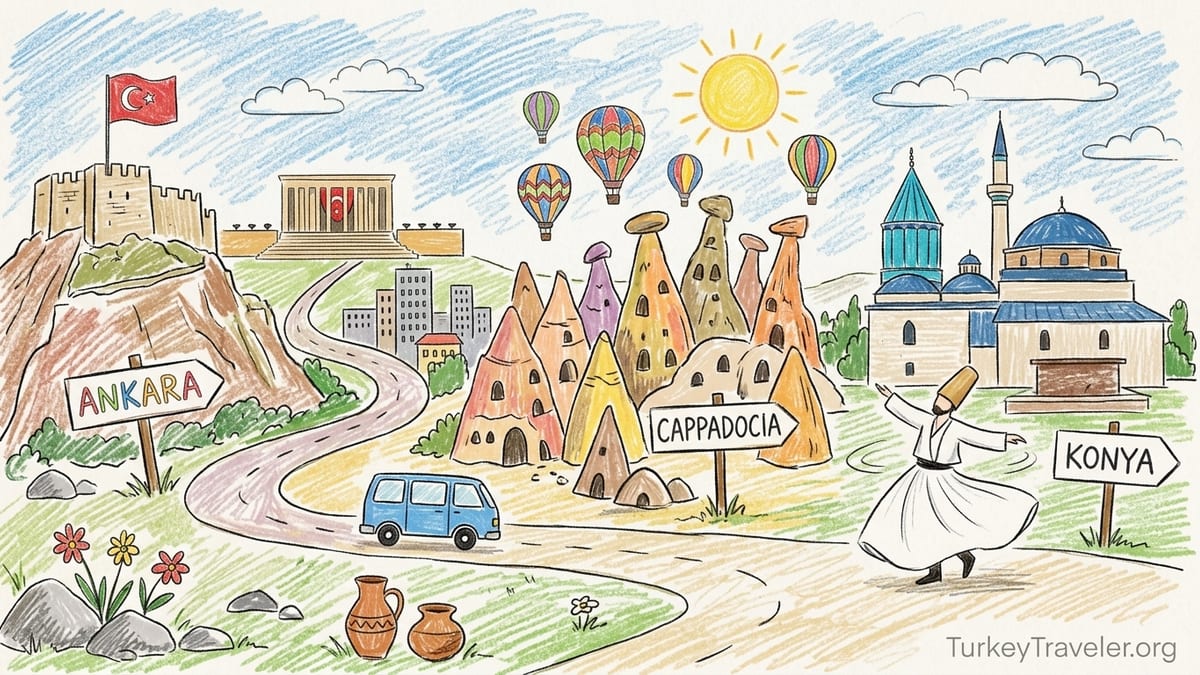
Why Combine Ankara, Cappadocia and Konya in One Journey
A classic Central Anatolia itinerary connects Ankara, Cappadocia and Konya in six to ten days, often starting or ending with a domestic flight to Istanbul. Ankara gives context: the Museum of Anatolian Civilizations and the hilltop citadel frame the history of Hittites, Phrygians and early Anatolian cultures before you see their ruins in the countryside. From there, road journeys fan out toward the fairy chimneys of Cappadocia or the archaeological hubs around Hattusa and Gordion, which sit within a few hours’ drive of the capital.
Cappadocia is usually the emotional center of the trip. Towns such as Göreme, Uçhisar and Ürgüp are surrounded by honeycombed cave dwellings, frescoed rock churches and wind-sculpted valleys like Love Valley and Rose Valley. Many Central Anatolia packages devote at least two nights here so guests can explore the open-air museums, hike a valley and, if weather allows, experience a sunrise hot air balloon flight above the tuff cones and plateaus.
Konya completes the triangle with its Seljuk architecture and the Mevlana Museum, dedicated to the 13th century mystic Rumi. Pilgrims and culturally minded travelers are drawn to the city’s mosques, caravanserais and quieter, conservative atmosphere. Many itineraries schedule Konya as a one-night stop between Cappadocia and the Mediterranean or as a final overnight before flying back via Istanbul, but some high-end cultural operators extend the stay to include nearby caravanserai routes and rural villages.
In practice, a six-day private Central Anatolia tour often looks like this: day one in Ankara, days two to four in Cappadocia, and one to two nights in Konya before departure. Longer, specialist packages run 10 to 14 days and add Kayseri, Hattusa, Gordion or even further routes into southeast Turkey, often marketed as “Anatolian Civilizations” or “Ancient Anatolia” journeys.
Understanding the Core Six-Day Central Anatolia Itinerary
The current standard inventory many agencies sell is a six-day private Central Anatolia itinerary that includes Ankara, Cappadocia and Konya. Typically it starts in Ankara, where travelers are met at the airport and transferred to a centrally located four-star hotel. A half or full day city tour covers the Museum of Anatolian Civilizations and Atatürk’s Mausoleum, with some programs adding a walk through the Ankara Castle district and old quarters before an overnight in the capital.
The next morning, guests drive to Cappadocia, a journey of roughly three to four hours on modern highways, often broken with rural photo stops. Two or three nights are then spent in Cappadocia. Standard inclusions are a full-day tour of Göreme Open-Air Museum and a circuit of viewpoints such as Uçhisar Castle, plus a second day focused on underground cities like Kaymaklı or Derinkuyu and valleys such as Ihlara. Many private itineraries keep at least one evening free so guests can book a traditional Anatolian dinner, a wine tasting near Uçhisar or a whirling dervish performance staged in a restored caravanserai.
From Cappadocia, the route usually continues overland to Konya, roughly three hours away. On arrival, travelers visit the Mevlana Museum, the Karatay Medrese and the Alaeddin Hill complex. Most six-day itineraries schedule just one night here, with an early evening stroll through the city center and dinner at a local restaurant specializing in etli ekmek, Konya’s signature flatbread. The final morning, guests are transferred either to Konya Airport for a domestic flight to Istanbul or back to Ankara by road or train, depending on ticket availability and budget.
Because the six-day structure is compact, it suits first-time visitors to Turkey who want a focused Central Anatolia section within a longer trip that might also include Istanbul and the Aegean coast. It also appeals to travelers with limited leave who still want a sense of Turkey beyond the classic Istanbul–Cappadocia combination, without committing to a two-week archaeological expedition.
Private Tours vs Escorted Group Tours in Central Anatolia
One of the main decisions is whether to book a fully private tour or to join an escorted group. Private Central Anatolia packages, such as a six-day Ankara–Cappadocia–Konya itinerary, typically include a private driver-guide or separate driver and licensed guide, with a modern sedan or minivan and airport transfers. For a couple, realistic pricing for mid-range private arrangements is often in the region of 1,500 to 2,500 US dollars per person, depending on hotel category, season and whether balloon flights and most dinners are bundled in the package price.
Escorted group tours spread fixed costs over more people. A seven-day “Anatolia” group circuit that includes Cappadocia and Ankara can sometimes be found in the 900 to 1,400 US dollar per person range in shoulder seasons, sharing a 30 to 40 seat coach. These departures run on fixed dates and fixed itineraries, usually with 15 to 25 participants. They tend to stay in comfortable three to four-star hotels with buffet breakfasts and a mix of included and optional dinners, and may limit free time at each site to keep the schedule on track.
Private tours generally make sense for travelers who value flexibility and quiet. If you want to linger longer in the Museum of Anatolian Civilizations, add a last-minute detour to a pottery workshop in Avanos, or spend an extra hour photographing sunset from a quiet ridge in Cappadocia instead of a busy roadside lookout, a private driver-guide can adjust the day on the fly. Families with children or older travelers who need a slower pace particularly benefit from this format, as they can shorten walking segments and take breaks without affecting others.
Escorted cultural tours come into their own when the itinerary is highly specialized. High-end British or European cultural operators, for example, often run 10 to 14 day Anatolian archaeology journeys that include Ankara, Gordion, Hattusa, Kayseri and Cappadocia together, accompanied by a subject expert such as a classical archaeologist or historian. These trips can cost several thousand US dollars per person and typically include most meals, porterage, entrance fees and tips, but the fixed structure and academic slant will suit only travelers seeking that depth.
How Many Nights in Cappadocia, and Where to Stay
Central Anatolia packages hinge on how many nights you dedicate to Cappadocia. Two nights, which is common on shorter group circuits, allow for one full day of touring and a balloon attempt on either morning. Three nights, which is more common on private itineraries, create a more relaxed rhythm: you can schedule hiking in one valley, dedicate a half day to a cooking class or pottery workshop, and still have a “backup” dawn for ballooning if the first attempt is canceled due to weather.
Most packages use towns like Göreme, Uçhisar or Ürgüp as a base. Mid-range group tours often book modern, resort-style hotels on the edge of town with pools and large dining rooms, chosen for bus access and inventory. Private trips are more likely to offer cave-style boutique hotels, where a handful of rooms are carved directly into the rock with arched ceilings and stone details. For example, a typical four-star cave hotel in Göreme might price standard rooms around 100 to 150 US dollars per night in shoulder season, while high-end suites with private terraces or plunge pools can run far higher.
Hotel standard is one of the clearest differentiators between mainstream packages and specialist Anatolian journeys. Long, high-end cultural tours often book consistently upscale properties, such as five-star business hotels in Ankara, atmospheric cave hotels in Cappadocia with on-site fine-dining restaurants, and well-located boutique hotels in Konya. Shorter six-day private tours usually give a choice: a slightly lower overall package price based on three to four-star hotels, or higher pricing for a mix that might include at least one memorable “splurge” cave property in Cappadocia.
If a balloon flight is a priority, ask specifically whether your Cappadocia hotel has an unobstructed terrace view over the valleys where balloons launch. On mornings when flights are grounded, watching the sunrise over an empty but beautiful valley can still be memorable, and on successful flight mornings you will have a front-row seat as balloons drift overhead before or after your own ride.
Meals, Guides, Transfers and the Balloon Flight Question
Package descriptions in Central Anatolia frequently refer to “BB,” “HB” or “FB.” BB indicates bed and breakfast only, HB adds dinners at the hotel, and FB means three daily meals. Many six-day private itineraries operate on a BB basis, leaving lunches and most dinners flexible so travelers can sample local restaurants in Cappadocia or Konya. Escorted group tours, particularly high-end cultural ones, more often include lunches during sightseeing days and group dinners, sometimes with wine where available.
Guide quality is a major point of comparison. Entry-level Central Anatolia group tours may use a single bilingual guide for the whole route, focusing on basic information and timekeeping. Private tours can pair you with an English-speaking driver-guide licensed for the region, or, on more upmarket products, a dedicated national guide plus local site guides in places like Hattusa or Gordion. Specialist cultural operators often advertise that their tours are “accompanied by an expert lecturer,” such as an archaeologist who adds context at lesser-known sites and in evening talks.
Airport transfers are usually included from Ankara or Kayseri at the start and Konya or Kayseri at the end, but there are exceptions. Some budget group trips require travelers to make their own way to a central meeting point at the first hotel; in contrast, private packages almost always bundle in private airport pick-up and drop-off. When comparing prices, factor in that a private airport transfer from Ankara’s main airport into the city can easily cost the equivalent of 40 to 60 US dollars one way, and similar amounts from Kayseri to Cappadocia depending on distance and vehicle type.
Hot air balloon flights above Cappadocia are nearly always treated as optional extras, even on high-end itineraries. As of late 2025 and 2026, realistic prices for a standard one-hour sunrise flight in the main Göreme flight zone generally fall somewhere between 200 and 300 euros per person, depending on season, basket size and operator. Online listings in peak months sometimes show prices above that range, while last-minute, in-person bookings in shoulder periods can be lower. Weather cancellations are common in winter and shoulder seasons, so itineraries with at least two mornings in Cappadocia offer better odds of flying.
Extending Your Route: Kayseri, Hattusa, Gordion and Cultural Trails
For travelers with more time and a strong interest in archaeology, many high-end Anatolian packages extend beyond the simple Ankara–Cappadocia–Konya triangle. Kayseri, around an hour from Cappadocia by road, appears in some itineraries as a gateway city with Seljuk monuments, markets and easy access to Mount Erciyes. A few operators schedule a short visit to the archaeological site of Kültepe, an important Bronze Age settlement known for its cuneiform tablets, before continuing toward Cappadocia or Ankara.
Hattusa, the former Hittite capital and a UNESCO World Heritage site near the town of Boğazkale, is a classic addition on specialist tours. Day visits or overnight excursions from Ankara let travelers walk through monumental gates adorned with lion and sphinx reliefs and explore temple and palace ruins spread across a windswept plateau. Nearby Alacahöyük and the rock sanctuary of Yazılıkaya deepen the experience, and artifacts from the region are prominently displayed back in Ankara’s Museum of Anatolian Civilizations, tying the route together.
Gordion, the ancient Phrygian capital west of Ankara, is another frequent stop on cultural itineraries. Travelers can see the great burial mounds on the plain and explore the site museum, which interprets finds such as wooden furniture and textiles preserved in the tumuli. Some multi-day tours link Ankara, Gordion and Hattusa in a loop before continuing east to Cappadocia, presenting a broad sweep of central Anatolian history from Bronze Age through Iron Age in a single journey.
Beyond these marquee names, routes increasingly reference cultural walking trails such as the Phrygian Way, a long-distance network connecting rock-cut monuments, rural villages and landscapes associated with ancient Phrygia. While most standard Central Anatolia packages will not include multi-day hiking, a private trip can easily weave in a half-day walk on one of these marked routes or arrange local village visits, adding a human dimension to what might otherwise be a museum- and ruin-focused itinerary.
Pricing, Booking Windows and Choosing the Right Operator
Pricing for Central Anatolia packages reflects a combination of hotel quality, transport type, group size and the level of guiding. A simple six-day private tour in shoulder season using comfortable four-star hotels, private vehicle, airport transfers and licensed local guides, but excluding balloon flights and most dinners, might come in around 1,800 to 2,200 US dollars per person based on two people sharing. Moving up to a high-end operator that includes five-star hotels, most meals, higher guide-to-guest ratios and added archaeological sites can easily double that figure, especially on itineraries that run 10 days or more.
When you compare offers, read the day-by-day breakdown closely. Check how many actual nights you spend in Cappadocia and whether early-morning flights or late-night arrivals effectively reduce sightseeing time. Confirm whether domestic flights are included or only quoted as a supplement. Ask which specific hotels are used rather than accepting generic labels like “cave hotel” or “5-star central hotel,” and verify whether balloon flights, entrance fees and tips are bundled or payable locally.
Booking windows vary by season. For peak spring and autumn dates, escorted group tours and balloon slots often sell out months in advance, particularly for departures that align with holidays. Private Central Anatolia itineraries offer more flexibility, but travelers who want particular cave suites or specific balloon companies should still plan several months ahead. In winter, availability tends to be better and prices softer, but shorter daylight hours and a higher risk of balloon cancellations are trade-offs.
Choosing the right operator depends on your priorities. Budget-conscious travelers may favor Turkish agencies that specialize in value-focused group circuits, while those looking for in-depth archaeology or comfort will gravitate toward European or North American cultural travel companies with an established track record in Anatolia. Either way, focusing on transparent itineraries, clear descriptions of inclusions and realistic daily pacing will help avoid disappointment once you arrive on the central plateau.
The Takeaway
Central Anatolia rewards travelers who look beyond the obvious Istanbul and coastal highlights. Combining Ankara, Cappadocia and Konya in one coherent route, with optional diversions to Kayseri, Hattusa or Gordion, offers a narrative arc that runs from ancient empires through Seljuk courts to modern Turkey. A six-day private itinerary gives a compact but satisfying introduction, while longer high-end Anatolian packages layer in more archaeological depth and comfort.
The key decisions are practical: whether you prefer the intimacy and flexibility of a private driver-guide or the cost efficiency and sociability of an escorted group, how many nights to devote to Cappadocia, and what level of hotel and meal inclusions match your expectations and budget. With balloon flights, transfers and guiding styles clearly understood before you book, Central Anatolia can feel less like a complicated puzzle and more like a thoughtfully curated journey through the heart of the country.
By approaching tour packages with these concrete questions in mind, you can compare real-world itineraries instead of abstract promises. That makes it far easier to choose the Central Anatolia experience that fits both your travel style and the stories you hope to bring home from Turkey’s high plateau.
FAQ
Q1. How many days do I need for a Central Anatolia tour including Ankara, Cappadocia and Konya?
Most travelers find six to eight days sufficient for a first visit, with one night in Ankara, two or three nights in Cappadocia and one night in Konya, plus travel time between them.
Q2. Is a private Central Anatolia tour worth the extra cost over a group tour?
A private tour usually costs more but offers flexible pacing, custom stops and quieter travel days, which many couples, families and older travelers consider worth the premium.
Q3. How many nights should I spend in Cappadocia within a multi-day package?
Two nights is the minimum to allow one full day of touring and a balloon attempt, but three nights give you a more relaxed rhythm and a better chance of flying if weather intervenes.
Q4. Are Cappadocia hot air balloon flights included in most tour prices?
Usually not. Balloon flights are commonly treated as optional extras, and you should budget roughly the equivalent of a few hundred euros per person in peak seasons.
Q5. What hotel standard should I expect on mid-range Central Anatolia packages?
Mid-range packages commonly use three to four-star business or resort-style hotels in Ankara and Konya and comfortable cave or boutique-style properties in Cappadocia.
Q6. Do Central Anatolia packages include all meals?
Many private tours include breakfast only and leave lunches and dinners flexible, while escorted cultural group tours more often include lunches during excursions and some group dinners.
Q7. Is it better to start the tour in Ankara, Kayseri or Cappadocia?
Starting in Ankara provides historical context and easier access to Hattusa or Gordion, while Kayseri or direct Cappadocia starts work well if your priority is maximizing time in the valleys.
Q8. Can I add Kayseri, Hattusa or Gordion to a standard six-day itinerary?
Yes. Operators can often customize a private six-day route to include at least a day trip to Hattusa or Gordion, or an extra night near Kayseri, if you are willing to add time or accept longer driving days.
Q9. When should I book a Central Anatolia tour and balloon flight?
For peak spring and autumn dates, booking several months ahead is advisable, especially if you want specific cave hotels or balloon operators; in low season, availability is generally better.
Q10. Are Central Anatolia tours suitable for families with children?
Yes, particularly private itineraries that can adjust walking distances and sightseeing lengths. Cappadocia’s landscapes and cave sites are often a highlight for school-age children.