


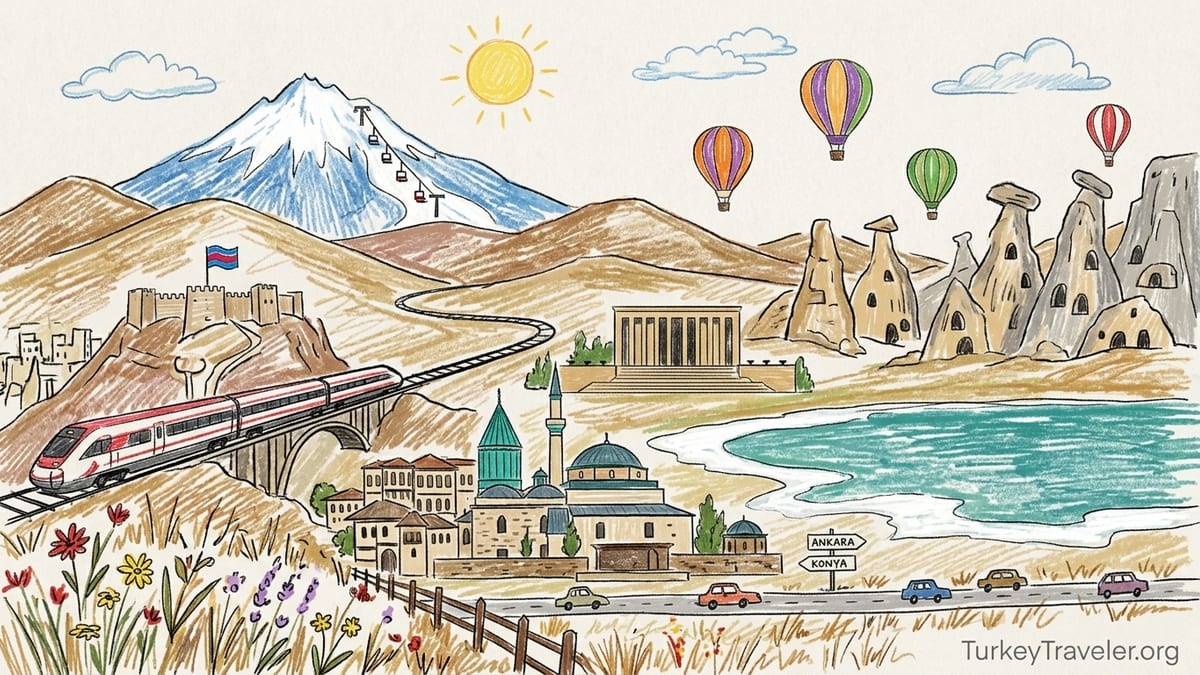
Central Anatolia is the big open heart of Türkiye: a high plateau of wheat fields and volcanoes, Seljuk caravanserais and Ottoman neighborhoods, salt lakes and ski slopes. For many international travelers it is synonymous with Cappadocia, yet the region is far broader. This guide introduces first-time visitors to the core Central Anatolian circuit anchored by Ankara, Cappadocia and Konya, and rounded out by Kayseri and Erciyes, Eskişehir, Aksaray with Ihlara Valley, and Tuz Gölü. It focuses on archaeology, Seljuk and Ottoman heritage, volcanic landscapes, winter sports, and the practicalities of airports, trains and driving.
Understanding Central Anatolia: The Plateau at the Center of Türkiye
Central Anatolia occupies the great inland plateau between Türkiye’s coastal mountain ranges. Ankara, the national capital, sits almost exactly in the middle, surrounded by rolling steppe, volcanic massifs and vast basins like the Konya plain and Tuz Gölü, the Salt Lake. Distances are long, horizons are wide, and weather can swing from snowy winters below freezing to hot, dry summers. Travelers often experience the region as a cultural corridor linking Istanbul and the Mediterranean, but it deserves time in its own right.
This landscape has hosted Hittites, Phrygians, Romans, Byzantines, Seljuk Turks and Ottomans. Sites such as the Hittite capital Hattusa near modern Boğazkale, the rock-cut monasteries of Cappadocia and the Seljuk monuments of Konya show how power shifted yet the plateau remained central. Modern infrastructure now overlays this history. Ankara, Konya and Eskişehir sit on Türkiye’s high-speed rail network, Cappadocia and Kayseri are tied in by frequent flights, and well-maintained highways make self-drive itineraries increasingly popular.
GoTürkiye, the national tourism organization, positions Ankara, Cappadocia and Konya as the defining destinations of Central Anatolia, and most international itineraries reflect that. A typical ten-day route might run Ankara to Cappadocia to Konya before dropping south to the coast. Yet many domestic travelers also detour to Erciyes Ski Resort above Kayseri, the youth-driven streets of Eskişehir, or the canyons of Ihlara and the mirror-flat expanse of Tuz Gölü. For a first trip, think of Cappadocia as the headline act within a much larger cultural and geographical stage.
Because the plateau is high, altitude affects both climate and activities. Ankara stands around 850 meters above sea level, Cappadocian towns such as Göreme and Ürgüp sit at roughly similar elevations, while the summit of Mount Erciyes rises above 3,900 meters. In practice this means cooler evenings than on the coasts, potentially icy roads between November and March, and a long ski season at Erciyes while hikers are already out on Cappadocia’s sun-warmed trails.
Cappadocia and Nevşehir: Fairy Chimneys, Underground Cities and Volcanic Valleys
Cappadocia dominates international demand for Central Anatolia, and with reason. The region’s signature “fairy chimneys” were carved from soft tuff deposited by eruptions from Mount Erciyes, Mount Hasan and other volcanoes over millions of years. Erosion sculpted this rock into cones, pillars and cliffs, which locals hollowed out into houses, churches, stables and entire underground cities. Today, visitors base themselves in towns such as Göreme, Ürgüp, Uçhisar or Avanos to explore valleys like Rose, Red, Pigeon and Love, and to visit open-air museums such as Göreme with its frescoed Byzantine churches.
First-time visitors usually spend at least two full days here, often three or four. Pre-dawn hot-air balloon flights are the most iconic experience: dozens of balloons rise over the valleys on suitable mornings. Prices fluctuate by season, operator and demand, but travelers in recent seasons commonly report per-person rates that can run to several hundred US dollars for reputable operators including transfers and breakfast. Those on tighter budgets often skip flying and instead hike to sunrise viewpoints above Göreme or Çavuşin to watch the balloons float past at eye level.
Below ground, sites such as Derinkuyu and Kaymaklı reveal multilevel cities where entire communities once sheltered from raids. A standard visit involves descending several levels through tunnels only wide enough for one person, with carved ventilation shafts, churches and communal rooms. Many day tours from Göreme combine one of these underground cities with the Ihlara Valley farther west or with valley hikes closer to town. Above ground, cave hotels are now one of Cappadocia’s defining accommodations. Options range from simple guesthouses converted from traditional stone houses to high-end suites with private terraces looking across at Uçhisar Castle or the Göreme valley.
Transport is straightforward. Cappadocia is usually accessed via Nevşehir Kapadokya Airport or Kayseri Erkilet Airport. Both receive daily domestic flights from Istanbul and other Turkish cities. From Nevşehir airport it is under an hour by shuttle to Göreme; from Kayseri airport around an hour to ninety minutes depending on where you stay. Many travelers also arrive by intercity bus from Ankara or Konya, or by combining high-speed rail to Kayseri with a road transfer. Once in Cappadocia, local buses exist between larger towns, but valley trailheads are often easiest reached with a rental car, an organized tour or a taxi arranged through your hotel.
Ankara: Political Capital and Gateway to the Plateau
Ankara is more than a waypoint between Istanbul and Cappadocia. As Türkiye’s political capital, it offers a concentrated introduction to the country’s modern story as well as its ancient civilizations. The Museum of Anatolian Civilizations, housed in restored Ottoman buildings beneath the citadel, is one of the country’s premier archaeological collections, with Hittite reliefs, Neolithic finds from Çatalhöyük and artifacts from across the plateau. Many travelers pair a museum visit with the Roman-era Temple of Augustus and the old quarter around the hilltop fortress.
Another key stop is Anıtkabir, the mausoleum of Mustafa Kemal Atatürk. Set on a hill reached by a ceremonial avenue lined with lion statues, it combines 20th-century monumental architecture with a detailed exhibit on the Turkish War of Independence and the founding of the republic. For first-time visitors this site often clarifies the strong place Atatürk holds in public life, visible in portraits in government offices, schools and even many restaurants.
Ankara’s modern districts reflect a different side of Central Anatolia. Neighborhoods like Kızılay and Tunali Hilmi are dense with cafes, bookshops and bars, while newer shopping centers on the western side of the city show how the plateau has urbanized. Prices for food and accommodation are often lower than in Istanbul. A centrally located business hotel can sometimes cost less than a similar property on the Bosphorus, and even small lokantas near the train station serve hearty plates of kuru fasulye and rice at prices comparable to provincial towns.
Practically, Ankara is the main rail and road hub of Central Anatolia. The city’s high-speed YHT lines link it to Istanbul, Eskişehir and Konya, with journey times that make rail competitive with flying once airport transfers are factored in. Esenboğa Airport to the north handles domestic and international flights and is served by airport buses and taxis into the center. For drivers, Ankara sits at the knot of major highways heading east to Kayseri and Cappadocia, south to Konya and west to Eskişehir and Istanbul.
Konya: Seljuk Capital and Spiritual Heartland
Konya, set on the wide Konya plain south of Ankara, is presented by GoTürkiye as one of Central Anatolia’s defining destinations. Once the capital of the Seljuk Sultanate of Rum, it is also associated with the poet and mystic Jalal ad-Din Rumi, known in Türkiye as Mevlana. His mausoleum and the former dervish lodge now form the Mevlana Museum, one of the country’s most visited religious and cultural sites. Visitors wander through courtyards and tiled rooms that display musical instruments, manuscripts and dervish robes, before stepping into the main hall where Rumi’s tomb stands under a green-tiled dome.
Beyond the museum, Konya still preserves a concentration of Seljuk architecture. The Alaeddin Mosque, set on a low hill in the city center, includes the tombs of Seljuk sultans, while the nearby Karatay and İnce Minareli madrasas are noted for their intricate stone carving and tilework. In practice, first-time visitors can see these main monuments on foot from a central hotel in a long day, often adding a wander through the historic bazaar streets where small workshops still produce metalware, textiles and religious items.
Konya is also one of the key places to experience the Mevlevi sema ceremony, the whirling ritual associated with Rumi’s followers. Performances are held in dedicated cultural centers, particularly on weekends or around special dates. Travelers should be aware that there is a distinction between tourist performances and more devotional gatherings, so it is worth asking at your hotel or at tourist information which they are attending. Dress modestly and behave respectfully; many local attendees treat the ceremony as a form of worship rather than entertainment.
Reaching Konya is straightforward. The city has its own airport with domestic connections, and it sits on the Ankara–Konya high-speed rail line, with typical journey times of a few hours. Many road itineraries link Konya with Cappadocia, driving across the Konya plain via Aksaray. The highway is generally in good condition with long straight stretches, but services can be sparse, so drivers often refuel and stock up on water and snacks before leaving the city.
Kayseri and Mount Erciyes: Between Caravanserais and Ski Slopes
Kayseri lies east of Cappadocia, in the shadow of Mount Erciyes, the stratovolcano whose eruptions helped shape the entire region’s tuff landscapes. Historically an important Seljuk and Ottoman trading city, it retains a compact walled center with a citadel, mosques, tombs and hans. Travelers often visit the city’s bazaars, especially the restored covered market where stalls sell pastirma, a seasoned cured beef for which Kayseri is famous, and mantı, small dumplings typically served with yogurt and a chili-flecked butter sauce.
For many, though, Kayseri is the gateway to Mount Erciyes, one of Türkiye’s most developed ski areas. The resort lies roughly half an hour from Kayseri city center and slightly longer from the airport by road, with shuttle services and private transfers available in ski season. Chairlifts and gondolas serve a network of groomed runs of varying difficulty, and the resort has invested in snowmaking and modern lift infrastructure. In recent winters, Turkish families and groups of younger riders from cities such as Istanbul and Ankara have increased the resort’s popularity, and weekend crowds can develop on easier slopes.
Equipment rental and ski schools operate on the mountain, making Erciyes accessible even to first-time skiers. Prices for day lift passes and rental have typically remained competitive with alpine resorts in Western Europe, although they vary by season and may change with exchange rates. Many visitors choose to base themselves in Kayseri city, using its wider hotel stock and restaurants, then commute up to the slopes daily. Others stay at hotels directly at the ski base to maximize time on the snow.
Air connections make this combination of city, ski and Cappadocia particularly appealing. Kayseri Erkilet Airport handles frequent flights from Istanbul and other domestic hubs, and is often sold in package itineraries that combine a few days in Cappadocia with a few days skiing. Outside winter, Erciyes draws hikers and climbers rather than skiers. Organized summer hikes can take you across volcanic terrain with broad views back over the plateau and towards Cappadocia’s valleys.
Eskişehir, Aksaray, Ihlara Valley and Tuz Gölü: Beyond the Big Three
Central Anatolia is broader than Ankara–Cappadocia–Konya. Eskişehir, west of Ankara on the high-speed rail line to Istanbul, is a university city known for its lively riverside promenades along the Porsuk River, public art and youthful cafe culture. For travelers who want to see how a Central Anatolian city has remade itself as a student and creative hub, Eskişehir offers a very different atmosphere from more conservative towns on the plateau. It can work as an overnight stop between Istanbul and the interior, with enough museums, parks and nightlife to fill a day and evening.
South-east of Ankara, Aksaray serves as the urban anchor for two of Central Anatolia’s most striking natural and cultural landscapes: the Ihlara Valley and Tuz Gölü. The Ihlara Valley is a deep canyon cut by the Melendiz River in the foothills of Mount Hasan. Steep cliff walls hide dozens of rock-cut churches with frescoes, as well as troglodyte dwellings, and a hiking path follows the river floor through poplars and orchards. A common day-trip pattern sees travelers enter the valley via steps down from the village of Ihlara, walk a few hours along the river, stopping at tea gardens with wooden platforms above the water, and finish near the village of Selime where a monumental rock-cut monastery crowns the cliffs.
Tuz Gölü, one of Türkiye’s largest salt lakes, lies northwest of Aksaray on the plateau. In summer and early autumn, when water levels are low, broad sections of the lake become a shallow reflective sheet over a thick salt crust. Visitors park on the edge and walk out over the crunchy salt, often taking photographs of mirror-like reflections at sunset. Conditions vary by season and rainfall, so views range from a wide white expanse to a pinkish shallow lake, but in all cases the exposure is intense. Sunscreen, hats and sturdy footwear that can handle salt are important, and drivers should heed local parking guidance to avoid getting stuck on softer ground.
These stops fit naturally into a self-drive itinerary between Ankara, Cappadocia and Konya. For instance, some travelers leave Ankara in the morning, stop at Tuz Gölü for a walk and photographs, continue to Aksaray for lunch, then drive on to a hotel in Göreme or Uçhisar by evening. Others integrate Ihlara Valley into a full-day Cappadocia excursion, combining a hike in the canyon with an underground city en route. Organized bus tours and small-group trips from Cappadocia frequently include Ihlara, Selime Monastery and a brief stop at Tuz Gölü on the return.
Archaeology, Seljuk and Ottoman Heritage Across the Plateau
Central Anatolia’s archaeological depth is one of its major draws. While this guide focuses on the main travel corridor, it helps to understand how sites connect. Hittite remains such as Hattusa and Yazılıkaya in Çorum province show that the plateau formed the core of an empire that once rivaled New Kingdom Egypt. Farther south, sites tied to the Neolithic settlement of Çatalhöyük underscore how farming communities thrived here thousands of years before classical antiquity. Many finds from across this landscape now reside in Ankara’s Museum of Anatolian Civilizations, which makes the capital an efficient place to get an overview.
The arrival of the Seljuk Turks after the 11th century reshaped Central Anatolia’s cities and trade routes. Konya’s Seljuk mosques and madrasas form the most concentrated urban ensemble, but Seljuk caravanserais also line the old Silk Road corridors between Kayseri, Aksaray and Konya. Some have been partially restored and converted into roadside stops or exhibition spaces. When driving between these cities you occasionally see massive stone courtyards set back from the modern highway that once sheltered entire camel caravans.
Ottoman urban heritage tends to be more fragmentary on the plateau than in cities like Istanbul, but it is still visible. In Ankara, the old citadel quarter contains traditional timber-framed houses that have been restored as cafes, guesthouses and craft shops. In Kayseri, mosques, tombs and hans from the Seljuk and Ottoman eras stand cheek by jowl with modern apartment blocks and shopping streets. Konya’s bazaar and residential backstreets also retain Ottoman-era housing textures amid contemporary growth.
For first-time visitors, the practical implication is that you can engage with deep history without needing specialist knowledge. A day that begins with Hittite artifacts at Ankara’s museum might continue on to Seljuk tilework in Konya and finish in an Ottoman neighborhood. Many guided tours in English are available at major museums and sites, and even independent travelers can gain context from bilingual signage that has improved in recent years at key attractions.
Getting Around: Airports, High-Speed Trains and Driving
Central Anatolia is one of Türkiye’s easiest regions to navigate, provided you plan around distances and seasons. By air, main gateways for this circuit are Ankara Esenboğa Airport, Nevşehir Kapadokya Airport, Kayseri Erkilet Airport and Konya Airport. Most international visitors connect through Istanbul, then take a domestic flight onward. Flight times from Istanbul to these cities are typically around an hour to an hour and a half, with additional time for airport transfers. For example, door-to-door travel from a central Istanbul hotel to Göreme via Istanbul Airport and Nevşehir often takes most of half a day once transfers and check-in are counted.
High-speed rail adds another efficient option. Trains currently link Istanbul with Ankara, Eskişehir and Konya on modern lines with reserved seating. For instance, you can ride from Istanbul to Eskişehir in a few hours, stroll the city’s riverfront and museums, then continue to Ankara or Konya. Tickets are sold in advance at stations and online, and prices are typically competitive with or cheaper than flying once luggage and airport transfers are considered. Conventional rail lines also serve Kayseri and other cities, but journey times are longer and schedules may be less convenient for short trips.
Many travelers choose to rent a car for flexibility, especially to combine Cappadocia’s dispersed valleys with stops at Ihlara, Tuz Gölü or Erciyes. Major rental agencies operate in Ankara and at regional airports. Roads on the plateau are mostly paved, with multi-lane highways connecting major cities and well-maintained secondary roads to tourist areas. Fuel costs are a significant part of the budget, and toll systems exist on some expressways around Ankara and between the interior and Istanbul. International drivers need a valid license; an additional international driving permit can be useful but is not always requested.
Seasonal conditions are the main caveat. From late autumn to early spring, snow and ice can affect roads, especially on higher passes and around Erciyes or between Ankara and Cappadocia. Winter tires are recommended, and rental cars in ski season are often equipped accordingly. In summer, the high plateau sun can be intense even though humidity is lower than on the coasts. When driving long distances across the Konya plain or towards Tuz Gölü, carry water and take breaks at roadside service areas, which often include fuel, basic restaurants and small markets.
The Takeaway
For first-time visitors, Central Anatolia offers a concentrated mix of landscapes and stories that differ markedly from Türkiye’s coasts. Cappadocia’s fairy chimneys and underground cities are the strongest magnet, but they sit within a broader context of Hittite capitals, Seljuk trade routes, Ottoman neighborhoods, salt lakes and ski slopes. Ankara explains the country’s ancient and modern statehood, Konya opens a window into Sufi spirituality and Seljuk power, Kayseri and Erciyes connect volcanic geology with contemporary winter sports, Eskişehir showcases a youthful inland city, and Aksaray anchors routes to Ihlara Valley and Tuz Gölü.
With multiple airports, a growing high-speed rail network and generally good highways, the region rewards both structured itineraries and independent exploration. A carefully planned week can take you from Ankara’s museums to Cappadocia’s valleys, Konya’s Mevlana Museum, the canyons of Ihlara and the reflective salt flats of Tuz Gölü, with options to add Eskişehir or Erciyes depending on your interests and season. Approached this way, Central Anatolia becomes less a transit zone and more a core destination in its own right, offering an inland counterpoint to Istanbul and the coasts that deepens any journey through Türkiye.
FAQ
Q1. How many days should a first-time visitor spend in Central Anatolia?
Most first-time visitors who include Central Anatolia in a longer Türkiye itinerary spend about 5 to 7 days, with at least 3 of those in Cappadocia and the rest divided between Ankara, Konya and side trips such as Ihlara Valley or Tuz Gölü. Travelers focusing mainly on inland culture and landscapes might extend to 10 days to include Kayseri, Erciyes and Eskişehir.
Q2. Is it better to base in one Cappadocia town or move around?
For a first visit, it is usually simplest to base in one town, commonly Göreme, Ürgüp or Uçhisar, and explore the surrounding valleys on day trips. Göreme has the broadest range of cave hotels and tour agencies, Ürgüp offers slightly more upmarket dining and wine bars, and Uçhisar is quieter with sweeping views from its natural rock fortress.
Q3. Can I visit Cappadocia, Konya and Ankara without renting a car?
Yes. Domestic flights link Istanbul with Nevşehir, Kayseri, Konya and Ankara, and high-speed trains run between Ankara and Konya and between Ankara and Eskişehir. Intercity buses connect these cities with Cappadocia’s hubs, and local agencies offer organized day tours to Ihlara Valley, underground cities and key viewpoints, so independent driving is convenient but not essential.
Q4. When is the best time of year to visit Central Anatolia?
Spring and autumn are generally the most comfortable, with mild days and cooler nights. April to early June and September to October are popular for hiking and sightseeing. Summer brings hotter, drier weather but remains manageable at the plateau’s higher elevations, while winter is ideal for combining Cappadocia’s snowy landscapes with skiing at Erciyes, provided you are prepared for cold temperatures.
Q5. How expensive are hot-air balloon flights in Cappadocia?
Prices vary by season, demand and operator, but in recent years travelers often report paying the equivalent of several hundred US dollars per person for a standard flight that includes hotel pickup, breakfast and around an hour in the air. Lower prices are sometimes available in shoulder seasons, and it is wise to book with reputable companies that prioritize safety even if they are not the cheapest.
Q6. Is Central Anatolia safe for independent travelers?
Central Anatolia’s main destinations are accustomed to domestic and international visitors, and independent travelers regularly move between Ankara, Cappadocia, Konya, Kayseri and Eskişehir without difficulty. As in any region, it is sensible to follow standard precautions, such as keeping valuables secure, using licensed taxis or reputable transfer services, and checking local advice on road and weather conditions, especially in winter.
Q7. Do I need to join a tour to explore Ihlara Valley and underground cities?
You can visit both independently if you are comfortable with local transport or have a rental car, but many travelers find small-group or private tours convenient for combining sites in a single day. Common full-day itineraries from Cappadocia include an underground city such as Derinkuyu or Kaymaklı, a hike through part of Ihlara Valley, lunch in a riverside village and a stop at Selime Monastery.
Q8. What clothing should I pack for visiting Konya and other conservative cities?
In Konya and some smaller Central Anatolian towns, visitors are encouraged to dress modestly, especially when entering mosques or attending a sema ceremony. Long trousers or skirts, covered shoulders and a scarf for women to cover hair in religious spaces are advisable. In more liberal cities such as Ankara and Eskişehir, everyday dress is varied, but having modest options makes it easy to adapt.
Q9. Is it practical to combine skiing at Erciyes with a Cappadocia trip?
Yes. Kayseri lies within easy driving distance of Cappadocia, and many winter itineraries pair a few days of hot-air ballooning and valley walks with one or more days of skiing or snowboarding at Erciyes. Visitors typically fly into Kayseri, spend time in Cappadocia, then base either at a hotel near the ski lifts or in Kayseri city, using shuttles or taxis to reach the slopes.
Q10. Do I need to speak Turkish to get around Central Anatolia?
Basic English is widely spoken in major tourist centers such as Cappadocia, Ankara’s main museums and many hotels in Konya and Kayseri, but less so in smaller towns and roadside facilities. Learning a few Turkish phrases and carrying written addresses for accommodations can be very helpful, and translation apps often bridge gaps when arranging taxis, meals or directions.