


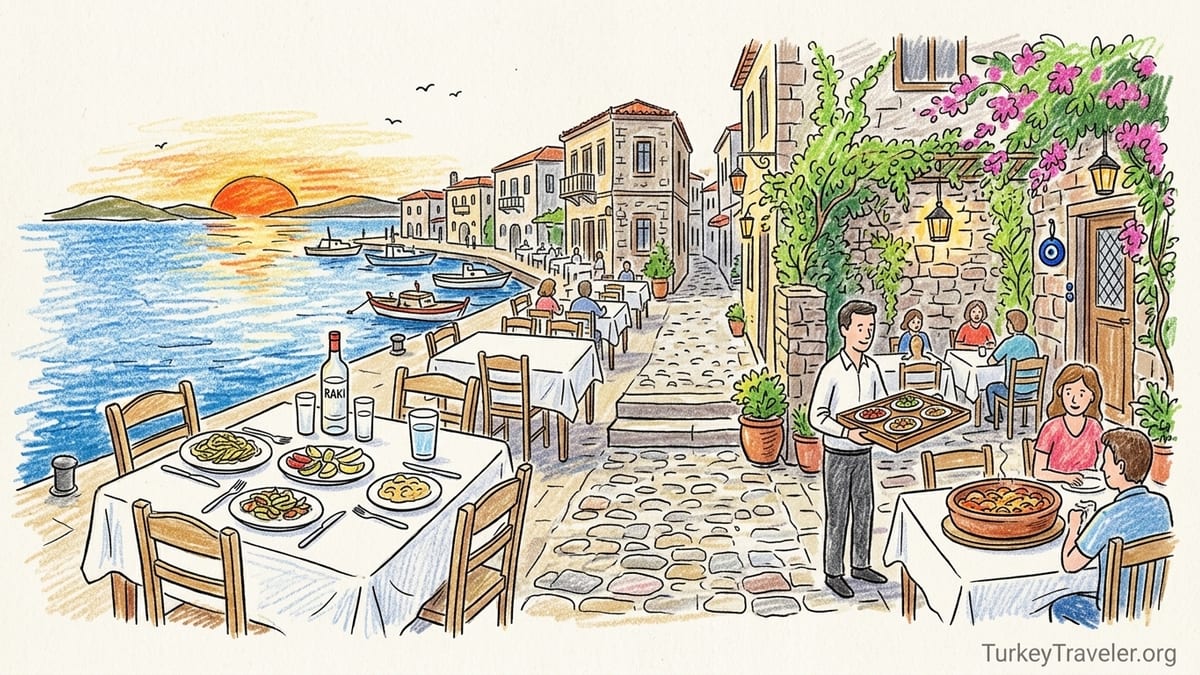
By the time the sun began to slide behind the low silhouettes of the Ayvalık archipelago, every table along Cunda Island’s waterfront seemed set for the same ritual: plates of gleaming seafood, saucers of olive-oil meze, sweating raki glasses and conversations that clearly were not going to end early. I had come to Cunda for this scene as much as for the sea and stone houses, and over a couple of long evenings I learned that where you sit and what you order matter almost as much as the view.
Arriving Hungry on an Island Built for Long Evenings
Cunda, also known as Alibey Island, sits just off Ayvalık on Türkiye’s North Aegean coast, connected to the mainland by a causeway and surrounded by the protected waters of the Ayvalık Islands Nature Park. It has a long-standing reputation in Turkey for seaside fish restaurants, raki-and-fish taverns and Aegean olive-oil dishes that draw visitors from Istanbul and Izmir for weekend breaks as much as from abroad. Walking from the bus stop toward the harbor in the late afternoon, I could already smell charcoal smoke and grilled fish on the breeze.
The island’s waterfront is a single, continuous promise. White-clothed tables line the quay, backed by restored stone houses and small hotels, facing west over the bay where the sun sets directly behind low, dark islands. Waiters stand outside with menus in hand, calling out the day’s fish, while glass cases display shimmering silver papalina, pink shrimp and neat rows of meze plates. It would be easy to assume that any table with such a view guarantees a great meal.
On my first night, I decided to follow that instinct and book a seafront table where the chairs almost brushed the harbor stones. On the second, I stepped back into the grid of narrow streets behind the main strip and discovered a quieter, more food-focused side of Cunda’s tavern culture. The contrast between those two evenings is the reason I would return to the island, and it shapes any honest guide to eating here.
Throughout, I paid for my own meals and, like everyone else scanning the chalkboards, I had one eye on the freshness of the seafood and another on the prices that have risen sharply across Türkiye in recent years. What follows is not a survey of every restaurant, but a detailed look at where I actually sat, what I actually ordered and how those choices shaped the night.
Waterfront Dinner: Papalina, Sunset and a Front-Row Seat
For the classic Cunda experience, I chose a table right on the harbor at a long-established fish-and-meze restaurant similar in style and price to places like Bay Nihat and the other old-guard spots that define the strip. I booked by phone the same afternoon for a Saturday in late season and asked specifically for a table “denize sıfır,” at the very edge by the water. When I arrived around 7:30 p.m., the sun was still high but the front row of tables was filling fast with Turkish couples and families from Istanbul and Bursa. The staff had held my two-top at the corner, with an unobstructed view of the bay.
As is standard in Cunda, the evening began not with a written menu but with a tour of the glass meze case just inside the door. The waiter pointed out classics in Turkish and in simple English: creamy haydari thickened with strained yogurt, smoky aubergine salad, stuffed mussels, a bright green tangle of deniz börülcesi (samphire) and slabs of artichoke hearts resting in a pool of olive oil. Prices were listed per portion on a board above the case, roughly 180 to 260 Turkish lira per cold meze in late 2026, depending on the ingredient.
I started with three small plates to share: samphire dressed with lemon and garlic, olive oil braised artichoke with carrots and peas, and a simple white bean salad tossed with red onion and parsley. Each portion was generous enough for two people, easily stretching into the long rhythm of the evening. The samphire snapped pleasantly between the teeth, still bright and saline. The artichoke heart, a local pride of the Aegean, was silky and mild, soaking up the excellent Ayvalık olive oil that is as central to the region as the sea.
For the main event, I asked for papalina, the tiny local anchovies that are something of a badge for Cunda. They arrived fried in a light coating of flour, piled in a shallow metal dish with lemon wedges and a scattering of crisp parsley. At around 320 lira for a plate large enough for one hungry diner or two to pick at alongside other dishes, it felt fair given the island location. Freshness is everything with fish this small, and these tasted as if they had been out of the water only a few hours: firm, clean and not overtly oily. I ate them with my fingers, dipping each into lemon and occasionally alternating with forkfuls of samphire.
With the food, I ordered a small 35 cl bottle of classic anise-scented raki, chilled and served with a bucket of ice and plenty of water, which came to about 400 lira. As on much of the Turkish coast, alcohol service is completely normal in Cunda’s fish restaurants, but you will not find the loud, shot-driven bar culture of some resort towns. Here raki, beer and a modest wine list fuel conversation more than volume. By the time the bottle was half gone, the sun had dropped into the sea, the harbor lights had come on and the atmosphere had shifted from golden-hour anticipation to a steady, satisfied buzz.
Service, Soundtrack and the Way the Night Unfolds
Service along Cunda’s seafront is practiced and efficient, shaped by years of seasonal crowds. At my harbor-side table, waiters navigated the tight gap between tables with practiced ease, balancing platters of grilled sea bream and turbot. My own server checked in just enough to top up water, refresh bread and occasionally suggest a hot starter without hovering. English was functional, not polished, but there was no difficulty ordering or asking how the fish was priced. As is typical on Cunda, whole fish are usually priced per kilogram, and staff will show and weigh them before cooking if you choose something like sea bass or grouper.
The soundtrack to that first evening was almost entirely the natural mix of clinking glasses, low conversation and the distant thrum of small fishing boats returning to dock. There was no live music at this particular restaurant, which suited the setting. A few neighboring places along the strip had solo musicians setting up later in the night to play Turkish pop or classic tavern songs, but at the start of October this was background, not the booming, amplified sound you might find in peak August.
By around 9:30 p.m., the harbor had fully shifted from sunset spot to tavern. Tables of friends ordered second rounds of raki, children fell asleep in strollers and neighboring groups began to chat across the narrow space between tables. The staff moved a little faster but never rushed anyone out. Even after finishing dessert, a simple plate of chilled melon and a slice of almondy semolina cake shared between two, we lingered for another half hour unbothered, watching latecomers negotiate for any remaining tables further back from the water.
Walking away from the restaurant along the promenade, it struck me that this is the side of Cunda most visitors see. It is undeniably scenic and pleasant, the kind of evening anyone could recommend in broad strokes. Yet the menu at most of these seafront spots overlaps heavily, the fish is priced at a premium and the view can be more memorable than the cooking. I was happy I had a front-row seat to the sunset, but I suspected the island had a more distinctive meal to offer once you accepted a slightly more modest backdrop.
Backstreet Taverns: Meze Focus and a Quieter Sophistication
The following night I made a deliberate decision to trade the sound of waves for narrow cobbled lanes one or two blocks inland. Behind the waterfront, Cunda’s old Greek stone houses form a small maze of streets now filled with boutique hotels, wine bars and contemporary takes on the traditional meyhane. I had heard consistently good things from recent visitors about quieter spots here, including places like Ayna and Dantela Cunda, which are praised for refined meze and a more local crowd than the front-row fish houses.
I chose a small tavern on one of these lanes with around a dozen tables set in a courtyard framed by stone walls and climbing bougainvillea. Arriving at 8 p.m. without a reservation on a shoulder-season Friday, I was lucky to get a two-person table near the doorway, and I watched at least three groups get politely turned away or asked to wait. In high summer, a booking here would be essential, especially on Friday and Saturday nights.
The first sign that I had stepped into a slightly different world was the way the meze were presented. Instead of a long glass case facing the street, the host brought a large wooden tray to the table, explaining each dish slowly. Alongside familiar options like haydari and şakşuka were more inventive plates: octopus salad dressed with fresh herbs, warm mashed fava beans topped with caramelized onion, and a salad of grilled calamari with a dressing that hinted at mercanköşk, the local marjoram that some Cunda kitchens are known for. Most cold meze here were priced around 220 to 300 lira per plate, slightly above my harbor meal but prepared with a noticeable attention to detail.
We ordered artichoke once again to compare, along with the fava purée and the octopus salad. The artichoke heart this time was smaller but sweeter, with its vegetables diced more finely and the olive oil perfumed with a little citrus zest. The fava was spread thin on a plate in traditional Aegean style, dense but not heavy, brightened by thin rings of red onion and dill. It paired beautifully with a glass of local white wine ordered by the glass, which cost just under 300 lira and was served cool but not ice-cold, something often overlooked in busier tourist spots.
What We Ordered, What It Cost and How It Tasted
At this backstreet tavern, I skipped papalina, which was not highlighted as a specialty, and instead followed the staff recommendation for a shared hot main: a clay pot of mixed seafood baked in olive oil with tomatoes, herbs and a touch of cream, similar in style to the seafood casseroles some Cunda restaurants have built reputations around. For around 520 lira, it arrived bubbling at the table, the lid lifted to release a wave of briny steam.
Inside, there were chunks of white fish, thick rings of tender calamari, a few mussels and shrimp, all cooked just to the point of tenderness rather than into the rubbery territory that mixed seafood dishes can easily slip into. The sauce clung to everything without feeling heavy, begging to be mopped up with the fresh bread that was topped up throughout the evening without any extra charge added to the bill beyond a modest cover.
Alongside this, we split another plate of samphire, eager to see how it differed from the previous night’s waterfront version. Here it arrived slightly warmer, with a more assertive squeeze of lemon and a sprinkle of crushed walnuts that added texture. The portion was slightly smaller than on the quay but still ample for two to share as a side, around 230 lira. A small carafe of local white wine and a single glass of raki between us kept the bill for two, with generous meze and one shared main, just under the cost of the waterfront meal even though the ingredients felt more carefully handled.
Perhaps even more than the details of each dish, what set this evening apart was the sense of pacing and calm. Tables were close enough to feel a communal buzz, but there was space to talk without raising your voice. The soundtrack here was a curated playlist of low-key Turkish rock and older tavern songs, never so loud that it forced conversation to compete. The staff moved with unhurried assurance, recommending dishes that made sense together and gently staging their arrival so the table never felt overcrowded.
Reservations, Alcohol, Live Music and the Mood After Dark
Across both evenings, a few practical patterns emerged that are worth keeping in mind if you are planning a visit. First, reservations are not only advisable but often necessary from roughly late June through early September, particularly on Friday and Saturday nights. Waterfront restaurants will do their best to squeeze in walk-ins, but the coveted front-row sunset tables are usually booked by mid-afternoon. Backstreet taverns with smaller capacities can fill entirely, leaving only late-night openings after 10:30 p.m. Shoulder seasons in May and October are looser, but I was still grateful for having called ahead for that waterside table.
On the question of alcohol, Cunda is very much a raki-and-fish destination rather than a dry or strictly conservative island. Every restaurant I visited served raki, beer and a range of Turkish and occasionally international wines. Prices for a small bottle of raki in late 2026 tended to hover around 350 to 450 lira in mid-range taverns, with house wine by the glass between roughly 250 and 320 lira, depending on label and location. The attitude to drinking was relaxed but measured; this is a place for long, companionable meals rather than pre-club shots.
Live music is sprinkled rather than omnipresent. A handful of seafront venues and at least one central spot like Hanya Cunda advertise canlı müzik, often a solo singer or small group performing Turkish favorites and light pop. On nights when they play, music usually starts after 9 or 9:30 p.m., and you can hear it faintly from neighboring streets. If you want to avoid amplified sound, mention this when you reserve, or choose a backstreet restaurant where the emphasis is squarely on the plates rather than performance.
As for the mood of the island after dark, Cunda occupies an interesting space between sophisticated and touristy. The main waterfront, with its string of restaurants and occasional ice cream queues, undeniably caters to visitors, and Turkish families on holiday outnumber foreign tourists once you step away from high season. Yet the combination of heritage stone architecture, the quality of the olive oil and seafood, and the mostly Turkish clientele at the more tucked-away taverns lend the island an atmosphere that feels grounded rather than manufactured. Walking back to my small hotel just after midnight, the streets behind the harbor were quiet but not deserted, with groups lingering over their last glasses in front of wine bars and only a handful of souvenir shops still lit.
Waterfront View vs Better Meal Inland: Choosing Your Evening
Reflecting on both dinners, the trade-off between a waterfront table and a more food-focused backstreet tavern became clear. That first night by the harbor gave me everything a first-time visitor might hope for: a front-row sunset over the Ayvalık Islands, the spectacle of fishing boats sliding past as plates of papalina landed on my table, and the easy pleasure of feeling at the heart of Cunda’s famous seafront. The food was good, the papalina fresh and the meze more than competent, and the bill, while not cheap by current Turkish standards, felt fair given the setting.
The second night, however, delivered a meal I would describe as memorable rather than simply pleasant. Without the distraction of a postcard-perfect horizon, I noticed the nuance in the olive oil, the way the artichoke and fava were seasoned, the careful cooking of mixed seafood that respected each ingredient. Portions were slightly smaller but more precise, and the service felt less like orchestrating a nightly theater of sunset and more like genuine hospitality. The fact that many of the other guests were speaking Turkish rather than a mix of languages added to the sense of being in on a local secret, even if these taverns are now widely written about within Türkiye.
If you have only one evening on Cunda, you could do far worse than book a seafront spot and fully lean into the island’s iconic image. If you have two or more nights, I would strongly recommend balancing that with at least one dinner a block or two inland, where you can trace the deeper contours of Cunda’s Aegean cooking. In my own memory, the photograph I took of the harbor at dusk belongs to the first night, but the flavors I continue to think about are from the second.
Either way, the practical difference is simple. On the waterfront, you are paying partially for the sunset and the convenience of strolling directly from promenade to plate. In the backstreets, the walk is a little longer and the backdrop more modest, but the kitchen has room to be the star. Knowing that distinction before you arrive lets you choose deliberately instead of being swept into the first empty table with a view.
The Meal I Would Return For
If I could fly back to Cunda tomorrow for a single dinner, I would build it around the strengths of that second night while stealing just one element from the harbor. I would book a table at a backstreet tavern known for its meze and quiet courtyard, asking in advance for an outdoor table away from any speakers, and I would aim to arrive just before 8 p.m., early enough to linger but late enough that the courtyard hums with conversation.
To start, I would order three cold meze to share: samphire dressed with sharp lemon, garlic and maybe a hint of walnut; a plate of olive oil braised artichoke with diced vegetables that showcases the Ayvalık region’s oil; and a smooth fava purée dotted with dill and red onion. With these, I would have a small carafe of chilled local white wine, enough for two or three glasses, and a basket of fresh, crusty bread to chase every last slick of olive oil around the plates.
For the main course, I would ask again for a mixed seafood casserole baked in olive oil and tomatoes, confirming that the fish and shellfish are from that day’s market in Ayvalık. I would skip whole grilled fish not because it is lacking on Cunda but because this particular dish, when handled with care, offers a cross-section of what the island and the surrounding sea can provide in a single clay pot. If papalina looked particularly bright and was being recommended by the kitchen that evening, I might add a small portion as a shared hot starter, but I would no longer feel obliged to order it solely out of duty to local specialties.
To drink alongside the main dishes, I would split a small bottle of raki, pacing it slowly with plenty of water, letting its anise note lift the richness of the seafood. I would end with whatever fruit was in season, perhaps melon or figs, and a small glass of tea offered by the house. The walk back toward the waterfront afterward would still deliver the glow of harbor lights and a glimpse of the sea, but the heart of the evening would remain in that courtyard, at a table where the food did not have to compete with the view.
That is the meal I would go back for on Cunda Island: not the most photographed, perhaps, but the one that keeps resurfacing whenever I taste good olive oil or hear the clink of small glasses against a backdrop of low, contented voices.
The Takeaway
Cunda Island’s reputation for seafood, meze and tavern life is not marketing fluff; it plays out tangibly from late afternoon until after midnight along the harbor and in the lanes behind it. A first-timer can easily be drawn to the waterfront and, for at least one night, should be. Watching the sun set over the Ayvalık Islands with a plate of papalina and a glass of raki is a ritual that connects you directly to why Turkish travelers have been coming here for years.
Yet the island’s deeper culinary appeal emerges when you look beyond the most obvious view. In backstreet taverns framed by stone walls and climbing flowers, the focus turns from spectacle to seasoning. Samphire snaps with salt and lemon, artichokes soak in fragrant local oil, and seafood casseroles arrive bubbling, cooked just to the edge of tenderness. Prices are not low by current Turkish standards, but the sense of care and context behind each plate helps justify the bill.
After dark, Cunda feels neither fully resort-like nor stubbornly provincial. It occupies a middle ground of casual sophistication: alcohol flows, live music pops up but does not dominate everywhere, and the island retains a rhythm shaped as much by Turkish weekenders as by international visitors. The decision that most shapes your evening is not whether to drink or how late to stay out, but whether you want waves at your feet or a kitchen quietly working at the back of a courtyard.
Go once for the view, then again for the meal. The combination of both is what makes Cunda Island’s seafood and tavern culture a reason not only to visit, but to plan a return.
FAQ
Q1. Do I need dinner reservations on Cunda Island in summer?
In July and August, it is wise to reserve at least a day ahead for both waterfront restaurants and smaller backstreet taverns, especially on Friday and Saturday nights.
Q2. Are Cunda’s seafood restaurants very expensive by Turkish standards?
Cunda is not the cheapest place to eat in Türkiye, but mid-range taverns still offer good value, with meze plates and fish priced to reflect fresh Aegean seafood and a popular island location.
Q3. Is alcohol widely available at Cunda’s taverns and restaurants?
Yes. Most fish restaurants and meyhanes serve raki, beer and wine, and drinking is part of the local dining culture, though the atmosphere is relaxed rather than wild.
Q4. Can vegetarians eat well on Cunda Island?
Vegetarians will find plenty of Aegean olive-oil dishes such as artichokes, beans, stuffed vegetables and various herb meze, though pure vegan options require a bit more attention when ordering.
Q5. What time should I book to catch sunset at a waterfront table?
In high summer, booking for around 7:30 to 8 p.m. usually allows you to be seated and served meze in time to watch the sun dip behind the Ayvalık Islands.
Q6. Is the seafood on Cunda always fresh?
Most reputable restaurants source daily from Ayvalık’s fish market, but you can always ask when the catch arrived and choose fish displayed on ice that looks bright and clear-eyed.
Q7. Are there loud nightlife spots on Cunda, or is it mostly quiet?
Cunda’s evenings are lively rather than loud, with a few venues hosting live music; however, many taverns keep the volume low and focus on food and conversation.
Q8. How late do restaurants and taverns stay open?
In peak season, many kitchens serve hot dishes until around midnight, with guests lingering over drinks and tea until shortly after, while shoulder seasons can be a little earlier.
Q9. Is it better to sit right on the waterfront or a street or two back?
For iconic sunset views, the waterfront is ideal, but diners seeking more distinctive cooking and a calmer atmosphere often prefer backstreet taverns one or two blocks inland.
Q10. What local dishes should I prioritize trying on a short visit?
On a short stay, focus on papalina if freshly available, a selection of olive-oil meze such as samphire and artichoke, and at least one well-made seafood main from a trusted tavern.