


Out in the Sea of Marmara, less than an hour from Istanbul’s tram bells and traffic, the Princes’ Islands feel like a parallel city made of pine forests, old mansions and pebble beaches. GoTürkiye counts nine islands in the group, but four of them form the heart of most visits: Büyükada, Heybeliada, Burgazada and Kınalıada. All four are car free in everyday use, all four are reached by regular ferries, and yet each has a distinctly different rhythm. Choosing the right island matters far more than many day-trip brochures suggest.
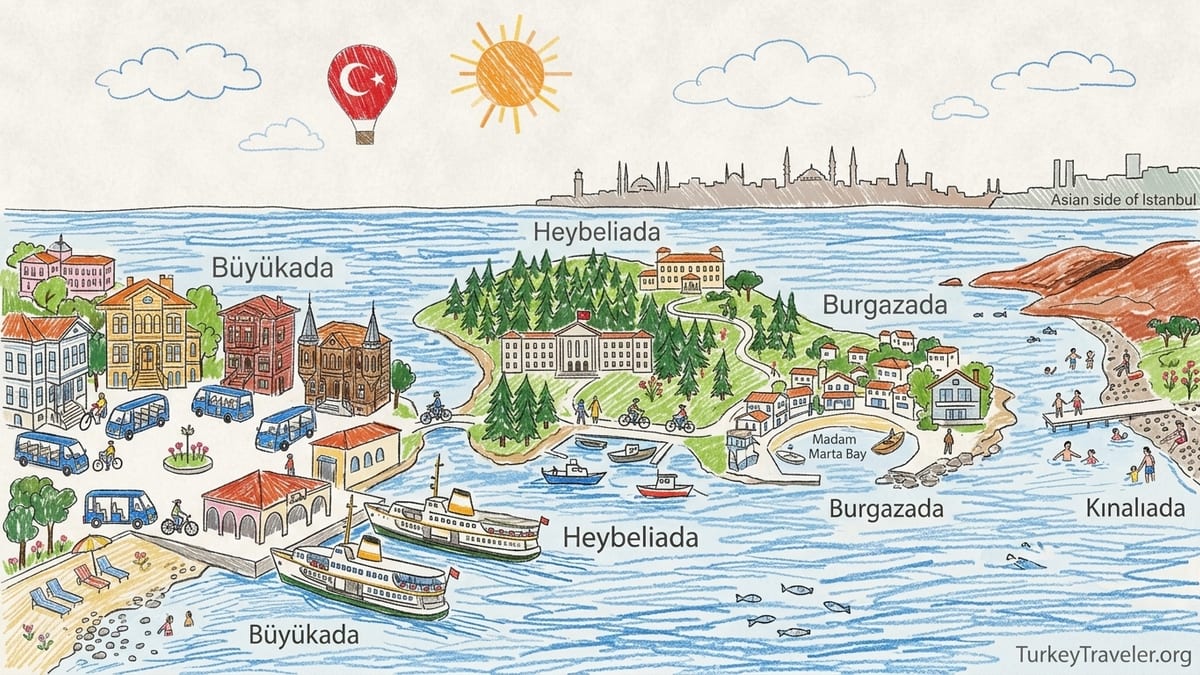
The Four Main Islands at a Glance
The Princes’ Islands sit just southeast of Istanbul’s historic peninsula, clustered close enough that on a clear day domes and skyscrapers are visible from almost every hilltop. According to official descriptions, there are nine islands in total, but ferries for visitors focus on four inhabited ones: Büyükada, Heybeliada, Burgazada and Kınalıada. Büyükada is the largest and administrative center of the Adalar district, with an area of about 5.4 square kilometers and a resident population of more than 7,000. Heybeliada is a little under half that size at roughly 2.4 square kilometers. Burgazada and Kınalıada are smaller still, with Burgazada around 1.5 square kilometers and Kınalıada compact enough to walk across in under thirty minutes from shore to ridge.
What makes them feel so different is not only size but landscape and history. Büyükada’s two hills are wrapped in grand wooden mansions and a dense commercial strip at the harbor. Heybeliada is greener and more residential, with pine forests, naval and theological institutions and long shaded streets. Burgazada mixes modest holiday homes with a low-key restaurant scene and literary heritage, especially around the writer Sait Faik’s waterside house. Kınalıada, by contrast, presents bare red hills and long public beaches running almost straight off the ferry pier, shaped by centuries of Armenian summer culture and quarrying rather than forest.
For visitors, the key question is rarely whether to go to the Princes’ Islands at all, but which island fits the day you want. Is it about ornate architecture and scale, about pine-scented paths and viewpoints, about a lazy seafood lunch with minimal crowds, or simply the quickest possible swim away from the city? Understanding each island’s character before you step on the ferry will save you time, money and frustration once you are out in the Marmara.
Getting There: Ferries, Piers and Travel Times
All four main islands are served year round by a mix of municipal and private ferries. Istanbul’s municipal operator, Şehir Hatları, runs traditional white ferries from central European-side piers such as Eminönü, Karaköy and Kabataş, as well as from Kadıköy and Bostancı on the Asian side. These slower boats are the classic way to go, taking approximately 75 to 100 minutes from Kabataş to the most distant island when running a full loop that includes Kınalıada, Burgazada, Heybeliada and Büyükada in sequence. From Bostancı, which sits opposite the islands on the Asian shore, travel times are much shorter, often 35 to 55 minutes depending on the exact route and stops.
Faster sea buses and catamarans are run by private companies such as Dentur Avrasya and other licensed operators, typically departing from Kabataş, Beşiktaş and Bostancı. Journey times on these express services can drop to around 50 to 60 minutes from Kabataş to Büyükada when there are fewer intermediate stops, and as little as 25 to 35 minutes between Bostancı and Kınalıada on direct or semi-direct trips. Schedules and departure piers change seasonally, especially around the switch to winter timetables in September, so it is worth checking the current day’s sailings before you lock in other plans.
As of late 2026, a single ride using an Istanbulkart on municipal ferries to the islands generally costs the equivalent of a few euros per direction, with contactless bank cards slightly more expensive. Private operators set their own tariffs, often charging a bit more than the municipal rate in exchange for speed or direct routes. There is also an inter-island ring service, sometimes branded as an Adalar içi or “within the islands” line, that shuttles between Kınalıada, Burgazada, Heybeliada and Büyükada. That line is particularly useful if you decide to start from the nearer islands like Kınalıada in the morning and work your way out to Büyükada for dinner, although as this article will explain, trying to tick off all four islands in a single day usually produces a rushed and thin experience.
Whichever island you choose, one planning habit matters: look up your intended return ferry before you disembark in the morning. On summer weekends, popular late afternoon boats from Büyükada and Heybeliada can be standing-room only inside, with long queues snaking back from the pier. In shoulder seasons or on winter weekdays, the last evening departures to certain piers may be surprisingly early. Many local residents who commute to the mainland recommend choosing a concrete return time when you buy your ticket, then building the day around that window.
Island Transport, Hills and Cycling Reality
One of the enduring myths about the Princes’ Islands is that they are tranquil flat places ideal for leisurely cycling. They are car free for private vehicles, which is part of their charm, but they are not flat. Each island rises sharply from the sea; even short loops between coves can involve significant climbs and descents. Until a few years ago, horse-drawn carriages covered much of the distance, but these have been phased out for ethical and practical reasons. Today, getting around relies on walking, bicycles and a growing fleet of electric municipal vehicles.
On Büyükada, the largest road network circles the island’s lower slopes and then climbs to hilltop viewpoints. Near the harbor, you will find multiple rental shops offering standard bicycles, e-bikes and sometimes tandems, usually rented by the hour or the day with prices clearly posted in Turkish lira. For strong cyclists, the full island loop with detours to places like Aya Nikola or Dilburnu makes a satisfyingly challenging ride, but families with younger children often turn back well before the southern hill climbs. Municipal electric shuttle buses operate on marked routes, connecting the ferry pier with residential neighborhoods and key viewpoints, and can be an easier alternative for steep sections.
Heybeliada has gentler gradients in its central saddle but still demands some climbing to reach attractions such as the former Halki Seminary or the Değirmenburnu picnic and swimming area. Bicycles can be rented close to the pier, though the selection is usually smaller than on Büyükada. The island’s electric minibuses and official electric taxis provide point-to-point transport that is popular with older visitors who want to enjoy the high forest views without a long uphill walk. On Burgazada, everything shrinks in scale: the small waterfront village, a ring road that changes quickly from café-lined promenade to quiet residential streets, and a single main hill rising to Aya Yani Church and views toward Kınalıada. Most people simply walk. On Kınalıada, a paved ring road and a small grid of streets behind the harbor make it the easiest island to walk, although the climb to the main ridge still rewards proper shoes and some stamina.
Because motors are restricted, there is no ride-hailing on the islands in the same way you might use taxis in central Istanbul. Visitors occasionally underestimate how long it takes to walk back from a beach or viewpoint to the pier, especially in the early afternoon heat of July and August. As a rule of thumb, allow at least 25 to 40 minutes to return from popular swimming areas such as Dilburnu on Büyükada, Değirmenburnu on Heybeliada or Madam Marta Bay on Burgazada. If you are cycling, remember that rental bikes must be returned to the shop where you started rather than left elsewhere, so factor that into your timing for return ferries.
Büyükada: Mansions, Scale and Classic Day Trips
Büyükada literally means “Big Island,” and it feels every bit the capital of the archipelago. Its ferry terminal opens onto a busy square lined with pastry shops, ice cream stands and restaurants marketing fish menus and Turkish breakfast platters. Behind this, broad streets lead into neighborhoods like Nizam and Maden, where ornate late Ottoman and early Republican mansions peek out behind garden walls. Some are carefully restored summer houses with lace-like wooden balconies; others stand slightly faded, their shutters weathered by salty winds but still conveying an air of seaside grandeur.
Architecturally minded visitors can spend several hours simply wandering these streets, tracing how different eras left their imprint. One loop leads past the Aya Dimitri Greek Orthodox church, smaller wooden villas and larger stone-fronted mansions once owned by Greek, Armenian and Jewish families who made the island their summer base in the late nineteenth and early twentieth centuries. Further south, where the houses become sparser and the forest thickens, trails ascend to the former Greek orphanage building, one of the largest wooden constructions in Europe, and the hilltop Aya Yorgi church with views back over Istanbul.
In terms of beaches and swimming, Büyükada’s size gives it multiple options, although few qualify as the wide sandy beaches that some visitors imagine before arrival. Along the west coast, forest-backed coves in and around Büyükada Nature Park offer rocky or pebble entry and floating platforms, with organized beach clubs charging a fee for loungers and facilities and quieter stretches where you can simply lay a towel on the rocks. To the east and south, smaller organized beaches such as Nakibey or Yörük Ali run their own shuttle boats or are reached by a mix of walking, cycling and electric shuttles. As of recent seasons, day-use prices for organized beaches on Büyükada sit noticeably higher than public beaches on the other islands, especially on peak summer weekends.
Büyükada is also where crowding is most visible. On sunny Sundays between late May and early September, a full mix of domestic and international visitors pour off the ferries from multiple piers, quickly filling the main square and the lower promenades. Restaurants near the harbor compete for attention and souvenir stalls and rental stands can feel overwhelming. For many travelers making a first and only trip to the Princes’ Islands, Büyükada remains the default choice, and its infrastructure is built to absorb them. For those who want a quieter island rhythm, this density makes Büyükada better suited either to early morning departures, shoulder seasons or overnight stays that allow you to enjoy the streets once the day-tripper boats have gone back to the city.
Heybeliada: Greener Slopes and Island Institutions
Heybeliada, whose name is sometimes translated as “Saddlebag Island” because of its double-humped shape, offers a softer, greener contrast to Büyükada’s busy waterfront. Arriving at the pier, you still step onto a small commercial strip of cafés, grocery stores and ice-cream sellers, but it feels more like a lived-in neighborhood than a resort strip. Within minutes of leaving the harbor, pine forests begin to dominate the slopes, and handsome but not ostentatious wooden houses line quiet residential streets with glimpses of the sea at the end of each downhill view.
The island is home to two major institutions that shape its atmosphere. The Turkish Naval High School occupies a prominent site near the shore, its reserved grounds keeping part of the waterfront calmer and more controlled. Higher up, surrounded by trees, lies the complex of the Halki Seminary, a historic theological school of the Ecumenical Patriarchate. While the seminary’s status and visiting arrangements have changed over the years, the walk up to the hill on which it sits remains one of the island’s classic routes, combining shade, birdsong and city views.
For walking and cycling, Heybeliada rewards those who like a mix of easy promenades and more demanding loops. A popular route follows the north shore to Çam Limanı and then climbs gently into forest, eventually circling back toward Değirmenburnu, where locals lay out picnics under the trees and swim from rock shelves or small organized platforms. Compared with Büyükada, distances are shorter and the gradients slightly kinder, so many visitors find they can comfortably combine a morning walk with an afternoon swim without needing any motorized transport beyond the ferry itself.
Food on Heybeliada falls into two main clusters. Around the harbor, small lokantas, börek shops and dessert cafés cater to commuters and day-trippers with simple, fairly priced menus. Along the seafront toward Değirmenburnu, a string of meyhanes and fish restaurants set tables close to the water. Prices are usually a little lower than equivalent spots on Büyükada while still offering the full Istanbul seafood spread, from grilled sea bream and calamari to seasonal mezes. For visitors who want an island lunch that feels connected to everyday Istanbul rather than built entirely around tourism, Heybeliada strikes a very appealing balance.
Burgazada: Literary Quiet and Waterfront Tables
Burgazada, the third island out on most ferry routes, is markedly smaller than Büyükada and Heybeliada and feels more like a large coastal village than a mini-resort. The ferry docks directly into a compact square where grocery stores, a bakery, a few cafés and the island’s main cluster of fish restaurants sit shoulder to shoulder. Behind them, one main street winds uphill past modest summer houses and year-round homes, quickly leaving the bustle of the pier behind.
The island’s most celebrated former resident is the writer Sait Faik Abasıyanık, whose waterside house on the northeast shore now serves as a small museum. The museum and its surrounding streets anchor Burgazada’s literary reputation and help explain the island’s quieter energy. Many Istanbul families with roots here return each summer, but there is relatively little space for mass tourism infrastructure. On a weekday in June, you might walk for ten minutes along the waterfront and pass only a handful of neighbors greeting each other by name and a single minibus delivering goods to a restaurant kitchen.
For beaches and swimming, Burgazada offers a mix of visible and slightly hidden options. Close to the village, small concrete platforms and narrow strips of pebble shore provide immediate access to the water, used mostly by locals taking quick dips. A longer walk south and west brings you to coves such as Madam Marta Bay, where pine trees lean over clear water and swimmers spread out along rocks and small pebble patches. Organized facilities are modest compared with Büyükada’s clubs, which keeps costs relatively low. For instance, recent visitor reports describe seasonal kiosks renting sun loungers and umbrellas for a few hundred lira while leaving plenty of free space for those who prefer to put down their own towels.
Burgazada’s restaurant scene feels curated by habit rather than marketing. Along the waterfront, several long-running meyhanes set white-clothed tables under awnings that fill up on summer evenings, particularly with Istanbul residents making a deliberate choice to dine here instead of more crowded islands. The menus focus on classic Aegean and Marmara seafood, but the pace is slower and the staff often recognize returning customers. Inland, simple cafés and gözleme stalls serve hikers and beachgoers. Combined with the island’s walkable size, this makes Burgazada an excellent choice for visitors who care more about lingering over a long meal and a few swims than ticking off viewpoints.
Kınalıada: Fastest Escape and Beach-Oriented Simplicity
Kınalıada is the closest of the four main islands to the Asian shore and usually the first stop on ferries leaving central Istanbul. Its Turkish name refers to the reddish, henna-like color of its hills, produced by exposed iron-rich rock and a relative lack of deep forest. Historically, it developed as a favored summer retreat for Istanbul’s Armenian community, a pattern still visible in its churches and social clubs. From the ferry, the island presents a compact waterfront of low-rise apartments, small hotels and a long seafront promenade that very quickly blends into beaches.
For travelers whose main priority is swimming with as little transit time as possible, Kınalıada is often the most efficient choice. From Bostancı on the Asian side, fast catamarans and municipal services can reach the island in roughly half an hour. From European-side piers like Kabataş and Eminönü, Kınalıada is usually the first island call, meaning you can often be off the boat and on the beach in under an hour even on a slower ferry. Public pebble beaches run on both sides of the pier, with organized venues such as Teos Beach or Ayazma Beach adding sun loungers, changing cabins and simple food service.
Unlike Büyükada or Heybeliada, where many beaches are several kilometers from the harbor, on Kınalıada the walk from ferry ramp to water can be as short as a few dozen steps. This gives the island a distinctly day-trip feel, especially on summer Saturdays when families arrive with picnic coolers and folding chairs, spreading out along the promenade. Beyond the main strip, the paved ring road climbs gently around the island, offering views back to Istanbul and across to Burgazada. A roughly 20 to 30 minute walk uphill leads to the ridge, where you can see the city skyline, the Asian suburbs and the string of other islands at once.
Food on Kınalıada clusters around the waterfront, with a mixture of pide bakeries, kebab stands, ice-cream kiosks and a few sit-down fish restaurants. Prices for casual meals tend to be modest compared with Büyükada, although organized beach clubs may charge additional entry or sunbed fees in high season. Because of the island’s small size and the concentration of activity along the shore, nightlife is low-key. Most visitors arrive late morning, swim and relax through the afternoon, then catch ferries back to the mainland in the early evening, leaving the quieter residential streets above the shoreline to year-round and seasonal residents.
Comparing Architecture, Nature, Crowds and Overnight Appeal
Although the four islands share certain traits, their differences become clearer when you compare them category by category. In architectural terms, Büyükada is the undisputed heavyweight. Its streets of late Ottoman and early twentieth-century mansions, many with carved wooden facades, stained-glass windows and deep verandas, provide the most rewarding wandering for anyone interested in urban history or design. Heybeliada offers more modest but still atmospheric wooden houses and civic buildings intertwined with pines and institutional campuses, while Burgazada and Kınalıada present simpler village-scale homes and modern apartment blocks, punctuated by a few historic churches and clubs.
For nature and walking, Heybeliada and Burgazada have the edge if you want forest shade and manageable distances. Heybeliada’s saddle shape creates sheltered valleys and looping paths where you can walk for an hour without losing sight of the sea. Burgazada’s single main hill concentrates its forest but rewards short hikes with wide views and access to sheltered bays like Madam Marta. Büyükada has extensive forest too, especially in its protected nature park, but the crowds and longer distances can make certain routes feel less tranquil in peak season. Kınalıada, with its barer, mineral hills, offers striking geology and panoramic views but less deep shade, so walks there are best in spring, autumn or earlier morning hours.
When it comes to beaches and swimming, the trade-offs are more nuanced. Büyükada has the greatest number of organized beach facilities with full services, but reaching them often requires extra time, transport and higher day-use fees. Heybeliada and Burgazada provide a mix of simple entry points and modestly organized spots where you can swim from rocks and enjoy clearer water with fewer people right on top of you, especially on weekdays. Recent guides and local commentary often highlight Kınalıada as offering some of the most convenient public-access swimming areas among the four, thanks to its long pebble beaches immediately beside the pier and additional coves within a short walk.
Crowds and overnight appeal tend to move in opposite directions. Büyükada is by far the busiest island for day-trippers, particularly in summer and on public holidays, but it also has the largest range of accommodation, from mid-range hotels close to the pier to smaller guesthouses in quieter backstreets. Staying the night allows you to experience a very different atmosphere once the excursion groups have left, with locals strolling the waterfront and the sound of church bells and mosque calls traveling clearly across the water. Heybeliada and Burgazada have smaller but appealing stocks of pensions and boutique-style stays, usually favored by Istanbulites who want more peace and a residential feel. Kınalıada has comparatively limited accommodation and fewer nightlife options, which keeps it focused on the day-trip and commuter market rather than extended holidays.
Why Four Islands in One Day Rarely Works
The existence of an inter-island ring ferry tempts some visitors into treating the Princes’ Islands like a checklist: breakfast on Kınalıada, a coffee on Burgazada, a walk on Heybeliada, and sunset on Büyükada. In practice, this often means spending more time waiting at piers and watching departure boards than actually enjoying any island. Each boarding and disembarkation eats into your day, and ferry intervals can stretch to 60 minutes or more outside the core summer timetable, especially on shoulder-season weekdays.
Distances on the islands themselves further complicate ambitious itineraries. Suppose you land on Büyükada around 11:00 in the morning with a plan to cycle to a beach, swim, return to the pier for an inter-island ferry and still repeat that pattern elsewhere. Renting a bike, navigating out of the busy town center, covering the hilly distance to a beach and then making your way back can easily take three to four hours, even without long breaks. On Heybeliada, the mellow atmosphere encourages slow walking, coffee stops and photo pauses under trees. Compressing that into a single hour before rushing back to the boat contradicts the very reason people come.
There is also a qualitative loss. The most rewarding moments on the islands are often the quiet ones that happen between activities: sitting with tea on a Burgazada bench watching fishing boats turn in the light; walking down an empty wooden-house street on Büyükada after dinner; or floating in Kınalıada’s water with the Istanbul skyline hazy in the distance. When you are watching the clock for the next connection, those unstructured intervals tend to disappear. Residents and regular visitors frequently advise friends to limit themselves to one island per day, perhaps two if they are very close together and you are content to treat the second as a short after-lunch stroll.
If you are short on time in Istanbul and want a single island experience, you will likely have a better trip by choosing the island whose strengths match your priorities and exploring it fully. That may mean committing to Büyükada’s scale and accepting the crowds, or skipping the “big island” entirely in favor of a greener or quieter alternative. With regular ferries running year round, you can always plan another visit on a future trip rather than trying to compress the entire archipelago into one long summer Saturday.
Who Should Choose Which Island
For first-time visitors who want a classic snapshot of the Princes’ Islands, Büyükada remains the most representative choice. Its mix of harbor bustle, mansion-lined backstreets, hilltop views and multiple beach options mirrors the islands’ collective identity. Arrive on an early ferry to avoid the heaviest crowds, rent bicycles or use electric shuttles selectively, and plan a route that combines architectural wandering with a few hours at one of the west coast coves. If you can stay overnight, you will see why many Istanbul residents maintain summer homes here despite the daytime chaos.
Families, especially those with younger children, often find Heybeliada or Kınalıada easier. Heybeliada’s softer gradients, abundant shade and compact village center mean less distance to cover between playgrounds, cafés, small markets and the sea. A family might arrive midmorning, walk or shuttle out to Değirmenburnu for a picnic and swimming, then return to the harbor area for a simple dinner before an evening boat back. Kınalıada, with beaches right at the pier, minimizes walking even further; children can be in the water within minutes of arrival. The trade-off on Kınalıada is less shade and less variety of activities away from the shore, so bringing sun protection and simple games for the beach matters.
Couples and small groups looking for a slower, more atmospheric day centered on conversation and food often gravitate toward Burgazada or Heybeliada. Burgazada’s waterfront meyhanes make a strong case for a late afternoon ferry, a brief stroll around the hill and a leisurely dinner watching the lights come on across the water before taking a night boat back to the city. Heybeliada offers similar experiences but with more forest walks possible before or after meals. Both islands generally feel calmer in the evenings than Büyükada, while still having enough residents around to avoid any sense of emptiness.
Swimmers and sun-seekers have to decide how much variety and infrastructure they want. Those happy to pay higher day-use fees for loungers, changing rooms and restaurant service may prefer the better-known beach clubs of Büyükada. Travelers who just want clean water, some rocks or pebbles to sit on and perhaps a kiosk for cold drinks might find Burgazada’s coves or Kınalıada’s public beaches more satisfying. Architecture lovers will be best served by Büyükada’s villa districts and Heybeliada’s combination of wooden houses and institutional complexes. Anyone specifically trying to avoid the busiest island should generally steer away from high-season weekends on Büyükada and instead target Burgazada, Heybeliada or Kınalıada, arriving either on a weekday or with an early-morning ferry.
FAQ
Q1. Which Princes’ Island is best for a first-time visitor from Istanbul?
For a first visit, Büyükada offers the broadest mix of experiences: historic mansions, hilltop views, several swimming spots and the feeling of a small town with full services. If you dislike crowds, consider Heybeliada instead for a greener, calmer introduction that still feels representative of the islands.
Q2. Where do ferries to the Princes’ Islands leave from in Istanbul?
Year-round ferries depart from several piers, including Kabataş and Eminönü on the European side and Kadıköy, Bostancı and sometimes Maltepe on the Asian side. Private operators may also run express services from Beşiktaş and other central locations in high season. Always check the latest daily schedule, especially around seasonal timetable changes.
Q3. How long does it take to reach each island?
From central European-side piers such as Kabataş, slower municipal ferries usually take around an hour to reach Kınalıada and roughly 75 to 100 minutes to reach Büyükada when making multiple stops. From Bostancı, crossings can be as short as 25 to 35 minutes to Kınalıada and around 40 to 60 minutes to the other islands on faster or more direct routes.
Q4. Can I visit more than one island in a single day?
Visiting two islands that are close together is possible if you treat the second as a short walk and café stop. Trying to meaningfully experience all four main islands in one day is rarely satisfying, as you spend a large share of your time waiting for ferries, boarding, disembarking and watching the clock rather than actually swimming, walking or exploring.
Q5. Are the Princes’ Islands really car free?
Private cars and standard taxis are not allowed on the islands, which makes the streets notably quieter than mainland Istanbul. There are, however, municipal electric minibuses, service vehicles and bicycles, so you will still see and hear some traffic. Walking remains the main way to get around, with bikes and electric shuttles as support rather than full replacements.
Q6. Which island is best for beaches and swimming?
Büyükada has the widest range of organized beach clubs but often with higher prices and longer transfers from the pier. Kınalıada offers the most immediate access to public pebble beaches right beside the harbor. Heybeliada and Burgazada sit in between, with simple swimming spots and a few modestly organized areas that appeal to people who prefer quieter coves.
Q7. Where should families with children go?
Heybeliada suits many families thanks to its shaded streets, manageable distances and mix of picnic areas and small swimming spots. Kınalıada is also popular because its beaches start almost at the ferry ramp, so little legs do not have to walk far. On both islands, it is easy to find grocery stores, bakeries and casual eateries for kid-friendly food.
Q8. Which island is best if I want to avoid big crowds?
To minimize crowds, avoid peak summer weekends on Büyükada and opt for Burgazada, Heybeliada or Kınalıada instead, especially on weekdays or with early-morning ferries. Burgazada, in particular, tends to stay quietest overall, with a small village center and limited capacity for mass tourism.
Q9. Is it worth staying overnight on the Princes’ Islands?
Yes, staying overnight can transform the experience. Once the last large ferries leave, the islands revert to a softer rhythm of evening walks and local life. Büyükada offers the widest choice of accommodation, while Heybeliada and Burgazada provide a more intimate residential feel. Kınalıada has fewer options and is used more as a day-trip destination.
Q10. Do I need to book anything in advance for a day trip?
For a simple weekday visit, advance booking is usually unnecessary; you can tap an Istanbulkart and board. In high summer, it is wise to check ferry timetables the day before, arrive a bit early for popular departures and, if you plan a special dinner at a waterfront restaurant on Heybeliada, Burgazada or Büyükada, call ahead from Istanbul to reserve a table.