


On a calm bend of the Euphrates in southeastern Türkiye, Halfeti has reinvented itself as one of the country’s most atmospheric water-based destinations. Partially submerged after the Birecik Dam, the old settlement now sits at the edge of a wide reservoir, where stone houses slip into green water and minarets rise from the depths. Today, dedicated Halfeti boat tours sail past the sunken village toward Rumkale fortress, while full-day packages from Şanlıurfa and Gaziantep combine river cruising with the wider heritage of Mesopotamia.
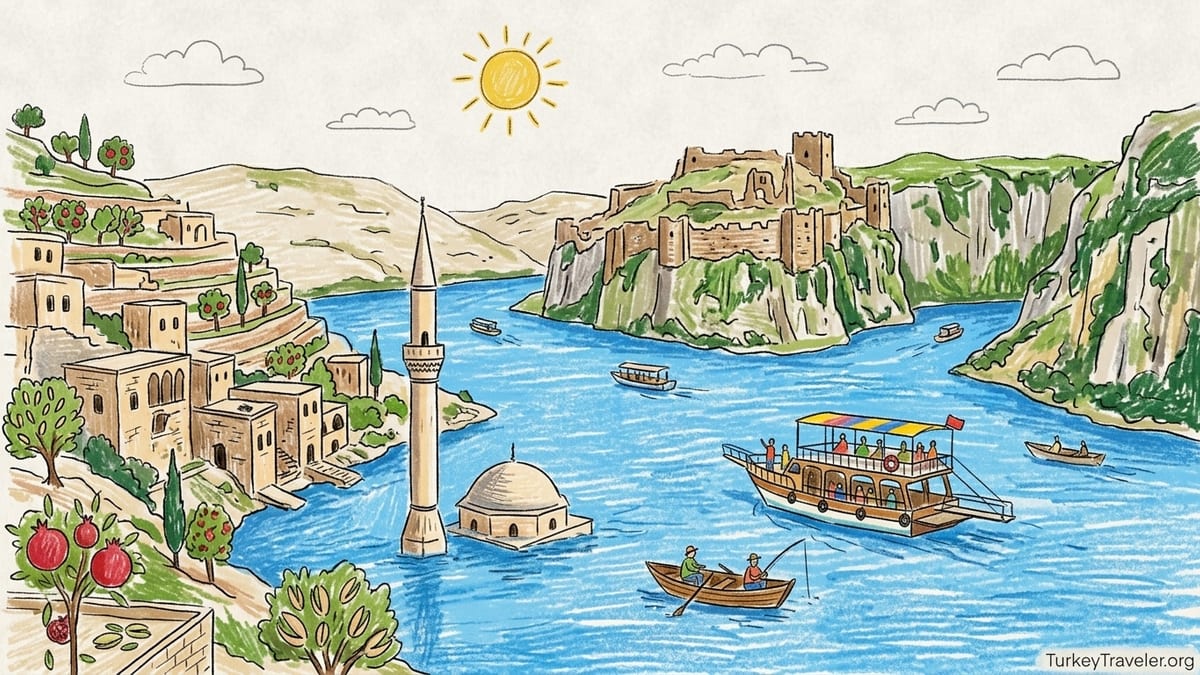
Euphrates Boat Trips: What a Halfeti Cruise Really Looks Like
Most visitors experience Halfeti from the water. Simple riverboats and long covered launches line the waterfront of Old Halfeti, departing on regular circuits that follow the Euphrates toward the ruined fortress of Rumkale and the famous submerged mosque at Savaşan village. In practical terms, these are not luxury cruises but relaxed, local-style outings. Seating is usually a mix of benches and plastic chairs. There is often a shaded upper deck and an open bow where people gather for photos as the boat glides past terraced hills and partially flooded stone houses.
Typical shared tours run for around 1.5 hours on the shorter loop and up to 2 or 3 hours on the longer route that goes beyond Rumkale and lingers around the submerged village. In 2026, standard shared cruises cost roughly 300 to 400 Turkish lira per person on the ground, depending on company and season, with some operators quoting prices in euros or dollars mainly for foreign groups. Private boats for families or small parties are priced per boat rather than per person and commonly range from the equivalent of about 70 to 120 US dollars for 1 to 2 hours, rising if you request a sunset slot or extended time on the water.
On board, expect a low-key experience. Some skippers offer Turkish tea and simple snacks for purchase, while others allow you to bring your own water and simit or pastries picked up in the village. Announcements about Rumkale, the dam project and the history of Old Halfeti may be given in Turkish only, although tour groups from Şanlıurfa or Gaziantep often travel with their own bilingual guide who provides commentary. Even without detailed explanations, it is the slow movement along the flooded valley that leaves the strongest impression, as the scale of the landscape and the transformed shoreline come into focus.
Rumkale and the Sunken Village: Highlights on the Water
Every Euphrates cruise from Halfeti pivots around two landmarks. The first is Rumkale, the crag-top fortress that once controlled a vital crossing of the river. As the boat approaches, visitors see sheer cliffs draped in green, topped by ruined walls and towers that appear to grow straight out of the rock. Many captains slow here, swinging the bow in a wide arc so passengers on both sides can photograph the citadel and the deep-cut coves beneath it. Some private itineraries add a brief shore stop at small jetties opposite Rumkale, but most standard cruises admire it from the water only.
The second highlight is the sunken village around old Halfeti, especially the area of Savaşan. Here the hull slips between stone facades that end abruptly at the waterline. The most photographed sight is the slender minaret that rises straight from the reservoir, its base long beneath the surface. Boats usually pause for several minutes so travelers can capture the scene and watch how the ripples distort reflections of the mosque and ruined houses. Even those who have seen images of Halfeti online often comment that the scale and quietness of the real place are more affecting than expected.
Along the way, other details bring the story of the dam to life. Terraces that once held pomegranate and pistachio trees now mark the former shoreline, and inlets cut deep into the limestone hills show how far the water rose when the reservoir filled. In summer, it is common to see locals fishing from the bank or small rowboats, and during peak domestic holiday periods the river can be dotted with multiple tour vessels at once. By contrast, a weekday boat in late autumn or early spring might share the water with only one or two other craft, emphasizing the remoteness of this corner of Şanlıurfa province.
Boat Sizes, Length of Tours and Seasonal Conditions
Halfeti’s boats vary from compact wooden vessels that carry around a dozen people to larger steel-hulled craft that can hold several dozen passengers under a long canvas canopy. Travelers who prioritize space and a quieter ride often look for mid-sized boats with a mix of open and covered areas. These can feel substantially more comfortable than a fully packed large tour boat on busy weekends. In practice, many independent visitors choose the first departure with free seats, while those on day trips from Şanlıurfa or Gaziantep usually have a specific vessel reserved by their tour operator.
Duration is another key variable. Local operators commonly sell a baseline 1.5 hour circuit that covers Rumkale and the sunken village without extended stops. Longer options of around 2 to 3 hours add more time dawdling near the fortress and partially submerged streets, and sometimes include a short swimming pause in high summer if conditions and safety rules allow. Private hires are the most flexible; if a couple or group books a boat for two hours, captains are typically willing to adapt the pace, staying longer at Rumkale for photos or circling back around the minaret at Savaşan on request.
Seasonal changes are significant on the Euphrates. From late April through October, Halfeti enjoys mostly clear, hot days, with daytime highs often surpassing 30 degrees Celsius in mid-summer. Boats in July and August can feel intense in the midday sun, even with shade canopies, so an early morning or late afternoon departure is usually more comfortable. Spring and autumn bring kinder temperatures and softer light, making these shoulder seasons attractive for photography. In winter, wind on the reservoir can be sharp, and although some operators run boats year-round when the weather is safe, sailings may be less frequent and water levels or wave chop can slightly affect comfort.
Shared Boats vs Private Charters: Which Works Best?
Most visitors first encounter shared boats, since these are the ones whose staff circulate along the Halfeti waterfront calling out departure times and prices. Shared cruises are straightforward and budget-friendly, with locals and domestic tourists often filling the benches alongside international travelers. For solo visitors or couples watching costs, a shared trip at a per-person rate delivers the core experience: Rumkale views, a close pass by the sunken mosque and a sense of drifting through a landscape reshaped by the dam.
Private charters shift the emphasis toward flexibility and quiet. A family or small group might reserve a boat directly at the dock or through a hotel in Şanlıurfa or Gaziantep, paying a flat fee for a set period, often 1.5 or 2 hours. In practice, this means more control over the schedule, the option to avoid the busiest midday window and more space to move around on deck. Many private captains will also adjust the route slightly, weaving into side coves or adjusting the order in which Rumkale and the sunken village are visited to chase better light.
There are trade-offs. A private boat costs significantly more than four or five seats on a shared vessel, so it tends to make sense only for small groups who can split the fee. On popular spring and summer weekends, reserving a private charter in advance through a local agency in Şanlıurfa or Gaziantep can be wise, as demand from domestic tour groups is high. Conversely, on a quiet weekday in November, travelers sometimes find captains amenable to short-notice negotiation at the pier, especially in the late afternoon when there are fewer bookings.
Independent Halfeti Boat Trips vs Day Tours from Şanlıurfa and Gaziantep
Before booking, it helps to decide whether you want to piece together your own visit to Halfeti or join a packaged day trip from Şanlıurfa or Gaziantep. Independent travelers usually travel by rental car or regional minibus to Halfeti’s modern town or directly to the old waterfront, then choose a boat on arrival. This approach offers maximum freedom. You can decide on the spot whether to take the next shared boat or negotiate a private charter, linger in a riverside café after the cruise or explore side streets and viewpoints above the water at your own pace.
Day tours from Şanlıurfa, by contrast, bundle road transport, guiding and the boat into a single product. A typical full-day “Harran and Halfeti” itinerary, for example, might leave Şanlıurfa city in the morning, visit the beehive houses and ancient ruins in Harran, stop for lunch by the Euphrates in Halfeti, then finish with a 1.5 to 2 hour boat cruise before returning to the city in the evening. Current 2026 offerings often include extras such as a visit to the northern bald ibis conservation area near Birecik or a short stop at a roadside viewpoint over the reservoir.
From Gaziantep, day trips usually highlight both culture and scenery. Operators commonly start the morning with the Zeugma Mosaic Museum or a walk through Gaziantep’s bazaars, then drive about 1.5 to 2 hours to Halfeti for lunch and a mid-afternoon cruise. Prices for these full-day packages in 2026 often fall in the range of roughly 500 to 800 lira per person for Turkish-language tours, with higher rates for smaller English-language groups or private vehicles. Advantages include door-to-door logistics, a guide who explains the dam project and local history, and a guaranteed boat slot without haggling at the dock.
The main limitation of touring with a group is reduced independent time in Halfeti itself. Many itineraries allow only an hour or so on shore before or after the cruise, much of which is punctuated by a set lunch at a riverside restaurant included in the tour fee. For travelers who like to linger in one place, wander the alleys or wait for the changing light over the water, that can feel rushed. By contrast, those who are short on days and want to fold Halfeti into a broader Mesopotamia route often find the all-inclusive day trips a pragmatic way to experience the Euphrates.
How Much Free Time You Really Get in Halfeti
Free time in Halfeti depends almost entirely on how you arrive. Independent visitors who come by their own car from Şanlıurfa or Gaziantep can realistically spend half a day or more in the area. A common pattern is to arrive late morning, have a leisurely riverside lunch, join an afternoon boat trip to Rumkale and the sunken village, and then climb up to one of the hilltop viewpoints for sunset before driving back after dark. This pace allows time to explore the lanes of Old Halfeti, step inside the small mosque, and pause at local stalls selling rose-scented cologne and regional sweets.
Travelers on organized day tours from Şanlıurfa often have more tightly choreographed schedules. When Halfeti is paired with Harran, Göbeklitepe or the main city sights, the river segment is slotted into a wider circuit. That usually translates into free time measured in tens of minutes rather than hours. You may still have a short window to wander the promenade or sip tea by the water, but moving too far from the group meeting point risks missing the bus. Some boutique agencies respond to this by offering “Halfeti focus” days that include a longer cruise and an extended riverside break, but these remain less common than multi-stop itineraries.
From Gaziantep, the pattern is similar. Full-day tours that combine city museums and bazaars with Halfeti typically allocate just enough time for a lunch and boat ride before turning back along the road that traces the Euphrates valley. If extended free time by the water is a priority, it is worth asking specifically, before booking, how long the group will spend on shore in Halfeti itself. Travelers who want the best of both worlds sometimes arrange a private day transfer that includes a set number of hours of unscheduled time in the village, allowing them to enjoy both the guided context and the slower rhythm of an afternoon on the riverbank.
When to Go and Practical Planning from Şanlıurfa or Gaziantep
Although day trips and packages promote Halfeti throughout much of the year, conditions on the ground change enough that planning around seasons matters. From May to early October, the combination of stable weather and school holidays makes this the busy season. Boats may fill more quickly, particularly on weekends and Turkish public holidays, and midday heat on the exposed decks can be strong. Booking a tour or at least calling ahead to a local agency in Şanlıurfa or Gaziantep is advisable in these months, especially if you prefer an English-speaking guide or a private charter.
Spring and autumn, particularly April and late September into October, offer a gentler experience. Daytime temperatures are comfortable for walking around the village, and the angled light on the limestone cliffs and flooded streets is often excellent for photography. During these shoulder seasons, many operators still run a full schedule, but crowds thin between major holidays, giving independent travelers more room to negotiate departure times and boat types on the spot. Winter visits remain possible but are more weather-dependent. Fog, rain or strong winds on parts of the reservoir can lead captains to shorten routes or cancel departures, so it is sensible to stay flexible and plan another activity in Şanlıurfa or Gaziantep as a backup.
From Şanlıurfa, Halfeti is typically reached by road in a couple of hours, with routes that sometimes combine stops at Harran or Birecik. From Gaziantep, the drive skirts the Euphrates valley and takes roughly 1.5 to 2 hours depending on traffic and road conditions. Public transport connections exist but are mainly oriented toward local use and can be time-consuming. In practice, many international visitors either rent a car for a few days to explore Şanlıurfa, Halfeti and nearby sites independently, or book a dedicated day trip to avoid navigating timetables in Turkish. In both cases, being clear about how much time you want on the water and in the village itself will help you choose the right combination of transport and boat.
The Takeaway
Halfeti’s boat tours on the Euphrates have become a signature experience of southeastern Türkiye, not because they are glamorous cruises, but because they offer an intimate view of a landscape reshaped by water. The slow approach to Rumkale, the silent walls of the sunken village and the contrast between old stone and new shoreline capture the region’s recent history as clearly as any museum display in Şanlıurfa or Gaziantep. Whether you join a simple shared boat or charter a private vessel, the essence of the experience lies in watching this story unfold from the river.
Choosing between a stand-alone visit and a packaged day trip comes down to priorities. Independent travel gives you control: time for an unhurried lunch, flexibility to choose your preferred boat on the spot and the option to wait for late-afternoon light over the reservoir. Packages from Şanlıurfa or Gaziantep, meanwhile, streamline logistics and fold Halfeti into a broader circuit that might include Harran, Göbeklitepe or Gaziantep’s mosaics and markets. In 2026, both approaches remain well supported, and operators continue to promote dedicated Halfeti seasons as a highlight of regional itineraries.
With a little planning around boat types, tour length and seasonal conditions, travelers can shape the Euphrates to match their own rhythm, whether that means a single, memorable cruise or a full day drifting between river, village streets and highland viewpoints. For many, the memory that lingers is not a specific landmark, but the sensation of the boat’s wake breaking against submerged stone and the realization that this tranquil waterline once lay far below.
FAQ
Q1. How long do Halfeti boat tours usually last?
Most standard shared tours from Halfeti run about 1.5 hours, while longer routes that spend more time near Rumkale and the sunken village can stretch to around 2 or even 3 hours, especially on private charters.
Q2. How much do Halfeti boat trips cost in 2026?
Shared boats typically charge in the region of 300 to 400 Turkish lira per person, depending on operator and season. Private boats usually have a set price per vessel, often equivalent to roughly 70 to 120 US dollars for 1 to 2 hours, with higher rates for peak holiday dates or sunset cruises.
Q3. Is it better to book a Halfeti boat directly there or through a tour from Şanlıurfa?
If you enjoy flexibility and want more free time in the village, going independently and choosing a boat at the Halfeti waterfront works well. If you prefer organized transport, a guide and a guaranteed departure, a day tour from Şanlıurfa that includes the boat can be more convenient, though it usually leaves less independent time on shore.
Q4. Can I visit Halfeti on a day trip from Gaziantep?
Yes. Many agencies in Gaziantep offer full-day excursions that combine the city’s museums or bazaars with a drive to Halfeti and an Euphrates boat tour. Travel time each way is roughly 1.5 to 2 hours by road, making it manageable as a long but rewarding day out.
Q5. What is the difference between shared and private Halfeti boats?
Shared boats operate on fixed schedules with per-person pricing and are usually the most economical choice. Private boats are reserved for your own group at a flat rate and offer more space, quieter conditions and flexibility over timing and route, but cost more overall.
Q6. When is the best time of year to take a Halfeti boat tour?
Spring and autumn are generally the most comfortable, with pleasant temperatures and softer light for photography. Summer brings long days and lively river traffic but can be very hot in the middle of the day, while winter sailings depend more on weather and may be less frequent.
Q7. How much independent time will I have in Halfeti on a day tour?
On typical group tours from Şanlıurfa or Gaziantep, expect around an hour or so of free time in Halfeti outside of the scheduled boat ride and group meal. Some itineraries offer slightly longer breaks, but if unstructured time is important to you, it is wise to confirm this with the operator in advance or travel independently.
Q8. Do Halfeti boat tours still run in winter?
Many operators continue limited services in winter when the weather is stable, but departures can be reduced or canceled in periods of rain, fog or strong wind. If visiting between November and March, it is best to stay flexible and check conditions shortly before planning a cruise.
Q9. Are Halfeti boat trips suitable for children and older travelers?
Yes, the cruises are generally gentle and family-friendly, with calm water and ample seating. Parents should keep a close eye on children near railings, and older travelers may prefer mid-sized boats with easier access and good shade, especially in hot weather.
Q10. Can I swim during a Halfeti boat tour?
Swimming is not guaranteed and depends on operator policies, safety conditions and season. Some private charters may allow a short swim stop in quieter stretches of water in high summer, but shared tours usually remain focused on sightseeing from the boat itself.