


By the time I reached Kovada Lake National Park, I had already done what most travelers do in Turkey’s Lake District: chased the white shores of Salda and watched the evening light fall over Eğirdir. Kovada came at the end of that circuit, a quieter green pocket at the southern tip of Lake Eğirdir that GoTürkiye now pairs with Yazılı Canyon and the ancient city of Adada. It felt less like another big-name lake to tick off and more like stepping into the forested backstage of the region, where the emphasis is on birdsong, needles underfoot and still water hidden behind trees rather than instantly striking Instagram scenery.
Finding Kovada on the Lake District Circuit
Most visitors encounter Kovada Lake National Park as a line on an Isparta road trip map. GoTürkiye and regional tourism boards now promote a loop that runs from Eğirdir to Kovada Lake, then onward to Yazılı Canyon and the hilltop ruins of Adada, before returning toward Isparta. It is presented not as a standalone resort lake with hotels and promenades, but as the quiet nature segment of a broader culture and landscape circuit. On paper, that makes sense. On the ground, Kovada feels even more low-key and provincial than the brochures suggest.
The national park hugs the southern extension of the Eğirdir basin in Isparta province. Official documents from the Ministry of Agriculture and Forestry list Kovada Gölü Milli Parkı as a protected area of just over six thousand hectares, established in 1970 and lying roughly 23 kilometers south of Eğirdir town by road.([tarimorman.gov.tr](https://www.tarimorman.gov.tr/DKMP/Belgeler/Korunan%20Alanlar%20Listesi/MP-WEB-Son.pdf?utm_source=openai)) From Isparta city, the distance is around 60 to 65 kilometers depending on the route. That geography is important: Kovada is not a separate crater or mountain lake like Salda, but a lower, marshier extension of the bigger Eğirdir system, enclosed by forested slopes. You feel that continuity if you drive down from Eğirdir; the lake is essentially the same water, but the human presence fades away.
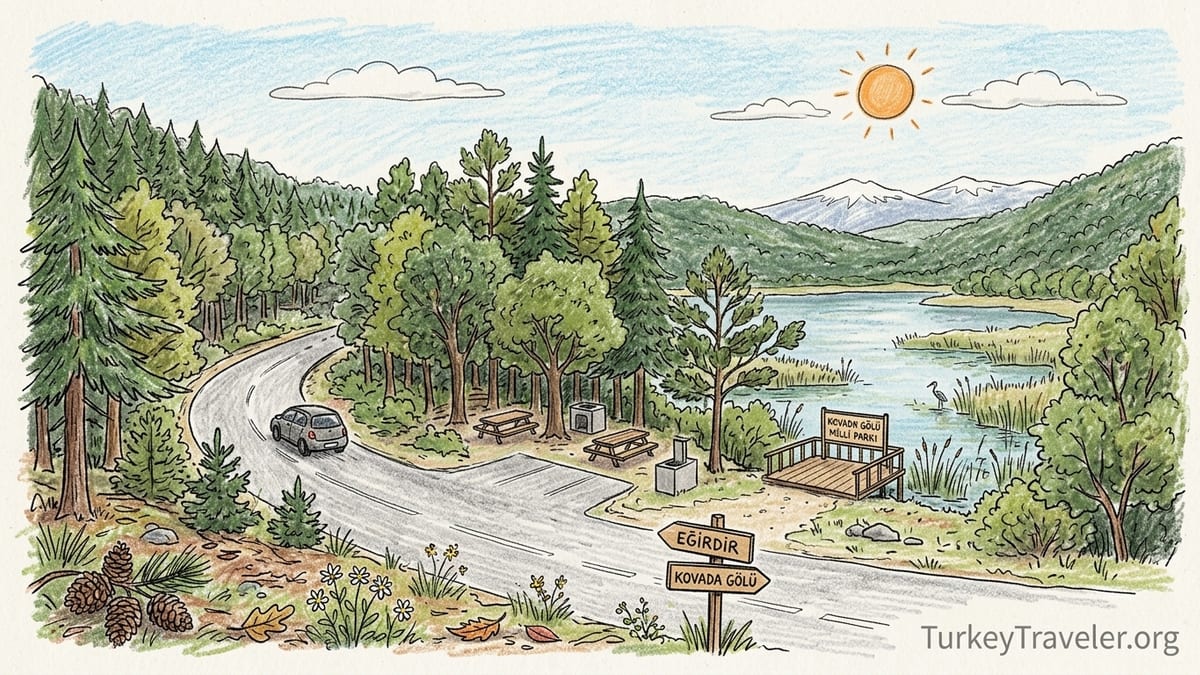
For travelers used to the polished lakefronts of Salda, where snack kiosks and rental umbrellas cluster near the main public beaches, Kovada’s entrance comes as a surprise. There is a small park gate with a booth, a few information panels in Turkish about birdlife and tree species, and a pair of modest parking areas set under pines. There are no hotel signs, beach clubs or “Maldives of Turkey” slogans. On a weekday visit in late season, my car was one of fewer than a dozen in the lot, most registered in Isparta and Antalya. Kovada is where locals come to grill sausage, listen to cicadas and stretch their legs under trees, while long-distance travelers tend to speed past toward the flashier lakes unless, increasingly, they have read about the GoTürkiye nature-and-history route.
Driving In: From Eğirdir and Isparta to the Forest Edge
The two most practical approach routes to Kovada Lake National Park are from Eğirdir and from Isparta. Arriving from the north, the road runs out of Eğirdir town along the eastern shore before branching toward the villages that line the southern end of the lake. Official regional guides note that Eğirdir lies about 34 kilometers from Isparta at an elevation of just under 1,000 meters, connected to the provincial capital by a good two-lane highway used by intercity buses.([dag.org.tr](https://www.dag.org.tr/media/webdocs/ISPARTA_rehber_ic_low.pdf?utm_source=openai)) From Eğirdir to Kovada, you drop slightly in height, and the landscape closes in, becoming more wooded and less cultivated.
The surface between Eğirdir and Kovada is asphalt almost the entire way, with occasional patched sections and narrow shoulders. It feels like a typical secondary rural road in western Turkey rather than a remote track: two vehicles can pass comfortably, but there are few guardrails, and in wet conditions you will want to take the bends slowly. Local cyclists and hiking tour operators who link the St. Paul Trail and Kovada describe this southern edge of the lake as suitable for support vehicles and minibuses, which matched what I saw on the ground.([morgezi.com](https://morgezi.com/programlar/st-paul-yolu-egirdir/?utm_source=openai))
From Isparta, drivers usually follow the signed route south through villages toward Sütçüler and the protected areas beyond. This is also the corridor that serves Yazılı Canyon Nature Park and Adada. Newer travel guides for Yazılı Canyon give concrete timing: about one hour from Isparta to the canyon entrance by car under normal traffic, with the turnoffs toward Kovada and Sütçüler branching along the same network of roads.([eodakirala.com](https://eodakirala.com/blog/yazili-kanyon-gezi-rehberi?utm_source=openai)) When I drove the Isparta to Kovada leg, it took just over an hour in light traffic in a compact rental car. The final stretch into the park narrows but remains fully paved, with simple brown national park signs and no need for high clearance.
The overall impression is of an easy, if slightly slow, approach: no off-road driving, no long gravel access track, but also no motorway-style speeds. It is comfortable enough for families in small hire cars coming up from Antalya or Konya. The one catch is fuel and supplies. Unlike the more frequented approach roads to Salda, where new roadside cafes and petrol stations have sprung up around the main intersections, services between Isparta, Eğirdir and Kovada remain sparse. It pays to top up fuel in Isparta or Eğirdir, and to bring picnic provisions rather than counting on a restaurant right at the park gate.
Inside the Park: Trails, Forest Cover and Insects
Once past the entrance booth, Kovada Lake National Park feels immediately different from the open horizons of Salda and the busy lakeside streets of Eğirdir. Here, the forest is the main character. Academic work on the park’s vegetation highlights that these are mixed Mediterranean forests, with pine, oak and maquis species arranged in distinct stands that conservationists have catalogued in detail.([dergipark.org.tr](https://dergipark.org.tr/tr/download/issue-full-file/20885?utm_source=openai)) On the ground, that translates into shaded lanes where sunlight falls in narrow strips across the path, and a constant background of resin and leaf litter. You rarely see the lake as a broad sheet; instead, it appears in glimpses through trunks and branches.
The easiest way to experience this is via the signed nature trails that loop from the day-use area. The main lakeside path near the picnic grounds is wide and mostly level, with sections of compacted earth and gravel, and short stretches of wooden decking near the water’s edge. In dry weather, this is walkable in ordinary trainers for almost anyone comfortable with a couple of kilometers of strolling. Short interpretive panels in Turkish mention bird species and tree names, and there are wooden railings where the path approaches steeper slopes. Deeper into the forest, narrower hiking paths climb toward viewpoints on the low hills that ring the lake. These are less manicured, with exposed roots and occasional loose stones, but still clearly trodden and marked, often used by trekking groups who link Kovada with sections of the St. Paul Trail.
Because so much of the park lies under tree cover, summer heat feels less oppressive than around Salda’s exposed shoreline. In July and August, standing under the pines above Kovada at midday, I found the air a little cooler than on Eğirdir’s paved waterfront, and certainly more bearable than the white shingle beaches of Salda, where reflected light can make the shore feel like a mirror. The trade-off is insects. Still water, reeds and shade create textbook conditions for mosquitoes. In late spring and early autumn, they were present but tolerable; long sleeves in the evening and a basic repellent were enough. In high summer, locals I spoke with recommended arriving earlier in the day for walks, as the lakeside can be buggy at dusk. Ticks are a possibility whenever you are moving through long grass in Anatolian forests, so closed shoes and a quick check after walking are sensible, just as they would be in similar national parks around Antalya or the Aegean interior.
The forest experience at Kovada is not about wilderness in the alpine sense. You will see access roads, firebreaks and the occasional ranger building. Yet compared with Eğirdir’s promenade, where cars, restaurants and small hotels press right up against the water, this feels markedly wilder. It is the difference between a lake town and a lake forest. Birdsong carries clearly across the understory in the morning, and the rustling in the canopy often drowns out any distant traffic. For anyone who has followed the new St. Paul Trail itineraries that promise a mix of rural life, ancient roads and quiet woods, Kovada is the forest chapter that justifies those marketing claims.
Picnic Lawns, Water Access and the Question of Swimming
At first glance, Kovada might look like another Turkish lake where you can spread a blanket, grill some meat and jump into the water between bites. Official information presents a slightly different picture. Regional park literature lists nature observation, hiking, picnicking and birdwatching among the main activities here, but does not highlight designated swimming beaches or water sports.([bolge6.tarimorman.gov.tr](https://bolge6.tarimorman.gov.tr/Sayfalar/Detay.aspx?TermId=dcbda54d-586f-4170-8f13-9bd6f4df4eed&TermSetId=2dc961d9-93d6-4f45-b5f5-91797dbbf703&TermStoreId=368e785b-af33-487d-a98d-c11d5495130b&UrlSuffix=17%2FMilli-Parklar&utm_source=openai)) When I visited, the clues were more practical than bureaucratic. Paths and observation platforms approached the water, but there were no marked bathing areas, no ladders, and no local families in swimsuits. The edge of the lake was often muddy or choked with reeds, and in several spots simple rope or rail barriers discouraged scrambling down to the shore.
The general understanding, confirmed by national park signage at the time, was that swimming was not permitted in the main day-use zone, both to protect the fragile lakeside ecosystems and because the lake’s shallow, reedy margins are not well suited to safe bathing. The water itself appeared relatively clear where the wind pushed reeds aside, with a soft green tint rather than the famous turquoise of Salda or the broad blue of Eğirdir. Patches of underwater vegetation were visible from small viewing points, and I saw shoals of small fish darting near the surface. From above, though, Kovada’s water did not offer the instant color contrast that has made Lake Salda a social media star and a subject of scientific study for its unusual shoreline formations.([en.wikipedia.org](https://en.wikipedia.org/wiki/Lake_Salda?utm_source=openai))
Instead of a bathing culture, Kovada leans into picnicking. The main day-use area near the entrance is laid out with wooden tables and benches under trees, most equipped with simple concrete barbecues. On weekends during warm months, these fill with families who drive in from Isparta or nearby districts, unloading large coolers and bags of bread, peppers and sucuk sausage. The infrastructure feels basic but functional: a scattering of public toilets in small buildings, a modest kiosk selling tea, bottled water and packaged snacks, and taps providing potable or at least wash water. There is no row of competing lakeside restaurants clamoring for custom, as at some coves around Eğirdir, nor the paid beach loungers and photo props that now cluster at popular Salda viewpoints.
For foreign travelers without their own grill gear, Kovada still works as a place for a simple picnic between walks. A bakery stop in Eğirdir or Isparta on the way in, plus fruit and cheese from a local grocery, can turn one of the free tables into a quiet lunch spot. It is worth noting that open fires are restricted during high summer across many Turkish protected areas, so park staff may limit barbecue use in very dry conditions. If your heart is set on swimming in this part of Turkey, you are better off planning your lake dips for Eğirdir’s small pebble beaches or for the designated public areas around Salda, and treating Kovada’s water as a reflective backdrop rather than part of your activity list.
Comparing the Atmosphere: Kovada, Eğirdir and Salda
Having stepped out of the car at all three lakes on the same broad trip, the differences are as much about sound and movement as about scenery. Salda is the most visually dramatic. Its main public beaches sit beside a pale, mineral-rich shore that gives the water a striking turquoise tone. That combination has invited intense tourism branding, with nicknames that compare it to tropical destinations and a steady growth in facilities near the main access points. By mid-morning in season, car parks fill with day trippers, local and foreign tour buses, and vendors selling gözleme, corn and cold drinks. The shore is open, the sunbeat relentless, and almost everyone is looking outward toward the open water.
Eğirdir, by contrast, is a lived-in lake town. Its water is a clear, deep blue in good light, but the experience is defined by the settlement on its edge: apartment blocks, small hotels, fishing boats, and the little Yeşil Ada linked to town by a causeway, with pensions and fish restaurants pressed along its streets.([en.wikipedia.org](https://en.wikipedia.org/wiki/Lake_E%C4%9Firdir?utm_source=openai)) Walking here, you share the paved lakeside with joggers, school kids, anglers and fruit sellers. It is less dramatic than Salda, but more social. The lake and the streets feel inseparable, especially in the golden hour when locals come out to stroll.
Kovada strips away both the spectacle of Salda and the human bustle of Eğirdir. Visually, it is the least immediate of the three. From the main picnic zone, you might see only a strip of water through trunks, with no grand arc of shoreline or distant mountains. The palette is dominated by greens and dark blues rather than bright whites and turquoises. The drama lies in small details: the ripples of wind across a narrow inlet, the reflection of pines in still water, a heron lifting off from the reeds. In return, you receive quiet. Moving along the forest paths, the loudest sounds are often birds and insects. Even when the picnic area is busy, the crowds are contained, and a ten-minute walk along a side trail can leave you nearly alone.
From a traveler’s standpoint, that means Kovada is not the place to come for a single photograph that encapsulates your Lake District journey. It is where you reset between the iconic views. After a morning photographing Eğirdir’s islands or Salda’s white bays, Kovada feels like a decompression chamber: calmer, cooler, more textured. If your expectations are set by social media imagery alone, the lake can underwhelm. If you arrive wanting a walk in the woods with occasional glimpses of water, it delivers exactly that.
Kovada as a Nature-and-History Hub, Not a Resort Lake
GoTürkiye’s current promotion of Isparta’s natural attractions frames Kovada alongside Yazılı Canyon Nature Park and the ancient city of Adada. That pairing reflects a broader trend among regional operators, who have begun to design two to four day circuits that combine forest, canyon and ruins rather than focusing on lakes alone. St. Paul Trail programs marketed for 2026, for example, outline itineraries that start with viewpoints over Eğirdir, continue to Kasnak oak forests and Kovada Lake vistas, then drop south toward Adada and Yazılı Canyon before looping back toward urban centers.([morgezi.com](https://morgezi.com/programlar/st-paul-yolu-egirdir/?utm_source=openai))
On the ground, this makes Kovada feel less like a final destination and more like a pivot point. To the south, the road climbs into the hills toward Sütçüler district, where a side valley hides Yazılı Canyon. Recent guides describe the canyon as about 60 kilometers from Isparta and a popular spot for day trips, with a short, well-marked walking route along the riverbed, wooden bridges, and pools where some visitors paddle or wade in warm weather.([eodakirala.com](https://eodakirala.com/blog/yazili-kanyon-gezi-rehberi?utm_source=openai)) A carved ancient inscription on the rock face gives the park its “Written” name and ties the gorge into the broader story of early Christian travel and the St. Paul Trail.
Adada, in turn, sits on a plateau above these valleys, a compact Pisidian city surrounded by forest. Archaeological guides describe it as a relatively little-visited ruin, with preserved temple podiums, sections of Roman paving and views down toward modern villages. Crucially for Kovada, Adada lies roughly 15 kilometers from the national park, helping to create a cluster of attractions within easy driving distance of each other.([ancientroutesturkiye.com](https://ancientroutesturkiye.com/en/adada?utm_source=openai)) You could, for instance, spend a night in Eğirdir, drive an hour or so to Kovada for a mid-morning forest walk and picnic, then continue in the afternoon to Adada’s ancient streets as the light cools.
In that context, Kovada’s role becomes clearer. It is not trying to compete with Eğirdir’s lakefront pensions or Salda’s high-contrast beaches. There are no large hotels fronting the water, no built-up holiday villages pressing into the forest, at least for now. Nearby accommodation options, highlighted by Yazılı Canyon travel resources, include small bungalows scattered between Sütçüler and Kovada or simple family-run guesthouses in villages, plus apartments back in Isparta city for those who prefer urban amenities.([eodakirala.com](https://eodakirala.com/blog/yazili-kanyon-gezi-rehberi?utm_source=openai)) Kovada itself serves as the green breathing space in between, a place to move your body, smell the pines and watch dragonflies skim low over the shallows before rejoining the cultural narrative further south.
My own impression, after following a version of this route, was that Kovada did not, on its own, justify a special detour if your time in Turkey’s interior is very limited and you are choosing between headline lakes. What it did do was make the entire circuit more livable. After the drive from Salda to Eğirdir, with stops at viewpoints and cafe terraces, a half-day in Kovada’s forest made the following day in Yazılı Canyon and Adada feel balanced rather than rushed. Without Kovada, the route would risk becoming a string of photo stops. With it, the trip became a rhythm of walking, sitting, driving and learning in turn.
Is Kovada Worth the Detour?
Whether Kovada Lake National Park is “worth it” depends less on the lake itself and more on what you are hoping to find that you have not already seen at Salda and Eğirdir. If you are collecting dramatic vistas, Kovada comes last in the ranking. Its shoreline is modest, its colors muted, its viewpoints subtle. There are no cliff-edge panoramas comparable to the Salda lookouts or the high terraces around Eğirdir that feature in autumn travel pieces on the Göller Yöresi, Turkey’s Lake Region.([likyayolu.net](https://likyayolu.net/sonbaharda-goller-yoresi-beysehir-egirdir-ve-salda/?utm_source=openai))
If, however, your appetite leans toward walking under trees rather than lying on beaches, the calculus changes. Kovada is one of the few places on the Salda–Eğirdir circuit where you can stretch your legs for an hour or two on waymarked paths without being constantly aware of a town, a road or a line of souvenir stalls. For birdwatchers, the combination of lake, reeds and forest edges offers habitats that differ from the more open waters of Eğirdir and the more mineral-heavy environment at Salda. Official park notes mention a variety of resident and migratory species, from waterfowl to raptors, though detailed English-language species lists can be hard to find.([bolge6.tarimorman.gov.tr](https://bolge6.tarimorman.gov.tr/Sayfalar/Detay.aspx?TermId=dcbda54d-586f-4170-8f13-9bd6f4df4eed&TermSetId=2dc961d9-93d6-4f45-b5f5-91797dbbf703&TermStoreId=368e785b-af33-487d-a98d-c11d5495130b&UrlSuffix=17%2FMilli-Parklar&utm_source=openai)) Carrying binoculars here feels more natural than at Salda’s main beaches, where the noise and movement can be distracting.
From a practical perspective, Kovada works best as a half-day or long-stop addition. Coming from Eğirdir, you can set out after breakfast, reach the park within an hour, take a lakeside and forest walk, enjoy a picnic or a simple tea at the kiosk, then decide whether to return north for sunset on the Eğirdir waterfront or continue south toward Sütçüler. Travelers on a tighter schedule who are tempted to squeeze Salda, Eğirdir, Kovada and Yazılı Canyon into a single jam-packed day from Antalya or Konya should resist the urge; you will spend most of your time driving. Spreading those destinations over two or three days, even with simple pensions or apartment rentals rather than luxury hotels, lets Kovada do what it does best: slow you down.
In the end, I left Kovada with fewer photos than at the other lakes, but more sensory memories: the soft crumble of dry needles underfoot, the abrupt hush when a group of picnickers drove away and the forest reclaimed the soundscape, the way the late afternoon light caught floating pollen above the water. None of those are things you can tick off a list, but they are precisely what can make a detour feel worthwhile if you have already seen the region’s better-known views.
The Takeaway
For all the recent attention on Turkey’s showpiece lakes, Kovada Lake National Park remains something of a local secret, folded into itineraries more for what it adds to the overall experience than for any single headline view. Positioned at the quiet southern end of the Eğirdir basin, it serves as the forested pause between the blue expanse of Eğirdir, the white shimmer of Salda and the rugged drama of Yazılı Canyon and Adada. The drive in from Eğirdir or Isparta is straightforward, the road fully paved and suitable for regular hire cars, and there is simple parking and day-use infrastructure under the trees rather than a built-up resort strip.
Inside the park, the focus shifts from shorelines to paths. Mixed Mediterranean forest wraps around much of the lake, providing shaded walking routes where the sound of the road fades quickly. Insects and undergrowth come with the territory, so long sleeves, sensible footwear and repellent improve the experience, but for most visitors the atmosphere feels more gentle woodland than harsh wilderness. Picnic tables and basic facilities make it convenient for families and groups who travel with their own food, even if those used to restaurants at every beauty spot may find the services sparse.
The water at Kovada is present more as a reflective, living surface than as a swimming pool. With reedy, sometimes muddy margins and signs that discourage swimming in key day-use areas, it does not offer the easy shore entry or photogenic color contrasts of Salda, nor the town-backed promenades of Eğirdir. Instead, it contributes to a layered ecosystem that draws birdlife and quiet observers. That makes Kovada especially appealing to those who value atmosphere and small-scale nature encounters over spectacle.
In practical terms, Kovada justifies itself when folded into a broader Lake District loop. Pairing a few hours there with a scenic drive from Eğirdir and, for those with more time, a subsequent visit to Yazılı Canyon or Adada, creates a trip that alternates water, forest and stone rather than repeating the same lake view from different angles. Travelers who expect a single, iconic photograph may leave slightly puzzled. Those who arrive looking for a contemplative interlude between more crowded stops are likely to remember Kovada as the moment when the Lake District finally felt as quiet as its name suggests.
FAQ
Q1. How far is Kovada Lake National Park from Eğirdir and Isparta?
From Eğirdir town, Kovada Lake National Park lies roughly 23 kilometers to the south by paved secondary road, usually around a 30 to 40 minute drive depending on conditions. From Isparta city, the distance is around 60 to 65 kilometers, and the drive typically takes about one hour in light traffic.
Q2. What is the road condition like when driving to Kovada Lake?
The approaches from both Eğirdir and Isparta are on fully paved two-lane rural roads, with occasional patched sections and narrow shoulders but no long gravel stretches. Ordinary rental cars and small family vehicles manage the route comfortably, though caution is advisable on bends and in wet weather due to limited guardrails.
Q3. Is there an entrance or parking fee at Kovada Lake National Park?
As a designated national park managed by the Ministry of Agriculture and Forestry, Kovada generally charges a modest vehicle-based entrance fee collected at the gate, which also covers day-use parking. Exact prices can change seasonally and are posted at the entrance, so travelers should bring some Turkish lira in cash and expect a small per-car charge.
Q4. Are the walking trails suitable for all fitness levels?
The main lakeside and picnic-area trails are short, mostly level and surfaced with compacted soil or gravel, making them suitable for casual walkers and families. More adventurous side paths climb into the surrounding forest on steeper, rockier terrain, better suited to those comfortable with basic hiking and uneven ground rather than visitors with very limited mobility.
Q5. Can you swim in Kovada Lake?
There are no developed swimming beaches at Kovada, and signs in the main day-use area generally discourage entering the water to protect the lakeside environment and for safety on the reedy, sometimes muddy shore. Travelers looking to swim on the same trip typically plan their lake dips at nearby Eğirdir, where small pebble beaches exist, or at designated public areas on Lake Salda instead.
Q6. What kind of picnic and restroom facilities are available?
The core day-use zone at Kovada offers simple wooden picnic tables and benches under the trees, many paired with concrete barbecue stands, along with basic public toilets in small buildings. A modest kiosk may sell tea, bottled water and snacks in busier periods, but there is no row of full-service restaurants, so bringing your own food from Isparta or Eğirdir is the most reliable option.
Q7. How bad are the insects, and what should visitors bring?
Because Kovada combines still water, reeds and shaded forest, mosquitoes can be active, particularly in late spring and summer evenings, and there is always a chance of ticks in grassy or shrubby areas. Visitors are well advised to pack insect repellent, wear closed shoes and light long sleeves for walks, and consider visiting earlier in the day if they are particularly sensitive to bites.
Q8. How does the atmosphere at Kovada compare to Eğirdir and Salda?
Compared with lively Eğirdir, where the town hugs the lakeshore, and visually dramatic Salda with its bright white beaches and turquoise shallows, Kovada feels quieter, greener and more enclosed by forest. It offers fewer sweeping vistas and commercial facilities but a calmer, more intimate experience focused on woodland paths and glimpses of water rather than big open panoramas.
Q9. Can I combine Kovada with Yazılı Canyon or Adada in a single day?
Yes, many travelers and local tour operators combine a morning or midday stop at Kovada for walking and picnicking with an afternoon visit to either Yazılı Canyon or the ancient city of Adada, both within comfortable driving distance. The key is to avoid trying to add too many other major lakes on the same day so that the forest and historical sites can be enjoyed without rushing.
Q10. Who will appreciate Kovada Lake National Park the most?
Kovada is especially rewarding for birders, walkers and photographers who enjoy forest textures and subtle lakeside scenes, as well as families seeking a shaded picnic spot away from large resort crowds. It also appeals to travelers who have already visited Eğirdir and Salda and are deliberately looking for a quieter, less commercial stop that rounds out a broader nature-and-history circuit in the Isparta region.