


On my first afternoon in Eğirdir, the bus dropped me on a lakeside road that felt more like the edge of a village than the gateway to what GoTürkiye calls the main hub of Türkiye’s Lakes District. There were no touts, no hotel boards, only the soft slap of water against the promenade and a row of apple orchards behind the houses. Eğirdir may market itself as a Cittaslow town, but it does not need the label. Its rhythm is already unhurried, the kind of place where you feel you should match your pace to the fishing boats sliding across the vast, pale green lake.
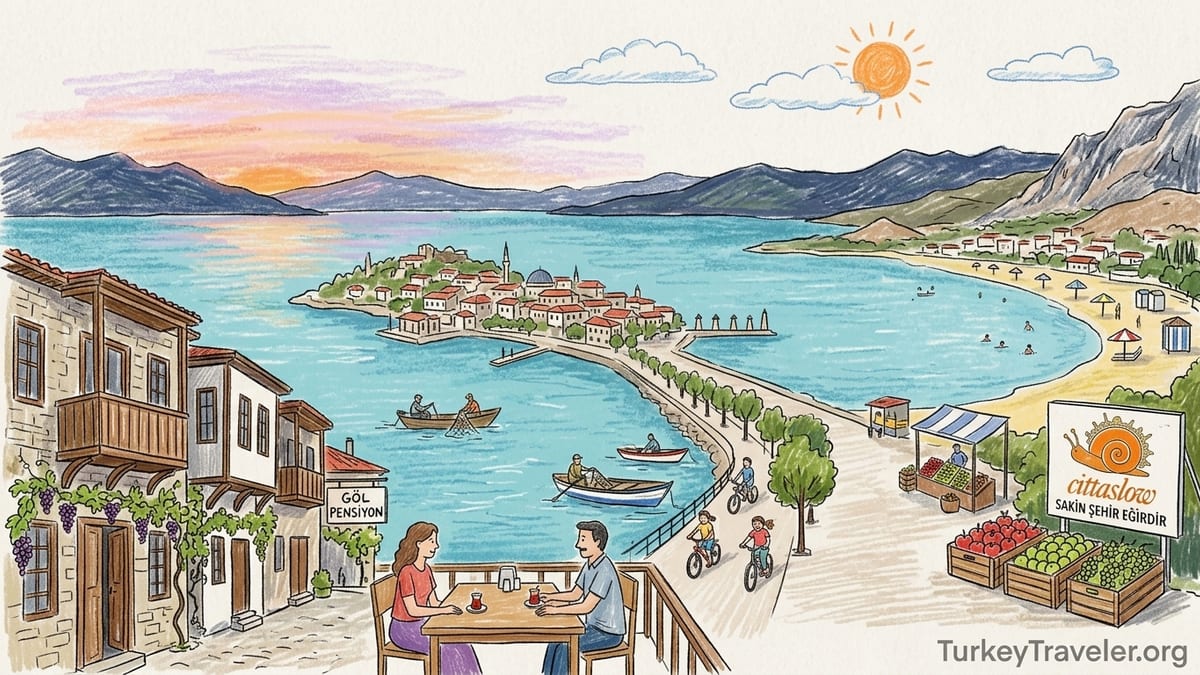
Arriving in Türkiye’s Cittaslow Lake Hub
Reaching Eğirdir from Isparta, the regional city an hour to the south, the landscape gradually loosens from apartment blocks into orchards and low hills before the road suddenly drops to meet the water. Lake Eğirdir is one of Türkiye’s largest freshwater lakes, wrapped by mountains and surrounded by fruit-growing villages. The town itself clings to the southern shore, with a narrow peninsula pointing like a finger into the lake and the former island of Yeşil Ada at its tip. Buses pull in near the waterfront, where a simple cluster of shops, bakeries and pensions sets the tone for what life here feels like: practical, local and quietly scenic.
GoTürkiye lists Eğirdir among Türkiye’s Cittaslow destinations, highlighting its slow pace, local food and emphasis on nature rather than nightlife. That label is not a marketing gimmick so much as a reasonably accurate description of what you notice in the first hour. Tractors move more slowly than the cars, and the loudest sounds tend to be from cafes turning up the television for a football match or from children cycling along the promenade at dusk. The big crowds and hectic traffic that shape much of coastal Türkiye already feel distant by the time you drop your bags at your pension.
Because this is a town that rewards lingering, I based myself on Yeşil Ada, the “Green Island” now linked to the mainland by a causeway. Aside from day-tripping coaches, which tend to come and go quickly, life out here still moves at village speed. Stone houses and old wooden balconies lean toward the lake, and grapevines climb around doorways. Staying overnight rather than just passing through lets you fall into the town’s cycle of early mornings, hot still afternoons and long, pastel sunsets over the water.
Almost everything in Eğirdir orbits the lake. From the bus stop to the old quarter and Yeşil Ada, the water is never far from sight, sometimes suddenly appearing between houses, sometimes stretching in an uninterrupted sweep beside the road. Even if you arrive with a checklist of sights in the wider Lakes District, the first temptation is simply to walk the shore and adjust to the slower gear of life here.
Where I Stayed: A Simple Pension by the Water
I chose a small lakeside pension on Yeşil Ada, the kind listed on local tourism pages and booking platforms as family-run accommodation with breakfast included. Similar guesthouses on the island, such as Gol Pension or Fulya Pension, typically charge the equivalent of about 70 to 90 US dollars per night for a double room with lake view in high season, with slightly lower prices earlier or later in the year. I paid in that range for a lake-facing double with private bathroom and breakfast included, booked a few weeks ahead in summer.
The room itself was modest but well maintained: tiled floors, a firm double bed, a wardrobe, a small desk and a big sliding window that opened straight toward the lake. The view was the main luxury. From the bed I could see the water change from steel grey at dawn to milky turquoise by mid-morning, framed by dark ridges of distant mountains. There was no balcony, but a shared terrace downstairs effectively extended the room. Chairs and simple wooden tables were scattered under grapevines, and guests drifted in and out at different hours with tea glasses and paperbacks.
Noise levels were low compared with the mainland. On Yeşil Ada, traffic thins out significantly after day visitors leave, and most of what you hear at night is the murmur of conversations from nearby pensions and the occasional car crossing the causeway. The pension’s walls were not fully soundproof, so you could occasionally hear footsteps in the corridor or a neighbour closing a door, but by 23.00 the island was largely quiet. Wi-Fi coverage was reliable enough for video calls, though speeds fluctuated during peak evening hours. Parking, like at many island pensions, consisted of free street spaces along the narrow lanes or near the causeway, and there was always somewhere within a short walk to leave the car.
The accommodation was not polished in the way a boutique hotel on the Mediterranean coast might be, but it felt closely aligned with the Cittaslow idea of everyday comfort and local ownership. The family who ran it lived in the same building and seemed to know most guests by name by the second morning. That intimacy, rather than any particular amenity, was what made the stay feel rooted in the town rather than simply adjacent to it.
Mornings: Breakfast Trays and the First Light on the Lake
Morning in Eğirdir comes with the rattle of bread vans and the gentle clink of tea glasses. Breakfast at my pension appeared as a generous tray carried to the terrace: slices of village bread still warm from the bakery, white cheese, black and green olives, sliced cucumber and tomato, a dish of local honey and a small plate of apple jam made from fruit grown in the owner’s family orchard. Eggs were cooked to order, usually menemen one day and fried the next. Filter coffee was available, but most people stuck to strong Turkish tea in small tulip-shaped glasses.
Eating outside felt almost compulsory. Yeşil Ada faces in several directions, and from the terrace the lake stretched wide toward the western mountains, already bright with early sun. A few local fishermen were usually out in small boats checking nets, their engines puttering quietly across the flat water. Down on the causeway, the first walkers from town appeared, often older residents taking their morning exercise before the day warmed up. It was an unfussy scene, the kind of setting where you linger longer over breakfast because there is no rush to be anywhere else.
After eating, I would walk from the island back toward the mainland, crossing the short stretch of road that once separated the town from its islands. Concrete fish sculptures decorate the causeway, a reminder of how closely Eğirdir’s identity is tied to its lake. On the right, the water is shallow, bordered by reeds. On the left it deepens quickly, changing colour as the light strengthens. Locals use the broad pavement for jogging or cycling, and early in the day there are more residents than visitors.
On the mainland, small groceries and bakeries open early. Men in work clothes lean against shopfronts, drinking tea and talking about the day’s tasks, while school students wait for minibuses to villages around the lake. It is here, rather than in any formal attractions, that you feel what daily life in a Cittaslow town looks like in practice: services aimed at locals first, visitors second, and an obvious familiarity among people who see each other every day.
Afternoons at the Water: Promenades, Buses and Altınkum Beach
By late morning, the sun gathers strength and the broad lakefront promenade becomes the town’s open-air living room. Families push strollers, older couples occupy favourite benches and occasional cyclists glide past. Minibuses, known locally as dolmuş, pull in and out of a small transport hub near the centre, linking Eğirdir with Isparta and with villages and coves around the lake. Destinations like Bedre Bay or Kovada Lake National Park are reachable via these local services, although schedules can be sparse outside summer and often cluster around early morning and late afternoon departures.
For swimming, the most practical and officially designated place is Altınkum Beach, on the southern side of town not far from the former train station. Local and provincial authorities identify it as the primary approved swimming area on the lake, and it has long been described as one of the safest parts of Eğirdir’s shoreline, with shallow water remaining below head height for quite a distance offshore. A short bus or car ride from the centre leads you to its broad strip of pale sand, created and maintained as a lake beach rather than a natural stretch of shoreline.
Altınkum functions almost like a small lakeside resort area for day use. Facilities include changing cabins, showers, simple cafes and kiosks, and a large free parking area for cars and campervans. During summer, lifeguards watch the marked swimming zone, and families set up under umbrellas for long afternoons. When I visited in late summer, the water felt noticeably cooler than the nearby Mediterranean but still comfortable, perhaps around the low twenties in degrees Celsius by midday. The lake is freshwater and, at least within the fenced swimming area, looked reasonably clear, with soft sand underfoot rather than stones or mud.
Water quality has been a topic of local discussion, particularly in parts of the lake affected by plant growth and changing water levels. Municipalities and provincial agencies carry out periodic cleaning of reeds and algae near harbours and popular swimming spots, including Altınkum. As a swimmer, you may notice some floating plant material near the shore, but inside the designated area the water felt clean enough to encourage unhurried laps parallel to the beach. The absence of waves or salt gives lake swimming here a gentle, almost pool-like character, especially appealing to families with young children or anyone less confident in rougher seas.
Eating the Lake: Fish, Crayfish and Orchard Fruit
Lake Eğirdir has long been known for its fish and freshwater crayfish, even if commercial fishing patterns and species have changed over the years. Many of the town’s restaurants line the waterfront near the central harbour or are scattered along Yeşil Ada, displaying menus that lean heavily on “göl balığı,” lake fish, and “kerevit,” crayfish. One evening I settled at a simple family-run place on the island, plastic chairs set on a terrace above the water, fishing boats bobbing gently below.
Freshwater species such as carp are commonly served, often prepared as “sazan tava,” carp cut into portions, lightly floured and fried in sunflower oil until the skin crisps. The version I ate arrived on a large platter, golden segments arranged around lemon wedges and a scattering of parsley, accompanied by a basket of bread, a tomato and onion salad and a plate of grilled peppers. A portion for one, which was more than adequate for dinner, cost the equivalent of roughly 10 to 15 US dollars at current local prices, which felt fair given the setting and the freshness.
Kerevit, or crayfish from the lake, appears either simply boiled and served with lemon or baked in a clay dish with butter and garlic. I ordered a small portion as a shared starter on another evening, which cost slightly less than the fish but still placed the meal in the mid-range for Türkiye, not a budget canteen but far from luxury pricing. The flavours were uncomplicated and comforting, relying more on the quality of the ingredients than any elaborate seasoning. For dessert, several places offer “elmalı tatlı,” a simple baked apple sweet that nods to the orchards stretching behind the town. Slices of local apple are cooked with sugar and spices and served warm, sometimes with a spoon of kaymak cream or ice cream.
Fruit stands are part of the town’s visual rhythm. In season, crates of apples, peaches and grapes spill onto pavements. Prices vary by harvest and year but are generally modest compared with larger cities. Buying a kilo of apples directly from a stall not only supports local growers but also reminds you that this part of the Lakes District is as much about agriculture as tourism. It is easy to assemble your own lakeside picnic of bread, cheese, tomatoes and fruit from the modest cluster of shops near the harbour and carry it out to a bench by the water.
Evenings: Sunsets, Quiet Streets and Yeşil Ada After Dark
Sunset is when Eğirdir feels most theatrical, even if the town itself does not act like a stage. The sky over the western peaks shifts through a slow gradient from pale blue to soft orange and deeper pink, often mirrored on the lake’s surface. People drift to the waterfront without much obvious coordination: couples with takeaway coffee cups, groups of friends, visiting families with children let loose on scooters. Some gather on the mainland promenade, others line the low walls along the causeway to Yeşil Ada, legs dangling above the water.
On Yeşil Ada itself, restaurants turn their chairs outward toward the lake to maximise the view. Lights strung between buildings reflect softly on the water. This is the busiest the island feels all day, yet even at the height of summer it remains gentle. A few local tour buses pull in, disgorging groups who eat quickly and then move back to their vehicles, but many tables are occupied by Turkish families who treat dinner here as part evening out, part small celebration.
After dark, the town quiets down sharply. Eğirdir does not have a nightlife district in the usual sense. There are no loud bars with live music blasting into the small hours, and alcohol is served more often within restaurants than in stand-alone venues. By around 23.30 or midnight in high season, the waterfront is largely empty apart from guests strolling back to their pensions and a handful of fishermen preparing gear for early starts. The mainland streets behind the lakefront go quiet even earlier, with only the occasional glow from a corner teahouse or grocery.
Yeşil Ada, in comparison with the mainland, feels slightly more atmospheric in the evenings. The combination of older stone houses, narrow lanes and the constant presence of the lake on both sides gives it a small-island mood even though it is now connected by road. Walking back to my pension at night, the only sounds were sometimes the soft clink of cutlery from a restaurant washing up or the buzz of a television coming through an open window. For anyone who associates Turkish towns with late-night traffic or amplified music, Eğirdir’s silence after dark can be pleasantly surprising.
Beyond the Peninsula: Using Eğirdir as a Base
One of the ongoing questions visitors ask themselves here is whether Eğirdir should be treated as a base for exploring the wider Lakes District or as a destination in its own right. The town sits conveniently between other natural draws such as Kovada Lake National Park, with its forest trails and birdlife, and villages known for rose and lavender fields in season. Local dolmuş services and private tours make it possible to reach these spots, but the logistics are not as seamless as in major coastal resorts. Buses are relatively infrequent outside peak times, and some excursions are easier with your own vehicle.
If you use Eğirdir primarily as a base, your days may start and end here but be mostly spent elsewhere. One morning you might ride to Kovada for a loop walk among lakeside trees and lunch at a simple roadside restaurant, another you could follow the road around the lake to small bays and viewpoints such as Bedre Bay or village terraces that overlook the water and surrounding orchards. Even half-day trips return you to the promenade in time for an evening swim or dinner on Yeşil Ada, which reinforces the town as a gentle anchor point rather than a packed sightseeing stop.
On the other hand, there is a strong argument for allowing at least one day with almost no plans beyond staying within Eğirdir itself. Walking the length of the peninsula, exploring the back streets of the mainland quarter, visiting small mosques and the occasional church ruin, sipping tea at different cafes along the lakefront and simply watching the light change across the water can fill a day in a way that feels quietly rich rather than idle. The Cittaslow idea here is less about a checklist of official initiatives and more about giving visitors implicit permission to value these apparently uneventful hours.
The question of base versus destination is perhaps best answered by your own travel style. If you are restless when staying in small towns, you may appreciate Eğirdir mainly as an affordable and peaceful overnight stop that keeps you close to lakes, national parks and rural landscapes. If you are comfortable allowing a place’s natural pace to shape your days, then the town itself becomes the experience and side trips fade into optional extras rather than requirements.
The Takeaway
Looking back on my time in Eğirdir, what lingers is not an individual attraction but the town’s overall tempo. Mornings of unhurried breakfasts with honey and apple jam on the terrace, cool freshwater swims at Altınkum Beach, late afternoons listening to local buses come and go while sipping tea by the harbour, and long, pastel sunsets followed by streets that quiet almost completely. Yeşil Ada’s modest pensions and fish restaurants provided a setting where days felt well framed but never jammed.
On a return visit, I would probably stay three nights. That would allow one day focused almost entirely on the town and its lakefront, one full day trip to a nearby natural area such as Kovada Lake or a bay on the far side of the lake, and one flexible day left intentionally unscheduled for walks, swimming and simply watching the water. I would book a similar small pension on Yeşil Ada again, prioritising a room with a lake view and terrace access over more formal hotel amenities, and budget roughly the same mid-range nightly rate for the sake of waking up to the lake at my window.
What I would skip on a second visit are the small attempts to rush or compress experiences. I would not try to tick off every village and scenic point around the shore, nor would I feel obligated to plan a different outing each day. Eğirdir works best when you give it the same patience its residents extend to the lake and to their orchards. Treat it less as a quick photographic stop and more as a place to briefly live, and the town’s Cittaslow label shifts from slogan to something you can feel in the timing of your own steps.
FAQ
Q1. How many nights should I stay in Eğirdir?
For slow travel, two to three nights works well. That gives you time for a full day in town, at least one swim at Altınkum Beach and a day trip into the wider Lakes District.
Q2. Is it better to stay on Yeşil Ada or on the mainland?
Yeşil Ada feels more atmospheric and quiet at night, with many small pensions directly by the water. The mainland offers easier access to shops, buses and everyday services but loses some of the island-village mood after dark.
Q3. How much does accommodation in Eğirdir usually cost?
Family-run pensions and small hotels typically charge the equivalent of about 50 to 90 US dollars per night for a double room, depending on season, lake views and amenities. Lakefront and Yeşil Ada properties tend to sit at the higher end of that range in summer.
Q4. Is the lake water clean and safe for swimming?
Altınkum Beach is the main approved swimming area, with shallow water, lifeguards in season, and basic facilities. Water quality is monitored and the beach area is regularly cleaned, though you may still see some natural plant material near the shore.
Q5. What is the water temperature like at Altınkum Beach?
In summer, midday lake temperatures usually feel comfortably cool, around the low twenties in degrees Celsius. The water can feel brisk when you first enter but quickly becomes pleasant for longer swims.
Q6. Are there changing rooms and showers by the lake?
Yes. Altınkum Beach has designated changing cabins, showers and toilets, as well as simple cafes and kiosks. Smaller informal swimming spots around the lake often lack such facilities.
Q7. What kind of local fish can I try in Eğirdir?
Restaurants commonly serve lake fish described as “göl balığı,” including dishes like fried carp known as “sazan tava,” along with local freshwater crayfish, or “kerevit,” sometimes baked in clay dishes with butter and garlic.
Q8. Do I need a car to explore the Lakes District from Eğirdir?
You can reach some places by local buses and dolmuş services, but a car gives you more flexibility for bays, viewpoints and nearby lakes. Without a car, it is still practical to focus on Eğirdir town, Altınkum Beach and one or two organised day trips.
Q9. Is Eğirdir a good stop for families?
Yes. The shallow freshwater at Altınkum, the quiet evenings, and the lack of intense nightlife make it comfortable for families. Children often enjoy the promenade, small playgrounds and gentle lake swimming.
Q10. When is the best time of year to visit Eğirdir?
Late spring and early autumn balance pleasant temperatures, swimmable water and fewer crowds. High summer is warm and good for swimming but can feel hot in the middle of the day, while winter is quiet and mostly about lakeside walks rather than time in the water.