


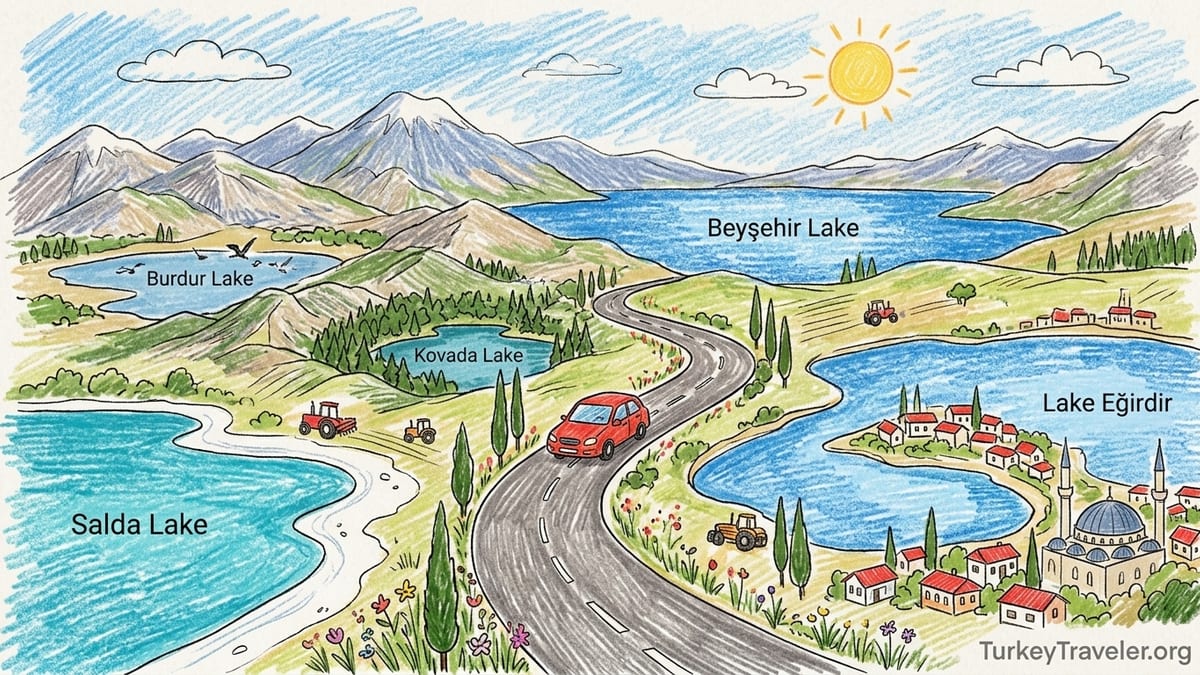
North of Antalya, the Taurus Mountains hide a chain of lakes that could not be more different from one another: an island-dotted blue expanse at Eğirdir, pine-fringed forest water at Kovada, flamingo-rich shallows at Burdur, a Mars-like turquoise crater at Salda, and vast Beyşehir backed by snowy peaks. Together they form Türkiye’s Lakes District, a region best explored as a road trip because buses between the lakes are patchy and several shores sit far from any town. This guide lays out how to link the five standout lakes by car, with realistic drive times, overnight strategy and seasonal tips so you can turn a dotty map into a satisfying loop.
Understanding Türkiye’s Lakes District as a Driving Region
The Lakes District is not a single destination but a highland plateau stretching across Isparta, Burdur and toward Konya, where a cluster of tectonic and crater lakes fills valleys within the Taurus Mountains. GoTürkiye and regional tourism boards often group Eğirdir, Kovada, Burdur, Salda and Beyşehir as the most rewarding for visitors with a car, because they showcase very different landscapes within manageable driving distances. The region sits roughly 1 to 2.5 hours north of Antalya by road, high enough that summer afternoons feel cooler than the coast and winter can bring frost and occasional snow.
On a map the lakes look close, but the topography matters. Main roads between provincial centers like Antalya, Isparta, Burdur and Konya are modern highways, often dual carriageway, while many stretches along the lake shores or inside national parks narrow to two-lane country asphalt. Driving is perfectly feasible for visitors used to rural roads, yet trip planning should be based on 60 to 80 km per hour averages in the mountains rather than the faster speeds shown in some navigation apps.
A rental car picked up in Antalya or Isparta unlocks the most flexible itineraries. From Antalya Airport, Eğirdir is roughly 140 to 170 kilometers depending on the route, typically a 2 to 2.5 hour drive in normal conditions. From Isparta city, Eğirdir is around 30 to 40 minutes along a straightforward, well-maintained road, which is why many Turkish visitors treat Eğirdir as an easy weekend escape. Once you are at Eğirdir, the other lakes unfold in a rough arc: Kovada is around 25 kilometers to the south, Burdur an hour or so to the west, Salda another hour beyond Burdur, and Beyşehir about 2 to 3 hours to the northeast depending on your route.
Because public transport between these lakes is limited mainly to infrequent dolmuşes and provincial buses that focus on town centers rather than shorelines, combining more than two lakes in a single day without your own vehicle is difficult. By car, however, you can comfortably link several, timing scenic stops with sunset, avoiding the peak heat of midsummer and dipping into smaller villages or viewpoints that never appear on bus timetables.
Choosing a Starting Point and Loop Direction
Most international travelers reach the Lakes District via Antalya or, less commonly, via Konya. Domestic flyers can also land at Isparta Süleyman Demirel Airport, which sits between Eğirdir and Burdur. The most logical loop for a lakes-focused trip is a rough circle: Antalya or Isparta to Eğirdir, then on to Kovada National Park, across to Burdur and Salda, before turning northeast to Beyşehir and looping back via Konya or Isparta. The same loop works in reverse if you are arriving from Cappadocia or central Anatolia through Konya.
Starting from Antalya, many drivers prefer to reach Eğirdir first. The main highways north are in good condition and the elevation gain is steady rather than sudden, which eases the adjustment from coastal traffic to mountain roads. You can be swimming off Eğirdir’s small beaches or sipping tea on Yeşilada island by late morning if you depart Antalya after breakfast. From Eğirdir the road to Kovada branches south, so visiting the national park as a half-day trip is much easier with Eğirdir as a base than if you attempted to reach it directly from the coast or from Burdur.
If you are arriving from Konya or Cappadocia, consider running the loop the other way: Konya to Beyşehir first, then onward toward Isparta, Eğirdir and Kovada, before cutting across to Burdur and Salda and finally dropping down to Antalya. The Konya to Beyşehir road is a modern multi-lane highway for much of its length, making the first day’s drive simple even if you are tired from long-haul travel. This also means you encounter the biggest lake, Beyşehir, before the smaller ones, which some travelers prefer for a sense of scale.
Whichever direction you choose, aim to avoid very late-night driving on unfamiliar rural stretches. Not only do you miss the scenery, but livestock, tractors without strong lights and sharp curves are more of a factor after dark in the highlands. A practical approach is to structure your days so that the longest drives happen in late morning, leaving afternoons and evenings for lakeside walking, swimming where permitted and sunset watching.
Lake by Lake: Character, Atmosphere and Overnight Logic
Eğirdir is the most rounded base in the Lakes District. The town straddles a peninsula that almost splits the lake, with the narrow causeway leading to Yeşilada and Can Ada islands creating a natural focal point for guesthouses and cafés. You will find a mix of small family-run pansiyons, simple lake-view hotels and a handful of newer boutique stays both in town and along the island streets. The feel is laid-back: fishermen repairing nets, locals strolling the waterfront, and cafes serving gözleme and fresh-caught fish. From here, you can swim at small pebble beaches in summer, hike the surrounding hills in spring or autumn, and be on the road to Kovada in under an hour.
Lake Salda is all about color and geology. Often compared in news reports to Martian landscapes because of its white magnesium-rich shore and turquoise water, Salda has become a domestic tourism star. The most photographed area is Beyaz Adalar, where the white shallows create almost Caribbean-like blues under a clear sky. However, to protect the fragile shoreline there are restrictions on entering the water and walking on certain white beach sections, especially around the Beyaz Adalar zone, so you should check current signs on-site rather than assume open beach access. This is a place to linger for views, careful paddling where allowed, and photography rather than long open-water swims.
Burdur Lake offers a more subtle, bird-focused experience. The main city of Burdur sits along its eastern shore, and you will see the lake as you enter town. The water here is more saline and swimming is not a primary draw. Instead, the shallow zones and reed beds attract many migratory and resident birds; birdwatchers sometimes time visits for early morning or late afternoon, when light is softer and activity increases. For travelers, Burdur makes logistical sense as a one-night or half-night stop because it lies directly on the road corridor between Salda, Isparta and Antalya, and because the city has a full range of services, from fuel stations to mid-range business hotels and simple lokantas.
Beyşehir combines scale and cultural layers. It is Türkiye’s largest freshwater lake and straddles Konya and Isparta provinces, with a national park status that protects its islands, birdlife and forested shores. The western and northern edges in Konya Province are easiest to access for most travelers, with the town of Beyşehir offering lakeside promenades, boat trip opportunities in season, and important Seljuk heritage at Eşrefoğlu Mosque. Sunsets here can be striking, especially in late spring and early autumn when the sun drops behind the distant Taurus ridges and reflects across the wide water surface.
Kovada Lake, by contrast, feels intimate. Entirely within a national park a short drive south of Eğirdir, it is encircled by forests and low hills rather than towns. Facilities are low-key: expect picnic areas, short walking trails and simple viewpoints rather than a developed resort. This atmosphere appeals to travelers who want a quieter day focused on nature. Because there is little formal accommodation immediately around Kovada, an overnight is rarely essential there. Instead, most visitors visit as a half-day excursion from Eğirdir, combining a lakeside picnic or walk with time back in town for dinner.
Driving Conditions, Fuel, Parking and Seasons
The main roads linking Antalya, Isparta, Burdur and Konya are modern highways with regular fuel stations, roadside cafes and signed turn-offs to the lakes. For a typical compact rental car with air conditioning, fuel costs for a full 700 to 900 kilometer loop that takes in all five lakes will be noticeable but manageable for most visitors, similar in overall fuel outlay to a week-long coastal drive of the same distance. Because fuel prices in Türkiye can fluctuate, it is smart to fill up in or near the larger cities where competition is higher and stations are more frequent.
Secondary roads to the lake shores and national parks are usually paved but can be narrower, with occasional rough patches near village entrances or where water run-off has damaged the shoulder. The road from Eğirdir to Kovada, for instance, is a two-lane asphalt road that feels rural but is perfectly passable in a standard car, provided you slow for curves and watch for tractors and livestock. The Beyşehir to Isparta route involves some mountain driving, but travelers and locals alike describe the core sections as in good condition, with newer tunnels and improvements easing gradients in places.
Parking is rarely a serious problem in the Lakes District except during peak Turkish holiday weeks, when some beaches at Salda or promenades at Eğirdir and Beyşehir can feel busier. In smaller towns you often park on the street near your pension or restaurant, while at national park gates and formal recreation areas there may be small parking lots and a modest entry or parking fee paid in cash. Around Salda, for example, dedicated parking areas have been created near the main viewpoints so that visitors do not drive directly onto the sensitive shore.
Seasonally, the lakes reward different rhythms. From late May to September, swimming in Eğirdir and some permitted bays around Salda feels refreshing rather than icy, and long daylight hours mean you can still be out on a lakeside terrace at 8 or 9 p.m. watching sunset. In July and August, daytime highs inland can still reach above 30 degrees Celsius, but nights are cooler than the coast, which makes Eğirdir and Beyşehir pleasant summer bases. Spring and autumn are arguably best for hiking and driving comfort, with wildflowers and snow-tipped peaks in April and May, and golden foliage around Kovada in October. Winter driving is possible but can involve icy stretches, especially on higher roads between Beyşehir, Isparta and Antalya, so those without cold-weather experience should time trips for the milder months.
How Many Days: 3, 5 and 7 Day Road Trip Versions
In three days you can visit the Lakes District without rushing, but you will need to prioritize. A practical three-day loop from Antalya might run as follows in concept rather than by strict schedule: drive from Antalya to Eğirdir on day one, spending the late afternoon exploring the peninsula, Yeşilada and perhaps taking a short swim or lakeside walk. Day two becomes your nature day, with a relaxed drive to Kovada Lake National Park for forest trails and quiet viewpoints, then onward toward Burdur in the late afternoon for a night in town. On day three, continue to Salda in the morning, linger at one or two viewpoints and permitted swimming areas, then drive back to Antalya or onward toward Denizli.
A five-day version allows you to add Beyşehir without turning the trip into an endurance test. For instance, after your first night or two based in Eğirdir, including the Kovada side trip, you could drive to Beyşehir on day three, taking the scenic mountain road and arriving in time for a lakeside sunset and dinner near the mosque. Spend the night in Beyşehir, then head south or southwest on day four toward Burdur, perhaps stopping at small villages or viewpoints en route. Finish with an overnight in the Burdur or Salda area, and on day five loop back to your starting point. Each day involves 2 to 3 hours of cumulative driving broken up by walks and lakeside time.
With seven days, the loop becomes properly relaxing. You might begin with two nights in Eğirdir, allowing one full day for lake activities and a second for Kovada. Then take a long, scenic day to Beyşehir via mountain roads, using two nights there so that you can experience the lake both at dawn and at sunset, and possibly join a local boat outing in season. From Beyşehir, drop down toward Burdur, breaking the journey with a rural stay if you find one that appeals, then dedicate most of a day to Lake Salda before spending your final night either back at Eğirdir, in Burdur city, or already on the way to Antalya or Pamukkale. The extra time makes it easier to have low-driving days where the car barely moves and the lakes themselves set the tempo.
These versions are guidelines rather than fixed itineraries. The key is to avoid chaining too many long drives in a row. For example, attempting Konya to Beyşehir to Salda to Antalya in a single day would compress more than 7 to 8 hours of driving if you include shore detours and photo stops, leaving little time to enjoy the lakes themselves. Whenever you see three or more long segments stacked in your plan, adjust by adding an overnight or dropping a lake.
Which Lakes to Combine and When Distances Become Too Much
Certain pairings work naturally because of geography and driving rhythm. Eğirdir and Kovada belong together, with Kovada an ideal half-day trip from an Eğirdir base. Burdur and Salda also combine easily, since the drive between Burdur city and Salda’s Beyaz Adalar area is roughly an hour, and you can use Burdur as your practical overnight while treating Salda as the scenic outing. Beyşehir aligns well with Eğirdir on a multi-day loop, giving you two contrasting big lakes with different moods and cultural surroundings.
Trying to include all five lakes in only two full days usually leads to hurried stops and fatigue. It is technically possible to wake in Antalya, drive to Eğirdir, briefly visit Kovada, then push on to Burdur or even Salda by nightfall, but you would barely scratch the surface at each stop. Similarly, adding distant lakes such as Akşehir or smaller crater lakes on the same trip is best left to travelers with ten days or more, otherwise you risk turning your journey into a checklist rather than an experience.
Another factor is your personal interest. If swimming and relaxed waterfront evenings are the priority, focus on Eğirdir and Beyşehir, where shoreline towns offer patios, promenades and small beaches. Birdwatchers might allocate more time to Burdur and quieter coves around Beyşehir, visiting Salda partly for its geological story rather than as a beach day. Photographers often want both Salda and Eğirdir in good light, which can argue for at least one dawn or sunset at each instead of a midday rush.
In practical terms, most travelers who have 5 to 7 days can comfortably visit four or all five of the headline lakes without feeling rushed, provided they accept that not every shore will be explored in detail. Those with 3 to 4 days often do better to choose three main bases, such as Eğirdir, Burdur or Salda, and Beyşehir, and leave the rest as purposeful future discoveries.
Swimming, Sunsets and When to Stay the Night
Not every lake in the district invites the same kind of water contact. Eğirdir is the most straightforward for casual swimming and lakeside lounging, with family-friendly beaches close to town and clear water in summer. Small local facilities like simple changing cabins or cafe-run loungers may appear at popular spots in high season, though they remain modest compared with coastal resorts. Many travelers happily wade in from pebbly shores near the causeway or slightly further out along quieter coves, then dry off over tea on Yeşilada.
At Salda, the visual temptation to plunge straight into the turquoise shallows is obvious, but you need to respect local regulations aimed at protecting the shoreline and underwater formations. Official notices have restricted swimming and beach use in the most fragile Beyaz Adalar section, steering visitors to designated areas where access is allowed. In practice this means you can usually still experience the water’s clarity and coolness, but you should follow roped-off zones, obey any directions from on-site staff and avoid stepping on the whitest, sponge-like shore patches.
Burdur Lake is less suited to recreational swimming due to its water characteristics and shore profile. Here the focus shifts to lakeside strolling and bird observation rather than getting in the water. Beyşehir, in contrast, offers opportunities for boat rides and, in some areas, lake access suited to experienced swimmers who are comfortable with deeper, cooler water. Official swimming platforms and beaches can change with local development, so your accommodation host in Beyşehir or Eğirdir will often have the most up-to-date advice on safe and recommended spots.
For sunsets and overnights, two lakes stand out. Eğirdir’s peninsula faces both east and west, so you can watch sunrise light up the opposite mountains, then shift to the other shore for an evening show as the lake turns pink and gold. Staying at least one night here allows you to experience that full cycle. Beyşehir’s wide horizon and islands produce dramatic silhouettes at dusk, especially from the town’s promenade or small piers; here too, staying overnight gives you sunset, a starry night over the water, and tranquil early-morning reflections before day-trip visitors arrive.
The Takeaway
A Turkish Lakes road trip is less about ticking off famous landmarks and more about letting the rhythm of water and mountains slow you down. With a rental car, a loose loop connecting Eğirdir, Kovada, Burdur, Salda and Beyşehir becomes a practical way to see how varied this inland region is, from white crater shores to forest-ringed coves and island-dotted blue expanses. The roads are generally good, the distances shorter than they appear once you factor in steady 2 to 3 hour driving blocks, and the rewards high if you allow time for more than fleeting photo stops.
If you have three days, aim for depth rather than breadth, letting Eğirdir anchor your plans. With five days you can bring Beyşehir into the mix without stress. With a week, you can comfortably complete a full loop from Antalya or Konya, revisiting favorite spots for second sunsets and unhurried swims. In every case, combining a few well-chosen lakes beats racing between them all. Let the map guide you, but let the lakes themselves decide where you linger.
FAQ
Q1. Do I really need a car to explore the Lakes District, or can I rely on buses?
Public buses and dolmuşes connect major towns like Antalya, Isparta, Burdur and Konya, and some services run to Eğirdir and Beyşehir. However, links between the lakes themselves and to national park entrances such as Kovada can be infrequent and may not align well with sightseeing. Having your own car makes it far easier to combine several lakes in a single trip, reach quieter shores and adjust your plans for weather and light.
Q2. Is it better to start the loop from Antalya, Isparta or Konya?
Antalya works best for most international visitors because it has many flights and rental options, plus a straightforward 2 to 2.5 hour drive to Eğirdir. Isparta is convenient for those flying domestically and wanting to reach the lakes quickly. Konya suits travelers arriving from Cappadocia or central Anatolia who plan to visit Beyşehir first and then continue toward the Mediterranean.
Q3. How many lakes can I realistically see in three days without rushing?
In three days, most travelers comfortably include Eğirdir, Kovada and either Burdur or Salda. Trying to add Beyşehir as well usually results in long driving days with little time at each lake. If your heart is set on both Salda and Beyşehir, consider adding at least one extra day so that each gets an afternoon or evening rather than a brief midday stop.
Q4. Are the roads safe for drivers who are new to mountain conditions?
The main highways between Antalya, Isparta, Burdur and Konya are well-engineered and used year-round, with gradual climbs and regular fuel stops. Smaller roads around the lakes can be winding and narrower, but they are generally paved and manageable at modest speeds. If you are unfamiliar with winter driving, plan your trip for late spring, summer or early autumn to avoid potential ice and snow at higher elevations.
Q5. When is the best time of year to swim in the lakes?
Swimming is most comfortable from late May through September, when air temperatures are warm and lake water has had time to heat up. Eğirdir is the most popular for casual swimming, while swimming at Salda is restricted to designated areas to protect the shore. Always observe local signs and ask your accommodation for current advice on safe, permitted spots.
Q6. Can I visit Lake Salda as a quick stop on the way to Pamukkale?
Yes, many travelers combine Salda with journeys between Antalya, Burdur and Pamukkale, stopping for a few hours to admire the white shoreline and turquoise water. If you are driving, plan at least a half-day including the detour from the main highway, parking, walking and photo breaks. Staying overnight in or near Burdur gives you more flexibility if the weather is cloudy when you first arrive.
Q7. Is accommodation easy to find around all five lakes?
Eğirdir and Beyşehir have the widest range of guesthouses and small hotels along or near the shore. Burdur city offers standard urban accommodation within a short drive of the lake. Around Salda, options are more scattered in nearby villages and small towns rather than directly on the most protected shores. Kovada has very limited or no formal accommodation right at the lake, which is why it is usually visited from an Eğirdir or Isparta base.
Q8. Are there entry fees for the national parks like Kovada and Beyşehir?
National parks and some protected lakeside areas may charge modest vehicle or per-person entry fees, which are usually paid in cash at the gate. The exact amount can change from season to season with national regulations. It is wise to carry small denominations of Turkish lira and to ask at your previous night’s accommodation if any recent changes have been reported.
Q9. What kind of car should I rent for this road trip?
A standard compact or mid-size car with decent ground clearance and air conditioning is sufficient for most travelers. The main and secondary roads are paved, so four-wheel drive is generally unnecessary unless you plan to venture onto unpaved forest tracks or high mountain roads beyond the lakes. Automatic transmission rentals may be more limited than manuals, so booking ahead is helpful if you prefer an automatic.
Q10. Is it possible to drive the loop with children, or is it too tiring?
Families can absolutely enjoy this loop if daily driving segments are kept to 2 to 3 hours and balanced with lake time, picnics and short walks. Choosing two or three bases, such as Eğirdir, Beyşehir and Burdur or Salda, reduces the number of hotel changes. Bringing car snacks, audiobooks and planned playground or promenade stops in towns along the way makes the journey itself part of the holiday rather than a chore.