


In Türkiye’s Lake District, far from the crowded Lycian coast, a quieter long-distance route threads its way between high Taurus ridges, deep canyons and remarkably intact ancient cities. The Pisidia Heritage Trail is a roughly 350 kilometre cultural corridor through the old region of Pisidia, linking sites such as Sagalassos, Pisidian Antioch, Kremna and Adada with lakes like Eğirdir and Kovada and the cliffs of Yazılı Canyon. It is part mountain walk, part archaeology expedition and part village-to-village journey, and it offers a very different way to see this inland landscape than simply driving from viewpoint to viewpoint.
What Is the Pisidia Heritage Trail?
The Pisidia Heritage Trail, often abbreviated as PHT, is a marked long-distance trekking route of more than 350 kilometres that winds through the ancient region of Pisidia in southwest Türkiye. Developed by archaeologists and local partners over the last decade, the route connects at least ten to twelve major archaeological sites and a string of rural villages between the northern slopes of the Taurus Mountains and the lakes of Isparta and Burdur provinces. Official descriptions emphasise that the path follows sections of Roman road and historic mule tracks wherever possible, effectively turning the landscape itself into an open-air museum.
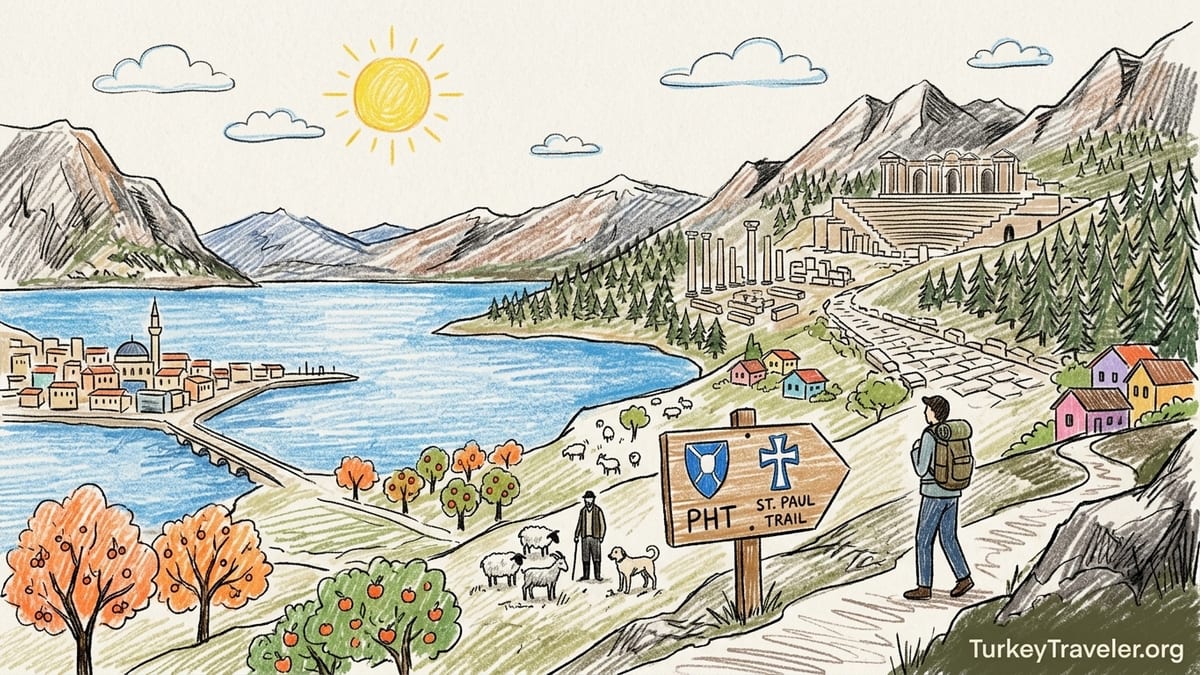
Unlike the coastal Lycian Way, which is now well known in guidebooks and package walking holidays, the Pisidia Heritage Trail remains relatively quiet. GoTürkiye and regional tourism bodies describe it as a roughly 350 kilometre itinerary that can be broken into stages, rather than a single through-route most visitors are expected to complete in one go. Parts of the trail are waymarked on the ground with painted symbols such as a stylised Pisidian shield, and detailed stage descriptions and GPX files are made available through dedicated Pisidia Heritage Trail resources and local tourist offices.
The trail’s core idea is simple: you move between mountaintop cities that once guarded the Roman frontier and the fertile valleys and lakes that fed them. In practice, that means climbs of 500 to 900 metres in a day, rocky single-track paths, forestry roads, and occasional asphalt links through villages where you can buy bread, cheese, tomatoes and olives or arrange a basic pension room. Elevations along the route typically range from about 900 metres near Eğirdir Lake to around 1,800 metres on higher passes, which affects both weather and hiking difficulty.
Importantly, the Pisidia Heritage Trail is not yet as continuously serviced as some other Turkish routes. There is no single booking platform for baggage transfer or accommodation, and signage can be patchy in forested sections. Experienced hikers with a GPS app and some comfort with off-road navigation will find it rewarding, but ordinary travellers should focus on well-defined day walks connected to roadheads, archaeological entrances and villages that already receive visitors for specific sites like Sagalassos or Sütçüler near Yazılı Canyon.
Why You Probably Will Not Walk All 350 Kilometres
Although the idea of trekking an entire 350 kilometre cultural route is appealing, most visitors to the Lake District will not, and realistically should not, aim to complete the full Pisidia Heritage Trail on a first trip. Even at a strong pace of 15 to 20 kilometres per day in mountainous terrain, it would require roughly three weeks of continuous walking. The trail also includes remote forest stretches with no formal accommodation and limited water, which demand camping gear, route-finding skills and some Turkish language ability for village interactions and logistics.
By contrast, many of the route’s highlights are concentrated around a handful of hubs that are easy to reach on public transport or with a rental car. Eğirdir, for example, is a lakeside town with several small hotels and pensions clustered around the town centre and the causeway to Yeşil Ada. In late 2025, double rooms in simple family-run pensions were often advertised in the equivalent of 30 to 60 euros per night with breakfast included, depending on season and exchange rates. From here, you can access day walks that climb to viewpoints above Lake Eğirdir or follow sections of the Pisidia Heritage Trail and the intersecting St. Paul Trail without committing to a through-hike.
Another reason to think in sections is that the trail was designed to highlight varied themes rather than to be treated as a single endurance challenge. Some stages focus on archaeology, linking sites such as Antioch of Pisidia and Kremna with villages that still use Roman stones in modern houses. Others traverse natural parks like Kovada Lake National Park or Yazılı Canyon, where the primary draw is scenery, swimming and picnic areas. Trying to force all of these into a continuous march risks turning a cultural walk into a schedule-driven race.
For most travellers, a smarter approach is to identify two or three clusters of interest and build day walks or short multi-day segments around them. A common pattern is to base in Eğirdir for lake views and easier logistics, then add a side trip to Sagalassos from Ağlasun or to Adada and Yazılı Canyon from Sütçüler or the Köprülü Canyon side. Serious long-distance hikers who have already completed routes like the Lycian Way or St. Paul Trail may choose to walk a week or more of the PHT in one stretch, but this is best done after careful research and in shoulder seasons to avoid extreme heat.
Best Short Sections for Ordinary Travellers
For those with only one or two days to spare, several sections of the Pisidia Heritage Trail offer the essence of the route without difficult logistics. One of the most accessible introductions is around Eğirdir itself. A popular day walk begins from the town centre, follows part of the St. Paul Trail up towards the ridge above the lake, and returns on a loop using village tracks. Hikers gain several hundred metres of elevation, enjoy sweeping views of Lake Eğirdir and its islands, then descend through cherry and apple orchards. The start and finish are both within walking distance of pensions and cafes on Yeşil Ada, so there is no need for complex transfers.
Another realistic day option is to combine road access with a partial stage near Sagalassos. Many visitors already travel to Sagalassos as a day trip from Burdur or Antalya by private car or organised tour. By starting early, fit walkers can spend a few hours exploring the upper and lower city, with its restored Antonine Nymphaeum and theatre, then follow marked sections of trail along an old Roman road towards Ağlasun or nearby villages before arranging a pickup. The gradients in this area are steep but the path tread is generally clear, and the sense of walking directly out of an archaeological site into living countryside is strong.
For travellers based further east, short segments around Adada are also appealing. Simple pensions in nearby villages or in Sütçüler can arrange transfers to the Roman site, where a remarkably preserved group of temples and a section of stone-paved Roman road sit in pine forest at around 1,300 metres. After visiting the ruins, walkers can follow the old road on foot along part of the PHT to meet a local roadhead, then return by pre-arranged taxi or minibus. This gives a half-day taste of the trail’s blend of archaeology and nature, with opportunities to see shepherds and village life along the way.
In each of these short sections, the key advantages are clear waypoints, nearby accommodation and reasonable escape options if weather or energy levels change. They also allow travellers to sample rural restaurants, such as small lokantas in Ağlasun serving lentil soup, grilled köfte and seasonal vegetables for modest prices, without needing to carry multi-day food supplies.
Archaeology-Heavy Sections: Walking Between Ancient Cities
The defining feature of the Pisidia Heritage Trail is its focus on archaeology. The route connects a chain of ancient cities that once formed part of the Pisidian frontier region, many of them founded or reshaped in the Hellenistic and Roman periods. For travellers particularly interested in ancient history, planning stages around these sites can be especially rewarding, even if that means using motorised transport between some of them rather than walking every step.
Among the trail’s crown jewels is Sagalassos, high above the modern town of Ağlasun. Archaeological work supported by international institutions has revealed a theatre, monumental fountains, an agora and a network of terraced streets that earned the site a place on Türkiye’s UNESCO Tentative List. Spending several hours on site, then walking part of the ancient road down towards Ağlasun, allows visitors to experience how ancient inhabitants once commuted between city and countryside. It also highlights the engineering required to build urban centres on steep mountain flanks.
Pisidian Antioch, near the present-day town of Yalvaç, is another major node. Here, remains include a Roman theatre, colonnaded streets, and structures linked in Christian tradition to the Apostle Paul. The Pisidia Heritage Trail passes in this area, and it is possible to combine a visit to the archaeological park with portions of nearby rural tracks that still follow the lines of old roads and terrace walls. Yalvaç itself has guesthouses and small hotels, making it a feasible overnight stop for those linking northern segments of the route.
Further along, sites such as Kremna, Termessos, Selge and Adada bring variety. Kremna sits on a plateau above deep valleys, with remnants of fortifications and civic buildings reached by steep paths. Termessos, although usually approached from Antalya by road, visually embodies the mountain-city concept, with tombs scattered through forested slopes and a theatre seemingly carved into the sky. Adada, by contrast, feels more intimate, with several standing temple facades and a stretch of Roman road that forms a tangible part of both the PHT and the St. Paul Trail network. Travellers who want archaeology-heavy days can weave these cities into an itinerary that alternates between guided site visits and self-guided walking sections that leave from their gates.
Lakes, Canyons and the St. Paul Trail Intersections
Beyond ruined theatres and temples, the Pisidia Heritage Trail spends long stretches in landscapes shaped by water. The region is known as Türkiye’s Lake District for good reason. Lake Eğirdir, one of the largest freshwater lakes in the country, forms a key reference point. The town of Eğirdir on its eastern shore is repeatedly described in regional tourism material as a transport and accommodation hub for both the Pisidia Heritage Trail and the St. Paul Trail, with bus links to Isparta and Antalya and a cluster of small hotels, guesthouses and restaurants around the lakefront.
South of Eğirdir, the route touches Kovada Lake National Park, a protected area reached via the canal that drains Lake Eğirdir. Here, marked walking paths offer forest shade, viewpoints over the lake and opportunities for birdwatching. Parts of the Pisidia Heritage Trail use existing park paths and forestry roads, and park information centres can give up-to-date advice on which segments are open and waymarked. For visitors who like combining cultural walks with swimming, lake days also provide a way to rest feet between more strenuous mountain stages.
To the southeast, Yazılı Canyon (Yazılı Kanyon) is another highlight. This narrow gorge is famous for a rock inscription in ancient Greek and is managed as a national park with entrance gates, picnic areas, riverside platforms and marked footpaths. Sections of the Pisidia Heritage Trail and the northern branch of the St. Paul Trail pass near here, offering options for half-day hikes that start on historic routes and finish with a cold drink or a riverside meal at simple restaurants near the canyon entrance. Because the gorge can funnel both cool breezes and sudden storms, local advice from park staff about weather conditions is important before setting out on longer walks.
The intersection with the St. Paul Trail is particularly useful for walkers planning multi-day trips. The St. Paul Trail is a well-known long-distance path of roughly 500 kilometres that runs from Perge near Antalya to Yalvaç, with a second branch beginning near the Roman bridge at Köprülü Canyon and joining the main route at Adada. In the Eğirdir, Adada and Yazılı Canyon region, the two networks overlap or run in parallel, meaning that guidebooks, GPS tracks and local knowledge developed for the St. Paul Trail can often support navigation on nearby PHT sections. Some Turkish trekking operators already offer itineraries that combine days on both routes, using Eğirdir as the linking base.
Camping, Village Stays and Logistics on Longer Stretches
On paper, it is possible to walk long, continuous segments of the Pisidia Heritage Trail, staying in villages every night and occasionally camping between them. In practice, the balance between camping and village accommodation depends heavily on your chosen section. Around hubs such as Eğirdir, Ağlasun and Yalvaç, village pensions, guesthouses and small family hotels are common enough that you can complete several days of walking with a light pack, sleeping each night in a bed and eating set-menu dinners of soup, salad and a main dish for a price often comparable to mid-range camping gear rentals back home.
In more remote forest and highland sections, particularly between lesser-known sites where villages have shrunk due to migration, accommodation can be scarce or seasonal. In these areas, experienced trekkers sometimes carry a lightweight tent or bivouac setup, a sleeping bag rated for spring or autumn mountain nights, and a compact stove for boiling water. Turkish regulations around wild camping are relatively flexible compared to many European countries, but hikers are expected to be discreet, avoid private farmland without permission, respect fire restrictions and pack out all waste. When in doubt, asking a village mukhtar (headman) or local shepherd where to pitch is both polite and often rewarded with clear directions to a safe, flat spot.
Resupply in villages is generally possible but limited. Many small shops stock bread, cheese, olives, biscuits, nuts and seasonal fruit, but selection can be basic. For example, in towns like Eğirdir or Yalvaç, you can visit small supermarkets to stock up on trail snacks, while in tiny hamlets you may find only one or two family-run groceries or rely on buying bread and eggs directly from households. Carrying a reserve of calorie-dense food such as nuts, dried fruit and chocolate is therefore advisable on longer legs.
Water is one of the most important logistical considerations. Springs, village fountains and mosque taps are frequent in settled areas, but on higher ridges and in late summer some sources can run low. Many experienced hikers in Türkiye carry a capacity of at least 2 to 3 litres per person on normal days, increasing to 4 litres or more when crossing dry stretches, along with a basic filter or purification tablets. In spring, snowmelt and rain typically make water more available, while autumn can see drier conditions. Always ask locally about current water status before committing to a long, exposed section.
Navigation, Terrain, Weather and Safety
The Pisidia Heritage Trail combines a variety of surfaces and navigation challenges. Parts of the route follow old stone-paved Roman roads, which, while uneven, are obvious corridors through the landscape. Other segments traverse farm tracks, forestry roads, goat paths and, occasionally, short stretches of asphalt through villages. Waymarking exists in many places through painted symbols and signposts, but hikers should not rely solely on blazes. Smartphone mapping apps with offline topographic maps and GPX files from official Pisidia Heritage Trail sources are extremely helpful, backed up by a power bank and, for cautious trekkers, a paper map printout of key sections.
Weather is highly seasonal. GoTürkiye and regional tourism boards emphasise that spring and autumn are the best periods for walking in the Mediterranean interior. In April and May, snow usually retreats from higher passes, wildflowers appear and daytime temperatures in the 15 to 25 degree Celsius range make uphill climbs more comfortable. In September and October, the heat of high summer eases while lake and canyon water often remain warm enough for swimming. July and August, by contrast, can bring daytime temperatures well over 30 degrees Celsius, particularly in lower valleys, and sun exposure on rocky slopes can become dangerous without early starts, ample water and sun protection.
Heat management is crucial even in shoulder seasons. Many local hikers begin climbs at sunrise, taking long breaks in shaded village squares or beneath pine trees at midday and finishing stages in the late afternoon. Wide-brimmed hats, light long sleeves and high-SPF sunscreen are important, as is the habit of refilling water at every reliable fountain. Elevation changes can be significant on individual stages, so travellers used to flat city walks should build up fitness before attempting routes that climb 600 metres or more in a single day.
Encounters with dogs and livestock are part of rural walking in Türkiye. Flocks of sheep and goats are typically guarded by dogs that may bark and run towards approaching strangers. The usual advice is to stop, remain calm, avoid direct eye contact, and allow the shepherd to call the animals off. Using trekking poles to create a visual boundary and speaking firmly can help, but aggressive gestures or running are discouraged. Stray dogs around villages are commonplace, though many are used to people and ignore hikers. Closed-toe footwear and awareness of where you step also reduce the chance of problems in areas shared with animals.
Overall safety on the Pisidia Heritage Trail is comparable to other rural hiking areas in Türkiye. The main risks are environmental: heat, dehydration, sprained ankles on rocky descents and occasional thunderstorms at higher elevations. Mobile phone coverage is present but can be patchy in deep valleys. Travelling with at least one companion, informing guesthouse owners of your planned route, and carrying a basic first-aid kit and whistle are prudent measures for anyone tackling longer sections away from roadheads.
When to Go: Spring vs Autumn in the Lake District
Seasonal timing shapes the character of a Pisidia Heritage Trail hike as much as route choice. Official walking-route information from GoTürkiye highlights spring and autumn as the ideal windows, and local experience supports this. Each season has distinct advantages that can shape whether you focus on archaeology, mountain views or lakes and canyons.
In spring, typically from late March through May, the Taurus foothills are green, and snow still lingers on higher summits, creating photogenic contrasts with the blue of lakes such as Eğirdir and Kovada. Wildflowers line paths, orchards around villages like Ağlasun and Barla are in blossom, and agricultural activity is visible everywhere. This is an excellent time for photography-focused travellers and those who enjoy cooler walking temperatures. However, early spring can bring muddy tracks and occasional rain showers, so waterproof layers and gaiters are worth carrying.
Autumn, from mid-September through October and sometimes into early November depending on the year, brings golden light, harvested fields and more stable weather. Daytime temperatures are usually comfortable for walking, particularly above 1,000 metres, while nights start to feel crisp in higher villages. Lake levels may be lower than in spring but still provide scenic backdrops, and canyon walks in places like Yazılı Canyon remain pleasant. Autumn is also popular with European hikers who combine the Pisidia Heritage Trail or parts of the St. Paul Trail with other regional routes, meaning you may encounter more fellow walkers on popular sections near Eğirdir.
Winter and high summer are more specialised seasons. Confident, well-equipped hikers with local knowledge sometimes tackle low-elevation segments on clear winter days, but snow and ice on shaded paths, as well as short daylight hours, make many mountain stages unsuitable for casual visitors. From June through August, heat and lack of shade on some exposed ridges turn mid-day walking into a serious risk. If summer is your only available period to visit, consider very early morning hikes around lakes and short canyon walks, and keep ambitious multi-day plans for another trip in shoulder season.
The Takeaway: Suggested Itineraries for Different Hikers
With its mix of ancient cities, villages, lakes and canyons, the Pisidia Heritage Trail offers something for almost every type of walker, provided expectations are realistic. The key is to treat the PHT not as a single challenge to be conquered, but as a flexible network of experiences that can be tailored to time, fitness and interests.
For 1-day hikers based in the Lake District or passing through on a wider Türkiye itinerary, the most practical choice is a hub-and-spoke approach from Eğirdir or a major archaeological site. One strong option is a loop walk from Eğirdir that follows part of the St. Paul Trail up to a ridge viewpoint and returns through orchards, with lunch back in town at a lakeside restaurant. Another is a Sagalassos day that combines a thorough visit to the ruins with a signed section of the PHT along the ancient road towards Ağlasun, coordinated with a taxi pickup. Both options provide satisfying full days of walking, history and scenery without complex logistics.
For 3-day hikers, a mini-trek centred on one or two hubs works well. A possible structure is to spend the first night in Eğirdir, walk a lakeside and ridge combination on day one, transfer by bus or taxi to Ağlasun on day two for Sagalassos and a section of the old road, then finish with a half-day walk around Adada and the approach to Yazılı Canyon on day three, staying in a local pension near Sütçüler or returning to a larger town. This style of trip keeps packs light, uses existing accommodation and allows flexibility for weather or energy levels, while also giving a real sense of moving through the historical landscape of Pisidia.
Serious multi-day trekkers who already have experience on routes like the Lycian Way or St. Paul Trail can aim for longer continuous stretches of the Pisidia Heritage Trail, but should still think in themed segments rather than insisting on the entire 350 kilometres at once. One approach is to plan a week that links Eğirdir, Kovada Lake, Adada and Yazılı Canyon, using a mix of camping and village stays and drawing on both PHT and St. Paul Trail resources for navigation. Another is to focus on the northern arc between Yalvaç, Antioch of Pisidia, Kremna and nearby villages, which offers a strong archaeology focus at moderate elevations. In all cases, spring and autumn timing, careful attention to water and heat, and a willingness to adapt plans based on local advice will make the difference between a punishing march and a memorable journey through one of Türkiye’s most intriguing inland landscapes.
FAQ
Q1. How long is the Pisidia Heritage Trail and do people really walk all of it?
Most official descriptions put the Pisidia Heritage Trail at a little over 350 kilometres. Only a small number of experienced long-distance hikers attempt to walk the entire route in one continuous trip. Most visitors focus on individual stages or clusters of stages, such as those around Eğirdir, Sagalassos or Adada, and treat the trail as a network rather than a mandatory end-to-end itinerary.
Q2. What makes Eğirdir such an important base for the trail?
Eğirdir sits on the shore of one of Türkiye’s largest freshwater lakes and functions as a regional transport and accommodation hub. Buses connect it to Isparta and Antalya, and the town has a concentration of small hotels, pensions and cafes. From here, walkers can access sections of both the Pisidia Heritage Trail and the St. Paul Trail, including ridge walks above the lake and links south towards Kovada Lake and Adada.
Q3. Do I need to carry a tent to hike the Pisidia Heritage Trail?
For short trips and popular sections near major towns and archaeological sites, you can often rely on village pensions, guesthouses and small hotels, so a tent is not essential. For longer, more remote stretches between lesser-known sites, carrying a lightweight tent or bivouac setup gives flexibility and safety, as some villages have limited or no formal accommodation and distances between settlements can be significant.
Q4. How difficult is navigation on the trail?
Navigation ranges from straightforward to moderately challenging. Some sections are clearly waymarked and follow obvious features like Roman roads, while others use faint paths, forestry tracks or short asphalt stretches where blazes may be faded or absent. A smartphone with offline topographic maps and GPX tracks from reliable sources, backed by a power bank, greatly improves route-finding, and basic map and compass skills are useful in case of battery failure.
Q5. When is the best time of year to hike the Pisidia Heritage Trail?
Spring, from roughly late March to May, and autumn, from mid-September to late October, are generally the best times. In these shoulder seasons, daytime temperatures are comfortable for walking, high mountain snow is limited or retreating, and lake and canyon areas are especially scenic. High summer can be dangerously hot on exposed ridges, while winter brings snow and ice to many higher sections.
Q6. How easy is it to find food and water along the route?
In and near towns like Eğirdir, Ağlasun and Yalvaç, food and water are easy to find, with small supermarkets, bakeries and village fountains. In smaller villages, shops may carry only a basic selection of bread, cheese, olives and packaged snacks, and opening hours can be irregular. On more remote stages, springs and fountains can be several hours apart, especially in late summer, so it is important to ask locals about current water conditions and to carry enough capacity, along with a filter or purification tablets.
Q7. How does the Pisidia Heritage Trail connect with the St. Paul Trail?
The Pisidia Heritage Trail intersects and runs near parts of the St. Paul Trail, particularly around Eğirdir, Adada and Yazılı Canyon. The St. Paul Trail’s northern branch begins near Köprülü Canyon and joins the main route at Adada, an area also featured on the PHT. This overlap allows hikers to combine stages from both routes, draw on existing guidebooks and GPS resources for the St. Paul Trail, and design longer treks that follow historic roads used in antiquity.
Q8. Are dogs and livestock a problem for hikers?
Sheep and goat flocks guarded by dogs are common in rural Pisidia. The dogs may bark or approach to check on you, but serious incidents are rare when hikers stay calm. Standard advice is to stop walking, avoid sudden movements or aggressive gestures, let the shepherd see you, and give the animals space to pass. Around villages, stray dogs are also present but are usually accustomed to people. Carrying trekking poles can help create a comfortable distance without confrontation.
Q9. Is the Pisidia Heritage Trail suitable for beginners?
Some short sections are accessible to fit beginners, especially day walks around Eğirdir, Sagalassos or Adada where paths are clearer and escape routes to roads are nearby. However, the full route involves significant elevation changes, rocky terrain and stretches with limited infrastructure. First-time long-distance hikers are better off starting with well-supported sections, possibly accompanied by local guides, before attempting remote multi-day legs.
Q10. Do I need to book guided tours, or can I hike independently?
Independent hiking is entirely possible, particularly for travellers comfortable with route-finding and basic Turkish phrases. That said, guided day tours are widely available to major sites like Sagalassos and Yazılı Canyon, and some Turkish trekking operators offer multi-day packages that combine parts of the Pisidia Heritage Trail and St. Paul Trail. Using a guide can simplify logistics, provide historical context at archaeological sites and reduce navigation stress, especially on your first visit to the region.