


Riding the Touristic Eastern Express between Ankara and Kars is no longer a niche rail journey. It has become one of Turkey’s most in-demand winter experiences, with tickets for the 2026–27 season expected to sell out within minutes of release. Understanding the difference between the ordinary Eastern Express and its touristic cousin, how cabins are set up, and how to secure a berth can be the difference between a dream trip and missing out entirely.
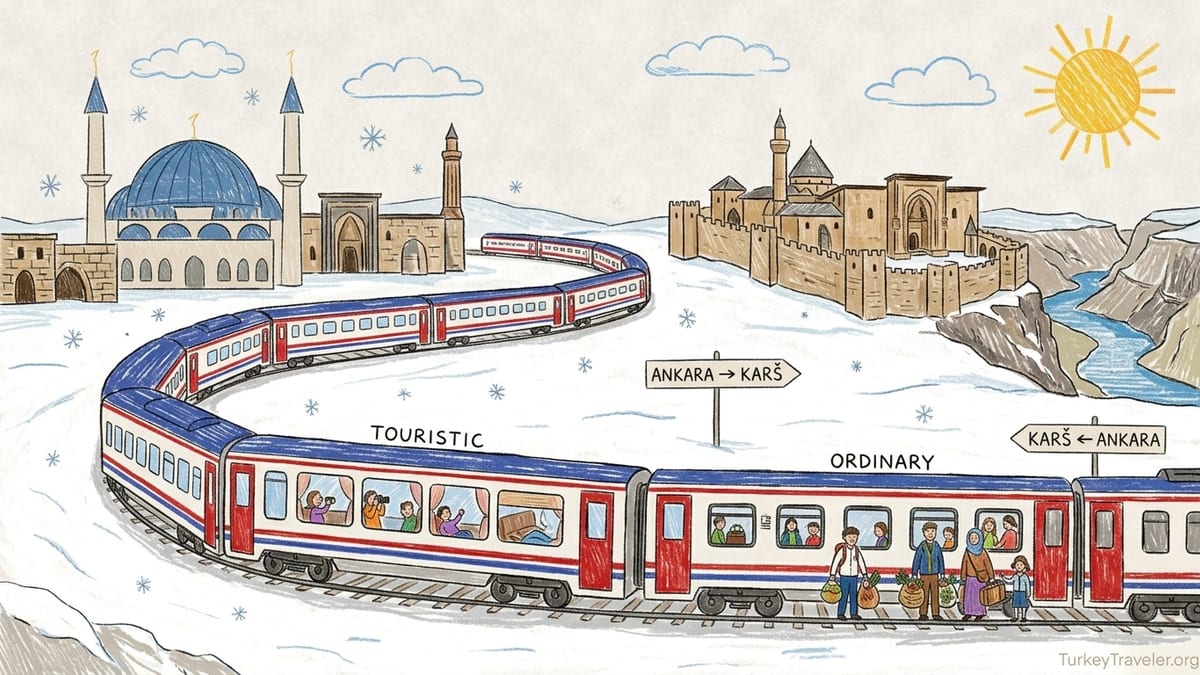
Touristic vs Ordinary Eastern Express: What Actually Changes
The Eastern Express name now refers to two very different experiences on the same Ankara to Kars line. The ordinary Eastern Express is a scheduled intercity train that mainly serves local passengers along the 1,300‑plus kilometer route. It usually offers pullman (reclining seats) and, depending on the year and rolling stock allocation, a limited number of couchette or sleeper cars. It runs most of the year and is priced as regular public transport, which makes it far cheaper but also more utilitarian.
The Touristic Eastern Express, by contrast, is operated as a seasonal, almost cruise‑style train. For the 2026–27 season, it runs from 21 December 2026 through 10 March 2027 from Ankara to Kars, with return departures from Kars through 12 March. Instead of maximizing speed and capacity, it focuses on scenery and off‑train excursions. The consist is made up almost entirely of sleeper cars plus a restaurant car, with passengers booked into private cabins for the full journey.
Time on the line is another key difference. The ordinary Eastern Express typically takes around 24 to 26 hours between Ankara and Kars with only brief station stops. The Touristic Eastern Express slows that down to roughly 30 to 32 hours. The extra time comes from long daylight pauses in places such as Erzincan and Erzurum on the eastbound run, or İliç, Divriği and Sivas on some westbound itineraries. These scheduled breaks are what allow tour operators to offer guided walking tours and photo stops right from the train.
The atmosphere also diverges. On the ordinary Eastern Express you share the train with students, families and people simply going home, often carrying bags of produce or luggage for long stays. On the touristic version most passengers are domestic and international visitors treating the journey as a once‑in‑a‑lifetime experience. That difference shows up in the on‑board mood, with more cameras and tripods on the touristic train and more quiet practicality on the ordinary service.
Ankara → Kars vs Kars → Ankara: Which Direction Is Better
Most travelers instinctively book Ankara to Kars, following the marketing photos of the red‑and‑white train snaking through snowy plateaus. That eastbound direction does have advantages. You leave Ankara in the late afternoon, settle into your cabin with dinner from the restaurant car, then wake up somewhere beyond Sivas or Erzincan with the landscape turning more rugged by the hour. Many winter departures reach the dramatic gorges around Erzincan and the high plains near Erzurum in daylight, which is ideal for photography.
The Kars to Ankara direction is underappreciated but can be just as rewarding, especially if you are pairing the journey with onward flights from Ankara or Istanbul. Westbound, some of the longest daylight stops are scheduled in İliç, Divriği and Sivas. Tour operators commonly build in local guides here, for example short excursions up to the UNESCO‑listed Divriği Great Mosque and Hospital or viewpoint stops over the Euphrates gorges near İliç. The second day then softens into Anatolian steppe as you roll toward Ankara by evening.
In practice, availability might decide your direction. Because demand is highest from Ankara to Kars in deep winter, Kars to Ankara cabins can sometimes be easier to secure closer to departure, especially outside popular dates such as New Year and the mid‑January semester break. Some Turkish agencies now design their packages around this reality, flying guests into Kars first, giving them two nights there and then sending them back to Ankara on the westbound train where cabin space is slightly less contested.
If you are mainly chasing scenery, many repeat riders say eastbound in late January or early February offers the best combination of thick snow pack and longer daylight hours. If your priority is logistics and onward connections, westbound works just as well, especially if you plan to catch a late‑night Ankara to Istanbul high‑speed train the same day you arrive.
Inside the Sleeper: Cabins, Comfort and What To Expect
The Touristic Eastern Express is composed almost entirely of TVS2000‑type sleeper cars and a restaurant car. Each sleeper compartment is sold as a private room, generally configured for two passengers, with two lower‑berth beds by default. In many cars the compartments are technically four‑berth, with two upper fold‑down bunks, but for touristic service they are sold to two people for comfort. You will find a sliding door, two full‑length beds with proper mattresses and linens, a compact wardrobe, power outlets, reading lights, a small table, and often a mini‑fridge and washbasin built into the cabin wall.
The corridor side of the sleeper car has large picture windows, and each cabin has its own big window facing the landscape. Curtains provide privacy at night, but passengers tend to leave them partly open during the day to watch the scenery roll by. Toilets are shared at each end of the car and can feel worn, especially by the second day of a fully booked trip, so carrying your own sanitizer, wet wipes and a pair of flip‑flops or train‑only slippers is practical rather than fussy.
Heating is generally strong to the point that cabins can feel overly warm, even while the outside world is deep below freezing. Windows do not open, so adjust clothing layers and use the curtains to manage temperature and light. Noise is what you would expect on an older long‑distance train: the rhythmic thump over joints, the occasional squeal of brakes, and the metallic clank of couplers during shunting at major stations. Light sleepers usually do best with earplugs and a sleep mask.
The restaurant car is a social hub rather than a fine‑dining venue. Menus vary by contract caterer and season, but you can expect straightforward Turkish dishes like lentil soup, meatballs, grilled chicken, pilav, omelettes and simple breakfasts, plus tea and instant coffee. Prices are comparable to a mid‑range Turkish highway service area, not a luxury train: think modestly higher than a basic lokanta. Many passengers still bring their own snacks, fruit and soft drinks from Ankara or Kars, especially for late‑night cravings when the kitchen is closed.
Cabins on the Ordinary Eastern Express
If you cannot secure a berth on the Touristic Eastern Express, the ordinary Eastern Express still gives you the same route, often with a stronger sense of daily life. Its rolling stock can vary from year to year, but you will usually encounter a mix of pullman, couchette and sometimes classic sleeper cars. Pullman cars are laid out 2+1 with reclining seats and small folding tables. They are the cheapest option but offer no true way to lie flat, which is tiring on a 24‑plus‑hour run.
Couchette cars are set up with four berths per compartment, each berth being a padded bunk that folds down from the wall. During the day the lower berths function as seats; at night all four are converted into bedding. Compartments are not gender‑segregated by default, so groups of friends or families who want privacy typically buy all four berths together, paying the per‑bed price for the extra space. Bedding packs are usually included or offered as a separate rental fee, depending on internal TCDD policy in a given year.
Classic sleeper cars on the ordinary Eastern Express, when available, are closer to what you find on the touristic train but more compact. Compartments are configured for one or two passengers, with proper mattresses, pillows and sheets, a small washbasin in many cabins, and shared toilets at the ends of the cars. Because the ordinary Eastern Express functions as a public service, sleeper quotas are low and demand is intense. Turkish travelers now routinely set alarms for ticket releases and buy entire compartments for groups, especially for weekend departures and holiday periods.
Comfort on the ordinary Eastern Express is shaped as much by crowding as by hardware. A pullman car full of overnight travelers can feel cramped once people start using blankets and neck pillows; a couchette compartment shared with strangers can be perfectly fine if everyone aligns their sleep schedules and keeps luggage tidy. If you value rest above all else and can afford it, booking a full sleeper or all four berths in a couchette remains the most reliable way to enjoy the journey.
Booking the 2026–27 Season: How Hard Is It Really
For the 2026–27 Touristic Eastern Express season, trains are scheduled to depart Ankara between 21 December 2026 and 10 March 2027, with return departures from Kars running through 12 March. TCDD sells the core ticket inventory directly through its official channels. In recent seasons, individual allocations for popular early‑season and holiday dates have sold out within minutes of opening, with large blocks purchased by Turkish tour operators who bundle cabins with hotel nights and excursions.
If you want to book independently, you should plan around both release timing and competition. In the past few years, TCDD has tended to open winter touristic train sales as a single seasonal block, with public communication via press statements and its online ticketing platform. Once sales open, cabins on prime dates like New Year, mid‑January school holidays and late February ski weekends around Sarıkamış start disappearing almost instantly. Travelers who succeeded recently often did so by registering in advance, saving their passenger details, and logging in simultaneously from app and desktop right as bookings opened.
There are trade‑offs between independent and agency booking. Going directly through TCDD usually means paying only the official cabin fare, which has risen sharply over the years but still represents the baseline. Media and traveler reports for the 2025–26 season suggest two‑person sleeper cabins on the Touristic Eastern Express moved from roughly mid‑five‑figure to upper‑five‑figure Turkish lira per cabin one way, with further adjustments possible for 2026–27. Tour agencies typically add their own margin but include airport transfers, at least two nights of hotel accommodation in Kars, some meals and guided tours to sites like Ani and Çıldır Lake.
For the ordinary Eastern Express, booking difficulty varies more by date than by season. Outside Turkish school holidays and major religious festivals, you can sometimes find pullman seats several weeks ahead. Sleeper and couchette berths, however, are limited and may be snapped up as soon as they appear. Many locals report setting alerts a few weeks before travel and checking multiple times per day in the lead‑up to their preferred date, especially for Friday and Sunday departures.
Station Stops, Scenic Highlights and Typical Timings
Although exact timetables are subject to change each year, both the ordinary and Touristic Eastern Express generally depart Ankara in the afternoon and arrive in Kars the following evening. Expect roughly 24–26 hours for the ordinary service and closer to 30–32 hours for the touristic version, taking into account the extended stops that are part of the experience. Eastbound on the Touristic Eastern Express, passengers often enjoy long breaks in Erzincan and Erzurum, timed for daylight so you can step off the train without rushing.
On a typical 2020s‑era itinerary, you might leave Ankara just before 16:00, pass Kayseri late in the evening, wake to mountain views somewhere between Sivas and Erzincan, then roll into Erzincan mid‑morning for a couple of hours. Tour staff or independent guides often lead quick city orientation walks, coffee stops or short drives to viewpoints above the Euphrates. Later in the day, a stop in Erzurum might last around four hours, giving you time to visit the Çifte Minareli Medrese, walk around the historic center or simply enjoy a bowl of cağ kebabı before re‑boarding.
Westbound, itineraries often emphasize different pauses. Many schedules include long breaks in İliç, with its dramatic canyon setting, and in Divriği, whose Great Mosque and Hospital complex is one of Anatolia’s standout Seljuk monuments. Some tours arrange for local minibuses to collect passengers right at the station for short cultural visits, then return them in time for departure. Sivas commonly appears as the last extended break before the train pushes overnight back toward Ankara, arriving the following afternoon.
The ordinary Eastern Express technically passes through many of the same stations but without these extended tourism‑oriented stops. At most you will get ten to fifteen minutes at major junctions, enough for a brisk platform walk or a quick tea from the station canteen. Because the train runs primarily as a transport service, the focus is on keeping to schedule rather than building in scenic pauses. If you are a photographer chasing particular bridges or curves, you will be doing your shooting from the cabin window rather than from station forecourts.
How Many Nights in Kars and What To Do There
For many travelers, the Touristic Eastern Express is only half the story. Kars itself, and the wider region, deserve time. In winter, the most common pattern is two or three nights in Kars at the end of an eastbound journey. Two nights gives you one full day for a standard Ani archaeological site excursion, plus a second half‑day for either Çıldır Lake or a walking tour of Kars city. Three nights lets you slow down, factor in weather disruptions, and add Sarıkamış ski slopes or an extra relaxed day exploring cafés and Russian‑era architecture.
A typical two‑night Kars stay might look like this in practice. On day one you arrive on the evening train, check into a restored stone hotel near the city center, and have a late dinner of kaz eti (roast goose) or hangel (local dumplings). Day two is devoted to Ani, with a local agency collecting you after breakfast for the 45‑minute drive to the ruined medieval capital on the Armenian border. In winter, the plateau can be windswept and icy, so sturdy boots and layered clothing are essential. You return to Kars by late afternoon, perhaps stopping for a panoramic view over the Arpaçay River canyon, then spend the evening strolling past the Orthodox‑style Church of the Apostles and the old stone bazaar.
With three nights, you can add a full‑day trip to frozen Çıldır Lake, where locals offer horse‑drawn sleigh rides across the ice and simple fish restaurants grill freshly caught yellow perch. Another option is a day at Sarıkamış ski resort, reached in about an hour from Kars by road. While it does not have the vertical drop or infrastructure of major Alpine resorts, its dry powder and larch forests have made it increasingly popular with Turkish skiers. Many tour packages now bundle one or two ski days into their itineraries alongside the train journey.
If you are traveling westbound from Kars to Ankara, it still makes sense to build in at least two nights before your departure. This gives you one full day for Ani and a second for either Çıldır or Sarıkamış before boarding the train in the evening. Because winter weather can disrupt domestic flights into Kars, allowing a buffer night on arrival is wise if your schedule is tight or includes international connections after the train.
The Takeaway
For the 2026–27 season, the Touristic Eastern Express sits at the intersection of classic rail travel and contemporary Turkish winter tourism. The ordinary Eastern Express continues to offer a more functional, budget‑friendly route along the same tracks, but the seasonal touristic train has become the headline experience, with its long daylight stops, private sleeper cabins and bundled excursions.
Deciding between Ankara to Kars or Kars to Ankara is less about “right” or “wrong” direction and more about how you want to structure the rest of your trip. Eastbound remains the iconic choice, especially if you want to end in Kars and ride straight into a two or three‑night stay taking in Ani, Çıldır Lake and Sarıkamış. Westbound works better for those planning to fly home from Ankara or Istanbul and may offer slightly better availability on popular dates.
The practical steps remain constant in either case. Watch for TCDD’s ticket release announcements, be ready to purchase the moment sales open, and consider whether an agency‑run package that bundles cabins and Kars hotels makes sense for your budget. Once you are on board, the details of cabin comfort, restaurant‑car meals and station stops blend into an experience that is more about watching Anatolia unfold outside your window than ticking off individual sights.
With realistic expectations about booking difficulty, cabin standards and winter weather, the Touristic Eastern Express can be the highlight of a Turkey itinerary rather than a logistical headache. Whether you choose the touristic or ordinary version, allowing enough time in Kars and along the route turns a long train ride into a memorable journey across the country’s eastern frontier.
FAQ
Q1. What is the main difference between the Touristic Eastern Express and the ordinary Eastern Express?
The Touristic Eastern Express is a seasonal, mostly sleeper‑only train designed for sightseeing with long daylight stops and higher fares, while the ordinary Eastern Express is a year‑round intercity service with standard seating and limited sleepers focused on getting passengers from Ankara to Kars as efficiently and cheaply as possible.
Q2. When does the 2026–27 Touristic Eastern Express season run?
For the 2026–27 season, eastbound Touristic Eastern Express services are scheduled from 21 December 2026 through 10 March 2027, with return trains from Kars continuing through 12 March, subject to operational adjustments by TCDD.
Q3. How long does the journey from Ankara to Kars take on each train?
On the ordinary Eastern Express the trip usually takes about 24 to 26 hours, depending on operational conditions, while the Touristic Eastern Express generally takes closer to 30 to 32 hours because of its extended sightseeing stops.
Q4. How hard is it to get a sleeper cabin on the Touristic Eastern Express?
Demand is very high, especially for popular dates like New Year and school holidays, so individual ticket allocations often sell out within minutes of release; many cabins are also pre‑purchased by tour operators, which makes it essential to be online and ready to buy as soon as TCDD opens sales.
Q5. Is Ankara → Kars or Kars → Ankara better for scenery and experience?
Both directions are scenic, but Ankara to Kars is more popular because the landscape becomes progressively more dramatic as you head east and many scheduled daylight stops fall in Erzincan and Erzurum, while Kars to Ankara can be better for those prioritizing westbound connections and sometimes slightly easier ticket availability.
Q6. What kind of cabin should I expect on the Touristic Eastern Express?
You can expect private sleeper cabins, typically sold for two passengers, with real beds, linens, storage, power outlets and often a small fridge and washbasin, plus shared toilets at each end of the car and access to a restaurant car for meals.
Q7. Can I still have a good experience on the ordinary Eastern Express if I miss out on touristic tickets?
Yes, the ordinary Eastern Express runs the same route and can be very atmospheric, especially if you book a couchette or sleeper compartment; you will miss the long sightseeing stops and curated tours but gain a more local, everyday travel atmosphere at a much lower cost.
Q8. How many nights should I spend in Kars after the train journey?
Most travelers find that two or three nights works well, with two nights allowing time for Ani plus either Çıldır Lake or a city tour of Kars, and three nights giving you the flexibility to add Sarıkamış skiing or to absorb weather‑related disruptions.
Q9. Is it better to book directly with TCDD or through a tour agency?
Booking directly with TCDD usually offers the lowest pure transport cost but requires fast action and some Turkish‑language comfort, while tour agencies charge more overall but bundle the cabin with Kars hotel nights, some meals, airport transfers and guided excursions, which many international travelers find simpler.
Q10. What should I pack specifically for a winter Touristic Eastern Express trip?
In addition to standard cold‑weather clothing, pack layered outfits for an overheated cabin, sturdy boots for icy station platforms and Ani’s ruins, earplugs and a sleep mask, basic toiletries, hand sanitizer, wet wipes, slippers for corridor walks, and a small stash of snacks and drinks for times when the restaurant car is closed or crowded.