


Driving the Turkish Riviera from Antalya to Fethiye and Ölüdeniz is one of the most satisfying road trips in the Mediterranean, combining winding coastal highways, small whitewashed towns and some of Turkey’s most important ancient cities. With a rental car and a flexible plan, you can move at your own pace between Antalya, Çıralı, Olympos, Kaş, Kalkan, Patara, Fethiye and Ölüdeniz, stopping for ruins, beaches and sunset viewpoints whenever the mood strikes.
Why Drive the Turkish Riviera Instead of Using Buses
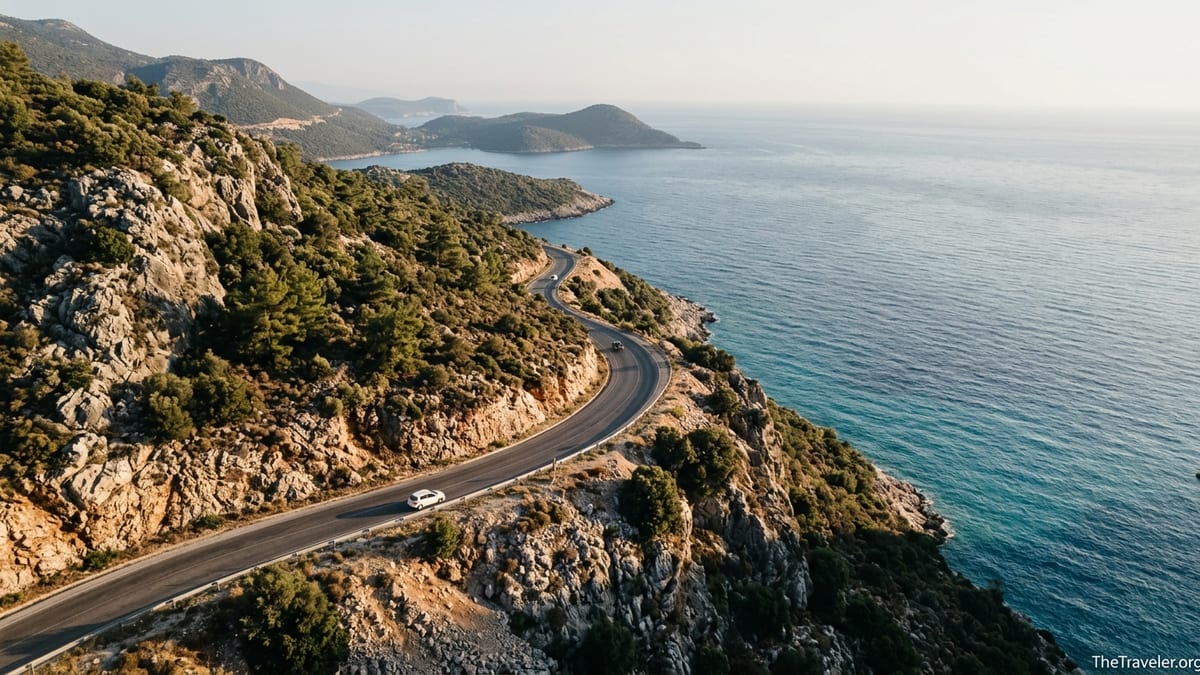
The stretch between Antalya and Fethiye is well served by intercity buses and shared minibuses, but driving yourself is the difference between simply getting there and turning the coast into a true journey. The D400 highway hugs the Mediterranean most of the way, with sweeping views and frequent lay-bys where you can pull over for photos or a swim. On public transport you pass this scenery behind glass; in a car you can decide on a whim to stop at a roadside stall for fresh pomegranate juice or divert to a tiny cove you spotted from above.
Having your own car also makes ancient-city stops far easier. Sites such as Olympos, Phaselis, Myra, Xanthos, Tlos and the ruins around Fethiye sit a few kilometers off the main road. With a rental car you simply follow the brown heritage signs and park at the entrance, instead of negotiating taxis from the nearest bus stop. For instance, a traveler who wants to see both the Olympos ruins and the eternal flames at Yanartaş in one day can comfortably do so by car, whereas linking these by minibus often means long waits and a late return.
Costs are another reason to consider driving, especially for couples or small groups. As of 2026, basic manual compact rentals in Antalya and Fethiye typically start around the equivalent of 20 to 30 euros per day outside of peak August, with automatic and SUV models higher. When you share that across two or three travelers and add fuel, the per-person cost for a week can be similar to or lower than buying multiple point-to-point bus tickets and then adding local taxis for beaches and ruins.
Finally, a car makes it easier to stay in characterful places that are not right in town centers. In Kaş or Kalkan you might choose a villa in the hills with a sea view pool, or a stone-built pension on a quiet side street. In Çıralı and Olympos you can sleep in simple bungalows set among orange groves a ten-minute walk from the beach, then use the car to reach trailheads or nearby viewpoints at sunrise without thinking about minibus timetables.
Renting a Car in Antalya, Kaş and Fethiye
Most travelers begin this road trip by picking up a car at Antalya Airport or in Antalya city. International brands and reputable Turkish agencies operate here, which means a choice of compact hatchbacks, sedans and crossovers. Booking ahead is strongly recommended for July and August. Many rental desks include basic third-party liability as standard; for peace of mind on mountain and coastal roads, it is sensible to add full damage waiver and check the deductible before you sign. Photos and a short walk-around video at pick-up are prudent in case of later disputes about existing scratches.
If you prefer to start in Kaş or Fethiye, you will find mostly local rental outfits rather than big global names. In Fethiye there are several agencies around the marina and in the town center that offer daily rentals and one-way drop-off back to Antalya for an extra fee. In Kaş, small family-run offices near the harbor typically keep a limited fleet, so it pays to call or email in advance if you are arriving in peak season. These can be ideal for travelers who bus in, spend a few days car-free, then rent a vehicle for 3 or 4 days of day trips to Kaputaş Beach, Patara and Saklıkent Gorge.
Transmission choice matters on this route. Much of the D400 is smooth highway, but access roads down to coves, to viewpoints above Ölüdeniz or up toward mountain villages are steep and narrow. Less confident drivers might prefer an automatic, which usually costs a little more per day but removes the stress of hill starts on hairpins. Compact cars are easier to park in tight village streets than large SUVs, and still perfectly adequate for the surfaces encountered between Antalya and Fethiye.
When collecting the car, ask explicitly whether your rental allows night driving outside urban areas and whether any specific roads are excluded. This is rare but worth confirming. Also check that you have a warning triangle, reflective vest and basic spare tire kit in the trunk. Mobile coverage is good along the coast, but offline maps downloaded in advance provide extra peace of mind when navigating through narrow town centers or following unmarked side roads to beaches and ruins.
Understanding the D400 Coastal Road and Driving Conditions
The main artery of this road trip is the D400 highway, which runs for roughly 300 kilometers between Antalya and Fethiye. The section you will use switches between dual carriageway and two-lane coastal road, climbing above the sea and dropping back to small bays. West of Kemer, expect frequent curves and short tunnels. Large coaches, local buses and delivery trucks also use this route, so the key to relaxing driving is to accept slower speeds and pull over into lay-bys when you want to let faster vehicles pass.
Daytime driving in dry weather is strongly recommended, especially if you are new to Turkish roads. At night, some segments feel narrow and unlit, and oncoming headlights can be intense on curves. In winter and early spring, heavy rain can reduce visibility and create standing water, particularly near river mouths. In summer, heat haze and glare off the sea are more common concerns, so good sunglasses and regular breaks are helpful. Fuel stations with cafés, toilets and small supermarkets appear every 30 to 50 kilometers along most of the route, which makes it easy to refuel before you tackle long curvy stretches.
Speed limits are typically 90 km/h on open highway sections and drop to 50 or 70 km/h near towns and roadworks. Fixed speed cameras and occasional police checkpoints encourage adherence, and fines can be issued on the spot or passed to your rental company if you are recorded exceeding limits. Locals sometimes overtake assertively on short straight segments, particularly between Kemer and Demre or between Kalkan and Fethiye. Keeping a steady, defensive line and avoiding sudden lane changes allows these drivers to pass safely while you maintain your comfort level.
Navigation is straightforward. Brown heritage signs indicate ancient sites, while blue and white signs mark towns and distances. For example, driving west from Antalya you will see signs for Kemer, then Phaselis, then Olympos and Çıralı, followed by Finike, Demre, Kaş and Kalkan. Having a navigation app active makes it easier to spot the small left turn to Kaputaş Beach or the inland detour to Saklıkent Gorge. Before leaving a bigger town like Antalya, Kaş or Fethiye, confirm your next major waypoint and estimated drive time, so you do not feel rushed when you decide to stop at a viewpoint or ruin that catches your eye.
Parking, Town Access and Beach Logistics
Parking along the Turkish Riviera is generally manageable if you arrive early in the day and avoid peak weekend afternoons in July and August. In Antalya’s old town, Kaleiçi, it is more practical to book accommodation that offers nearby parking or to use paid lots at the edge of the historic core, then explore the pedestrian streets on foot. In modern districts of Antalya, multi-story garages and open-air lots near shopping centers are easy options when picking up supplies before you leave the city.
In smaller towns like Kaş and Kalkan, public parking lots near the marina or waterfront fill up quickly in high season. Many pensions and boutique hotels in these towns either have a few private spaces or collaborate with nearby lots and can reserve a spot for guests. It is worth asking about this at the time of booking. On-street parking is usually time-limited or paid during the day in central areas, managed by attendants who issue a ticket and collect a modest fee when you depart. A common pattern for road trippers is to park at their hotel and then walk to dinner in the old town, keeping the car only for day trips to surrounding sights.
Beach parking varies by location. At Kaputaş Beach, a highlight between Kaş and Kalkan, you will typically park along the roadside above the gorge, in marked spaces or wherever attendants direct you, then descend by steps to the sand. Space is limited, so arriving before late morning helps. In Patara, after paying the combined entrance fee for the ancient city and the beach, you drive through the ruins and continue to an organized parking area set back from the dunes, with clear signage reminding drivers not to venture onto the sand. In Çıralı, simple dirt lots and informal roadside parking allow access to the long pebble beach, though you should avoid blocking small lanes that serve guesthouses.
Ancient sites often have dedicated parking lots near their gates, sometimes with shade structures and snack kiosks. At Olympos and the Chimaera (Yanartaş) above Çıralı, there are separate small lots with attendants collecting a fee. Saklıkent Gorge, inland from Fethiye, provides several private and shared parking areas linked to restaurants and rafting operators. Leaving the car at one of these establishments and buying a meal or drink there is common practice. As a general rule, keep valuables out of sight, lock the vehicle and avoid leaving passports or large sums of cash in the glovebox when you park at beaches and heavily visited ruins.
Must-See Stops: From Antalya to Kaş, Kalkan, Patara and Fethiye
Most itineraries begin in Antalya, where it is worth spending at least a night or two before hitting the open road. Explore Kaleiçi’s Ottoman-era houses, Hadrian’s Gate and the Roman harbor, then visit nearby Roman and Hellenistic ruins at Perge and the impressive theater of Aspendos as day trips from the city. When you are ready to leave, head southwest on the D400 toward Kemer, then turn off for Phaselis, an ancient city with pine-framed ruins spilling right down to small coves where you can swim above half-submerged stones.
Continuing west, a signed turnoff leads to Çıralı and Olympos, where a side road descends through orchards to a laid-back village of wooden bungalows and small pensions. Park near the beach access and walk along the riverbed path into the Olympos archaeological zone, where Lycian, Hellenistic and Roman remains sit in a wooded valley that opens to the sea. In the evening, many travelers drive or hike up to the Chimaera, where natural gas vents flicker from the rocky slope, visible after dusk. Spending a night here breaks up the drive and immerses you in a quieter side of the coast.
West of Demre, known for the Church of Saint Nicholas and rock-cut tombs at Myra, the D400 becomes increasingly scenic as it winds toward Kaş. This compact town, backed by mountains and facing a Greek island offshore, is a natural base for two or three nights. Use your car to reach beaches such as Büyük Çakıl and İnceboğaz, or to drive to the nearby village of Üçağız for a boat tour over the sunken ruins of Kekova. A typical day might combine a morning swim close to Kaş, an afternoon exploring the ancient theater at Antiphellos above town and a sunset drive back along the coastal cliffs.
Between Kaş and Kalkan, Kaputaş Beach is almost impossible to pass without stopping. The view from the road, looking down into a narrow gorge filled with turquoise water, is one of the signature scenes of the Turkish Riviera. After climbing back to the D400, continue to Kalkan, a whitewashed hillside town with rooftop restaurants and a small pebble beach. From here it is a short drive to Patara, where the excavated agora, theater and monumental gate of the ancient city sit just inland from what is often described as one of Turkey’s longest sandy beaches. Further west, the road bends inland toward Fethiye, a lively harbor city that makes a good base for exploring Ölüdeniz, Kayaköy and the inland ruins of Tlos and Saklıkent Gorge.
Sample 5-, 7- and 10-Day Road Trip Routes
For travelers with limited time, a five-day itinerary focuses on highlights without rushing. One practical version is to start in Antalya and spend the first day exploring Kaleiçi and nearby beaches before picking up the car. On day two, drive to Çıralı via Phaselis, then visit Olympos and the Chimaera overnight. Day three takes you along the coastal D400 to Demre for a quick stop at Myra, then onward to Kaş for two nights. Use day four for a Kekova boat trip or local beaches, returning to Kaş in the evening. On day five, leave early and drive to Fethiye via Kaputaş, Kalkan and Patara, dropping the car in Fethiye if your onward journey is by bus or boat.
A seven-day road trip allows a more relaxed pace and additional inland detours. The first two days can mirror the five-day plan, with Antalya sightseeing and an overnight in Çıralı or Olympos. Day three delivers you to Kaş, where you stay two or three nights, using the car for side trips: one day to Kaputaş and Kalkan for beach time and dinner, another day to the inland ruins of Xanthos and Letoon. Afterward, drive to Fethiye for the final two or three nights, using one full day for Saklıkent Gorge and Tlos, and another for time in Ölüdeniz, perhaps including a short hike on the first section of the Lycian Way above the lagoon.
With ten days, you can design a loop with more overnight stops and less backtracking. One option begins with two nights in Antalya, then one night in Çıralı, one in Demre or nearby, and three in Kaş. From there, spend a night in Kalkan or Patara to enjoy the beach at different times of day, then end with two nights in Fethiye. This pacing gives you time to linger in markets, take spontaneous swims and add less-visited sites, such as the ghost village of Kayaköy near Fethiye, where abandoned stone houses line the hillside, or the small bays around Kabak where the road drops steeply to hidden beaches.
In all three time frames, you can run the route in either direction: Antalya to Fethiye or Fethiye to Antalya. Many travelers plan point-to-point by arranging a one-way rental with pickup at Antalya Airport and drop-off in Fethiye, then continuing by bus to other parts of Turkey. Others prefer to do a loop, returning the car to the original city to avoid one-way fees. Because the D400 remains visually striking even when driven twice, repeating some segments on the return is less of a drawback than it might be in less varied landscapes.
Ancient Cities Along the Route: How to Fit Them In
One of the defining features of this road trip is the density of ancient sites, many of which sit only a short detour away from the coastal highway. To the east of Çıralı, the ruins of Phaselis are a natural first stop after leaving Antalya, with Roman streets and harbor structures framed by pine forest and sea. Farther west, the Olympos archaeological area at the mouth of a river offers a mix of crumbling tombs, mosaic fragments and vine-covered walls that feel more atmospheric than manicured. Parking is straightforward at both locations, and you can swim either before or after exploring the ruins.
Nearing Demre, the rock-cut tombs and theater of ancient Myra are a compact but impressive stop that can be visited in an hour or two. Around Kaş, the ruins are more subtle but equally rewarding, from the hillside theater of Antiphellos overlooking the bay to scattered Lycian tombs built into the cliffs behind town. Inland, the UNESCO-listed sites of Xanthos and Letoon sit in a rural landscape of olive groves and small villages. These pair naturally with a beach afternoon at nearby Patara, making a full day that combines history and swimming.
Approaching Fethiye, the landscape opens into a broader valley where additional sites await. Tlos crowns a hill above the plain, with an acropolis, rock tombs and views toward the mountains. Combined with nearby Saklıkent Gorge, where you can walk through icy water between steep canyon walls, this makes for a varied day trip from Fethiye by car. Within Fethiye itself, the rock tomb of King Amyntas and smaller Lycian graves dot the hillside above town, accessible by short, steep streets where you can usually find street parking in the lower neighborhoods.
Because entrance fees and opening hours can change from season to season, it is advisable to check details with your accommodation or local tourist information the night before you visit major ruins. In practice, most archeological parks on this route open in the morning and remain accessible until late afternoon or early evening. Carry cash as well as cards, bring water and sun protection, and allow time to sit in the shade and absorb the setting rather than rushing from one structure to the next.
The Takeaway
A road trip along the Turkish Riviera between Antalya and Fethiye rewards drivers with an unusually rich mix of coastal scenery, beach stops and historic sites. The D400 highway, combined with easy side roads down to villages such as Çıralı or up to inland ruins like Tlos, allows travelers to step between eras in a single day, from Roman theaters and Lycian tombs to modern harbors and beach clubs. With a carefully chosen rental car and a realistic daily distance, the driving remains enjoyable rather than exhausting.
Planning around five, seven or ten days gives you a framework, but the true luxury of this route lies in the freedom to adapt as you go. If Kaş’s harbor cafés prove irresistible, stay an extra night and shift another stop. If the dunes of Patara pull you back at sunset, rearrange the next day to accommodate another swim. Provided you respect local driving rules, park thoughtfully and allow extra time for winding segments, this stretch of the Turkish Riviera is a safe and highly rewarding introduction to road tripping in Turkey.
Whether you are a couple chasing hidden coves, a family weaving beach days between ancient-city visits or a group of friends keen on photography and small-town evenings, this route can be tailored to match your pace. Start with Antalya’s urban energy, follow the coast through Çıralı, Olympos, Kaş, Kalkan and Patara, and end with Fethiye and Ölüdeniz’s lagoons and viewpoints. The memories that linger are often the unscripted ones: a roadside orange stand at golden hour, the echo of your footsteps in a ruined theater and the first glimpse of the sea as the D400 curves toward another bay.
FAQ
Q1. Is it safe to drive the D400 coastal road between Antalya and Fethiye?
Yes, it is generally safe for cautious drivers. The D400 is a main highway used daily by local traffic and tour buses. The coastal stretches are winding, so take your time, avoid night driving when possible and keep to posted speed limits. Newer drivers may find the curves challenging at first but manageable with a relaxed pace.
Q2. What type of rental car is best for this Turkish Riviera road trip?
A compact or mid-size car is ideal. These are easier to park in tight streets in Kaş and Kalkan and perfectly capable on mountain and coastal roads. Many travelers prefer an automatic transmission for steep access roads and hairpin bends, even though it costs a little more per day than a manual.
Q3. Do I need an International Driving Permit to rent a car in Antalya or Fethiye?
If your license is issued in Roman script and from most European countries, the United Kingdom, the United States, Canada or Australia, it is typically accepted on its own for short visits. However, some travelers carry an International Driving Permit as an extra document. It is best to check current rules and your rental company’s policy before you travel.
Q4. How easy is parking in popular towns like Kaş, Kalkan and Fethiye?
Parking is usually straightforward if you plan ahead. Many hotels and pensions either have their own small lots or work with nearby paid car parks. Town-center street spaces can be limited in July and August, so it is smart to park once near your accommodation and explore on foot, using the car mainly for day trips to beaches and ruins.
Q5. Can I visit beaches like Kaputaş and Patara by car?
Yes. Kaputaş Beach is directly on the D400 between Kaş and Kalkan, with roadside parking above the cove and stairs leading down to the sand. Patara requires a short signed detour off the highway. After paying the entrance fee, you drive through the ancient city and park in an organized lot behind the dunes before walking to the beach.
Q6. Is it realistic to cover Antalya, Çıralı, Olympos, Kaş, Kalkan, Patara and Fethiye in five days?
It is possible, but your schedule will be busy. A five-day plan works best if you limit overnight stops to three or four bases, for example Antalya, Çıralı or Olympos, Kaş and Fethiye. If you prefer slower travel with more time in each town and at ruins, seven to ten days is more comfortable.
Q7. Are fuel and toll costs high on this route?
Fuel prices fluctuate, but this section of the Turkish Riviera involves only moderate distances. There are no special toll roads between Antalya and Fethiye on the standard coastal route. Expect to refuel every few days depending on your side trips, and factor in that fuel may be a significant but manageable part of your driving budget.
Q8. When is the best time of year to do this road trip?
Late April to early June and September to October usually provide the best balance of warm weather, swimmable sea temperatures and lighter traffic. July and August can be very hot and busy, particularly around beaches and small towns. Winter months bring cooler temperatures and occasional heavy rain, which reduces swimming options but can mean quieter roads and sites.
Q9. Do I need to reserve accommodation and car hire in advance?
For peak season, reserving both the car and key overnight stays ahead of time is advisable, especially in smaller towns like Kaş and Kalkan where rooms sell out. In shoulder seasons, you have more flexibility and can often book a few days in advance, adjusting your route according to weather and your interests.
Q10. Can I drive one way, for example pick up the car in Antalya and drop it in Fethiye?
Many rental companies offer one-way rentals between major hubs for an additional fee. Picking up in Antalya and dropping in Fethiye is a popular option for travelers who continue by bus, domestic flight or boat. When comparing quotes, check whether the one-way charge is included so you can budget accurately.