


The Turkish Riviera stretches for hundreds of kilometres along Turkey’s south coast, from the big resorts around Antalya to the smaller bays near Fethiye and Göcek. It is one of Europe’s most varied coastlines: in a single week you can move from high-rise all-inclusive hotels and waterparks to tiny coves, pine forests and yacht-filled marinas. The key decision that shapes your entire trip is where you choose to base yourself. This guide compares the main areas – Antalya, Lara, Belek, Side, Kemer, Kaş, Kalkan, Fethiye, Ölüdeniz and Göcek – to help you match the right town to your budget, travel style and plans for beaches, nightlife and road trips.
How to Choose Your Base on the Turkish Riviera
Before comparing individual towns, it helps to be clear about what you want from this stretch of coast. If you are looking for a classic package holiday with kids clubs, multiple pools and nearly all your costs wrapped into one payment, then the big resort strips of Lara, Belek and Side near Antalya are designed for you. Many hotels here operate on an all inclusive or “ultra all inclusive” basis, where drinks, buffet meals and many activities are bundled into the room price. Typical summer nightly rates at large four and five star resorts in Lara or Belek can start from around the mid to high double digits per person in US dollars in shoulder season, rising higher in July and August.
Travellers who want a more independent feel, easy access to restaurants and small shops, and the option to explore ancient sites and mountain villages often gravitate further west. Kemer offers a halfway house between big resorts and natural scenery, while Kaş, Kalkan, Fethiye, Ölüdeniz and Göcek are better for smaller hotels, apartment stays and road trips along the dramatic Lycian Coast. In these areas, many properties are bed and breakfast boutique hotels or self-catering apartments, with nightly double room rates that can be roughly comparable to the big resorts once you factor in restaurant spending.
Another key question is how much you want to move around. The Antalya area works well if you prefer to unpack once and rely on day trips: there are organised excursions to sites such as Perge, Aspendos, the Düden and Manavgat waterfalls, and boat trips along the coast. By contrast, the Fethiye to Kaş stretch is ideal for a rental car, with coastal drives that link beaches, Lycian rock tombs and small villages. Many visitors split a week or ten days between, for example, three nights in Fethiye or Ölüdeniz and four nights in Kaş or Kalkan to experience both scenery and relaxed nights out.
Finally, consider season. From late June to early September, the Antalya region is extremely hot and busy, with hotel pools and waterparks in full swing. In May, early June, late September and October, sea temperatures are usually still pleasant but prices fall and the heat is more manageable for hiking and sightseeing. The smaller resorts around Kaş, Kalkan and Göcek have a shorter season, with some beach clubs and hotels closing from late October to April, so outside summer it pays to double-check which places are open before you book.
Antalya City: Urban Base With a Beach
Antalya city is the Turkish Riviera’s main hub, with the international airport just east of town and a population in the hundreds of thousands. Staying here suits travellers who want a mix of city life and beach time rather than a pure resort bubble. The old town, known as Kaleiçi, is a tangle of restored Ottoman houses, boutique hotels and small pensions. Many of these are in historic buildings with enclosed courtyards and a handful of rooms, which can appeal to couples who prefer character over size and do not need direct beach access.
For the beach, the main city option is Konyaaltı, a long stretch of mostly pebble shoreline west of the centre, backed by a promenade, cycle paths and apartment blocks. Hotels here range from simple guesthouses to contemporary mid-range properties, including some with rooftop pools facing the sea and the Taurus Mountains. Travelling between Konyaaltı and the historic centre is straightforward using Antalya’s tram system or taxis, and this combination of urban restaurants, museums and seafront makes the area popular with travellers who care about local food and nightlife more than on-site resort entertainment.
Antalya also offers the widest choice of non all inclusive accommodation on this coast, from business-style chain hotels to small design properties. You can, for example, stay in a boutique hotel within Kaleiçi’s walls and spend your days exploring nearby archaeological sites such as Perge and Termessos on organised tours or by rental car. This works well for short stays of two to three nights before or after time in the more resort-focused areas further along the coast.
One factor to keep in mind is that Antalya is a real working city rather than a purpose-built resort. Traffic can be heavy in peak hours, and city beaches have a more local, urban feel compared with the long sandy strips of Lara and Belek. If your priority is a quiet, self-contained beachfront stay with kids using water slides and kids clubs, Antalya city itself may not be the most straightforward match.
Lara, Belek and Side: All Inclusive Heartland
The all inclusive core of the Turkish Riviera lies east of Antalya city, in the zones known as Lara, Belek and Side. Lara, often called Lara-Kundu, is the closest to the airport, with transfers that can take as little as 20 to 30 minutes by pre-booked vehicle. The coast here is lined with large beachfront hotels, many of them themed properties with elaborate pool complexes, private sections of sandy beach and full-board or ultra all inclusive meal plans. This is one of the easiest areas for families who want minimal logistics: you arrive, settle into one resort, and most daily needs, from children’s activities to evening shows, are available on site.
Belek lies further east and is known as Turkey’s golf centre as well as one of its most polished resort areas. Several internationally recognised golf courses sit close to the shore, and many five star hotels run shuttle buses between their grounds and the greens. Belek is also popular for honeymoons and special occasions because of its large suites, spa facilities and more tranquil atmosphere compared with Lara. Travellers paying for high category rooms in Belek can expect larger space, private pools or swim-up terraces in some properties, and more emphasis on attentive service over high-energy nightlife.
Side sits yet further along the coast and offers a different mix: an atmospheric historic centre on a small peninsula, with Hellenistic and Roman ruins integrated into the streets, surrounded by long resort beaches to the east and west. Families often choose the larger hotels along Side’s main beach areas, where you can find water slides, kids clubs and buffet restaurants, while couples might opt for smaller hotels or pensions closer to the ruins and harbour for evenings with more independent restaurant choices. From Side, it is easy to book boat trips, jeep safaris into the Taurus foothills or excursions to Manavgat’s waterfalls.
In these three areas, all inclusive packages are dominant, but there is still variation in atmosphere and price. Lara often appeals to those who want quick airport access and value, Belek to travellers seeking polished service, golf and spa facilities, and Side to visitors who want a balance of resort comfort and a walkable historic centre. If you are planning to rent a car and take day trips, check whether your hotel offers convenient parking and how easily you can drive in and out, as some resort strips involve gated complexes set back from the main roads.
Kemer: Forested Bays and Mid‑Size Resorts
Southwest of Antalya city, the coastal road curves along the foot of the Taurus Mountains to reach Kemer. This town and its neighbouring villages sit between pine-covered hills and the sea, giving the area a greener, more mountainous feel than the flatter resort strips to the east. Kemer itself has a marina, a small town centre and a mixture of mid-sized all inclusive hotels, apartment complexes and a few boutique-style properties. The beaches are mostly pebbly, with clear water and mountain views, which can be a trade-off if you are specifically seeking wide sandy beaches for young children.
Kemer attracts travellers who want easy access to nature without giving up resort comforts. Popular day trips include cable car rides up Tahtalı Mountain, boat cruises past coves and small islands, and visits to the ancient sites of Phaselis and Olympos, both set in national parkland with beaches and pine trees. For drivers, the coastal road between Kemer and the smaller settlements to the southwest offers a preview of the more rugged Lycian coastline that stretches toward Kaş and Fethiye.
Accommodation in Kemer tends to be more varied in size and style than in Lara or Belek. Alongside large resort hotels with pools and animation teams, you will find smaller family run properties, some offering bed and breakfast or half board rather than full all inclusive. This mix makes Kemer a useful compromise for couples or families where one person wants organised entertainment and another prefers a quieter base with opportunities to get out into nature.
Nightlife in Kemer is present but more compact than in Antalya city, with a cluster of bars and clubs near the centre that come to life in high season. Outside July and August, evenings are noticeably quieter, which can suit travellers looking for relaxed dinners in small restaurants followed by early nights rather than loud music into the small hours.
Kaş and Kalkan: Boutique Hotels and Scenic Road Trips
Further west along the D400 coastal road, past the more scattered resorts of Çıralı and Adrasan, the twin towns of Kaş and Kalkan mark the start of a very different section of the Turkish Riviera. Here the coast is rugged and indented, with cliffs, small coves and dramatic mountain backdrops. Large all inclusive resorts are rare. Instead, the accommodation stock is dominated by small boutique hotels, villas and apartment rentals, many of which cascade down hillsides with sea views and shared or private pools.
Kaş is the slightly larger and more bohemian of the two, centred on a compact harbour with narrow streets, whitewashed houses and bougainvillea. Travellers stay in small hotels on the peninsula west of town, where properties often have sea platforms or small private beach areas built onto the rocks, or in pensions and guesthouses closer to the harbour. From Kaş, you can take boat trips to nearby bays, go sea kayaking over the submerged ruins of Kekova, or drive inland to visit ancient Lycian sites.
Kalkan, a short drive to the west, spreads across steep hills facing a wide bay and small harbour. Many British visitors have long favoured Kalkan, and you will find a high number of villas and apartment complexes built into the slopes, with infinity pools and large terraces designed for families or groups. In the old town near the harbour, restored stone houses have become boutique hotels and rooftop restaurants. Beach clubs, in this area, are typically wooden platforms built into rocky coves with ladders into the sea, rather than long natural beaches, and guests often pay a modest entry fee that includes a sunbed and umbrella.
These towns are ideal bases for road trips. Within roughly an hour’s drive of Kalkan, you can visit Patara with its long sandy beach and extensive ruins, the Saklıkent Gorge for river walks in summer, or drive into the mountains to see smaller villages. Because the terrain is steep, walking to and from accommodation in Kalkan in particular can involve uphill climbs. Travellers with limited mobility or families with small children may want to choose properties closer to the seafront or budget for frequent short taxi rides up and down the hills.
Fethiye and Ölüdeniz: Flexible Bases for Mixed Itineraries
At the northern end of the Lycian Coast, Fethiye serves as another major hub, with a working town centre, marina and easy access to a range of beaches. Unlike the pure resort strips near Antalya, Fethiye is a place where locals live and work year-round. Staying here puts you close to the Tuesday market, the harbour promenade and the Lycian rock tombs carved into the hillside above town. Accommodation covers everything from small city hotels and pensions to mid-range seafront properties and apartment complexes in areas such as Çalış Beach, which sits a short drive or local bus ride from the centre.
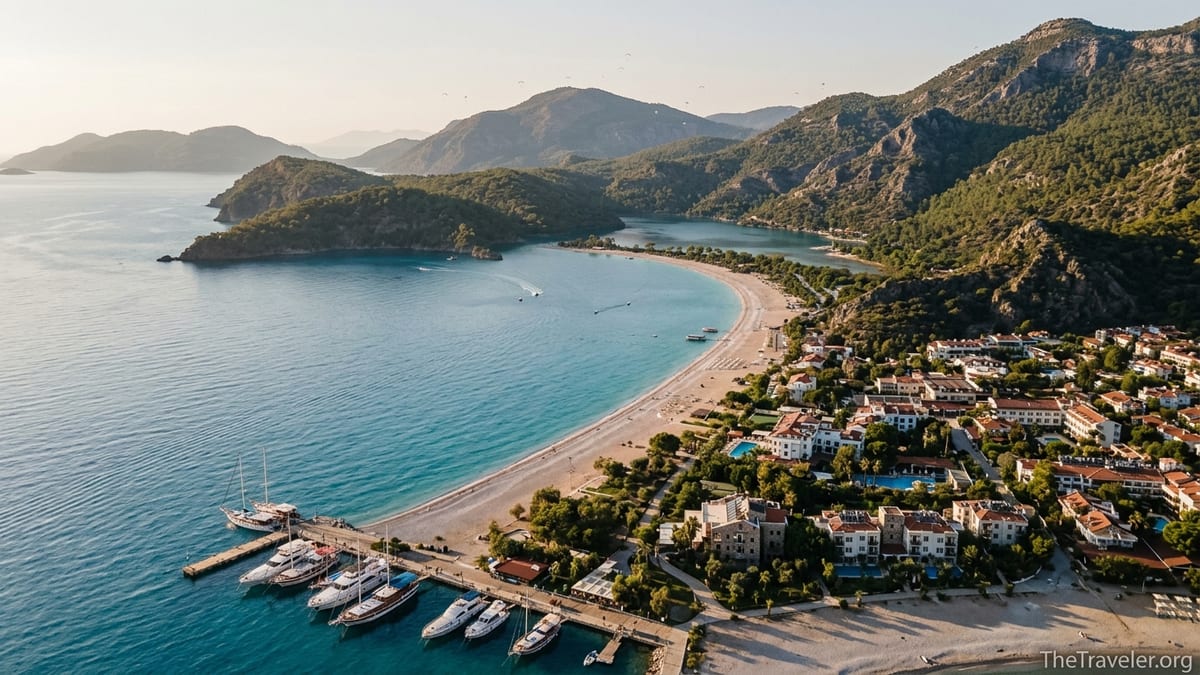
Ölüdeniz, around 20 to 30 minutes by road from Fethiye, is one of Turkey’s most photographed spots, with a sheltered blue lagoon and a paragliding scene that sees colourful wings circling above the bay in peak season. The village backing Belcekız Beach contains a strip of small hotels, apart-hotels and restaurants aimed squarely at holidaymakers. Many properties fall into the three to four star range, with pools and breakfast included. The lagoon itself is reached either on foot or by local shuttle, and some travellers choose to stay closer to the lagoon entrance or in nearby forested areas for a quieter feel.
Fethiye is a strong choice if you want to combine beach time with excursions and do not mind taking short dolmuş bus rides or taxis to different coasts each day. From town you can join boat trips that circuit the nearby islands, visit Butterfly Valley by sea on day cruises, or head inland to Kayaköy, a ghost village set among hills. Ölüdeniz suits travellers whose priority is to walk to the beach, book paragliding flights and spend evenings in a compact resort atmosphere without needing a car.
Budget wise, Fethiye offers a wide spread, from simple guesthouses and budget apartments that can appeal to long-stay visitors, to higher-end marina hotels with more polished service and wellness facilities. Ölüdeniz is more seasonal, with rates climbing in late June, July and August as package-holiday demand peaks. Families may prefer the flatter layout and promenade of Çalış Beach or the quieter residential areas just outside Fethiye’s centre, while younger travellers and first-timers often enjoy the lively bars and easy beach access in Ölüdeniz itself.
Göcek: Quiet Marinas and Yacht‑Focused Stays
Between Fethiye and Dalaman Airport, Göcek occupies a small bay ringed by forested hills. It is best known for yacht tourism, with several marinas clustered around a compact town centre. Rather than long beaches, Göcek offers a sheltered harbour and access by boat to coves and bays scattered around the Gulf of Fethiye. This makes it a favourite starting point for blue cruises and crewed yacht charters, as well as a low-key base for travellers who prefer boat trips and calm evenings over busy resort streets.
Accommodation in Göcek mirrors this calmer, more upscale atmosphere. There are a handful of higher-end hotels with stylish pools and direct access to private or managed beach areas, as well as smaller boutique hotels and guesthouses on residential streets set back from the waterfront. Because land is limited and demand from yacht owners is steady, summer prices in Göcek can be higher than in larger resorts for equivalent room categories. Travellers who mainly want beaches and nightlife may feel the choice here is narrow compared with places like Fethiye or Antalya.
From a practical perspective, Göcek works very well as a first or last stop on a Turkish Riviera trip, especially if you arrive or depart via Dalaman Airport. A stay of two or three nights allows time for a day-long boat trip around the nearby bays, an evening stroll along the promenade and perhaps a visit to a beach club reached by short shuttle boat. For longer holidays focused on variety of beaches or extensive sightseeing, most travellers combine Göcek with other towns rather than using it as their only base.
For drivers, Göcek’s position on the main coastal highway makes it simple to link with other parts of the coast. You can, for example, land at Dalaman, spend a couple of nights in Göcek to recover from the flight and enjoy the marinas, then continue on to Fethiye, Ölüdeniz and eventually Kaş and Kalkan along the D400, returning by the same road or flying out from Antalya if flight connections allow.
Matching Areas to Different Types of Trip
Choosing between these locations often comes down to matching them to the type of trip you have in mind. For a straightforward one-stop all inclusive holiday with children, Lara, Belek or Side are practical answers, with short airport transfers, water slides, kids clubs and predictable costs. Lara wins for the shortest transfer and relatively easy access to Antalya’s old town for a change of scene. Belek stands out for golf and upmarket spa facilities, particularly for couples or multi-generational groups booking suites or villas. Side balances resort life with the chance to walk through ancient streets and dine in off-resort restaurants overlooking the sea.
For couples seeking boutique hotels, romantic scenery and evenings in small restaurants rather than buffet halls, Kaş, Kalkan and parts of Fethiye or Göcek are more compelling. A typical romantic itinerary might involve three nights in a sea-view boutique hotel on the Kaş peninsula, followed by four nights in a hillside villa or apartment near Kalkan’s old town, with car hire for day trips to Patara Beach, Saklıkent Gorge and mountain villages. Dinner would be in small harbourfront or rooftop restaurants rather than hotel dining rooms, and days split between boat trips and small beach clubs.
Families who like flexibility may find Fethiye and Ölüdeniz a good compromise. You can stay in a hotel or self-catering apartment near Çalış Beach, where children can play on the promenade and enjoy sunset walks, then take day trips by bus or organized excursion to Ölüdeniz, Butterfly Valley, the ghost village of Kayaköy or nearby waterparks. Alternatively, basing yourself in Ölüdeniz puts the beach and paragliding at your doorstep but still allows easy access to Fethiye’s markets and harbour by short bus ride.
For road trips, the most rewarding stretches run between Kemer and Fethiye, and especially between Kaş, Kalkan and Fethiye. Hiring a car for at least part of your stay opens up small coves, rural ruins and viewpoints that are hard to reach on organised tours. Drivers should be comfortable with winding mountain roads, particularly after Kaş, but the views of cliffs dropping into bright blue sea are part of the Turkish Riviera’s appeal. Breaking the journey into stays of two or three nights in different towns prevents too much packing and unpacking while still giving a sense of movement along the coast.
The Takeaway
The Turkish Riviera is not a single homogeneous strip of sand but a chain of very different coastal towns linked by sun, sea and history. Your experience will change dramatically depending on whether you stay in a high-rise all inclusive complex in Lara, a golf resort in Belek, a family-run pension in Kaş or a marina hotel in Göcek. There is no single “best” base, only the one that fits your priorities for beaches, nightlife, independence and budget.
If you want simplicity and resort facilities, look first at Lara, Belek and Side. For greener scenery and a mix of resort comfort with nature, Kemer is a strong candidate. Travellers seeking character, boutique hotels and good road trip potential are usually happiest further west in Kaş, Kalkan, Fethiye, Ölüdeniz and Göcek. With flight connections into both Antalya and Dalaman, it is easy to design itineraries that combine two or three of these bases in a single trip.
Whichever area you choose, booking early for July and August is wise, especially for popular family resorts and small boutique hotels with limited rooms. For those who can travel in late spring or early autumn, the rewards are significant: milder temperatures, lower rates, and a gentler pace along one of the Mediterranean’s most varied and rewarding coasts.
FAQ
Q1. Which area on the Turkish Riviera is best for a first visit?
For a first visit, many travellers choose Lara or Side if they want an easy all inclusive holiday, or Fethiye and Ölüdeniz if they prefer more independence and a mix of beaches and excursions.
Q2. Where should families with young children stay?
Families with young children often do best in Lara, Belek or Side, where large resorts provide shallow pools, kids clubs and on-site entertainment, or in flatter areas such as Çalış Beach near Fethiye with a promenade and easy stroller access.
Q3. What is the best base for couples looking for a romantic trip?
Kaş, Kalkan and Göcek are particularly appealing for couples, thanks to small boutique hotels, sea views, atmospheric harbourfront restaurants and options for private boat trips or quiet beach clubs.
Q4. Is it better to stay in Antalya city or Lara Beach?
Antalya city suits travellers who want a mix of museums, local restaurants and an urban beach, while Lara Beach is better if you prefer a self-contained all inclusive resort strip with quick airport access and less focus on city sightseeing.
Q5. Do I need a car to enjoy Kaş, Kalkan and Fethiye?
You can manage without a car using local buses and organised tours, but hiring a vehicle for a few days around Kaş, Kalkan and Fethiye gives far more freedom to reach small coves, ancient sites and viewpoints along the coastal and mountain roads.
Q6. Which areas have the best nightlife?
For nightlife, Antalya city has the broadest range of bars and clubs, followed by resort-based entertainment in Lara, Belek and Side, while Ölüdeniz and Kalkan offer compact strips of lively bars and rooftop venues that appeal to younger visitors and couples.
Q7. Where can I find the most budget friendly accommodation?
Budget travellers generally find better value in Fethiye town, parts of Antalya city and some smaller pensions in Kaş and Kemer, where simple guesthouses and apartments can undercut large resort prices, especially outside the peak summer weeks.
Q8. What is the best time of year to visit the Turkish Riviera?
Late May, June, late September and early October are often ideal, with warm sea temperatures, generally pleasant weather and lower prices than the peak school holiday period from late June to early September.
Q9. Which base works best for combining beaches with ancient sites?
Side is excellent for combining resort beaches with on-the-doorstep ruins, while Kaş, Kalkan and Fethiye also provide good access to ancient Lycian cities, rock tombs and coastal archaeological sites within day-trip distance.
Q10. Is Göcek a good choice if I am not interested in yachting?
Göcek can still be enjoyable without yachting, especially for a short, quiet stay with boat trips to nearby bays, but travellers focused on beaches, nightlife or a wide range of restaurants may prefer to base themselves in Fethiye, Ölüdeniz or Antalya and visit Göcek on a day trip.