

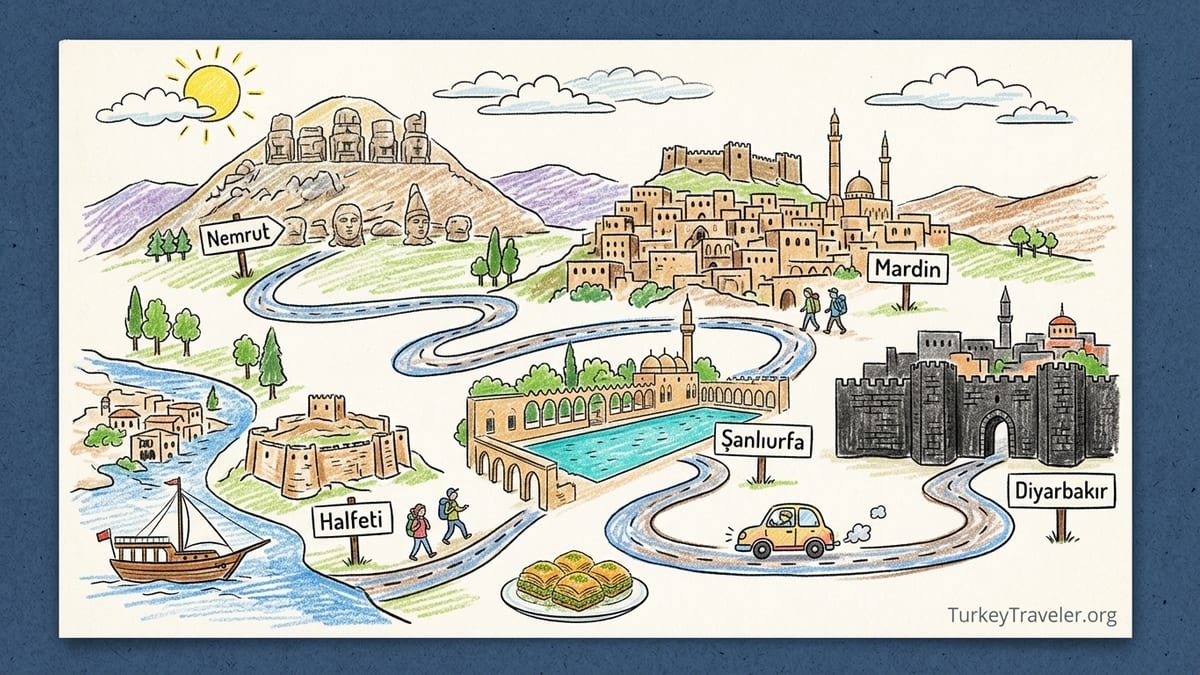
Southeastern Anatolia is one of Turkey’s most rewarding regions for a road trip: a compact loop of culinary cities, ancient hills and desert light, stitched together by new highways and surprisingly manageable driving days. A realistic core route needs about a week, not a rushed long weekend. This guide follows a practical 7-day Gaziantep to Diyarbakır itinerary, built around current 2025–2026 driving times and GAP tour patterns, and explains how to handle one-way car rentals, parking, heat and airport logistics along the way.
Why 7 Days Is the Sweet Spot in Southeastern Anatolia
Tour operators designing GAP (Southeastern Anatolia Project) itineraries in 2025 and 2026 have largely converged on a seven-day structure between Gaziantep and Diyarbakır, often with two nights each in Gaziantep, Şanlıurfa and Mardin, plus a Nemrut segment in between. That timing allows for late-afternoon drives after sightseeing, sunset and sunrise at Mount Nemrut, and at least half a free day in each of the big stops. Some guides stretch to 10 days when adding satellite sites like Harran, Hasankeyf or Göbeklitepe, but for the core cities a week is a comfortable, workable baseline.
The distances support that. Gaziantep to the Nemrut area is around 225 kilometers by road with a typical drive time of about 3.5 to 4 hours in decent traffic. Mardin to Diyarbakır is roughly a 90-minute drive in current conditions, short enough to leave after breakfast and still have a full afternoon inside Diyarbakır’s basalt walls. Between Şanlıurfa and Halfeti, recent local coverage puts the drive at about 120 kilometers and roughly 1.5 hours by private car, which makes a Halfeti boat trip easy to fit into a travel day.
Trying to compress Gaziantep, Nemrut, Şanlıurfa, Halfeti, Mardin, Midyat and Diyarbakır into five days means every day becomes a transfer day, with lunches eaten in fuel station cafés and key experiences like Nemrut sunrise or Mardin’s stone terraces reduced to quick photo stops. Seven days strikes a balance: an efficient one-way progression from west to east with enough slack to absorb traffic, heat and the occasional long lunch after a plate of Antep baklava.
For travelers who cannot spare a full week, the better solution is not to race the highways but to drop one city, usually Nemrut or Diyarbakır, and run a five- or six-day loop between Gaziantep, Şanlıurfa and Mardin. This keeps daily drives short and still showcases the region’s distinctive food, architecture and layered history.
Getting In, Getting Out and One-Way Car Rentals
The cleanest version of this road trip is a one-way drive west to east: arrive at Gaziantep Airport, pick up a car and drop it at Diyarbakır Airport seven days later. Gaziantep and Diyarbakır both handle domestic flights from Istanbul and Ankara, and Diyarbakır usually has late afternoon and evening departures that make it easy to fly out on your final day after a few last hours in the old city. If return fares from Diyarbakır are high for your dates, some travelers instead fly home from Gaziantep and add an internal evening hop back on the last night.
International and Turkish rental brands currently operate at both airports, commonly including Avis, Budget, Enterprise and Hertz in addition to local firms. One-way fees between Gaziantep and Diyarbakır fluctuate, but in mid-2026 it is typical to see a small to medium manual car quoted with a base weekly rental in the region of several thousand Turkish lira, plus a one-way surcharge that can be comparable to a domestic flight ticket. Automatic transmissions are available but less common; booking at least a month ahead is wise, especially for August.
Most contracts allow intercity driving across Southeastern Anatolia on paved highways without special permits. However, rental desks can be particular about taking cars across borders into Iraq or Syria, which does not concern this itinerary but explains why staff may emphasize “no border crossings” when you pick up the keys. Check the mileage policy; some budget offers cap kilometers, and this route will easily exceed 1,000 kilometers once you include Halfeti and short side trips around Mardin and Midyat.
If a one-way fee feels too steep, the main alternative is a loop that starts and ends in Gaziantep, dropping Diyarbakır and finishing in Mardin or Şanlıurfa before driving back. That saves money but adds hours of backtracking. For most travelers who value time in August heat, the one-way rental is the more comfortable choice.
The 7-Day Core Route: Gaziantep to Diyarbakır
Day 1: Arrive in Gaziantep. Pick up your car at the airport and drive into the city, where many visitors stay near the Kale (citadel) and the Zeugma Mosaic Museum. Parking garages on the fringes of the bazaar district, such as multi-story otopark facilities, are often easier than trying to squeeze into on-street spaces beside copper workshops and baklava shops.
Day 2: Spend a full day in Gaziantep. In practical terms, this means an early visit to Zeugma before tour buses, a slow exploration of the covered bazaars and copper-smith alleys, and a long lunch featuring local dishes like beyran soup or Ali Nazik kebab. In the afternoon, retrieve your car from the car park rather than driving all day; central streets are a warren of one-way alleys and frequent loading vehicles. Consider topping up fuel at a big brand station on the city outskirts in preparation for the next day’s drive.
Day 3: Drive Gaziantep to Nemrut / Adıyaman. Use the morning for any final Antep errands, then set out after lunch. The direct drive to the Nemrut area, usually via Adıyaman and Kahta, takes around 3.5 to 4 hours in current conditions. Many travelers base themselves in small pensions around Karadut or Kahta rather than on the mountain itself, both for price and for easier parking. Plan to arrive by late afternoon, settle into your guesthouse, then arrange your Nemrut sunrise or sunset visit with a local driver if you prefer not to handle the steep final approach in your own car.
Day 4: Nemrut sunrise and drive to Şanlıurfa with Halfeti. Sunrise over the stone heads at the summit typically means a start around 3:30 or 4:00 in summer, depending on your base village. After descending and resting, drive toward Halfeti. You can approach either via Birecik or loop farther south depending on roadworks. Realistically, plan on about 3.5 to 4.5 hours of driving broken into segments, then a late afternoon boat tour on the Euphrates from Old Halfeti to Rumkale. After the cruise, continue to Şanlıurfa, roughly 1.5 hours from Halfeti by car, arriving in the evening.
Day 5: Şanlıurfa. With the car safely parked at your hotel or a nearby paid lot, you can spend most of the day on foot: the Balıklıgöl complex, the bazaar streets and the climb to the hilltop castle. Göbeklitepe, which lies about a 20 to 30 minute drive outside the city, fits well as a late afternoon or early morning side trip when temperatures are cooler. In the evening, seek out a sıra gecesi musical night in a restored stone konak; some venues provide parking arrangements with nearby private lots as part of the experience.
Day 6: Drive Şanlıurfa to Mardin with Midyat. The main highway east is straight and relatively fast. Allow around 3 hours to Mardin’s new town, plus an extra hour to detour south to Midyat. Many itineraries handle this by driving Şanlıurfa to Midyat first, exploring the Syriac stone houses and churches for a few hours, then continuing to Mardin for sunset. Expect roughly 4 hours of total driving, plus stops. Parking around Midyat’s old town tends to be informal; small paid lots and curbside spaces are common, and it is customary to leave your keys with an attendant in tight courtyards.
Day 7: Mardin to Diyarbakır. Mardin’s old town is pedestrian-focused and compact, so you can leave the car in one of the established peripheral car parks at Diyarbakır Gate or near Cumhuriyet Square, then explore by foot in the morning. After lunch, return to the highway for the drive to Diyarbakır. Current estimates place the journey at about 1.5 hours, giving you a last afternoon to walk part of the city walls or visit the Ulu Cami before dropping your car at Diyarbakır Airport for an evening flight.
Driving, Heat and Road Conditions in August
Most of this route uses modern asphalt highways and regional roads, but August conditions transform how they feel. Afternoon temperatures in Gaziantep, Şanlıurfa and Mardin frequently rise well above 35 degrees Celsius, with the heat reflecting off long, exposed stretches of tarmac. A car with working air conditioning is not a luxury; it is essential. Before accepting your rental, sit in the car with the engine running and the air conditioning on for several minutes to confirm it cools the cabin effectively.
Plan your driving blocks for early morning and late afternoon whenever possible. On Nemrut day, for example, you will already be up for sunrise; consider using the early morning slot to cover a longer section of the onward drive while temperatures are still reasonable, then stopping for a shaded lunch around Birecik or Halfeti. For the Şanlıurfa to Mardin leg, many travelers leave shortly after sunrise to arrive in Mardin before the hottest part of the day and check into hotels built around internal courtyards that stay relatively cool.
Service stations along the main highways typically include shaded seating, cold drinks and basic food. Big names like Opet or Shell often have cleaner restrooms and small minimarkets where you can buy bottled water in bulk at supermarket prices. It is sensible in August to carry several liters of water in the car at all times; if there is an accident-induced closure on a highway, you may sit in your vehicle for an hour or more without services.
City traffic varies. Gaziantep’s center can feel chaotic, especially near the main bazaar and industrial zones, with sudden lane changes and frequent delivery vans. Şanlıurfa and Mardin have simpler grids but more constraints in their historic cores. Diyarbakır’s approach roads are broad, but around the city walls and Sur district, streets narrow dramatically. In all of these, local drivers expect assertive but predictable behavior: use turn signals, avoid sudden stops, and when in doubt, pull over and let minibuses pass rather than trying to match their pace.
Parking in Şanlıurfa, Mardin, Midyat and Diyarbakır
In Şanlıurfa, newer hotels in the city center often provide basement or courtyard parking, a major advantage in summer. If your accommodation does not, look for private otopark signs on side streets; attendants will typically guide you into tight spots and charge a modest flat fee for several hours. Around Balıklıgöl and the bazaar there are municipal car parks, but these can fill quickly on weekends and holidays. Many visitors choose to park once near the historic core and navigate the rest on foot.
Mardin is more constrained. Old Mardin is a protected area strung along a ridge, with its main street operating as a one-way artery. The provincial culture and tourism directorate highlights three primary parking areas: one by Diyarbakır Gate at the western entrance to the old town, another around Cumhuriyet Square near the archaeology museum and Ziraat Bank, and a third beside the Sabancı City Museum, reached by a dead-end access road. From these lots, you explore the stepped streets and stone terraces on foot. Trying to thread a rental car along 1st Avenue to find a curbside space is usually frustrating, and local advice consistently recommends leaving cars on the edges of the historic zone.
Midyat has a looser, small-town feel. Near the old guesthouse used as a filming location in Turkish TV dramas, signposted public car parks and informal gravel lots allow easy access on foot to Syriac churches and stone mansions. Parking attendants may expect payment in cash only. It is common for drivers to double-park on quiet side streets; if you do this, leave your phone number on the dashboard and be prepared to move if required.
Diyarbakır’s old city is ringed by car parks just outside the walls, particularly near main gates like Mardin Gate or Urfa Gate. Many hotels in the new town offer secure parking and then suggest a short taxi or tram ride to the old quarter. If you prefer to drive in, aim for early morning or later evening when spaces open up. Within Sur, streets are narrow and one-way; parking wherever you see an open curb often leads to tickets or fines, so heed local signage even if you see other cars bending the rules.
Shorter Alternatives: Where to Trim if You Only Have 5–6 Days
If you cannot spare a full week, the region still works as a 5- or 6-day trip, but the key is to drop one major segment rather than hurriedly touching them all. Many travelers choose to omit Mount Nemrut, especially if they are not strongly drawn to Hellenistic archaeology, focusing instead on Gaziantep, Şanlıurfa, Halfeti and Mardin. That version might look like two nights in Gaziantep, two in Şanlıurfa with a Halfeti side trip, and one or two in Mardin before ending in either Diyarbakır or back in Gaziantep by car.
Alternatively, you can keep Nemrut and the three main cities but drop Diyarbakır, turning the last day into a slower departure from Mardin. In practice, this is appealing for travelers who find the maze of city walls and black basalt lanes less compelling than the sand-colored terraces of Mardin or the sacred pools of Şanlıurfa. It also simplifies departure: Mardin’s own airport, located about 20 kilometers from the old town, has domestic connections that can link you back to Istanbul or Ankara without the extra drive to Diyarbakır.
Another trimming option is to treat Halfeti not as a separate stop but as a long detour between Gaziantep and Şanlıurfa, reducing overnight moves. For instance, you could leave Gaziantep mid-morning, reach Halfeti around lunchtime for a short Euphrates cruise, then continue to Şanlıurfa for sunset. The total driving time is manageable in one day if you start early and accept a later arrival in Urfa.
Whatever you compress, keep at least one full unscheduled afternoon in each city you retain. These are places where the real charm lies in unstructured wandering: lingering over tea in a courtyard, browsing a copper workshop that caught your eye, or simply watching dusk settle over the Mesopotamian plain from a Mardin balcony.
On the Ground: Culture, Food and Seasonal Considerations
Southeastern Anatolia’s cities are conservative in feel but accustomed to visitors. In August, male travelers in shorts and T-shirts are widely seen, but longer, lightweight trousers are more comfortable against the sun and often preferred in religious sites. Women will feel at ease in loose linen trousers or maxi skirts and a light blouse that covers shoulders. Scarves are provided at many mosques, but carrying your own cotton scarf is more comfortable and saves time.
Food is a highlight in every stop. In Gaziantep, baklava shops sell trays by the kilo, with pistachio-heavy varieties like fıstıklı şöbiyet or kare baklava being regional signatures. In Şanlıurfa, look for patlıcan kebab grilled over open coals and served with raw onions and flatbread; local restaurants often bring a spread of meze, salads and ezme at no extra charge. Mardin’s menus feature Syriac and Arabic influences, including dishes like kaburga dolması, slow-cooked stuffed lamb ribs, and wine from local monasteries in cooler months.
Ramadan and major religious holidays change the rhythm of the route. In fasting hours, you may find restaurants with closed doors even if they are technically open, and daytime streets a little calmer. After sunset, crowds surge around Balıklıgöl, Diyarbakır’s main squares and Mardin’s terraces. In these peak hours, parking lots reach capacity quickly; it is wise to arrive well before iftar or to leave the car at your hotel and walk or take a taxi.
Language is rarely a barrier for key transactions. Hotel staff usually speak English, and major museums have signage in Turkish and English. In smaller guesthouses and car parks, a mix of basic Turkish phrases, gestures and phone translation apps works fine. Kurdish and Arabic are also widely spoken, especially in Şanlıurfa and Mardin, adding another layer to the region’s cultural texture.
The Takeaway
A 7-day road trip from Gaziantep to Diyarbakır offers a concentrated but humane introduction to Southeastern Anatolia: the pistachio sweets of Antep, the stone kings of Nemrut, the Euphrates around Halfeti, the sacred pools and hilltop temples of Şanlıurfa, the layered stone terraces of Mardin and the basalt walls of Diyarbakır. By following a west-to-east one-way route, you keep daily driving predictable and leave room for long lunches, evening strolls and unplanned discoveries.
The keys to enjoying it are practical: secure a one-way rental with effective air conditioning, plan your longer driving blocks around the August heat, use peripheral car parks in historic centers and avoid cramming every satellite village into an already full schedule. Seven days is not an indulgence here but a realistic reflection of current driving times and the region’s density of sights.
For those with fewer days, the smart move is to trim a city rather than compress them all. Whether you end up watching sunset from a Mardin terrace or at a café under Diyarbakır’s black walls, the combination of landscapes, food and living history along this route rewards travelers who allow themselves time to absorb it.
FAQ
Q1. Is it safe to drive a rental car in Southeastern Anatolia on this route?
Driving this Gaziantep to Diyarbakır route is generally straightforward for experienced drivers, as most of it follows paved highways and regional roads. You should drive defensively around city centers, watch for sudden lane changes by minibuses and trucks, and avoid night driving on rural stretches to reduce risks from livestock, pedestrians and unlit vehicles.
Q2. How much should I budget for fuel on a 7-day trip?
Fuel prices in Turkey fluctuate, but a compact petrol car on this route will typically use a bit more than a full tank and a half over the week, once Halfeti and local day trips are included. Rather than calculating exact figures, assume that fuel will be a visible but manageable part of your budget and top up at larger brand-name stations where card payments and receipts are more reliable.
Q3. Do I need an international driving permit for this itinerary?
Most visitors who already hold a valid license from their home country can legally drive in Turkey for a limited time, especially if the license uses Latin letters. However, many rental companies still recommend or prefer an international driving permit alongside your original license, so it is sensible to carry one if it is easy to obtain before departure.
Q4. Is parking difficult in old towns like Mardin and Diyarbakır?
Parking inside the historic cores can be challenging, but both cities provide car parks at their edges that are designed for visitors. In Mardin, for example, there are designated lots near Diyarbakır Gate and around Cumhuriyet Square, from which you explore the old town on foot. In Diyarbakır, parking just outside the walls near major gates is usually easier than trying to navigate tight alleys within Sur.
Q5. What kind of car is best for this road trip?
A small or mid-size car with good air conditioning is ideal. You do not need a four-wheel-drive vehicle because main access roads, including the approach to the Nemrut area, are paved, although the final section up the mountain is steep and sometimes handled by local shuttle drivers. Choose a car size you feel comfortable parking in tight urban spaces and make sure the trunk can hold all your luggage out of sight.
Q6. When is the best time of year to do this route if I want to avoid extreme heat?
Spring and autumn are more comfortable than August, with milder daytime temperatures and cooler nights. April, May, late September and October are especially pleasant, though you may encounter occasional rain showers. If your travel window is fixed in high summer, plan early-morning and late-afternoon sightseeing, long midday breaks indoors and plenty of water in the car.
Q7. Can I visit Halfeti as a day trip instead of staying overnight?
Yes, most travelers treat Halfeti as a long stop rather than an overnight base. For example, you can leave Şanlıurfa in the morning, spend midday on a Euphrates boat tour from Old Halfeti to Rumkale and then continue to your next city by late afternoon. The key is to start early enough that you avoid driving long rural stretches in the dark.
Q8. Is it better to book hotels with parking included?
In this region, choosing accommodation that guarantees on-site or closely affiliated parking makes logistics far easier. Hotels in Gaziantep, Şanlıurfa and Diyarbakır often have their own garages or courtyard spaces, while many Mardin properties direct guests to nearby paid lots. Confirm in advance whether parking is available, whether it is free or paid, and whether reservations are needed in peak season.
Q9. How early should I book a one-way car rental for August?
August is a busy travel month within Turkey, so it is advisable to secure your one-way Gaziantep to Diyarbakır rental several weeks, and ideally a month or more, in advance. Booking early improves your chances of finding an automatic transmission, keeps prices more predictable and allows time to compare different companies’ policies on one-way fees.
Q10. What should I do if there is a road closure or unexpected delay?
If you encounter a closure due to roadworks or an accident, local drivers will often reroute along village roads or wait it out. Having offline maps on your phone, a full water supply in the car and some flexibility in your day’s plan helps you adapt. When in doubt, stopping at the next service station or town and asking attendants or café owners for current advice is often the quickest way to find a practical detour.