


Southeastern Anatolia is where Türkiye drops into the plains of Upper Mesopotamia, the northern edge of the Fertile Crescent where some of humanity’s oldest cities and rituals took shape. Today it is a welcoming, surprisingly easy region to travel, with good roads, modern airports and a concentration of authentic food, living faith and archaeology rarely matched elsewhere. This guide takes first-time visitors through a logical route centered on Gaziantep, Halfeti, Şanlıurfa, Göbeklitepe, Harran, Mount Nemrut, Mardin, Midyat and Diyarbakır, focusing on how to structure your bases, how to get around and what to expect on the ground.
Understanding Upper Mesopotamia and Why It Matters
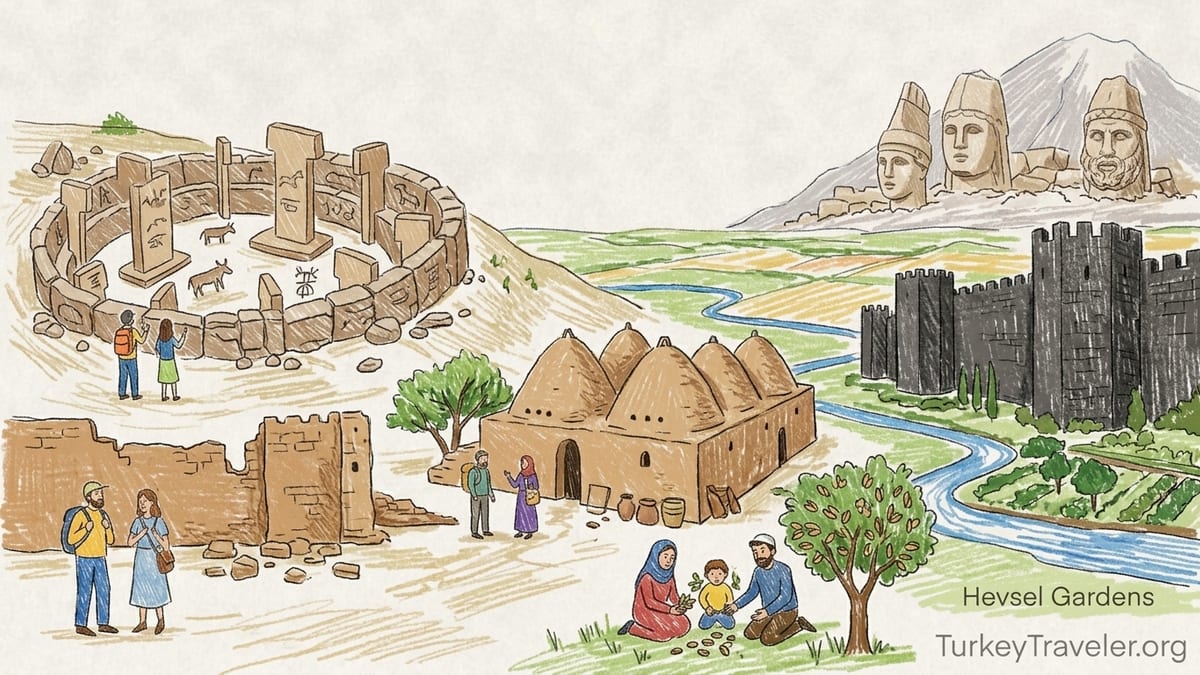
Look at a relief map of Türkiye and you see how Southeastern Anatolia forms a natural bridge between the Anatolian plateau and the river plains that run towards Syria and Iraq. Gaziantep, Şanlıurfa, Mardin and Diyarbakır sit on or above wide, dry plains, an area scholars describe as Upper Mesopotamia and part of the historic Fertile Crescent. This was among the first regions where wild grasses were domesticated and settled life emerged, which is why sites like Göbeklitepe near Şanlıurfa, with T-shaped stone pillars dating back to the 10th–9th millennia BCE, have reshaped the story of how and where organized ritual began.
You feel that deep time not only at archaeological sites, but in today’s cities. In Diyarbakır, black basalt walls and the cultivated Hevsel Gardens below them tell of a city that has been provisioned from the same river terraces for thousands of years. In Harran, beehive houses echo older building traditions adapted to scorching summers on the plain. Yet this is not a museum region. Local life continues in busy bazaars, pistachio orchards, mosques, churches and monasteries that sit beside or on top of much older layers, giving first-time visitors the sense of moving through a living landscape rather than a sealed-off heritage park.
For travelers, the Upper Mesopotamian setting has practical consequences. The semi-arid climate means fierce sun in summer and cool, sometimes snowy winters, so timing matters. Distances between the main cities are significant but manageable, generally two to four hours by car on modern highways between Gaziantep, Şanlıurfa, Mardin and Diyarbakır. With some planning, you can anchor yourself in a handful of bases and day trip to world-class sites instead of packing and unpacking every night.
Gateways, Airports and How to Get Around
Most first-time visitors arrive via Istanbul, which offers frequent domestic flights to the region. Gaziantep Oğuzeli International Airport, usually listed as GZT, is the most convenient entry point if you want to start in the west around Gaziantep and Halfeti. From Istanbul, flight times are around 1 hour 45 minutes to 2 hours. Sanlıurfa GAP Airport, with IATA code GNY, serves Şanlıurfa, Göbeklitepe and Harran and sits roughly a 30 to 40 minute drive from the city center in normal traffic. Mardin and Diyarbakır also have their own airports, making open-jaw itineraries easy, for example flying into Gaziantep and out of Mardin or Diyarbakır.
On the ground, highways are generally in good condition, and driving is the most flexible way to link dispersed sites. As an example, Gaziantep to Halfeti takes around 1.5 hours by car, while Gaziantep to Şanlıurfa is roughly 2 hours. Şanlıurfa to Göbeklitepe is about 30 minutes by road, and from Şanlıurfa down to Harran village you should budget around 45 minutes to an hour. Continuing east, Şanlıurfa to Mardin is around 3 hours, Mardin to Midyat around an hour, and Mardin to Diyarbakır about 2 hours depending on traffic and roadworks.
For travelers who prefer not to self-drive, intercity buses link the main cities with multiple departures daily, and local tour agencies in Gaziantep, Şanlıurfa, Mardin and Diyarbakır sell day trips to headline sites such as Göbeklitepe, Mount Nemrut and the stone houses of Midyat. As a benchmark, a small-group day tour from Şanlıurfa to Göbeklitepe and Harran might cost the equivalent of 40 to 80 US dollars per person depending on group size and inclusions, while a private driver for a long day loop from Mardin to Midyat and back may run higher. Taxis can be arranged for half or full days at negotiated rates, but confirm whether fuel and waiting time are included.
Climate, Best Seasons and Practical Packing
Southeastern Anatolia has a pronounced continental and semi-arid climate. Summers, especially July and August, are extremely hot on the plains around Şanlıurfa and Diyarbakır, with daytime highs regularly well above 35 degrees Celsius and occasionally higher. Winters can be surprisingly cold, and cities like Diyarbakır do see snow some years. Spring and autumn are therefore the most comfortable times to visit. Late March to early May brings mild temperatures and some green on the steppe after winter rains, while late September through early November offers warm days and cooler nights after the peak summer heat has passed.
Climate also shapes the daily rhythm of travel. In summer, locals often avoid the midday sun, especially in exposed places like Göbeklitepe or the basalt walls of Diyarbakır. You may find it more pleasant to visit outdoor sites in the early morning or late afternoon, then retreat for a long lunch or rest at midday. Dress codes are generally relaxed but modesty is appreciated, especially when entering mosques or Christian monasteries. Lightweight long sleeves, a hat, sunglasses and high-SPF sunscreen are more practical than shorts and tank tops in the intense sun. In shoulder seasons, a light jacket is useful for cool evenings in Mardin’s old town or breezy viewpoints on Mount Nemrut.
Dust and strong light are also part of the experience. Travelers who plan to photograph sites like Harran’s beehive houses or the sculpture terraces on Mount Nemrut often appreciate a lens cloth, a polarizing filter and a lightweight scarf to protect from windblown grit. Comfortable walking shoes with good grip are essential because many archaeological sites combine smooth stone, loose gravel and uneven steps. Even in cities, some of the most atmospheric streets, such as the stepped lanes of old Mardin, are best explored on foot, and you can easily cover several kilometers in a day without realizing it.
How Many Bases You Really Need
With limited time, you do not need to sleep in every city. For most first-time visitors, two or three main bases are enough for the circuit from Gaziantep to Diyarbakır. One practical structure for a week to ten days is to use Gaziantep as a western base, Şanlıurfa as a central base for Göbeklitepe and Harran, and either Mardin or Diyarbakır as an eastern base to explore the stone towns and the Tigris. Each of these has a range of hotels from simple guesthouses to well-known international chains, plus lively dining scenes that make evenings enjoyable.
For example, you might spend two nights in Gaziantep to recover from your international flight, visit the Zeugma Mosaic Museum and sample the city’s famous baklava and kebab houses, with a side trip to Halfeti. Then move on for two or three nights in Şanlıurfa, giving yourself a full day for Göbeklitepe and another for Harran and the old city around Balıklıgöl, including the covered bazaars and historic mosques. Finally, spend two or three nights in Mardin, using one day for the steep, honey-colored lanes of the old town and another for Midyat and nearby monasteries.
If you have more time or a special interest, you can add a night in Adıyaman or Kahta to be close to Mount Nemrut for sunrise or sunset, or stay in Diyarbakır itself for two nights to explore its long city walls and the Hevsel Gardens along the Tigris River. Some travelers also base themselves in Diyarbakır and do a day trip to Mardin, but that makes for more time on the road and less in the old stones. Whichever configuration you choose, a realistic approach is to limit yourself to three overnight bases at most, especially if you prefer a slower pace with time for café stops and spontaneous detours.
Gaziantep, Halfeti and the Western Gateway
Gaziantep is the region’s most convenient western hub and one of Türkiye’s great food cities. The restored copper and spice bazaars in the city center pulse with pistachios, dried peppers and copperware. The Zeugma Mosaic Museum, one of the largest mosaic museums in the world, displays detailed Roman mosaics unearthed from villas at the ancient city of Zeugma, now partly submerged by dam waters on the Euphrates. Visiting here offers a visual prelude to the river landscapes you will encounter at Halfeti and near Mount Nemrut.
In practical terms, Gaziantep offers a modern feel, with shopping malls, international hotels and a busy airport. Yet a short taxi ride takes you into the old alleys around Yemeniciler Arastası, where you can try local specialties such as pistachio kebab, yuvalama soup and baklava from long-established patisseries. A typical dinner for two at a popular but not overly fancy kebab restaurant might cost the equivalent of 20 to 40 US dollars including shared meze, grills and soft drinks, more if you choose upmarket venues or imported alcohol.
Halfeti, about an hour and a half northeast by road, offers a different mood. Part of the old town lies partially submerged due to dam construction on the Euphrates, and boat trips glide past half-drowned minarets and stone houses clinging to the shore. Many travelers do Halfeti as a day trip from Gaziantep, combining a river cruise with a simple fish lunch on the water. The experience underlines how modern dams have transformed parts of Upper Mesopotamia while also bringing irrigation and electricity that support today’s cities.
Şanlıurfa, Göbeklitepe and Harran: Ritual Landscapes
Şanlıurfa, often shortened to Urfa, is the spiritual heart of the region and a natural base for exploring Göbeklitepe and Harran. In the city, the complex around Balıklıgöl features a sacred carp pool, mosques and gardens that draw local families and pilgrims throughout the day. Covered bazaars nearby sell textiles, spices, prayer beads and local cheeses. The atmosphere is distinctly Middle Eastern, with Arabic widely heard alongside Turkish and Kurdish, and evenings bring packed tea gardens and sweets shops around the main square.
About 18 kilometers northeast of the city center, Göbeklitepe sits on a low hill that once dominated the surrounding plain. Here, circular stone enclosures with T-shaped pillars carved from limestone are interpreted as communal ritual structures built by Pre-Pottery Neolithic communities long before pottery or metal. The site has been recognized as a UNESCO World Heritage property since 2018 and is carefully managed, with shaded walkways, explanatory panels and a visitor center. A visit typically takes two to three hours, including time to study the carvings of animals and abstract symbols on the pillars and to absorb the views over Upper Mesopotamia.
South of Şanlıurfa, Harran lies in the flat plain near the Syrian border. Its beehive houses, built from mud brick in conical forms that shed heat and allow ventilation, have become an architectural icon of the region. A typical day trip from Şanlıurfa combines Harran’s houses and ruined city walls with stops at smaller archaeological sites or traditional villages along the way. In Harran, families sometimes open parts of their houses as small cafés or demonstration spaces, offering tea on floor cushions and a look at how these structures work in practice during the hot months.
Mount Nemrut, Mardin, Midyat and Diyarbakır: Eastern Highlights
Mount Nemrut, though slightly off the main Gaziantep–Mardin–Diyarbakır axis, is one of southeastern Türkiye’s most unforgettable sites. The summit, over 2,000 meters above sea level, hosts colossal stone heads and seated figures commissioned by King Antiochus I of Commagene in the 1st century BCE. The site is inscribed on the UNESCO World Heritage List as part of the Nemrut Dağ complex and is especially famous at sunrise and sunset, when the scattered sculptures glow orange and the surrounding mountains fade into layers. Reaching the top requires a final walk on a steep gravel path, which can feel strenuous at altitude, so visitors often bring trekking poles or use the handrails, especially when descending in low light.
Further east, Mardin spills down a south-facing ridge in a cascade of sandstone houses. From the rooftop terraces and narrow lanes of the old town you look out across the Mesopotamian plain stretching into Syria, a view that makes the Fertile Crescent feel very real. Many boutique hotels in Mardin occupy restored stone mansions, with arched courtyards and carved facades that glow honey-colored at dusk. Spending two nights here allows time for slow walks through the bazaar, visits to historic mosques and churches, and rooftop dinners where local dishes like stuffed dried eggplants, bulgur pilaf and Syriac wines express the area’s mixed heritage.
Midyat, about an hour east of Mardin, offers a smaller, more concentrated version of similar stone architecture. Its old quarter features intricately carved houses and several Syriac Orthodox churches, some of which may be visited outside service times. Nearby monasteries, such as Mor Gabriel and Deyrulzafaran closer to Mardin, are active religious centers that welcome respectful visitors. Entry fees are modest, and guided explanations in Turkish or sometimes basic English help contextualize centuries of Christian life in a region now majority Muslim but historically diverse.
Diyarbakır, to the north of Mardin, anchors the region with its black basalt city walls and historic core clustered along the Tigris. The Diyarbakır Fortress and Hevsel Gardens Complex has UNESCO World Heritage status, recognizing both the formidable walls and the river-fed gardens that have supplied the city with fruit and vegetables over many centuries. Walking segments of the walls, visiting restored churches and mosques inside the old city, and then descending towards the green Hevsel terraces by the river all show how urban life and agriculture have been intertwined here since antiquity. Cafés with views over the river and gardens offer a convenient place to rest and watch local life, from children flying kites to farmers tending plots.
Food, Daily Life and Staying Grounded
Southeastern Anatolia is one of Türkiye’s richest gastronomic regions, and food is woven into daily life. Gaziantep is officially recognized for its culinary heritage, and its restaurants and sweet shops draw domestic food pilgrims. Dishes you are likely to encounter throughout the region include lahmacun topped with spicy mince, grilled skewers of lamb or chicken, içli köfte stuffed bulgur dumplings and a wide range of meze plates featuring chickpeas, lentils, eggplant and yogurt. Pistachios are omnipresent, from morning pastries to evening desserts, and local baklava, often eaten warm from the oven, sets a high bar for anywhere else.
Prices vary by venue, but visitors often note that everyday costs, such as simit and tea for breakfast or a plate of lentil soup and bread at a casual lokanta, can be relatively affordable compared with major Western European cities. On the other hand, specialty coffees, imported alcohol and fine dining experiences in boutique hotels can quickly reach prices more familiar from international destinations. Tipping in restaurants and for drivers is appreciated but not obligatory, with small cash tips often making a genuine difference to service staff in family-run establishments.
Daily rhythms reflect climate and faith. In hotter months, outdoor life shifts later, with families strolling and shopping after sunset when temperatures drop. You will hear the call to prayer from mosques in all the cities, and in more conservative neighborhoods people dress modestly, though visitors are not expected to cover their heads except when entering mosques, where both men and women should cover shoulders and knees and women are usually offered scarves at the entrance. In Christian monasteries and churches, modest attire and quiet behavior are likewise appreciated, and photography rules may vary, so always check with staff or signs before shooting interiors.
English is spoken in varying degrees in hotels, museums and some restaurants, especially in larger cities like Gaziantep and Diyarbakır, but less so in rural areas. Learning a few words of Turkish, such as please and thank you, helps smooth many interactions, and you may also hear Kurdish and Arabic in markets and shared taxis. Mobile data coverage is generally good along main routes, though signal can dip in some rural stretches. Carrying some cash in Turkish lira remains important since small cafés, village shops and minibus drivers may not accept cards, even if large supermarkets and hotels increasingly do.
FAQ
Q1. How many days should a first-time visitor spend in Southeastern Anatolia?
Most first-time visitors find that 7 to 10 days is enough to cover Gaziantep, Halfeti, Şanlıurfa, Göbeklitepe, Harran, Mardin, Midyat and either Diyarbakır or Mount Nemrut without rushing, using two or three main bases.
Q2. Is it better to rent a car or rely on buses and tours?
Renting a car offers maximum flexibility, especially for reaching Göbeklitepe, Harran and Mount Nemrut, but intercity buses and locally arranged day tours can work well if you prefer not to drive, particularly between Gaziantep, Şanlıurfa, Mardin and Diyarbakır.
Q3. When is the best time of year to visit this region?
Spring from late March to early May and autumn from late September to early November usually offer the most comfortable temperatures and clearer air, while summers can be extremely hot on the plains and winters can be cold and occasionally snowy.
Q4. Which city makes the best base for visiting Göbeklitepe?
Şanlıurfa is the most convenient base for Göbeklitepe, as the archaeological site is roughly a half-hour drive from the city center, and staying in town also lets you explore Balıklıgöl, the old bazaars and nearby Harran on separate days.
Q5. How physically demanding are the main archaeological sites?
Many key sites such as Göbeklitepe and the main mosaics in Gaziantep are relatively accessible via walkways, but Mount Nemrut requires a steep walk on gravel at altitude, and old town areas like Mardin and Diyarbakır involve stairways and uneven pavements, so sturdy shoes and a moderate fitness level help.
Q6. What kind of clothing should I pack for cultural and religious sites?
Pack lightweight, breathable clothing that covers shoulders and knees, along with a scarf that women can use to cover their hair in mosques, plus comfortable walking shoes, a sunhat and a light jacket for cooler evenings or higher elevations.
Q7. Are credit cards widely accepted, or do I need a lot of cash?
Credit and debit cards are widely accepted in hotels, larger restaurants and supermarkets in cities, but you should carry cash in Turkish lira for small cafés, market stalls, taxis, minibuses and entrance fees at some rural or smaller sites.
Q8. Can I visit all the UNESCO World Heritage sites mentioned on one trip?
Yes, it is realistic on a single trip to include Göbeklitepe near Şanlıurfa, the Diyarbakır Fortress and Hevsel Gardens complex in Diyarbakır, and Mount Nemrut in Adıyaman Province, provided you plan at least a week and are prepared for several overland travel days.
Q9. Is English signage common at museums and archaeological sites?
Major museums and sites such as the Zeugma Mosaic Museum, Göbeklitepe and Mount Nemrut usually provide information panels in Turkish and English, but in smaller sites or village settings you may find only Turkish, so a guidebook or translation app can be useful.
Q10. How safe is it to travel independently in Southeastern Anatolia?
Conditions can change, but many independent travelers report that the main cities and tourist routes feel welcoming and manageable, especially when following local advice, keeping an eye on current travel advisories and using common-sense precautions similar to those you would use in any unfamiliar region.