


From the moment I first saw Akdamar Island marked on a map of Lake Van, the place felt less like a stop on an itinerary and more like a destination with its own gravity. GoTürkiye calls Akdamar the largest island in Lake Van and spotlights the 10th century Church of the Holy Cross as its defining attraction, and that is certainly how most visitors first hear about it. Yet what stayed with me most was the whole sequence of the visit: the drive along the lakeshore, the slightly improvised feel of the pier at Gevaş, the short but atmospheric boat crossing, and then stepping onto a rocky Armenian island whose church once served as a royal and religious seat in historic Vaspurakan. This is what my trip was really like, in practical detail and with the respect the monument and its heritage deserve.
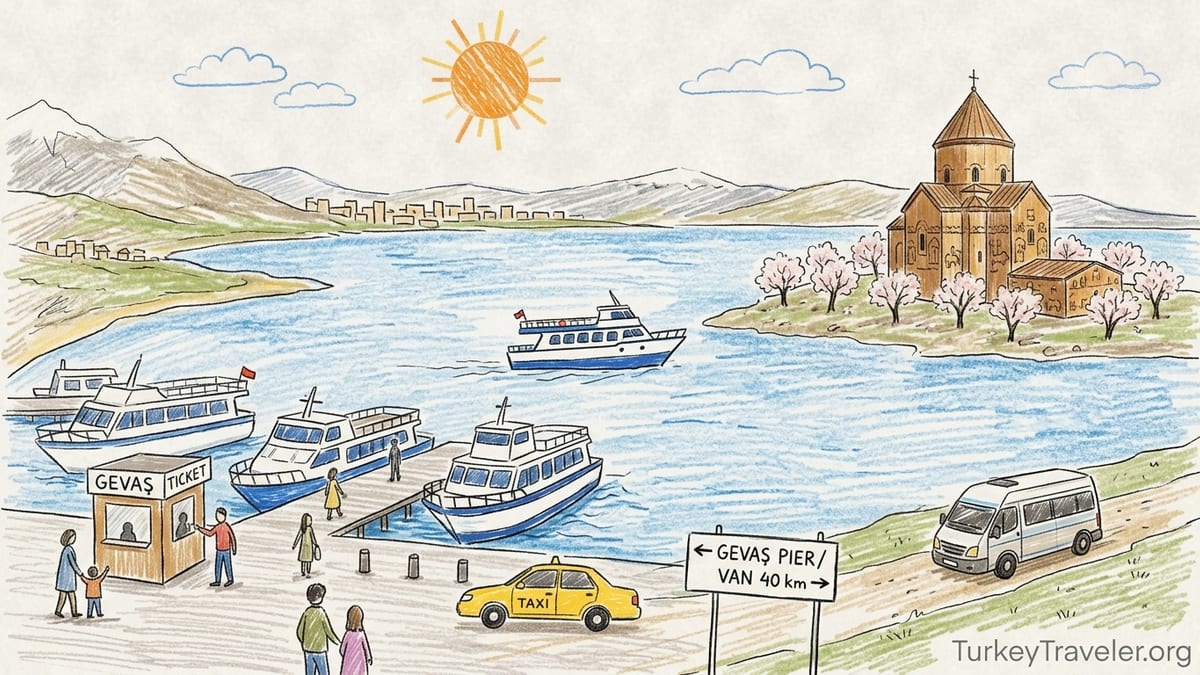
Getting From Van to the Gevaş Pier
My Akdamar visit started in central Van on a clear spring morning, with the city already buzzing after the legendary breakfast salons had emptied their last tea glasses. Akdamar lies off the shore of Gevaş, about 40 kilometers southwest of Van, so the first step was reaching the lakeside pier. I chose the most common option for independent travelers: a dolmuş, or shared minibus, from the Van city center toward Gevaş, then a short taxi hop to the pier. Dolmuşes for Gevaş leave from the area near the old city and main minibus stands, and on the day I traveled departures were frequent, roughly every 20 to 30 minutes, filling and leaving rather than running on a strict clock.
The ride out of Van followed the southern shore of Lake Van, the water on my right a metallic blue strip that kept widening as concrete gave way to low, scattered villages. About 40 minutes later we were dropped along the highway near Gevaş. From there, a couple of yellow taxis were waiting and knew exactly why foreign travelers had appeared. I shared one with two other visitors and we agreed the fare up front, a short five minute drive down a side road to the pier. For travelers who prefer less improvisation, local tour agencies and some Van hotels offer half-day Akdamar excursions in small groups, bundling this transfer, the boat ticket and sometimes a basic guiding service.
If you go by self-arranged transport, it is worth building a time buffer into your plan. Traffic on the Van ring road can be slow at peak hours, and dolmuş drivers may take detours to fill seats. On my visit I left Van around 9:00 in the morning and reached the pier just after 10:00, which gave me some flexibility with boat departures. The road is paved and in decent condition, but it is a genuinely rural stretch; there were long moments where the only fellow travelers seemed to be shepherds and the occasional long-distance truck grinding past.
Arriving at the Gevaş pier the atmosphere shifted from countryside to low-key lakeside resort: kiosks selling tea and snacks, a simple ticket booth, and a line of white-and-blue boats rocking gently against the dock. This is where the Akdamar trip really begins to feel like an outing of its own rather than a transfer to a sight.
Boat Tickets, Crossing Times and Lake Conditions
At Gevaş the process is straightforward. There is a small building functioning as the ticket office for the scheduled boats to Akdamar Island. When I visited, the standard round-trip boat fare for an adult was posted at roughly a few hundred Turkish lira per person, with children at a reduced rate. Prices on Lake Van have risen several times in recent years due to inflation, so it is essential to check the current board at the pier or confirm with your hotel in Van the day before you go. Payment was in cash in Turkish lira; cards were not accepted at the ticket window when I traveled.
Boats depart whenever enough passengers gather rather than on a rigid timetable, although crews broadly cluster departures in the late morning and early afternoon when most visitors arrive. On my trip in shoulder season, we waited about 25 minutes after buying tickets before our boat cast off, with roughly 30 passengers on board. In high summer and on weekends, departures are more frequent, and several boats can be loading at once. The posted crossing time is about 20 to 25 minutes each way, and my experience matched that: just over 20 minutes from pushing off at Gevaş to touching the small jetty on Akdamar.
The boat itself was a two deck vessel with indoor seating below and open benches on the upper deck. Lake Van has its own character; it is saline and slightly alkaline rather than fresh, with a flat, richly colored surface that can look almost metallic under strong sun. On my crossing the lake was calm, a soft wind ruffling the wake. Local operators are cautious about setting out in rough conditions, especially during sudden afternoon winds outside the summer months, so there may be delays or cancellations in bad weather, but most visitors in the warmer half of the year find the ride smooth. Sitting on the open deck, I could see the hazy line of the opposite shore and the foreshortened silhouette of Akdamar gradually resolving into a real island, the profile of the church rising just above a scatter of almond trees.
One practical point surprised me: the schedule on the island side. For our group, the crew announced as we disembarked that the boat would depart back to Gevaş in 90 minutes and emphasized that this was a firm time. From what other travelers and the crew themselves explained, common visit windows are about 1.5 to 2 hours on the island before the same boat returns, though in busier periods some operators may let visitors return on a later boat from the same company. Either way, it is safer to assume you have about an hour and a half unless you have prearranged a private charter with flexible timing.
First Impressions: Landing on an Armenian Island
Stepping off onto Akdamar’s small concrete jetty, the first sensation was how close the island felt to the lake surface. The church does not tower overhead at that point; instead the island seems low, almost modest, with the path climbing gradually toward the main plateau. Only as you walk up from the landing does the building begin to dominate, its conical dome and warm tuff stone standing out against the blue of Lake Van behind it.
The official Turkish name is Akdamar Adası, but historically in Armenian it is known as Aghtamar or Akhtamar, and for centuries it was not simply a remote monastery but part of the cultural and political heartland of medieval Armenian kingdoms. The Church of the Holy Cross, completed in the early 10th century, served as a palatine church for the kings of Vaspurakan and later as the seat of the Catholicosate of Aghtamar, one of the highest ranks in the Armenian Apostolic Church. That context matters. Walking up the path lined with low shrubs and almond trees, it is worth remembering that this rocky island once anchored royal processions, theological debates and liturgies in classical Armenian, not just day-tripping camera lenses.
Even on a relatively quiet weekday, I was far from alone. School groups from Van and nearby towns spilled along the path, their guides mixing Turkish explanations with the occasional Armenian name. Domestic tourists posed for photos with the church and Lake Van in the background, and a few international visitors moved slower, lingering at the informational panels. Yet the island did not feel crowded in a theme-park sense. Outside peak holiday periods, people disperse quickly between the shoreline, viewpoints and the paths around the church, and there is enough space to step aside and take in the scene quietly.
From my first elevated vantage point, I noticed how the island is not just a pedestal for the monument. It is a rocky, layered landscape with gentle rises and drops, wildflowers in the spring and almond trees that famously bloom in early April, briefly surrounding the church with pale blossoms. The horizons are broad. To the south and west the darker shapes of surrounding hills and distant mountains frame the lake, while to the north the expanse of water stretches toward Van. The relationship between this larger landscape and the church would shape how I later felt about what the “main” highlight of Akdamar really was.
Exploring the Exterior Reliefs of the Church of the Holy Cross
If the boat journey is about space and scale, the first close contact with the Church of the Holy Cross is about detail. The church’s exterior is famous for its carved reliefs, and walking clockwise around the building turns into a kind of stone storyboard in low relief. Built in the 900s under the patronage of King Gagik I Artsruni and designed by the architect Manuel, the church walls are clad in biblical scenes, royal images and decorative bands that blend Christian narratives with local artistic traditions.
On the western facade, for example, I could pick out a large scene of Jonah being swallowed by a sea creature, the prophet almost cartoonlike yet dignified in his carved robes. Nearby, David faces Goliath, the giant towering but already in a moment of defeat. There are also scenes from the life of Christ, including the Nativity and the Entry into Jerusalem, alongside Old Testament stories. The carvings are not as razor sharp as in older archive photos, but many figures remain remarkably legible despite a millennium of weather and more recent history.
Interspersed with these narratives are rows of animals, vines and fantastical creatures: lions, birds and grape clusters that echo motifs seen in other medieval Armenian churches. A band of Armenian inscriptions runs along parts of the exterior, and even if you do not read the script, its presence asserts plainly that this is an Armenian ecclesiastical space. Information panels around the church describe some of the scenes and usually mention Armenian names and dates, though some visitors of Armenian heritage have noted that on-site signage still understates aspects of the building’s Armenian context. As a visitor, I found the panels useful but supplemented them with prior reading to fully appreciate what I was seeing.
Practically speaking, to do justice to the exterior reliefs you need at least 30 to 40 minutes outside the church. The light also matters. In the morning, the eastern and southern walls can be easier to study, while late afternoon brings the western facade into better relief. The day I visited was bright with thin clouds, which softened shadows just enough to bring out carvings without harsh contrast. It is one of those rare cases where a slightly overcast sky can be a gift to heritage travelers, even if it disappoints those looking for punchy blue-sky photos.
Inside the Church: Frescoes, Atmosphere and Crowds
The interior of the Church of the Holy Cross is more intimate than its fame might suggest. Stepping through the relatively low door, I entered a cool, high space where the eye is immediately drawn upward to surviving frescoes on the vaulted ceilings and dome. Many of these wall paintings have suffered over the centuries, with sections lost or heavily faded, but important fragments remain. I could make out Christ Pantocrator in the dome, ringed by angels, and below, bands of saints and prophets along the upper walls. Some lower areas preserve scenes from the Gospels, though in places the plaster has fallen away entirely.
The restoration and conversion of the church into a museum in the early 21st century was controversial among Armenians worldwide, particularly when it reopened without a cross on its dome and with limited explicit reference to Armenian religious life in some official narratives. Over time, a cross was reinstalled, and the site now serves both as a museum under Turkish administration and, on limited occasions, as a place of Armenian liturgy. That layered status is part of what gives the interior its particular charge. Visitors speaking Turkish, Kurdish, Armenian, English and Russian moved under the same paintings, which originally spoke in a single liturgical language to a defined community.
In practical terms, the interior visit is shorter than the time you will likely spend outside. Even pausing at length under several frescoes, I spent about 20 to 25 minutes inside. There is no formal guided route; people circulate more or less freely, though staff encourage a slow one way movement on busier days. Photography is allowed but flash is discouraged to help protect what remains of the pigments. When crowded, expect clusters of schoolchildren, domestic tour groups and a steady stream of independent travelers. I visited just before midday and found there was always a corner or archway where I could stand quietly for a minute or two, but the church never emptied.
The soundscape is part of the experience: low conversations, the soft echo of footsteps on stone and occasionally a guide raising their voice to point out a particular saint on the wall. At one moment, a member of a small Armenian group near me began quietly singing a hymn near the apse. It was brief and informal, but it shifted my perception of the church from an artifact to a space still capable of holding prayer. That is the intangible side of Akdamar that no schedule or price list can fully capture.
Facilities, Shade and the Realities of Visiting an Exposed Island
Akdamar’s compact size means facilities are limited but sufficient if you arrive prepared. Close to the pier area there are public toilets, basic but serviceable during my visit, with a small fee collected in cash. Near the same zone and along the main path you will usually find a couple of kiosks or small cafes selling bottled water, tea, soft drinks and simple snacks like chips and packaged biscuits. On busy weekends, an additional stall may appear with grilled items, but it is safest to treat food options as modest. I was glad I had brought my own sandwich and fruit from Van and used the island vendors only for drinks.
Shade is a real consideration. Apart from scattered almond trees and a few other low trees, much of the island’s path network is exposed. Around midday in late spring and summer the sun on Lake Van can feel punishing, especially with the reflected light off the water and the pale stone. The only reliably shaded indoor space is the church itself, which visitors naturally do not want to occupy solely for cooling down. A hat, sunscreen and a refillable water bottle are not optional extras here; they are the difference between a comfortable heritage visit and an exhausting slog. There are some benches and low walls where you can rest, but many are in open sun.
There is no accommodation on the island and no formal picnic infrastructure like covered gazebos. However, informal picnicking is common on the shore near the pier and at a few viewpoints. During my visit, families from Van had spread blankets on small flat patches, eating food they had brought from home and occasionally offering tea to passing travelers. The atmosphere felt relaxed rather than heavily regulated, though visitors are expected to respect the church grounds and avoid leaving any litter. Trash bins are available near the pier and main path.
In terms of time, the 90 minutes my boat allotted were just enough to walk from the jetty to the church, circle the exterior reliefs with some care, spend about 20 minutes inside, and then follow a short loop path out to a viewpoint overlooking Lake Van before descending. I did not feel rushed, but I also would not have minded an extra half hour. Travelers who are particularly interested in Armenian art and architecture might consider negotiating with a boat operator at Gevaş for a slightly longer island stop or, if in a group, chartering a boat with a custom schedule.
Landscape vs Monument: What Felt Like the Real Highlight
Before I went, I expected the Church of the Holy Cross to be the unquestioned centerpiece of my Akdamar trip, and in one sense it was. The reliefs are unlike anything else in this part of Türkiye, the frescoes still hint at their former richness, and the building’s history as a medieval Armenian royal and ecclesiastical center gives it a depth no simple lakeside chapel could claim. If your interest is in Armenian heritage, Byzantine era architecture or Christian art along the Silk Road routes, the church alone justifies the journey.
Yet walking the island’s perimeter path shifted my perspective. There are several spots where you can stand slightly above the church and look down at it framed by Lake Van and the mountains beyond. From one rocky outcrop, the dome and walls formed a compact ocher mass against water that changed from steel to turquoise as clouds moved. In those moments, the island landscape asserted itself as the equal of the monument, not just its backdrop. It felt less like I was visiting “a church on an island” and more like I was standing within a complete cultural landscape where geology, architecture and memory all intertwined.
There is also, unavoidably, a sense of absence. Akdamar once held not only the church but monastic and residential buildings that supported the Catholicosate, and the wider Lake Van basin was densely woven with Armenian villages, monasteries and castles. Today, only ruins and isolated monuments remain, and the living Armenian communities that animated them are largely gone. The calm beauty of the island sits over that history. Even if you arrive on a cheerful group tour, it is hard not to feel that contrast when you look out over the lake from the edge of the plateau, the wind strong enough to pull at your clothes while the stone walls behind you hold stories from a different world.
In practical travel terms, I left feeling that neither the church nor the landscape alone was the true highlight. It was the interplay between them, stitched together by the boat ride that set the island apart from the everyday rhythms of Van. If you only rush from jetty to church and back, you will see the famous reliefs, but you may miss the larger emotional register of the place.
Fitting Akdamar Into a Half Day From Van
Measured against the realities of itinerary planning in eastern Türkiye, Akdamar works well as a half day excursion from Van city. From my departure from central Van around 9:00 until my return around 14:30, the trip filled a little over five hours, including dolmuş and taxi transfers, waiting time at the pier, the boat crossings and roughly 90 minutes on the island. Travelers starting earlier could be back in Van by early afternoon in time to visit Van Castle for sunset or explore the city’s museums and lakeside promenade.
If you are moving at a slower pace or traveling with children, it may be more comfortable to consider Akdamar as the main anchor of your day and add only a light activity on either side, such as a stroll along the lake near Edremit or a relaxed multi course breakfast in Van before the trip. The combination of bright sun, wind exposure and boat motion can be tiring, especially at Lake Van’s elevation of around 1,640 meters, where visitors not accustomed to altitude may feel slightly more fatigued after climbing paths or stairs.
Costs for the total outing add up but remain manageable by European standards. Between the shared minibus, short taxi rides, round trip boat fare and the museum entrance ticket for the church itself, you can expect to spend the rough equivalent of a casual lunch in a mid range Van restaurant for one person, depending on current lira values and seasonal price adjustments. Families and small groups can keep costs lower by sharing taxis and possibly negotiating slightly better rates with boat operators if traveling outside peak times.
The main planning variables are season and day of the week. Weekends in spring, particularly during the brief almond blossom period, can be crowded with domestic day trippers and tours from elsewhere in Türkiye, leading to busier boats and less quiet space on the island. Weekdays and visits outside major holidays offer a noticeably calmer experience. Winter visits are possible, with snow on nearby peaks and fewer visitors, but boat operations may be more dependent on weather, and paths on the island can be slippery.
The Takeaway
Looking back, my Akdamar Island trip was not a single highlight but a sequence that unfolded with its own rhythm. The drive along Lake Van’s southern shore, the loose organization of the Gevaş pier, the short crossing on slightly alkaline water and the first glimpse of the church framed by almond trees all contributed to a feeling of stepping briefly into a separate world. This was not just another stop on a checklist of Van attractions; it was an encounter with a piece of Armenian heritage that has survived events and absences far larger than any single traveler’s story.
In concrete terms, Akdamar functions well as a half day excursion from Van. The logistics are simple enough for independent visitors, the time window on the island, while finite, is adequate to appreciate both the church and its setting, and the costs remain within reach for most international travelers. Facilities on the island are basic but acceptable if you bring your own water and snacks, and the lack of heavy commercialization around the church itself helps preserve a degree of dignity that the site deserves.
Did the boat journey justify the visit on its own? For me, yes. The sense of leaving the mainland, however briefly, amplified the significance of arriving at a church that once stood at the center of a medieval Armenian kingdom. Without the water crossing, Akdamar might risk being experienced as just another historic church. With it, the island feels like a distinct chapter in a Lake Van journey, where geology, history and present day Türkiye converge in a way that is both beautiful and quietly complicated.
For travelers willing to approach Akdamar with curiosity and respect, acknowledging its Armenian roots and its layered modern status, the island offers far more than a backdrop for social media posts. It is a place where reliefs carved more than a thousand years ago still catch the changing light off Lake Van, and where a 20 minute boat ride can carry you not only across water, but also, briefly, into another historical and emotional register within contemporary eastern Türkiye.
FAQ
Q1. How do I get from Van city to the Akdamar Island boat pier?
Most independent travelers take a shared minibus from central Van toward Gevaş, then a short taxi ride from the main road down to the lakeside pier where boats depart for Akdamar.
Q2. How often do boats run to Akdamar Island and how long is the crossing?
Boats usually depart whenever enough passengers gather, with more frequent trips late morning and early afternoon; the crossing itself typically takes about 20 to 25 minutes each way.
Q3. How much time do visitors usually have on Akdamar Island?
Standard boat services generally allow about 90 minutes on the island before the same vessel returns to Gevaş, which is enough for a focused visit but can feel tight for in depth exploration.
Q4. What are the current ticket prices for the boat and the church?
Round trip boat fares and the museum entrance fee for the Church of the Holy Cross are posted at the pier and can change with inflation, so travelers should check the latest prices locally in Van or at Gevaş before visiting.
Q5. Is there shade, food and drinking water available on the island?
Shade is limited to a few trees and the church interior, but there are simple kiosks near the pier selling bottled water and snacks, so it is wise to bring your own water and some food from Van.
Q6. Are there toilets and other basic facilities on Akdamar Island?
Yes, there are basic public toilets near the pier area, usually with a small cash fee, along with trash bins, a few benches and informal picnic spots, but no accommodation or extensive services.
Q7. How crowded does the Church of the Holy Cross get and when is it quieter?
The church can be busy with school groups and domestic tourists on weekends and during spring blossom season, while weekday visits outside holidays tend to be noticeably calmer and more contemplative.
Q8. Is photography allowed inside the Church of the Holy Cross?
Photography is generally permitted inside, but visitors are asked to avoid flash to protect the remaining frescoes, and to be considerate of others who may be praying or reflecting quietly.
Q9. How should I approach Akdamar’s Armenian heritage as a visitor?
Recognize that the church is a medieval Armenian Apostolic monument and former seat of the Catholicosate, read available information panels carefully, and treat the site as a place of cultural and religious significance rather than just a photo backdrop.
Q10. Does Akdamar Island work as a half day trip and what else pairs well with it in Van?
Akdamar fits comfortably into a half day from Van, and many travelers combine it with an early Van breakfast and a late afternoon visit to Van Castle or the lakeside promenade back in the city.