


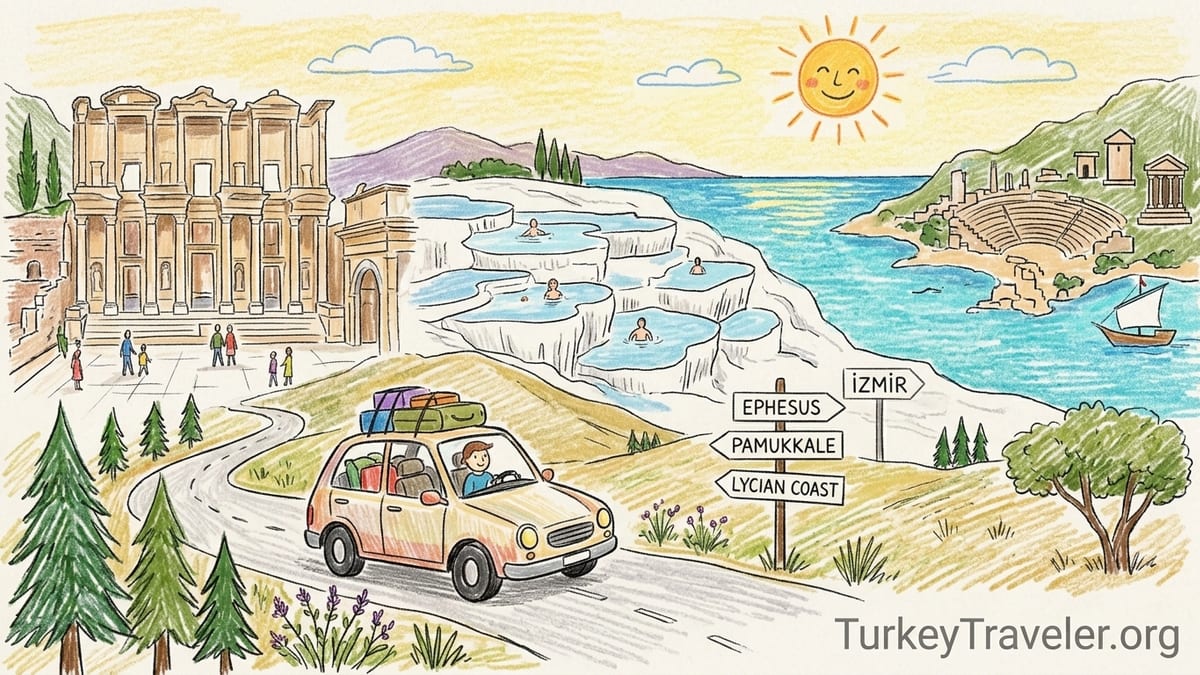
Western Turkey is one of the few places on earth where you can drive from one ancient city to the next and still be back at a beach hotel by sunset. Between İzmir and Antalya, marble streets, Roman theatres and Lycian tombs line the valleys and coast. This itinerary turns that density of ruins into a practical 10 to 12 day road trip, starting in İzmir, dropping south through Ephesus and Pamukkale, and finishing on the turquoise bays of the Lycian Coast, with clear guidance on driving times, heat, tickets and how long to spend at each site.
Planning Your Western Turkey Archaeology Road Trip
Most travelers will arrive at İzmir Adnan Menderes Airport, which has frequent domestic connections from Istanbul and Ankara and seasonal direct flights from several European cities. Car rental desks at the airport include recognisable brands such as Avis, Enterprise and local firms like Garenta. For a 10 to 12 day trip covering Ephesus, Pamukkale and the Lycian Coast, a compact or midsize car with good air conditioning is sufficient. Manual transmission is common, but automatics can be reserved if booked in advance, especially in peak months from June to September.
Turkish highways along this route are generally well maintained divided roads, with toll motorways between İzmir and Aydın and standard highways further south. Speed limits are usually 90 km/h on open roads and 50 km/h in towns. The core route for this itinerary runs İzmir to Selçuk, on to the Meander Valley around Aydın and Denizli, then southwest toward Fethiye and along the Lycian Coast to Antalya. Fuel stations appear regularly on major roads, often combined with simple restaurants and clean toilets that make convenient refresh stops in the heat of the day.
For archaeological enthusiasts, the main planning question is how long to allocate to each ancient city without turning the trip into a race. This article treats Ephesus, Aphrodisias, Pamukkale and Xanthos plus Letoon as full or near full days, while sites like Priene, Miletus, Patara and Phaselis work well as half day or shorter combined stops. Families or casual visitors can shorten some visits or end their trip at Pamukkale, while serious enthusiasts might add a northern loop to Pergamon and Sardis before dropping south.
Summer temperatures in western Turkey regularly exceed 30 degrees Celsius from late June through early September, with mid afternoon peaks often higher inland near Pamukkale and Laodicea. Plan most site visits for early morning or the last three hours before closing, carry at least 1.5 liters of water per person for each major visit, and expect little shade at stadiums, theatres and hilltop acropolises. Light clothing, hats and sunscreen are essential for all but winter trips.
Days 1–2: Ephesus and Selçuk, Where the Sea Used to Be
Start by driving about 60 kilometers from İzmir Airport to Selçuk, the modern town that serves as the base for Ephesus. The trip usually takes about one hour on the O-31 motorway and connected highways, with good signage to Selçuk and Kuşadası. Many travelers choose to stay in Selçuk itself at small guesthouses near the old town, which allow easy access to both Ephesus and the Basilica of St John, or in Kuşadası, about 20 minutes further, if they prefer a larger seaside resort with more restaurant choices.
Devote most of Day 1 to Ephesus and the Terrace Houses. The lower gate car park, used by independent drivers and small groups, is only a few minutes from Selçuk by car. Parking is paid but reasonably priced compared to European city centers, and attendants are used to visitors arriving throughout the day. In 2026, foreign visitors pay around 40 euros equivalent for entry to Ephesus, plus about 15 euros extra for the covered Terrace Houses section. These prices are published in lira, updated periodically, and were already set with increases announced for 2027 in September 2026, so always check the date of any tariff information at the ticket office or official boards.
Allow at least three to four hours for a standard visit, longer if you linger in the Terrace Houses with their remarkable frescoes and floor mosaics. Start early to walk the marble-lined Curetes Street before the main cruise ship crowds arrive from Kuşadası. The grand theatre, which could seat tens of thousands, looks out toward what was once a harbor. Over centuries, the Cayster River carried silt to the coast, gradually pushing the shoreline several kilometers away and leaving Ephesus stranded inland. That process of sedimentation, still visible as flat agricultural land between the site and the modern sea, turned a bustling port into a landlocked city and is one reason later trade shifted elsewhere.
Day 2 revolves around Selçuk itself. Begin at the Selçuk Archaeological Museum, where sculptures, reliefs and household items from Ephesus are displayed with context that can be hard to absorb on site, especially in the heat. Two to three hours is usually enough for a careful visit. Parking is easy on nearby streets or in small paid lots. Continue uphill to the Basilica of St John, whose ruined brick and marble walls frame views back to Ayasuluk Castle and across the plain. Finally, visit the fragmentary Temple of Artemis, once one of the Seven Wonders of the Ancient World. Today only a single re-erected column and scattered drums hint at its former size, but the stop takes only 20 to 30 minutes and helps complete the mental map of classical Ephesus spread across the valley.
Day 3: Priene, Miletus and Didyma in a Single Arc
On Day 3, drive around 80 kilometers from Selçuk to Priene, allowing about 1.5 hours due to narrower local roads inland from the main highway. Priene’s parking area sits below the site, with a short uphill walk through pines. Allocate around two hours here. Priene is an outstanding example of planned urbanism, with a rectilinear grid of streets laid out on terraces across a hillside, reflecting Hellenistic ideas of rational city planning. The theater, agora and residential quarter are compact and easy to grasp as a whole city, which makes it an excellent contrast to the more sprawling Ephesus.
From Priene, continue about 20 kilometers, roughly a 30 minute drive, to Miletus. The road crosses flat river plains that once helped make Miletus a maritime power. Two to three hours at Miletus allows time for the massive Roman theater, the baths of Faustina and a walk up to the remnants of the harbor area. Just as at Ephesus, sedimentation from the Meander River gradually cut Miletus off from the sea. Yet in its prime, this was a thriving trade and intellectual center, home to early philosophers like Thales and Anaximander who debated the nature of matter and the cosmos, inspired in part by the city’s outward looking seafaring culture.
Finish the day by driving about 25 kilometers, usually 30 to 40 minutes, to Didyma. Here, the focus shifts to religious architecture rather than urban planning. The Temple of Apollo at Didyma formed part of an oracle complex linked by a sacred way back to Miletus. Visitors today park near the edge of the village and reach the temple within minutes. One and a half to two hours is generally enough. The colossal columns and partially preserved cella walls focus almost entirely on the sanctuary itself rather than a city. The contrast between Priene’s rational street grid, Miletus’s harbors and markets, and Didyma’s towering religious space crystallises three different facets of classical life in a single driving loop.
Meal planning on this circuit benefits from timing a late lunch or early dinner at a roadside lokanta between Miletus and Didyma, where simple grilled meats, vegetable stews and rice are served all afternoon. In high summer, use the middle of the day for shaded meals and driving, concentrating your site walking before 11:00 and after 16:00 to avoid the hottest hours.
Day 4: Aphrodisias, A City of Beauty and Stone
From the Meander plain, head inland to Aphrodisias, one of the most rewarding sites in western Turkey and easily a full day stop for enthusiasts. The drive from the Miletus or Didyma area to Aphrodisias is approximately 180 to 200 kilometers and usually takes three to three and a half hours, passing near Nazilli and then turning southeast into the hills toward Geyre village. Many travelers choose to overnight in the nearby town of Nazilli or continue later to Denizli after their visit, but a slower option is to stay in simple guesthouses around Geyre for a quieter rural base.
Parking at Aphrodisias is in a dedicated area about one kilometer from the entrance, connected by a shuttle tractor-train or a shaded walking path. Plan at least four hours on site, more if you are an archaeology enthusiast. The Tetrapylon, an elaborate four way gate of carved marble, marks a ceremonial entrance into the city and is one of the site’s signature viewpoints. Beyond it, the Sebasteion preserves a unique complex of reliefs that blend imperial Roman ideology with local traditions centered on the goddess Aphrodite, giving unusually rich insight into provincial political messaging.
Aphrodisias also boasts one of the best preserved ancient stadiums anywhere in the Mediterranean, stretching more than 200 meters and seating tens of thousands. Walking the length of the stadium in the afternoon heat can be tiring, so many visitors opt to rest high under the stone seating where breezes move more freely. The on site museum, housed in a modern building close to the ruins, displays finely carved statues by the city’s renowned sculptors, whose workshops supplied high quality marble work across the Roman world. At least an hour should be reserved just for the museum.
For meals, there are modest cafes near the parking area that serve gözleme (savory flatbreads), salads and tea. However, choice is limited compared with larger towns. If you have dietary restrictions or are traveling with children, consider bringing snacks or a simple picnic from Nazilli or Denizli. Heat can be especially intense in the central part of the day inland, so carrying sufficient water and taking advantage of any shaded courtyards around the museum is important.
Day 5: Laodicea, Hierapolis and Pamukkale Without the Rush
Drive from Aphrodisias toward Denizli and Pamukkale, a distance of about 120 to 130 kilometers that usually takes two to two and a half hours. Base yourself in a hotel either in Pamukkale village, which sits directly below the famous travertine terraces, or in Denizli city, roughly 20 minutes away by car, where larger business style hotels offer more facilities. For a balanced Day 5, plan Laodicea in the morning and Hierapolis and the Pamukkale terraces from mid afternoon into early evening, rather than trying to squeeze all three into a short window.
Laodicea lies about 10 kilometers from Denizli and offers convenient parking right next to the visitor facilities. Two to three hours gives time to explore its expanding excavations, which have revealed colonnaded streets, churches and a stadium. Laodicea is still more of an active dig than a polished showpiece, but that can appeal to travelers interested in seeing archaeology in progress. Surfaces here can be dusty and exposed, so early morning visits are best in summer, with hats and water essential.
After a break for lunch in Denizli or Pamukkale village, head up to Hierapolis and the Pamukkale travertines. Allow at least four hours to combine the archaeological site, its well preserved theatre and necropolis, with time on the travertine pools. Cars are usually parked at one of the official entrances, from which visitors follow designated paths. The hot springs were channelled in antiquity to feed both baths and cascade over the hillside, depositing the calcium carbonate that built the white terraces. Today, some sections are protected while others remain open for paddling, so families can alternate cultural exploration with short spells in the warm water.
Because Pamukkale is a major stop for domestic tours and international bus groups, ticketing and crowd patterns can change. A combined ticket for Hierapolis archaeological site and access to the travertines is standard, and optional extra fees apply for swimming in the so called antique pool among submerged columns. As with Ephesus, entrance fees are published in lira and adjusted periodically. MuseumPass options may cover Hierapolis and Laodicea, but travelers should check current lists at the time of purchase, since coverage can change between seasons and some attractions, including special pools, might be excluded.
South to the Lycian Coast: Xanthos, Letoon, Patara, Myra and Phaselis
From Pamukkale and Denizli, drive southwest about 230 to 250 kilometers to Fethiye, a journey of roughly four to four and a half hours on winding but scenic roads. Many travelers break the drive for lunch in smaller towns like Çameli, where roadside restaurants offer grilled trout and simple stews. Fethiye makes an ideal base for two or three nights, with a sheltered harbor, numerous hotels ranging from family run pensions to resort style properties, and a downtown of restaurants that stay open late into summer evenings.
From Fethiye, Xanthos is around 65 kilometers to the southeast, usually a 75 to 90 minute drive. The site has a small parking area beside the entrance. Xanthos was a key city of the Lycian League, and its combination of an acropolis, theater and distinctive pillar tombs makes it a highlight for those interested in non Greek, non Roman traditions within Anatolia. Two to three hours here is reasonable. The nearby sanctuary of Letoon, about 10 kilometers and 15 to 20 minutes away by car, can then be visited on the same day in roughly one to one and a half hours, focusing on its trio of temples and pools that reflect the religious heart of the Lycian region.
Patara, set behind long sand dunes, lies roughly 40 kilometers from Xanthos and combines beach and ruins, making it a flexible stop for families. The drive takes about 45 minutes. Parking is available near the entrance, from which visitors access both the archaeological area with its theatre, bouleuterion and city gate, and the beach further on. Allocate at least two to three hours if you plan only a short swim and a quick exploration of the monumental core, or a longer half day if you want extended time by the sea. In summer, many travelers choose to explore the ruins in the late afternoon, then walk to the beach for sunset, when temperatures ease and the sand is more comfortable underfoot.
Continuing east, Myra sits near the modern town of Demre, about 120 kilometers and around two and a half hours’ drive from Fethiye or one and a half hours from Patara. Its cliffside Lycian rock cut tombs and Roman theatre can be visited in about one and a half to two hours. Parking is typically in paid lots near the entrance, with short walking distances that suit families. From Myra, it is a further 130 kilometers, generally two to two and a half hours, to Phaselis, which lies between Kemer and Antalya. Phaselis occupies a coastal peninsula where three small bays once formed natural harbors. Visitors today combine walking the Roman street lined with ruins, exploring the theatre and aqueduct remains, and swimming in the shallow, clear water. Two to three hours is usually enough, though some travelers bring picnics and stay longer.
Antalya Finale: Perge, Aspendos and Comparing Ancient Cities
Base your final nights in Antalya, about 60 kilometers from Phaselis and one of Turkey’s largest coastal cities. The old town of Kaleiçi, with its restored Ottoman houses converted into boutique hotels and pensions, offers atmosphere and easy evening dining on pedestrian streets. Larger resort hotels line beaches to the east and west if you prefer full service facilities. Antalya Airport handles both domestic flights and frequent international services, making it a convenient endpoint for this west to east road trip.
Perge lies roughly 17 kilometers east of central Antalya, around a 25 minute drive, with a large parking area close to the entrance. Allocate at least two to three hours to walk its long colonnaded street with central water channel, extensive bath complexes and city walls. Perge is a good place to think about urban planning and water management in Roman era cities. The visible remains of its baths and aqueducts show how communities in this semi arid landscape invested in infrastructure to move and recycle water. In summer, many visitors choose to visit Perge in the morning, then retreat to Antalya for lunch and a rest during midday heat.
Aspendos is about 45 kilometers east of Antalya, typically a 45 minute drive, and is best known for its remarkably intact Roman theatre. Parking sits at the base of a short hill leading up to the theatre. One and a half to two hours on site is often enough for casual visitors, though enthusiasts may wish to explore remains of the nearby aqueduct and other structures on the plateau above. When comparing theatres along this journey, from Ephesus’s vast cavea to Xanthos, Myra and Aspendos, the latter stands out for its near complete seating, stage building and continued use for performances, illustrating the longevity of Roman design.
Comparing the cities of this route as a whole highlights different solutions to shared problems. Ephesus, Laodicea and Perge demonstrate careful orthogonal street plans adapted to varied terrains. Aphrodisias and Hierapolis emphasise the social role of stadiums, baths and sanctuaries in provincial life. Aqueduct remains at Perge and Aspendos show how water was captured and delivered, while the inland shift of Ephesus and Miletus’s harbors underlines the vulnerability of maritime trade hubs to environmental change. As you drive between them in air conditioned comfort, it is worth reflecting on how ancient travelers once moved along the same corridors at a far slower pace.
Ticketing, MuseumPass Options and Shorter or Longer Variations
Ticketing across these sites is managed by national authorities, with fees stated in Turkish lira and periodically updated. Foreign visitors often think in euros or dollars, but actual payment at the gate usually occurs in lira, whether in cash or by card. In 2026, for instance, Ephesus entry for foreign visitors sits around the equivalent of 40 euros, with the Terrace Houses inside the site costing about 15 euros extra. These amounts fluctuate with exchange rates and domestic inflation, and official communications have already announced that certain tariffs will rise again in 2027, with those changes publicized as early as September 2026. For this reason, travelers should always note the date of any quoted price and confirm again closer to travel.
MuseumPass cards sold in Turkey provide multi day access to many state run museums and archaeological sites. There are versions for specific regions, such as MuseumPass Aegean, and nationwide variants valid for longer periods. On a 10 to 12 day itinerary including Ephesus, Aphrodisias, Pamukkale, Xanthos, Patara and Perge, a regional pass can quickly become cost effective for individual travelers and couples, especially if they also plan to see urban museums in İzmir, Denizli or Antalya. However, coverage lists can change, and some add on experiences like the Terrace Houses at Ephesus or the antique pool at Pamukkale may not be included. It is important to check the current coverage and validity period when purchasing and to keep purchase receipts or digital confirmations handy.
For travelers with less time, a seven day version of this itinerary can end around Denizli and Pamukkale. In that case, plan Days 1 and 2 in Selçuk and Ephesus, Day 3 at Priene, Miletus and Didyma, Day 4 driving to and exploring Aphrodisias, and Days 5 and 6 based around Laodicea, Hierapolis and Pamukkale, with Day 7 reserved for a relaxed return to İzmir or a domestic flight from Denizli to Istanbul. This shorter route still offers a strong mix of harbor cities, planned towns and sanctuary complexes, with less total driving.
Enthusiasts with two full weeks can add a northern extension before heading south from İzmir. From the airport, drive first to Bergama to explore ancient Pergamon, about 110 kilometers or two hours away. Pergamon’s steep theater clings to a hilltop acropolis that contrasts strikingly with the flatter plans of Ephesus and Laodicea. Allow most of a day here, including the Red Basilica complex in the lower town. From Pergamon, it is roughly 160 kilometers, or three hours, to Sardis near modern Salihli, another former capital city that combines a gymnasium complex, synagogue, and Lydian tumuli in its wider landscape. After at least half a day to a full day around Sardis, travelers can then turn southwest through the Gediz and Menderes valleys to meet the original route near Selçuk or directly toward Aphrodisias.
Family, Enthusiast and Bus Plus Guide Versions
Families traveling with children may wish to limit the number of sites per day and prioritise locations that blend ruins with natural features or water. For them, Ephesus still merits close to a full day when combined with the Terrace Houses and a gentle pace, while Pamukkale works well as another full day mixing Hierapolis with time in the travertine pools and perhaps the antique swimming area. Patara and Phaselis both offer soft landings, with beaches alongside compact ruins that can be explored in one to two hours. Priene, Miletus and Didyma can be compressed into shorter visits of about one hour each, focusing on a single highlight such as Priene’s theater, Miletus’s harbor view and Didyma’s temple courtyard.
Archaeology enthusiasts, on the other hand, might easily stretch Aphrodisias to a full day by reading inscriptions, sketching structures and spending extended time in the sculpture museum. Pergamon, if included, is another site that deserves almost an entire day between the acropolis, Asklepion sanctuary and lower town. Laodicea, with active excavations, could also expand to three or more hours for those interested in church architecture and late antique urbanism. For such travelers, it can be worth sacrificing one coastal swimming stop to create extra time at a site like Xanthos, whose inscriptions and tombs reward closer study.
Bus plus guide versions of this route are available from larger centers such as İzmir, Kuşadası, Pamukkale and Antalya, typically as day tours. For example, visitors based in Kuşadası might join a full day guided tour covering Ephesus, the Terrace Houses and the House of the Virgin Mary, returning to the same hotel at night without needing a rental car. From Pamukkale, agencies in the village and Denizli offer full day excursions that combine Laodicea, Hierapolis and winery or textile stops. In Antalya, widely marketed day trips bundle Perge, Aspendos and Side into one long day. While these packages simplify logistics and usually include transport, admission and lunch, they allow less flexibility in timing, which can be an issue in peak heat.
Whichever style you choose, it helps to sketch your days according to which sites demand the most time. Ephesus with Terrace Houses, Aphrodisias, Pamukkale with Hierapolis and Pergamon, if added, function best as full days or at least long partial days. Priene, Miletus and Didyma share one day well, as do Xanthos and Letoon, or Perge and Aspendos. Laodicea often works as a three hour morning complement to an afternoon at Pamukkale, while Myra and Phaselis can be slotted comfortably into shorter coastal driving days without feeling rushed.
The Takeaway
A 10 to 12 day road trip from İzmir to Antalya turns western Turkey’s dense archaeological landscape into a coherent journey linking coast, plains and mountains. Using Selçuk as a base for Ephesus gives time to understand how a once thriving harbor city ended up landlocked by silt. Driving inland to Aphrodisias highlights the artistry and political messaging of a provincial capital, while Pamukkale and Laodicea combine monumental architecture with striking natural settings. Continuing to the Lycian Coast and on to Antalya reveals different cultural traditions and ingenious uses of harbors and water infrastructure.
Practical details matter on this route as much as historical narratives. Distances often fall in the 60 to 250 kilometer range between key stops, with driving times from one to four and a half hours, which makes it possible to travel in the cooler parts of the day and walk sites in comfort. Ticketing systems, including individual admissions and MuseumPass options, continue to evolve, with specific prices and coverage lists tied to particular dates, especially after announced adjustments for 2027. Heat, parking and meal planning also shape the experience, from shaded taverns at inland junctions to sea facing restaurants in Fethiye and Antalya.
Whether you travel with children and favor shorter, mixed activity days, or plan the journey as a focused archaeological expedition, this corridor between İzmir and Antalya offers an unusual chance to compare multiple ancient cities side by side. You can stand in the stadium of Aphrodisias, the theatre of Aspendos and the grid of Priene in a single week, while evenings are spent at modern hotels and seaside promenades. Few regions reward such close reading of landscapes and ruins with equally rich modern comforts along the way.
FAQ
Q1: How many days do I really need for this road trip?Most travelers are comfortable with 10 to 12 days between İzmir and Antalya, which allows two days around Ephesus, one long day each at Aphrodisias and Pamukkale, and several shorter coastal days. A seven day version ending at Pamukkale works if you skip the Lycian Coast, while adding Pergamon and Sardis increases the itinerary to roughly 14 days.
Q2: Is renting a car essential, or can I rely on buses and tours?Renting a car provides the greatest flexibility for early starts and late finishes at archaeological sites, especially in summer heat. However, it is possible to stitch together public buses between İzmir, Selçuk, Denizli, Fethiye and Antalya, then join local day tours for places like Ephesus, Pamukkale, Perge and Aspendos. Travel will be slower and less flexible, but costs may be lower for solo travelers.
Q3: How hot does it get at sites like Pamukkale and Aphrodisias in summer?From late June through early September, midday temperatures inland often rise above 30 degrees Celsius, sometimes higher. Stone surfaces and open stadiums amplify the heat. Plan to visit major sites in the first few hours after opening or in the late afternoon, carry plenty of water, and wear hats and light clothing. Shoulder seasons in April, May, late September and October are more comfortable for extensive walking.
Q4: Are the Ephesus and Terrace Houses tickets included in MuseumPass cards?Coverage can change, but typically standard Ephesus entry is included in regional or national MuseumPass products, while the separate Terrace Houses section inside the site may require an additional ticket. Because entrance fees and coverage lists are updated periodically, and tariff changes for 2027 were already flagged in late 2026, travelers should check current details at purchase and note the date.
Q5: Which sites should I prioritise if I only have three or four days?If time is short, base yourself in Selçuk and spend a full day at Ephesus and the Terrace Houses, plus time at the Selçuk Archaeological Museum and Basilica of St John. Add one long day trip to Priene, Miletus and Didyma, and another to Aphrodisias. This trio of days offers a strong mix of urban planning, maritime history, oracle architecture and sculpture.
Q6: Are the roads in western Turkey safe for foreign drivers?Main highways between İzmir, Aydın, Denizli, Fethiye and Antalya are generally in good condition, with clear signage. Driving is on the right, and fuel stations are frequent. The main challenges for foreign drivers are adapting to local overtaking habits and staying alert on winding inland roads. Avoid night driving in rural stretches, keep within posted speed limits, and factor in extra time for slower trucks on mountain routes.
Q7: What kind of accommodation should I expect along this route?The route offers a mix of small guesthouses in Selçuk and Pamukkale, mid range city hotels in Denizli and Antalya, and resort or boutique options in Fethiye and on parts of the Lycian Coast. In high season, it is wise to book ahead in coastal towns and at Pamukkale. Families might prefer hotels with pools in Fethiye and Antalya, while enthusiasts may choose simple pensions in Selçuk or Bergama to be close to the ruins.
Q8: Can children enjoy this itinerary, or is it too focused on ruins?Children can enjoy the trip if days are paced carefully. Sites like Pamukkale, Patara and Phaselis offer water and beach time alongside ruins, breaking up purely archaeological visits. Shorter, focused stops at Priene or Didyma, plus shaded breaks and ice cream or snack stops in nearby towns, help maintain energy. Very long, sun exposed visits, such as full days at Aphrodisias or Pergamon, are best reserved for older children or split with pool or rest time.
Q9: How should I handle cash, cards and payments at the sites?Major ticket offices at Ephesus, Pamukkale, Aphrodisias and Antalya area sites usually accept international credit and debit cards, but smaller parking lots, rural cafes and souvenir stalls may prefer cash. Carry a modest amount of Turkish lira for parking, small snacks and tips. ATMs are found in larger towns like Selçuk, Denizli, Fethiye and Antalya. It is sensible to keep some coins on hand for paid toilets at fuel stations.
Q10: When is the best time of year to do this road trip?Spring, from April to early June, and autumn, from late September through October, are the most comfortable times, with mild temperatures and blooming or golden landscapes. July and August bring reliable sunshine but also higher heat and more visitors, especially at Pamukkale and coastal resorts. Winter travel is possible, with quieter sites and cool air, but some facilities in smaller coastal towns may operate reduced hours or close temporarily.