


The first time I saw Pamukkale’s white cliffs in real life, I was not standing in a steaming infinity pool. I was queuing at the South Gate ticket office, squinting into flat late-morning light, clutching 30 euros and wondering where the postcard version had gone. Below the turnstiles, the travertine slope looked more like a patchy chalk hillside than an endless staircase of turquoise basins. The water level was low, the brightest pools roped off, and dozens of visitors were already shuffling barefoot through a narrow, wet channel that felt more like a funnel than a dream. Within an hour, it was clear: Pamukkale’s famous white pools were nothing like the photos, and the real star of the day was the ancient city of Hierapolis spread out above them.
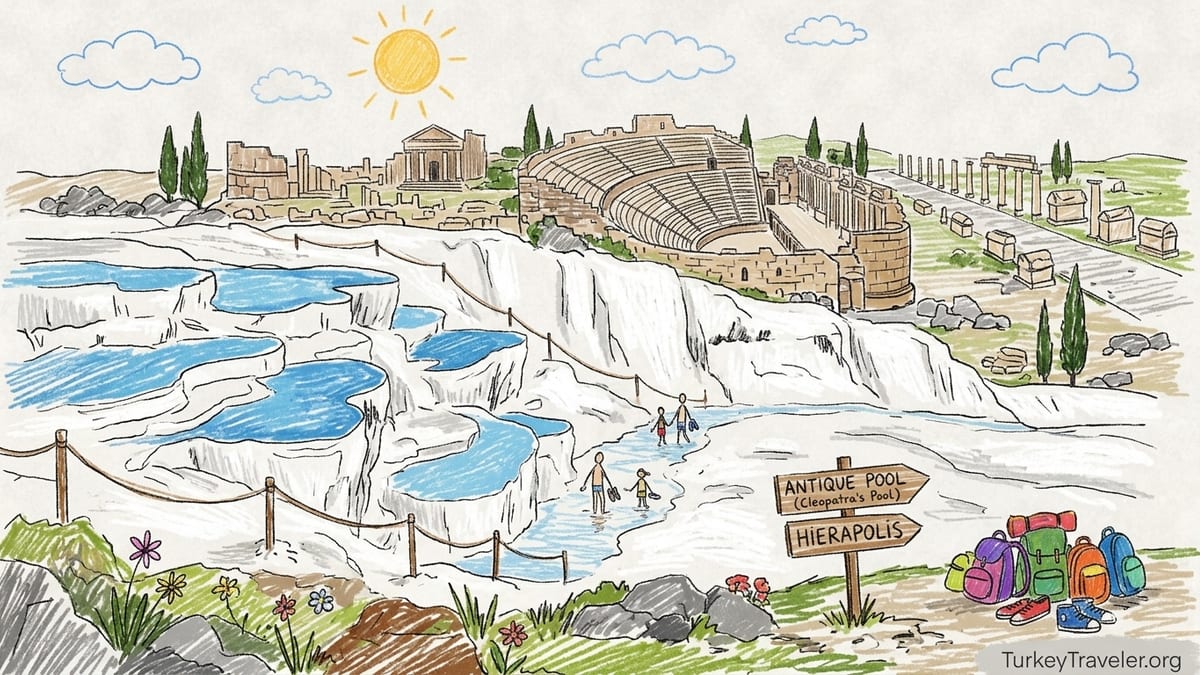
From Postcard Fantasy to the Real Entrance
Most glossy images of Pamukkale are taken at the upper travertine edge in soft sunset light, zoomed tight on a few blue basins with everything messy cropped out. My visit began somewhere far more prosaic: at the South Gate vehicle entrance, a cluster of parking lots, tour buses and souvenir stands on the plateau behind the cliffs. After paying the foreign visitor fee of 30 euros, which covers both Pamukkale and Hierapolis under a single ticket in late 2026, I walked through the turnstiles directly into an archaeological landscape of stone walls and dusty paths. The famed terraces were actually below me, out of sight.
There are three ways into this combined UNESCO site. The North Gate and South Gate both sit on the high plateau, reached by road and favored by tour buses. The pedestrian entrance starts at village level, beneath the cliffs, and leads you straight onto the travertine slope. Official provincial schedules in autumn 2026 put all entrances opening at 08:00, but with subtly different closing routines: the North and South gates close at 18:00, while the pedestrian access is shut an hour earlier, at 17:00, to allow staff to clear the walking path safely as light fades. Those details rarely appear in brochure copy, yet they shape every real itinerary.
My first glimpse of the cliffs came only after following signs downhill from the South Gate, past snack bars and the Antique Pool complex. There was no theatrical reveal of a glowing white amphitheater. Instead I saw a steep, chalky slope with a ribbon of shallow water running across it, the surface pitted and rough like a badly laid limestone patio. Under the harsh midday sun, the much-advertised “cotton castle” looked tired and slightly dirty, the upper crust of calcium carbonate interrupted by safety ropes, dry patches and clusters of people hunched over their phones, angling for that one shot that might still look like the brochure.
It was under this unromantic light that Pamukkale’s reality settled in. The cliffs are not a free-form infinity spa, and you do not simply wander from pool to pool. The site is a controlled environment where the flow of water and people is engineered to keep the travertine alive, even if that means shattering the fantasy many visitors have been sold.
What Those White Terraces Really Are
To understand why so much of Pamukkale looks “off” compared to Instagram, it helps to know what you are actually walking on. Pamukkale’s cliffs are made of travertine, a sedimentary rock formed when calcium-rich thermal spring water reaches the surface and begins to cool and degas. As the hot water from the plateau’s springs emerges, it carries dissolved calcium carbonate. Exposed to air, carbon dioxide escapes, and the calcium carbonate precipitates out, layering over time into soft deposits that harden into the bright white terraces.
Geologists describe the process as a finely balanced system. The water flows down a slope about 60 to 70 meters high, over a width of several dozen meters, constantly depositing new material. Left untouched, the calcium carbonate starts as a mushy, almost gelatinous film before consolidating into crust, then into the firm, ridged surfaces that shape the pools seen from the valley road. Disturb the film with too much trampling, soap, or diverted flow, and the balance collapses. Surfaces turn grey or brown, basins dry out, and the “cotton” of the castle becomes ordinary rock.
That is exactly what happened during decades of unregulated tourism in the twentieth century, when hotels were built directly on the terraces and vehicles were allowed to drive across the formations. UNESCO and Turkish authorities responded with drastic measures: demolishing hotels, closing roads, banning shoes on the active terrace path, and setting up a complex system of channels and sluices to rotate which pools receive thermal water at any given time. By 2026, large parts of the travertine face are essentially under life support, with artificially regulated flows and alternating wet and dry areas intended to let damaged sections regenerate.
This is where the gulf between marketing and reality opens wide. Those famous images of endless blue lagoons are snapshots of small, carefully watered zones taken at just the right angle and time of day. The broader slope is a working, recovering landscape. Some shelves are brilliant white and wet, others are crusty and dull, and several areas are completely closed to visitors. From a conservation point of view, this is essential. From an expectation point of view, it can feel like bait and switch.
Conservation First, Visitor Experience Second
The most striking difference between the fantasy and actual visit is how little of the travertine you are allowed to touch. Conservation rules in late 2026 are clear: no shoes, no sandals, no socks, and no swimming on the broad terraces themselves. Only a designated barefoot route, about a few hundred meters long, is open for paddling in shallow flowing water. The rest of the face is either dry, irrigated only for visual effect, or roped off entirely.
These restrictions are not the problem. They are the reason Pamukkale still exists at all. The issue lies with the way marketing materials, tour brochures and social media influencers continue to push outdated images of people floating in secluded basins or roaming freely across the entire white hillside. That world ended years ago. Today’s visitor steps into an environment that feels more like a managed outdoor museum than a giant natural spa. Guards remind you to stay within the marked channel. Ropes and signs divert you away from especially fragile ledges. At times, the spectacle is less about nature and more about crowd control.
Even the water itself is rationed. To protect the terraces, authorities regularly redirect the spring flows, meaning that parts of the slope can look desiccated or streaked on any given day. The Instagram-famous upper basins near the plateau overlook sometimes sit nearly dry, with only a few centimeters of water, while a lower step receives the lion’s share. Visitors who planned their trip around one specific photograph may arrive to find that exact basin out of rotation, leaving them staring into a chalk bowl with a thin puddle.
None of this is made explicit on most long-distance tour descriptions, which still feature almost identical blue-on-white imagery regardless of season or water management phase. That marketing choice makes it easy to frame conservation rules as an annoyance or “scam” once visitors arrive. In reality, the scam is the promise that you can have full access without consequence.
The Barefoot Path: Slippery, Crowded and Not for Everyone
Access to the active travertine is channelled into a single barefoot walkway that connects the plateau with the village level. At the upper end, near the South Gate path, guards enforce the shoe ban. Plastic bags and flip-flops pile up by the fences. The transition is abrupt: one moment you are walking on ordinary paving, the next you are stepping onto a cold, textured white surface beneath a thin stream of flowing water.
Physically, this can be challenging. Parts of the travertine are ribbed and rough, with tiny ridges that act like natural pumice. Other patches, especially where the water has polished the rock, are extremely slippery. The path is uneven, with gullies and small drops carved by the constant flow. Within minutes, I watched multiple people stumble and catch themselves, and a few simply sit down and shuffle because they did not trust their balance. For anyone with mobility issues, bad knees, balance disorders or very sensitive feet, the experience is closer to an obstacle course than a leisurely stroll.
The crowds add another layer. Because only a narrow section is open, everyone is funneled through the same route regardless of direction. Families inch downhill with small children; influencers stop suddenly to pose; tour groups bunch up while leaders wave flags. There is no way to bypass slower walkers without stepping onto drier, more slippery sections. In peak season this can mean extended periods of shuffling at a near-standstill, pressed between other visitors, with limited opportunity to simply stand and take in the view.
For some travelers, this alone justifies rethinking a hurried day trip. If your primary image of Pamukkale was a serene soak in wide terraces, the reality of a congested barefoot corridor with strict boundaries may feel deflating. If, on the other hand, you treat the travertine path as a short sensory experience and then move on, the day improves dramatically once you leave the water and step into Hierapolis proper.
The Optional Antique Pool: Extra Fee, Different Promise
Many visitors conflate Pamukkale’s travertine terraces with Cleopatra’s Pool, the Antique Pool complex near the plateau. They are related but distinct experiences. The main 30 euro entrance ticket covers the archaeological site and the travertine path. The Antique Pool is a separate commercial facility inside the complex and carries its own charge. Late 2026 provincial fee tables list 600 Turkish lira for foreign visitors aged 12 and over, 300 lira for foreign children between 7 and 12, and free entry for children under 7.
This matters for planning and expectations. The Antique Pool is not a second compulsory entrance; it is entirely optional. You can spend the whole day exploring Hierapolis and the terraces without ever paying for the pool. Yet many tour brochures gloss over this distinction, bundling “swim in Cleopatra’s Pool” into their marketing without highlighting that you will have to decide on the day whether an additional 600 lira is worth it on top of your 30 euro entry fee.
The pool experience itself is closer to a historic swimming complex than a natural pond. Warm, mineral-rich water, reportedly around the mid-30s Celsius, fills an irregular basin dotted with submerged Roman column drums and blocks. Wooden decking, café seating and rental lockers surround the pool. Visitor numbers are controlled, and lifeguards monitor behavior. There is genuine charm in floating above toppled antiquities, but the mood is less mystical and more mildly chaotic holiday resort, especially in high season when the water bristles with foam noodles and selfie sticks.
Compared with the travertine path, the Antique Pool is actually the place where you can properly swim in thermal water rather than just wade. That reality alone should be clearer in promotion. The “cotton castle” terraces are not for swimming. The pool, for an extra fee, is. Framing it this way would help visitors understand that what they see in old marketing shots of people submerged on the cliffs is no longer on offer, and the paid pool is the closest modern alternative.
Hierapolis: The City That Outshines the Cliffs
The revelation of my visit was that the real reason to come to Pamukkale is not the white hillside at all. It is Hierapolis, the ancient Greco-Roman and Byzantine city that sprawls for more than two kilometers along the plateau above the travertine. Once you climb a few minutes beyond the travertine edge, the crowds thin, the ground evens out, and an entirely different world opens.
From the South Gate, a broad street leads into the heart of the ruins. To the north stretches a monumental colonnaded avenue, sometimes called Frontinus Street, flanked by the remnants of shops and public buildings. Beyond that lies the North Necropolis, one of the longest and best-preserved ancient cemeteries in Turkey, with hundreds of sarcophagi and tombs lining the road out of the city. It runs for more than two kilometers, a tangible reminder of how large and long-lived this settlement was.
The theatre is the undeniable centerpiece. Built into the hillside, it seats thousands and has a spectacularly preserved stage building rich with reliefs. Climbing the stone steps, you can look back across the plateau toward the travertine cliffs dropping abruptly into the valley, a view that finally ties together the geological and cultural sides of the site. In late afternoon, with most day tours already herding people back toward the gates, the theatre can feel almost contemplative, its stone seats warming in the low sun.
Other structures add layers of complexity. The massive bath complex and gymnasium buildings speak to daily life and the original importance of the springs as healing waters. The Hierapolis Archaeological Museum, housed in former baths, displays sculptures and sarcophagi found in the area, offering respite from the heat. On the eastern edge stands the martyrium of Saint Philip, an octagonal structure linked to early Christian pilgrimage traditions. Reaching it involves a modest uphill walk, rewarded with panoramic views over the valley and a sense of distance from the busy travertine corridor below.
A Vast Site in Relentless Heat
On a map, Hierapolis looks like a compact cluster of ruins. On the ground, it is huge. The distance from the North Gate through the necropolis, along the main street, past the theatre, and down toward the travertine edge easily runs to several kilometers. Add side detours to the martyrium, the southern baths and the museum, plus the barefoot travertine walk itself, and a full exploration day quietly becomes a substantial hike.
In summer, this size collides brutally with the climate. Central Anatolia’s inland plateau bakes under long hours of intense sun, with temperatures frequently climbing above 35 degrees Celsius in July and August. Shade is limited; hieroglyphs of stunted trees and small shelters dot the site, but long stretches remain fully exposed. The stone underfoot radiates heat, and even modest inclines feel punishing by early afternoon.
Rushed day tours from coastal hubs like Antalya or Fethiye tend to arrive in this exact window, between late morning and mid-afternoon, when conditions are at their most draining. A typical coach itinerary leaves the coast very early, drives three or four hours each way, then grants perhaps three hours inside the site, including lunch and souvenir stops. In practice, this often means that participants spend half their time at the travertine path and the Antique Pool and barely scratch the surface of Hierapolis itself.
Walking the full length of the necropolis or sitting quietly in the top rows of the theatre are hard to reconcile with a watch-waving schedule. You feel the pressure in the behavior of groups hustling through the ruins, barely reading the site panels, focused on ticking off a list of views rather than inhabiting any of them. The scale and heat of Hierapolis demand slowness, and slowness is precisely what most long-distance day trips do not have time to offer.
Entrances, Logistics and the Problem with Long Day Trips
Understanding the three entrance options is key to avoiding a miserable, rushed visit. The North Gate is farthest from the main village and deposits you almost directly into the northern necropolis area of Hierapolis. It is the preferred drop-off point for many tour buses because it allows people to walk downhill through the ruins toward the travertines. The South Gate, where I entered, sits closer to the Antique Pool and the theatre and is often used by independent travelers arriving by taxi or rental car from Denizli or Pamukkale village.
The pedestrian entrance, sometimes called the village or lower gate, is at the base of the cliffs within walking distance of hotels and pensions in Pamukkale town. It leads almost directly onto the barefoot travertine path, from which you can climb up to the plateau. Provincial notices in autumn 2026 specify that this access closes an hour earlier than the hilltop gates, which catches some visitors by surprise. Arrive too late and you may be forced to use a taxi or path from a higher gate to exit, complicating return plans to your accommodation.
For travelers staying overnight in Pamukkale or nearby Denizli, these entrances offer flexibility. You can begin early from the pedestrian gate, ascend the travertines while they are relatively quiet and cool, then spend the bulk of the day in Hierapolis, exiting later through whichever gate suits your onward transport. You are not locked into a linear, one-way march dictated by a bus schedule. You can also return at dusk, when the cliffs soften in color and some areas of the site thin out noticeably.
By contrast, long-distance day trips from Antalya or Fethiye offer convenience at a price. On paper, they solve the logistics: hotel pickup, air-conditioned coach, guided visit, sometimes lunch included. In reality, they front-load your day with hours on the highway and leave little margin for lingering. You arrive at roughly the same time as dozens of other buses, crowding the same gates and viewpoints. If traffic or slow group members eat into your allocated window, something has to give, and that something is usually meaningful time in Hierapolis’ far-flung corners rather than the quick, marketable barefoot walk.
Five Hard Truths About Visiting Pamukkale and Hierapolis
Seen from a distance, Pamukkale still looks like a dream. Close up, the experience reveals a set of hard truths that potential visitors deserve to know. The first is the most obvious: the photos that dominate search results and tour posters are selectively framed and often outdated. They rarely reflect the current reality of restricted access, rotated water flows and visible wear on the terraces. Expecting a private infinity pool moment amid endless blue shelves is a recipe for disappointment.
The second truth is that bathing on the travertine itself is highly restricted. The only authorized barefoot route is a narrow channel, and there is no longer any legal way to sit deep in the travertine basins as older images suggest. If full-body immersion in thermal water is your priority, your realistic option is the Antique Pool, not the hillside. Treat the travertine walk as a symbolic physical contact with the landscape rather than a swim.
Third, the Antique Pool comes with a significant extra fee. For a family of four with two teenagers over 12, swimming there pushes the day’s cost sharply higher once you add the 30 euro site entrance. While the pool can be memorable, it is not compulsory and should be weighed against other priorities, especially if you are on a tight budget or visiting at a time of day when it will be most crowded.
Fourth, the distances within Hierapolis are long, and the terrain is often uneven. Even fit visitors can find themselves walking several kilometers under strong sun, especially if they want to see both the far necropolis and St Philip’s Martyrium as well as the theatre and baths. People with limited mobility, young children or older relatives may struggle far more here than on compact, shaded archaeological sites elsewhere in Turkey, such as Ephesus, which offer more continuous paving and tree cover.
Finally, the combination of heat, crowds and rushed tour schedules can erase much of what makes this place extraordinary. When bus groups cluster on the same travertine steps and bottleneck at the same photo spots, the landscape transforms into a backdrop for content rather than a wonder to sit with. Hierapolis, spacious and nuanced, suffers from the opposite problem: it is too large and layered to be appreciated in the thin slice of time most day tours allocate to it.
The Takeaway: Who Will Appreciate Pamukkale and Who Will Love Hierapolis
By the time I left through the South Gate in the early evening, my original disappointment with the white pools had shifted into something more nuanced. Pamukkale, as sold in postcards and package tours, barely exists anymore, and perhaps it never fully did. The travertine terraces are a fragile, recovering organism, rightly shielded by conservation rules that leave only a narrow margin for direct contact. Expecting an open spa is unfair both to the site and to yourself.
If your main interest is geology and natural phenomena, you can still find meaning here. Watching the milky water ripple over newly forming deposits, feeling the strange texture under your bare feet in the authorized channel, and viewing the white cliff from the theatre’s upper tiers or the plateau edge gives a powerful sense of the forces that shaped this place. Geology-focused travelers should plan for an overnight stay, prioritize early morning or late afternoon visits, and accept that the most spectacular vistas will be seen from a distance rather than from within the pools themselves.
For most visitors, however, Hierapolis will be the highlight. History and archaeology enthusiasts, photographers interested in ruins and landscapes, and anyone who enjoys walking through large, open-air sites will find far more depth in the city than on the slope. The theatre alone rivals more famous ancient venues in Turkey, and the long necropolis, monumental gates, baths and martyrium together create a sense of time that no single viewpoint over the travertine can match.
If you are considering a long day trip from Antalya or Fethiye solely to “see Pamukkale,” ask yourself what you truly want. If it is that one iconic photo of blue pools, you risk a long bus ride for a managed, crowded corridor that may not resemble your expectations. If, instead, you are ready to treat the travertine as just one facet of a broader archaeological landscape and can give the site at least a full day, ideally with a night in Pamukkale or Denizli, the disappointment fades and something more interesting emerges. Pamukkale’s white pools may no longer match the postcards, but Hierapolis, quiet and expansive above them, more than repays the journey for those who come with clear eyes and realistic hopes.
FAQ
Q1. Is the 30 euro ticket for Pamukkale also valid for Hierapolis?
The late-2026 30 euro foreign visitor ticket is a combined entrance that covers both the Pamukkale travertine area and the ancient city of Hierapolis within the same visit.
Q2. Do I have to pay separately to swim in Cleopatra’s Pool (Antique Pool)?
Yes. The Antique Pool has a separate fee inside the complex. In late 2026, foreign visitors aged 12 and over pay 600 Turkish lira to swim, in addition to the 30 euro site ticket.
Q3. Are the famous white pools at Pamukkale still full of water?
Some basins are watered while others are left dry as part of conservation management. Water flow is rotated, so on any given day certain terraces may look shallow or empty compared with older photos.
Q4. Can I swim or fully bathe on the travertine terraces themselves?
No. Current rules allow only barefoot walking and shallow paddling along a designated channel on the travertine. Full swimming is restricted to the Antique Pool, which charges a separate fee.
Q5. How difficult is the barefoot walk on the travertine for people with mobility issues?
The barefoot path can be rough, uneven and slippery, with small steps and inclines. Many visitors with sensitive feet or balance problems find it uncomfortable, so it is not ideal for those with limited mobility.
Q6. Which entrance should I use if I am staying overnight in Pamukkale village?
The lower pedestrian entrance near the village is convenient if you want to start with the travertine walk, but remember it usually closes an hour earlier than the hilltop North and South gates, which may affect your exit plans.
Q7. Is a day trip from Antalya or Fethiye to Pamukkale worth it?
Day trips are convenient but very rushed, with long bus rides and limited on-site time. You will likely see only a slice of Hierapolis and spend peak heat hours in crowds on the travertine path.
Q8. How much time do I need to see both Pamukkale and Hierapolis properly?
To walk the travertine, explore the theatre, main streets, necropolis and St Philip’s Martyrium without hurrying, plan on a full day on-site, ideally anchored by an overnight stay nearby.
Q9. What should I wear and bring for a summer visit?
Light clothing, a hat, high-SPF sunscreen, plenty of water and sturdy sandals for the ruins are essential. You will carry your shoes while on the travertine path, so a small backpack is useful.
Q10. Who will enjoy Pamukkale and Hierapolis the most?
Travelers interested in geology, ancient history and large open-air sites will get the most from a visit. Those expecting a quiet luxury spa experience in the travertine pools are likely to be disappointed.