


I arrived at Troy expecting a city that never really existed: the towering walls of Homer’s Iliad, the sweeping battlefield from modern films, and, if I am honest, a single iconic Trojan Horse waiting on the horizon. What I found on the low hill of Hisarlık, outside the Dardanelles town of Çanakkale, was something far messier and more interesting: nine cities stacked on top of one another, broken walls, deep excavation cuts, wind over dry grass, and two different wooden horses, neither of which has anything to do with the Late Bronze Age. Troy, it turns out, is worth visiting, but not if you arrive expecting Homer set in stone.
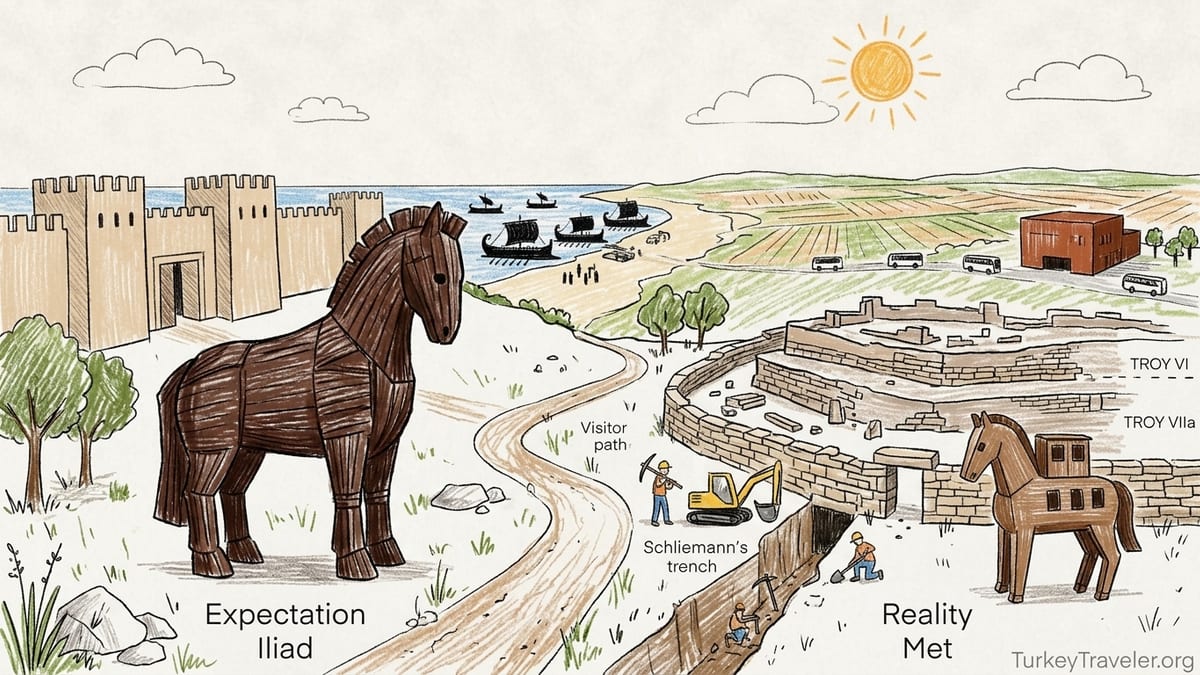
The Troy I Expected Versus the Troy I Met
On the drive from Çanakkale toward Hisarlık, the marketing is on Homer’s side. Roadside boards show a huge wooden horse rearing over the ruins. Tour brochures talk about the "legendary city of the Iliad" as if a single, coherent fortress is waiting on the hill. In my mind I carried an even clearer picture, pieced together from school translations and the 2004 film: high gates, long curtain walls dropping toward a plain crowded with spear points, and a harbor where black ships once lined up in perfect rows. I thought I was going to walk through a city and recognize it.
Instead, the first thing I saw by the entrance was not epic masonry but a modern staircase and a path curving toward low, fragmented stone walls. The famous silhouette of Troy is not a skyline at all. It is a flattened mound, a tell built by almost four thousand years of human occupation. The battlefield I had imagined as a vast coastal plain now stretches inland and has been reworked by agriculture and the slow retreat of the shoreline. Any harbor that once existed has silted up and moved away from the site by several kilometers. The view is still wide and atmospheric, but it is not the instant visual match to Homer or Hollywood that many visitors silently expect.
This gap between expectation and reality is at the core of whether Troy feels worth visiting. If you arrive looking for a single, frozen city, with a photogenic gate and an obvious battlefield, you will almost certainly leave disappointed. If you are willing to see a compact hill with layer after layer of walls, streets, storage jars, and burnt debris, interpreted by a modern museum next door, then Troy becomes something else entirely: not a monument to one war, but a case study in how stories attach themselves to real places.
Nine Troys on One Hill: Troy I to Troy IX
The intellectual adjustment starts the moment you realize that archaeologists talk about Troy in Roman numerals. Troy I, Troy II, all the way up to Troy IX: these are not neighborhoods, but successive phases of settlement, stacked vertically through the mound of Hisarlık. The earliest levels, Troy I and II, begin around the early third millennium BCE, long before the Mycenaean palaces that are usually associated with the world of the Iliad. Higher up come Troy III to V, then Troy VI and VIIa in the Late Bronze Age, and finally the much later Greek and Roman phases that produced temples, theaters, and city walls that look more familiar to casual visitors.
Walking the paths, this stratigraphy is not a tidy diagram but a puzzle of stones at your feet. A line of massive blocks may belong to Troy VI, while a brick and rubble wall sitting clumsily on top might belong to Troy VII. The Roman-period street, with its flagstones and drains, cuts casually across the remains of earlier houses. Signboards do try to explain which layer you are looking at, but they cannot give you the godlike perspective of a cutaway drawing. It is easy to get lost in the visual noise and feel that you are just looking at generic ruins.
What makes the place important, however, is precisely this vertical complexity. Few sites in the eastern Mediterranean preserve such a long, continuous sequence of occupation, from early Bronze Age through Late Bronze Age and on into the classical and Roman periods. That is why Troy is on the UNESCO World Heritage list and why archaeologists have kept coming back since the late nineteenth century. The charm is not one perfectly preserved city, but the chance to see how different societies reused the same strategic hill near the entrance to the Dardanelles over and over again, often dismantling their predecessors as thoroughly as any invading army.
By the time you understand this, though, you may also understand one of Troy’s built-in disappointments: nine cities in one place are intellectually exciting, but visually confusing. Unless someone has walked you through what all those Roman numerals mean, the hill can feel more like a stony maze than a myth made real.
Why Troy VI and VIIa Matter More Than Homer’s Plot
If there is any part of Hisarlık that gets close to the world of the Trojan War stories, it is the sequence archaeologists call Troy VI and VIIa. Chronologically, these layers belong to the Late Bronze Age, roughly the period when Mycenaean palaces in mainland Greece flourished and when Hittite documents from Anatolia mention a city called Wilusa that many scholars connect, cautiously, with Ilios or Ilion. It is attractive to place Homer’s great siege here, on this level, with its massive limestone walls and towers.
In practice, the evidence is more ambiguous. The fortification walls of Troy VI are undeniably impressive, with carefully fitted ashlar blocks and sloping foundations designed to resist attack and earthquakes alike. At some points you can still walk beside these walls and see how they once ringed the citadel, with four to five meter high sections surviving. Within, archaeological traces of large houses and storage buildings speak of a settlement that controlled agriculture, trade routes, and access to the straits. Troy VIIa sits on top of this phase, marked by signs of fire, collapsed buildings, and storage jars sunk into floors, which suggest a community under stress from siege or shortage.
This combination of strong defenses and a destruction horizon underpins many modern discussions of a possible historical kernel behind the Trojan War legends. But standing at the wall, it is crucial to resist the temptation to treat every cut stone as documentary proof of Achilles and Hector. Archaeology here provides a plausible Late Bronze Age context for memories of conflict around a rich coastal citadel. It does not, and probably never will, confirm Homer’s narrative in detail. The Iliad itself was written down centuries later and is shaped as much by oral tradition and poetic needs as by any specific historical event.
As a visitor, that nuance can be frustrating. I watched a tour group ask their guide directly, "So is this where the Trojan Horse came in?" The guide, to his credit, smiled and said, "If there was a horse at all, it was an idea, not this gate." That collision between story and science is at the heart of Troy’s identity. It also feeds the sense of anticlimax for travelers who secretly came to tick off a real battlefield from their bucket list.
Schliemann’s Trench and the Cost of Discovery
You cannot walk far at Hisarlık without encountering Heinrich Schliemann’s legacy, and it is not a subtle one. In the late nineteenth century, driven by his conviction that Homer described a real place, Schliemann attacked the mound with methods that would make a modern archaeologist wince. The most visible result is the enormous north–south trench that still slices through the site, a canyon of exposed sections and broken walls that feels as brutal as it is impressive.
Standing on the viewing platform beside that trench, I felt a double reaction. On one hand, this was the cut that brought Troy back into modern consciousness when many scholars doubted that any such city existed. On the other, the trench quite literally removed large parts of the upper layers to get at what Schliemann believed was "Priam’s Troy" near the bottom. In the process, earlier phases were damaged or lost, and the neat stack of nine cities became harder to read forever.
Later excavations under Wilhelm Dörpfeld, Carl Blegen, and more recent teams have done the patient work of sorting out Schliemann’s over-enthusiastic conclusions. The gold jewelry he trumpeted as "Priam’s Treasure" turned out to belong to a much earlier phase, long before any plausible Trojan War. Many of his identifications of specific buildings have been revised or abandoned. Nonetheless, the popular imagination is still haunted by that image of sacks of gold and a businessman-archaeologist who seemed to have dug up a legend by sheer force of will.
This history matters for visitors because it shapes both what you see and how you feel about it. In some sectors, like the famous trench, you are looking at a place where the story of archaeology itself has become part of the site. Later project signage acknowledges this openly, which is to the credit of the Turkish teams now leading the research. But it also adds another layer of abstraction. Not only are you trying to picture a Bronze Age city from low walls, you are also being reminded that those walls were selectively exposed and, in some cases, carelessly cut through more than a century ago.
The Two Wooden Horses: Expectation Versus Reality
For many visitors, the true emotional center of their Troy pilgrimage is not the walls at all, but the wooden horses. In my case, I had seen photos of both and assumed at least one might be rooted in something older. That illusion did not survive long. The first horse I met was at the archaeological site itself, a towering timber construction not far from the entrance. It dates from the mid 1970s, erected as a visual symbol for tourists rather than as a reconstruction of any excavated structure. It is hollow, with a staircase inside and small windows cut into its flanks.
Up close, this horse feels like a theme-park statement, an honest one, but still a statement. There is no serious claim that it reproduces any Bronze Age design; it is a twentieth-century imagination of an already legendary device. The second horse, on the Çanakkale waterfront, feels even more aggressively cinematic, because it literally is. This dark, jagged structure is the screen-used prop from Wolfgang Petersen’s 2004 film "Troy," shipped to Turkey and installed by the harbor after the production wrapped. Today it stands on the promenade, surrounded by ice cream kiosks, benches, and children posing for photos.
Both horses are highly photogenic, and neither is ancient. I watched teenagers queue to climb into the site horse for selfies, and families later gather under the film prop on the seafront as the sun went down over the Dardanelles. If your inner child came for a Trojan Horse, you will get not one but two. If your inner historian hoped for any material connection between these hulking sculptures and Late Bronze Age warfare, you will get none. The horses work as modern markers of Troy’s place in global popular culture. They also crystallize the expectation problem: visitors are unconsciously searching for an artifact to anchor the myth, and what they find are clever, unapologetically modern fakes.
In that sense, the wooden horses are both a delight and a disappointment. They offer a concrete, playful way to engage children and non-specialists who might find the low walls of Hisarlık hard to interpret. At the same time, they risk becoming the center of attention, reducing one of the most significant archaeological sites in Turkey to a backdrop for movie memorabilia.
Why the Troy Museum May Be the Real Highlight
Paradoxically, the part of Troy that feels most like a "real" city is not on the hill at all, but in the Troy Museum a few minutes’ walk away. The museum building itself is a rust-colored, cube-like structure partly sunk into the ground, designed to echo both the color of the soil and the form of a tell. Inside, four main floors spiral around a central atrium, taking you from the earliest prehistoric layers through the Bronze Age and classical city to late antiquity and the modern reception of Troy.
Here, the abstract talk of Troy I to IX turns into objects you can focus on. Pottery sequences line glass cases, with labels explaining how shapes and firing techniques change over time. Bronze weapons and tools, spindle whorls, loom weights, and storage jars give a sense of domestic life that the exposed foundations on the hill cannot convey alone. Funerary material, including the impressive Polyxena sarcophagus brought from a tumulus near Çanakkale, fills in the rituals and beliefs of communities across the region.
Crucially, the museum foregrounds archaeology as a process. One of the first things you encounter is an explanation of how archaeologists date layers, through stratigraphy, radiocarbon analysis, and comparative typology. There are displays explaining terms like Neolithic, Bronze Age, and Iron Age, accompanied by timelines that link Troy to better known sites elsewhere in the Mediterranean. Models reconstruct parts of the citadel at different periods, allowing you to visualize how fragmentary walls on the mound could once have supported two- and three-story structures.
All of this context helps soften some of the site’s biggest disappointments. Where the hill itself can feel visually underwhelming, the museum gives you the missing narrative spine. The roughly 27 euro open ticket, purchased on site and valid for both museum and archaeological park, is central to making a visit worthwhile. As of autumn 2026, foreign visitors pay this amount at the combined ticket counter, quoted officially in euros and charged in lira at the previous day’s exchange rate. For that price, you get the ruins, the modern interpretive displays, and a climate-controlled environment to absorb the details that the wind and sun on the mound may discourage you from reading in depth.
Practical Realities on the Hill: Paths, Signs, and the Lost Harbor
Troy’s infrastructure tries hard to bridge the gap between myth and stones, but it has its limits. The circular visitor path that loops around the citadel area is well defined and mostly easy to follow, yet it is far from a polished urban promenade. Sections are uneven, with compacted earth, stone steps, and short stretches of boardwalk or metal grating. After rain, some slopes can be slippery. Travelers with mobility issues will find parts of the circuit challenging, and there are not always alternative routes to viewpoints.
Signage is bilingual, in Turkish and English, and generally clear about the basics: which level you are looking at, whether the structure in front of you is a wall, gate, house, or well. However, the density of information varies. Some panels plunge into details of stratigraphy and architectural phases that will thrill archaeology students and glaze over almost everyone else. Others are surprisingly brief, leaving you to stare at a jumbled foundation and wonder why it merited a stop on the path. There are paid guides at the entrance offering one- to two-hour tours, and for most visitors, investing in a guide, or at least an audio guide when available, can dramatically change how coherent the site feels.
The views from the hill are another subtle disappointment for those expecting a literal match with Homer. Today, you look out over cultivated fields, scattered farmhouses, and distant, low hills. The Dardanelles are visible, but the shoreline sits further away than many first-time visitors imagine. Geological and geomorphological studies suggest that in the Late Bronze Age the coastline was closer, with a more complex estuary system that may have hosted anchorages or a shallow bay. None of that is obvious to the naked eye now. Without a guide pointing it out, you might simply register a pleasant but generic rural landscape.
Reconstructed sections of wall, such as the re-erected gate area and a stretch of fortification showing the characteristic sloping base, do help visitors imagine the scale of certain periods. Yet these reconstructions are partial and, in places, controversial. Some archaeologists feel that modern masonry blends too readily with ancient stone, potentially confusing future research and present-day tourists alike. As a traveler, you are caught between the desire for something vertical and photogenic and the awkward knowledge that much of what you see as "wall" has been curated and, to an extent, rebuilt to meet that desire.
Comparing Troy with Assos and Pergamon
One way to understand Troy’s particular mix of greatness and anticlimax is to compare it with other archaeological sites in western Turkey. Assos, perched high above the Aegean, offers a textbook example of visual drama. The Doric columns of the Athena temple stand on a cliff edge, surveying a wide bay and distant islands. Even if you know little about its history, the combination of classical architecture and sea views makes Assos instantly satisfying. Pergamon (modern Bergama) goes even further, with its steep theater clinging to a hillside, monumental terraces, and colossal altar foundations that inspired the museum in Berlin.
By contrast, Troy’s above-ground architecture is modest. There are no freestanding columns silhouetted against the sky, no intact theater seating to descend, no long colonnaded street to frame your photos. Historically, Troy’s claim to fame rivals or exceeds those of Assos and Pergamon, especially once you account for the site’s possible links to the Late Bronze Age political world and to Hittite texts. But that depth is locked in the ground and the museum cabinets. The hill itself asks more from the visitor in terms of imagination and prior knowledge.
In practical terms, this imbalance affects how satisfying a day trip feels. A traveler based in Çanakkale might visit Troy in the morning and Assos or the Gallipoli battlefields in the afternoon. Many I spoke to admitted that, on a purely visual level, Troy was the least striking stop. Yet several also said that, after spending time in the museum and reading about the stratigraphy, Troy stayed with them longer. It had forced them to think, to confront the way legend, nationalism, and scholarship overlap in a landscape that has seen both Bronze Age trade and twentieth-century war.
Whether that is "worth it" depends heavily on your priorities. If you want one unforgettable photograph, Pergamon’s theater or Assos’s headland will probably deliver more instantly. If you are curious about how stories are built on top of real places, and comfortable with ruins that do not immediately spell out their secrets, Troy offers a different, quieter kind of reward.
Five Real Disappointments You Should Anticipate
After a full day split between the hill of Hisarlık and the Troy Museum, my verdict on disappointments is not theoretical. It is based on what I felt and what I overheard from other visitors on the path and at the café.
First, the lack of a single, visually striking "city of Troy" can be jarring. The site is an archaeological mound, not a standing fortress, and much of what you walk past are waist-high walls or even lower stone outlines. If your mental picture comes from glossy film stills, you will struggle to reconcile those with the scrappy foundations on the ground.
Second, the Trojan Horse is not an archaeological artifact in any form. Both the 1970s wooden horse at the site and the 2004 film prop on the Çanakkale promenade are modern constructions. They are fun for photographs but offer no real insight into Bronze Age warfare or religion. Travelers who arrive expecting some fragment, however small, of an ancient wooden structure to have survived will leave that particular wish unfulfilled.
Third, the on-site experience demands more effort than many casual travelers expect. Paths can be uneven, shade is limited, and on hot summer days the combination of reflective stone and dry earth creates a harsh microclimate. Information boards are helpful but cannot replace a good guide, and if you do not hire one, you may spend much of your time squinting at diagrams without ever feeling that the city’s plan has clicked into focus.
Fourth, the surrounding landscape has changed enough over millennia to undermine some of the most evocative mental images. The ancient shoreline is gone, silted and shifted away. The river system that may once have brought ships nearer to the citadel has altered course. What you see today is productive farmland and a distant strip of sea, not the teeming beachhead of a decade-long siege.
Fifth, some visitors feel misled by how heavily tour marketing leans on Homer and Hollywood without preparing them for the archaeological reality. Brochures full of dramatic paintings and film stills set up expectations of grandeur that even the best signage and museum exhibits cannot completely recalibrate on arrival. If you do not adjust your own expectations before you go, you risk spending the visit measuring every stone against a mental storyboard that no real ruin could match.
The Takeaway
So, is Troy worth visiting? For me, the answer became yes, but only after I let go of the Troy I thought I was coming to see. The city of Homer is a poetic construct, stitched together from older tales, contemporary concerns, and the performance needs of an oral tradition. The cinematic Troy of sweeping cranes shots and fortress walls is another layer again, a modern visual language grafted onto that poem. The archaeological Troy at Hisarlık is something more modest and, in its way, more profound.
On that low hill, nine different communities built, rebuilt, and sometimes violently erased each other over the course of nearly four thousand years. Their walls and houses survive in fragmentary form, made harder to read by early, destructive excavations and by the simple fact that later inhabitants quarried earlier stone. The Trojan Horse, as a physical object, is absent. In its place stand two modern sculptures that testify not to Bronze Age stratagems, but to the grip of a legend on modern imagination and tourism.
The Troy Museum, with its carefully curated pottery, weapons, inscriptions, and funerary finds, offers the clearest window into this long history. It anchors the site, provides the intellectual scaffolding that the walls alone cannot, and justifies the roughly 27 euro combined ticket in a way the hill, on its own, might not. Between museum and mound, you can piece together an understanding of Troy as a palimpsest of power, trade, war, and story, rather than as a single cinematic set.
In the end, Troy is both underwhelming and extraordinary. It will frustrate anyone who arrives looking for unbroken battlements and a tangible horse. It will reward those who come willing to learn how archaeology actually works, how myths take root in particular places, and how modern nations negotiate their heritage. If you calibrate your expectations toward ruins and research rather than spectacle, Troy ceases to be a ruined version of a film and becomes something harder to photograph but richer to remember.
FAQ
Q1. Is the combined ticket for Troy Museum and the archaeological site really around 27 euro?
As of late 2026, foreign visitors pay about 27 euro for a single open ticket that covers both the Troy Museum and the archaeological site, quoted in euro and charged in Turkish lira at the daily official rate; always confirm shortly before your visit in case national tariffs change.
Q2. How much time should I plan for Troy and the museum?
Most visitors who want more than a quick photo stop should allow at least two to three hours in the museum and another one and a half to two hours on the hill, plus transport time from Çanakkale, turning the experience into a solid half-day or more.
Q3. Are the ruins of Troy visually impressive compared with other sites in Turkey?
Compared with places like Pergamon or Assos, Troy’s visible architecture is fairly low and fragmentary, so it is less dramatic to the eye but richer in terms of long-term settlement history and archaeological complexity.
Q4. Is there anything original left of the Trojan Horse at the site?
No physical remains of any ancient wooden horse have been found at Hisarlık; the large horse at the archaeological site is a modern 1970s construction, and the one on the Çanakkale waterfront is a prop from the 2004 film, so neither is an ancient artifact.
Q5. Do I need a guide to appreciate Troy?
You can walk the marked loop and read bilingual information boards on your own, but many visitors find that hiring a licensed guide or using an audio guide makes the multiple settlement layers, key walls, and excavation history far easier to understand in a short visit.
Q6. How difficult are the paths around the ruins?
The main circuit is not long, but it includes uneven ground, steps, and some slopes that can be hot and slippery in summer, so comfortable shoes are essential and visitors with limited mobility may find parts of the route challenging.
Q7. Is Troy a good site for children and non-specialists?
Children often enjoy climbing the modern wooden horse and exploring the open-air ruins, while the museum’s models and reconstructions help non-specialists, but parents and group leaders should be ready to interpret what is on display to keep attention from drifting.
Q8. What is the best season or time of day to visit Troy?
Mornings in late spring and early autumn usually offer the best combination of manageable temperatures and good light, while midday in high summer can be very hot and exposed on the hill, making the museum’s air-conditioned galleries a welcome refuge.
Q9. How does Troy compare to Gallipoli or Assos for a day trip from Çanakkale?
Gallipoli offers powerful twentieth-century war memorials and landscapes, Assos delivers stunning classical ruins above the sea, and Troy provides deeper time depth but a more subdued visual impact, so travelers often choose based on whether they prioritize recent history, scenery, or Bronze Age archaeology.
Q10. If I care mainly about Homer and the Iliad, is Troy still worth it?
If you are prepared to accept that archaeology cannot prove Homer’s story literally, Troy can be fascinating as a place where Late Bronze Age remains, later Greek and Roman cities, and modern interpretations all intersect with the poem, but you should not expect to find a perfectly preserved battlefield or clear material evidence of specific heroes.