


Cappadocia’s underground cities are some of the most extraordinary places you can visit in Türkiye, but they are also among the most physically demanding. Choosing between Derinkuyu, Kaymaklı, Özkonak and smaller sites such as Mazı is less about which is “best” and more about which one matches your curiosity, fitness and comfort level underground. This guide compares the main options with a practical focus on accessibility, crowding and how much underground time most travelers actually enjoy.
How Cappadocia’s Underground Cities Came To Be
Cappadocia’s famous soft rock, known as volcanic tuff, is the starting point for every underground city. Millions of years ago, eruptions from volcanoes such as Erciyes and Hasan Dağı buried the region under thick ash. Over time this compacted into tuff, a rock soft enough to carve with simple tools yet solid enough to stand as walls and ceilings. Locals learned that with a pick and patience they could tunnel horizontally and vertically, creating entire hidden settlements under their villages.
These underground cities were not the work of a single civilization at one moment in time. Early chambers may date back to pre-Christian periods, then were expanded and reworked by Byzantine communities, medieval Christian groups and later local populations facing raids or persecution. Over centuries people dug out storage rooms for grain and wine, kitchens blackened with smoke, rock-cut churches with simple crosses, vertical ventilation shafts and wells that allowed them to stay hidden for weeks. Many of the rooms you walk through today in Kaymaklı or Derinkuyu sit above or beside areas that are still being studied or have collapsed, a reminder that these are living archaeological sites rather than finished monuments.
Excavations and surveys across the wider Cappadocia region suggest there are scores of underground cities, from small multi-room refuges to sprawling complexes. Only a small number are stabilized, lit and open to visitors. Derinkuyu and Kaymaklı are the best known, but places like Özkonak and Mazı offer a more compact experience. All are cut into the same tuff and use similar defensive ideas, yet they feel very different when you are the one stooping through the tunnels.
Because underground cities evolved across multiple historical periods, the rooms often reflect changing needs and technology. For example, later levels might include more elaborate wine presses or communal churches, while older spaces could be simple chambers connected by low, rough tunnels. As a visitor you are seeing a palimpsest of many centuries of fear, faith and practical engineering layered underground.
Derinkuyu vs Kaymaklı: Depth, Layout and Experience
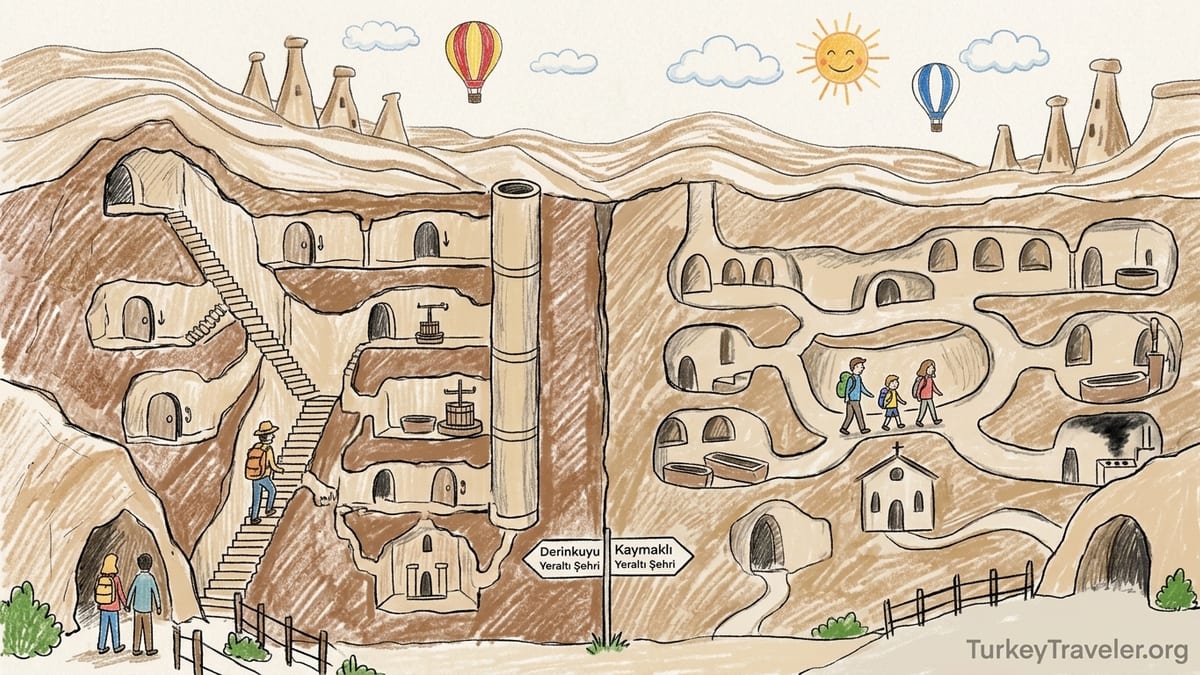
Derinkuyu is the headline act for many travelers. It drops roughly 85 meters below the surface across eight known levels, making it the deepest explored underground city in Cappadocia. Not all of that depth is accessible; tourist routes typically include a series of illuminated levels connected by steep staircases and narrow passages, then stop where the rock becomes unstable or excavation is ongoing. You will still feel the dramatic vertical descent as you move from stables near the surface to chapels and communal areas far below.
Kaymaklı, by contrast, spreads out more than it plunges. Archaeologists also count eight levels in total, but only the upper four are open to the public at the time of writing. Those four levels form a relatively wide horizontal maze of low-ceilinged corridors, storage niches, wineries and a small church. Instead of repeatedly climbing steep shafts, you tend to wind around the same general depth, which many visitors find less exhausting and slightly less claustrophobic.
In practical terms, many local guides in Göreme and Ürgüp describe Derinkuyu as the choice for travelers who want the most intense underground experience, and Kaymaklı as better for first-timers or families. For instance, a common Green Tour route pairs Derinkuyu with the Ihlara Valley; travelers who book that often say they feel “done” with underground cities after Derinkuyu because the deep stairwells and crowds can be tiring. Others who start at Kaymaklı report that they would have considered Derinkuyu too much but enjoyed the broader, slightly gentler layout of Kaymaklı.
Both sites show clear traces of daily life. At Derinkuyu you can stand beside a huge cylindrical ventilation shaft dropping out of sight and imagine air and voices drifting between levels. At Kaymaklı you might run your hand along the rock-cut troughs that carried grape juice from a pressing area into a collection basin. These concrete details help the spaces feel like real homes and refuges, not just mysterious tunnels.
Common Myths: Secret Tunnels and What You Actually See
One story that refuses to die is that tourists can walk from Derinkuyu to Kaymaklı entirely underground. Archaeological evidence does suggest an 8 to 9 kilometer tunnel once linked the two complexes. Short sections have been identified by researchers, but there is no continuous, safe corridor open to the public. Modern roads, buildings and partial collapses break up the original route. Today the only way travelers move between Derinkuyu and Kaymaklı is above ground by car, minibus or bus.
Another misconception is that every level mentioned in guidebooks is fully open. In reality, the total archaeological extent is always larger than the signposted tourist area. At Derinkuyu, you may read that the city reaches eight levels, but the marked visitor circuit uses a selection of chambers and stairways that can be ventilated, lit and monitored. At Kaymaklı, the fact that four levels are open does not mean those are the top four clean horizontal floors in a modern building; some sections are deliberately closed off to protect fragile areas or to keep the visit to a manageable length.
Visitors sometimes expect large caverns and smooth floors after seeing heavily edited social media photos. The reality is more intimate. Most of your time is spent in human-scale tunnels and rooms. Ceilings can be as low as 1.5 to 1.7 meters in stretches, forcing taller travelers to walk bent over. Stone doors, when present, are not theatrical props but genuine defense elements that could be rolled shut. Understanding these limits helps set realistic expectations and avoids disappointment or anxiety once you are underground.
Finally, it is worth remembering that ongoing conservation can change what is open at short notice. A passage that friends walked through in spring may be closed in autumn for stabilization. When choosing between Derinkuyu and Kaymaklı, treat any map you find online as indicative rather than a precise promise of what you will see.
Accessibility, Comfort and Who Each Underground City Suits
Accessibility is where the differences between the underground cities really matter. None of the major sites is wheelchair accessible in the usual sense. All involve uneven rock floors, steps carved from stone and sections where you must bend or twist to pass through. If anyone in your group has reduced mobility, severe claustrophobia, heart or respiratory issues, you should consider whether going underground is right for them at all, or limit the visit to the very first chambers near the entrance.
Derinkuyu is generally the most physically demanding for two reasons. First, its visitor route follows a pronounced vertical descent. You will tackle several long, steep staircases that function as combined corridor and ladder, often only wide enough for single file. Second, congestion can build up quickly on busy days. When multiple tour groups arrive from Göreme around mid-morning, the main shafts can become a slow-moving line of people. Tall travelers often report needing to duck for extended stretches, and anyone with even mild claustrophobia may find the combination of low ceilings, bodies close on both sides and limited options to step aside uncomfortable.
Kaymaklı is usually more forgiving. The ceilings are still low in places, but the overall layout is broader and more horizontal, so your legs get a break from constant stair-climbing. Passages often loop back into larger chambers, which gives a sense of space and makes it easier to pause if you start to feel overwhelmed. Lighting is functional but not bright, which preserves atmosphere while still letting you see steps and edges. For families, guides often recommend Kaymaklı because children can imagine life underground without spending too long in narrow vertical shafts.
Özkonak and Mazı sit somewhere between the two major sites and small village refuges. Özkonak is known for its relatively tight defensive layout, with narrow corridors and cleverly designed communication holes that allowed people in different rooms to talk while staying protected. After experiencing either Derinkuyu or Kaymaklı, many travelers find Özkonak better suited to a shorter, secondary visit rather than their single underground stop, especially if anyone in the group is already tired of ducking through passages. Mazı, which is smaller and often quieter, can appeal to those who want a less crowded but still authentic sense of underground life without tackling the depth of Derinkuyu.
In all underground cities, expect a cool, stable temperature once you are below the first level, often around the low teens Celsius even in summer. This is comfortable for most people but can feel chilly if you arrive in a light shirt straight from a hot July afternoon. Ventilation shafts work well enough that the air does not feel stale, yet some visitors with asthma or anxiety about enclosed spaces notice the difference and prefer to stay near the entrance chambers where exits are visible.
Opening Hours, Tickets and When to Go
Official opening hours for the major underground cities routinely state 08:00 to 18:00, with last ticket sales at 17:15. In practice, seasonal variations and occasional evening openings can apply, but you should plan on arriving well before 17:00 if you want an unhurried visit. The national museum authorities advise checking current hours closer to your travel date, as maintenance or visitor load can lead to temporary adjustments.
As of October 2026, independent ticket surveys report that both Derinkuyu and Kaymaklı charge around 13 euros for international adult visitors, with prices also displayed in Turkish lira at the gate. Turkish citizens typically pay a lower lira-based price and can often use the Müzekart museum pass for free or discounted entry. Children under a certain age usually enter free with a paying adult, although age cut-offs and ID requirements are subject to change, so families should confirm details at the ticket window.
Özkonak, which is also operated as an official museum site, follows similar general hours, opening at 08:00 and closing at 18:00 with last tickets around 17:15. Its ticket price for foreign visitors is in the same broad range, and the Müzekart is accepted for eligible Turkish citizens. Mazı and some smaller underground cities may have more basic ticketing, sometimes using a simple booth at the entrance with a posted lira price. Because their visitor numbers are lower, online information can be out of date; if your heart is set on a smaller site, it is wise to ask at your hotel in Göreme or Ürgüp on the morning of your visit.
For comfort and crowd levels, the first and last hours of the day are usually the best times to visit. Early morning visits, before most Green Tours depart Göreme, tend to be quieter, with small independent travelers arriving by rental car. Late afternoon can also be pleasant, especially in summer when air outside is hot but the rock inside stays cool. Mid-morning to early afternoon sees the peak influx of tour buses and minibuses from Göreme, Ürgüp and Nevşehir; if you must visit then, be prepared for queues at staircases and crowded chambers, particularly in Derinkuyu.
Getting to Derinkuyu, Kaymaklı, Özkonak and Mazı
If you are staying in Göreme, Derinkuyu lies roughly 35 to 40 kilometers to the south by road, while Kaymaklı is closer to 25 kilometers. Driving times with a rental car are about 30 to 45 minutes depending on traffic and weather. From Ürgüp or Uçhisar, journey times are similar, with slightly shorter distances to Kaymaklı. Nevşehir, the provincial capital, is the main hub for local buses and minibuses that fan out to the villages and underground city entrances.
By car, routes are straightforward, following well-signed roads that list “Kaymaklı Yeraltı Şehri” and “Derinkuyu Yeraltı Şehri” on brown tourist boards. Parking at both sites is usually in open surface lots just outside the entrance area. Fees are modest by international standards and are often collected by attendants at the lot entrance. For example, independent Turkish travel guides in 2026 mention typical car park fees in the tens of lira range rather than hundreds. You may also find informal parking further away in village streets, but these are less secure and can involve a longer walk.
Public transport is practical if you are staying in Nevşehir. Regular dolmuş minibuses run from Nevşehir’s central stand to both Kaymaklı and Derinkuyu, with services throughout the day. Fares are inexpensive, roughly comparable to a few euros or less, and the ride to Kaymaklı takes around half an hour. From Göreme, Ürgüp or Uçhisar you would first travel to Nevşehir, then transfer. Schedules can change seasonally and are rarely posted far in advance online, so it is best to ask your guesthouse host or check the timetable at the dolmuş stand the day before.
Taxis and private transfers are convenient for small groups. From Göreme, a one-way taxi to Kaymaklı or Derinkuyu typically costs an amount similar to a short intercity transfer, so splitting the fare between three or four people can make this competitive with organized tours. Many hotels can arrange a driver who waits while you visit and then takes you on to another sight, such as the Ihlara Valley or a viewpoint over the fairy chimneys, turning the underground city into part of a wider day out.
Most first-time visitors encounter underground cities as part of the popular Green Tour, a full-day small-group excursion that usually runs in a loop from Göreme through key sights on the southern side of Cappadocia. Green Tour itineraries almost always include one underground city, often Derinkuyu but sometimes Kaymaklı, plus stops like the Ihlara Valley gorge and the rock-cut monastery complex at Selime. For travelers who prefer not to drive or navigate bus transfers, this is a straightforward way to ensure transport, entrance arrangements and guiding are all handled together. If you have a strong preference for either Derinkuyu or Kaymaklı, check the specific tour description or ask your agency before booking.
Choosing Özkonak, Mazı or Other Alternatives
While Derinkuyu and Kaymaklı dominate most itineraries, there are good reasons to consider Özkonak or Mazı, especially if you dislike crowds or are visiting in peak season. Özkonak, located on the slopes of İdiş Dağı north of Avanos, features a compact but ingenious defensive design. Its most distinctive elements are the small communication holes bored above some of the passageways. These allowed residents to speak between rooms while keeping sliding stone doors closed, and in some interpretations could have been used to pour hot liquids or projectiles onto intruders who forced an outer door. Walking through Özkonak after seeing a larger city helps you appreciate these differences in detail rather than just size.
From a logistical standpoint, Özkonak works well combined with a day exploring Avanos and the ceramic workshops along the Kızılırmak River, since it lies only about 14 kilometers away. You might spend your morning visiting potters’ studios, have lunch in Avanos and then head up to Özkonak in the cooler late afternoon, returning to Göreme or Uçhisar by early evening. Underground, expect low ceilings and some tight passages comparable to sections of Kaymaklı, but on a smaller overall scale. If you have already spent an hour in Derinkuyu or Kaymaklı on a previous day, many travelers report that Özkonak feels like a satisfying but not overwhelming “second chapter.”
Mazı, south of Ürgüp, is another option for those who want a quieter underground experience. It is smaller, with fewer tour buses, and often visited by travelers with rental cars or on customized private tours. The spaces here can feel more rustic and less curated, which appeals to some visitors and worries others. Lighting and interpretive signs may be minimal, so hiring a local guide at the entrance, if available, can add context and help you navigate confidently.
Other underground sites around Cappadocia are in various states of excavation and stabilization. Some may open for limited hours or close temporarily for safety work with little advance notice. For this reason, it is safest to choose at least one of the main trio of Derinkuyu, Kaymaklı and Özkonak for your plans, then treat smaller sites as flexible add-ons if conditions allow. Your hotel or a local tourism office in Göreme, Ürgüp or Nevşehir can usually give same-week information that is more reliable than older printed guidebooks.
Decision Matrix and a Realistic Half-Day Plan
For first-time visitors who want a single underground city and have no strong mobility limitations, Kaymaklı is often the best all-round choice. Its four open levels provide a vivid sense of underground life without pushing depth to an extreme. Children can explore rock-cut stables, food storage rooms and the small church without needing to climb too many steep shafts. Slightly wider tunnels and the more horizontal layout also make it a gentler introduction for those who are unsure how they will react to being underground.
For archaeology enthusiasts and travelers keen on the most dramatic experience, Derinkuyu has a stronger emotional impact. Standing beside its deep ventilation shaft or in the larger communal church chamber far beneath the surface conveys the scale of the community that once sheltered there. If you enjoy visualizing construction techniques and imagining siege conditions, Derinkuyu’s depth and concentration of features make it worth the extra effort. You should, however, be comfortable with enclosed spaces and continuous stair-climbing, and be ready to wait in line when it is busy.
Families with young children or mixed comfort levels might consider pairing a relatively short visit to Kaymaklı with more open-air sights the same day. For example, you could leave Göreme around 08:30, arrive at Kaymaklı just after opening, spend 45 to 60 minutes underground and then drive on to the Ihlara Valley for a riverside lunch and an easy walk through green canyon scenery. This balances the subterranean adventure with time in the sun and gives anyone who found the tunnels stressful a chance to decompress quickly.
Visitors who are uncomfortable in tight spaces, very tall or traveling with someone with reduced mobility should think carefully before committing to the deeper sections of any underground city. In many cases, you can buy a ticket, walk through the first level or two where ceilings are higher and exits visible, then decide as a group whether to go further down. Guides are generally understanding if part of the group waits near the entrance cafe or in a surface courtyard while others continue. For some travelers, simply seeing the entrance, first chambers and the massive stone doors is enough to satisfy their curiosity without pushing physical or psychological limits.
As for how many underground cities to visit, a realistic rule of thumb is that most travelers enjoy one major underground city and at most one smaller or secondary site. The physical experience of stooping, climbing and navigating dim tunnels is similar across sites; what changes is scale, crowding and specific features. After two, many people report that a third feels repetitive, especially on a short trip of two or three days. If you have only one full day in Cappadocia, focus on a single underground city and spend your remaining time on above-ground highlights such as the Göreme Open Air Museum, sunset viewpoints around Red and Rose Valleys and the rock citadel of Uçhisar.
The Takeaway
Choosing between Derinkuyu, Kaymaklı, Özkonak and Mazı is ultimately about matching your appetite for historical immersion with your tolerance for physical strain and enclosed spaces. All of these places emerged from the same volcanic tuff landscape, carved and re-carved across centuries by communities seeking safety, storage and spiritual space underground. Each offers storage rooms, kitchens, wineries, churches, wells, ventilation shafts and defensive passages, but they package those elements in very different visitor experiences.
If you are a first-timer to Cappadocia with average fitness and only mild concerns about tight spaces, Kaymaklı is the most balanced introduction. If you crave the deepest, most intense underground adventure and are confident about your stamina and comfort level, Derinkuyu is hard to beat. Özkonak and Mazı reward those with extra time or a desire to escape the main tour-bus circuit, offering smaller-scale but still fascinating glimpses into Cappadocia’s subterranean history.
Whatever you choose, plan with the realities of low ceilings, steep steps, cool air and potential crowds in mind. Allow plenty of time to move at your own pace, wear sturdy shoes and a light layer, and communicate honestly within your group about how everyone is feeling. These cities were once places of refuge and resilience; visiting them with care and respect helps ensure they remain safe and meaningful for the generations of travelers who will follow you underground.
FAQ
Q1. Which underground city is best for a first-time visitor to Cappadocia?
Kaymaklı is usually the best all-round choice for first-timers because it offers four accessible levels with a relatively horizontal layout, plenty of historical features and slightly wider tunnels than Derinkuyu, while still delivering a strong sense of underground life.
Q2. Is Derinkuyu too intense for someone who is mildly claustrophobic?
Derinkuyu can feel intense because it descends roughly 85 meters through steep, narrow stairways that can become crowded; visitors with mild claustrophobia sometimes manage by staying on higher levels, but anyone who is very anxious about enclosed spaces is usually better off choosing Kaymaklı or limiting their visit to the first chambers only.
Q3. Can tourists really walk underground from Derinkuyu to Kaymaklı?
No, tourists cannot walk between Derinkuyu and Kaymaklı underground; although archaeological evidence suggests there was once a several-kilometer tunnel connecting the two cities, only short sections have been identified and none form a continuous, safe route open to the public.
Q4. How much does it cost to visit the main underground cities?
As of late 2026, independent ticket checks report that international adult visitors pay around 13 euros per person to enter Derinkuyu and Kaymaklı, with similar pricing at Özkonak; Turkish citizens generally pay lower lira-based prices and may use a national museum pass, but exact amounts can change, so you should confirm at the ticket window on the day.
Q5. Are the underground cities suitable for young children?
Many families visit Kaymaklı and Derinkuyu with children, but parents should be ready for low ceilings, uneven steps and crowded passages; Kaymaklı’s more horizontal layout often works better for younger kids, and some families choose to explore only the first one or two levels to avoid fatigue or anxiety.
Q6. Which underground city is least crowded?
Derinkuyu and Kaymaklı receive the most tour groups, especially from mid-morning to early afternoon, while Özkonak and Mazı tend to be quieter; visiting any site near opening time or late in the afternoon also significantly reduces crowding compared with peak hours.
Q7. How long should I plan for a visit to an underground city?
Most visitors spend about 45 to 60 minutes exploring a major underground city such as Kaymaklı or Derinkuyu, not counting travel time; if you like to photograph details or listen to a guide’s full explanations, allowing up to 90 minutes underground keeps the pace relaxed.
Q8. Can people with reduced mobility visit any part of the underground cities?
None of the major underground cities are fully accessible, but some visitors with limited mobility do manage short sections near the entrance where floors are flatter and stairs fewer; however, deep exploration requires climbing, stooping and negotiating narrow passages, so anyone with significant mobility challenges should discuss options with their doctor and consider remaining on the surface.
Q9. Is it worth visiting a second underground city on the same trip?
For travelers especially interested in archaeology or history, visiting one major site such as Derinkuyu or Kaymaklı and then a smaller one like Özkonak or Mazı can be rewarding, but many visitors find that more than two underground cities feel repetitive in terms of physical effort and visual impressions.
Q10. What should I wear and bring for a comfortable visit underground?
Wear sturdy, closed shoes with good grip, long pants you do not mind brushing against rough rock, and a light layer or jacket because temperatures underground stay cool even in summer; carrying a small flashlight or using your phone’s light can help on dim steps, but large backpacks are best avoided since they catch easily on low ceilings and narrow corners.