


The plateau between Şanlıurfa and Gaziantep offers one of the clearest time‑tunnels in world archaeology, running from early Neolithic ritual architecture to late Roman riverside villas. This four to six day itinerary is designed for travelers who want to understand that chronological arc on the ground, using Şanlıurfa and Gaziantep as comfortable bases while visiting sites that range from 9600 BCE stone circles to some of the most celebrated mosaics in the Mediterranean.
How to Use This Itinerary and When to Go
This route is built as a neutral, archaeology‑focused journey. You can complete a compact four day version that concentrates on Şanlıurfa, Göbekli Tepe, Harran and Gaziantep’s Zeugma mosaics, or extend to five or six days to add time for the wider Taş Tepeler zone and a long excursion toward Nemrut Dağ or Arslantepe. The order starts in Şanlıurfa, where the city museum provides the essential framework for everything that follows, then moves west to Gaziantep for the Roman and late antique period.
Most international visitors arrive via Istanbul or Ankara. Şanlıurfa GAP Airport lies about 35 to 45 minutes by road from the city center, while Gaziantep Oğuzeli Airport is roughly 30 minutes from central Gaziantep by taxi or shuttle. Many travelers fly into Şanlıurfa first, then depart from Gaziantep to avoid backtracking. Several domestic carriers usually operate daily flights on these routes, but schedules change frequently, so flights should be confirmed close to travel dates.
Spring and autumn are generally the most comfortable times for field visits. Between late April and early June and again from late September to early November, daytime temperatures are warm but not punishing, and the light on stone reliefs and mosaics is sharp without intense glare. In July and August, temperatures around Göbekli Tepe, Harran and Belkıs/Zeugma can climb well above 35°C, turning exposed walks into demanding physical efforts, particularly on metal walkways and unshaded slopes.
Before departing each morning, check museum and site opening hours, which are set by the Turkish Ministry of Culture and Tourism and can shift between summer and winter seasons. For example, the Şanlıurfa Archaeology Museum and Haleplibahçe Mosaic Museum share a single combined ticket and are currently listed with separate summer and winter schedules; official channels emphasize reconfirming times and any holiday closures just before visiting. The same caution applies to Belkıs/Zeugma and to more recently opened Neolithic sites in the Taş Tepeler program.
Şanlıurfa as a Base: Museums, History and Practicalities
Şanlıurfa, often shortened to Urfa, makes a logical starting point for this journey because it anchors both ends of the time span: its museum displays early Neolithic pillars from Göbekli Tepe and Taş Tepeler, yet the city itself overlays the ancient center of Edessa with later Islamic architecture and living pilgrimage traditions. A central hotel near the Balıklıgöl (Pool of Sacred Fish) area allows easy evening walks among the bazaar streets and historic caravanserais after daytime excursions to the sites.
Accommodation ranges from restored stone mansions converted into boutique hotels in the old town to modern business hotels along the main boulevards. Many archaeology‑minded travelers choose small heritage properties within 10 to 15 minutes’ walk of the museum complex, in order to visit in several shorter sessions rather than one long push. Taxis within the city are relatively inexpensive by European standards and are practical when carrying camera gear or in hot weather.
Şanlıurfa’s traffic can be busy at peak hours, but self‑driving is manageable for experienced drivers. Car rentals are usually available at Şanlıurfa GAP Airport and in the city, which can be worthwhile for those planning to reach Harran, Göbekli Tepe and the more remote Taş Tepeler sites independently. Fuel prices in Turkey fluctuate; given recent volatility, anyone budgeting a self‑drive trip should check current local rates shortly before travel and treat online estimates from previous seasons as approximate guides only.
Security perceptions of southeastern Turkey change with wider regional events. Official travel advisories from your home country should be checked in the weeks before departure for the latest guidance on the Şanlıurfa and Gaziantep provinces, road travel after dark and excursions toward the Syrian border. On the ground, many visitors report that archaeological sites feel quiet and well monitored, but it remains sensible to travel during daylight, keep identification with you and follow local instructions at police or gendarmerie checkpoints.
Day One: Şanlıurfa Archaeology Museum and Haleplibahçe Mosaics
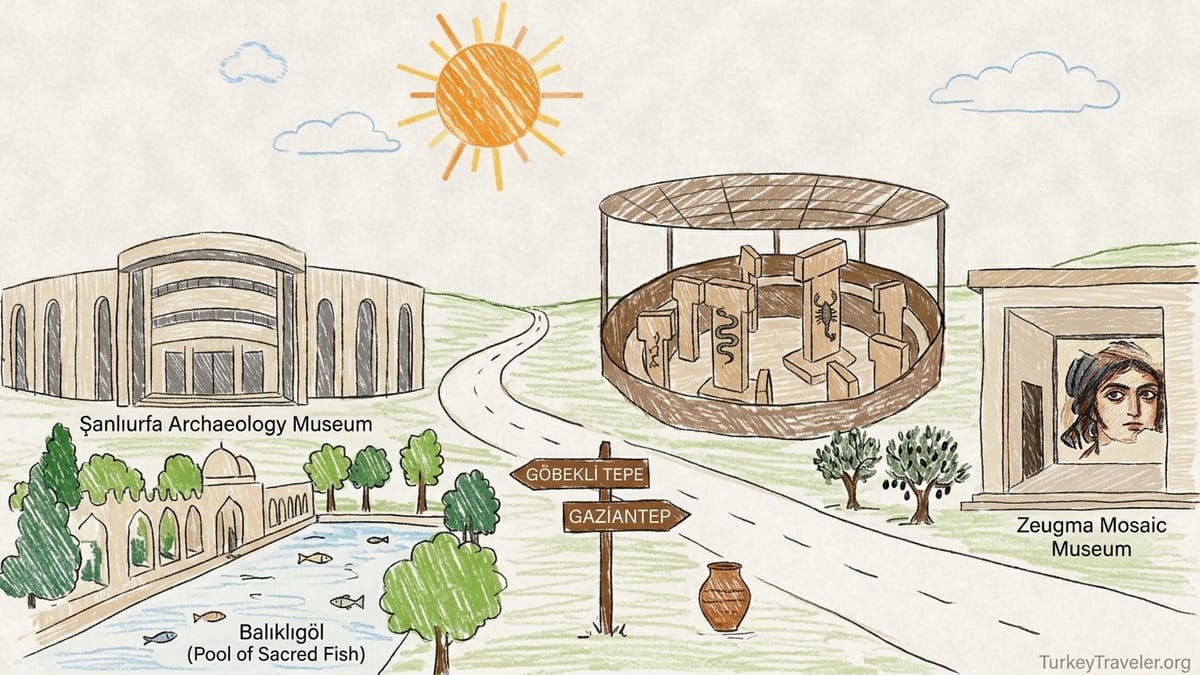
The Şanlıurfa Archaeology Museum is the anchor for this entire itinerary and should be your first major stop. Located in the Haleplibahçe area a short drive east of the historic center, the complex houses extensive prehistoric collections, large architectural reconstructions and material from multiple Neolithic sites in the Taş Tepeler project. The museum’s Stone Age halls include a full‑scale replica of one of the monumental circular enclosures from Göbekli Tepe, built with concrete pillars that mirror the originals and surrounded by original relief‑carved blocks brought from the hill for conservation and display.
The most arresting single piece in the museum is the so‑called Urfa Man, a life‑size limestone statue with inlaid obsidian eyes and hands clasped at the abdomen. Often dated around the late 10th to early 9th millennium BCE, it is widely discussed as one of the oldest known near life‑size naturalistic human sculptures in the world. Seeing Urfa Man before visiting Göbekli Tepe helps frame Neolithic Upper Mesopotamia not as a place of anonymous stone circles alone, but as a landscape in which people were experimenting with how to represent the human body, authority and perhaps ritual specialists in permanent materials.
Alongside Göbekli Tepe material, the museum displays pillars and relief fragments from other Taş Tepeler sites such as Karahantepe and Sayburç. Text panels, models and films introduce the idea that the region between the Euphrates and Tigris hosted a constellation of early sites with similar T‑shaped pillars, often organized in circular or oval buildings sunk into the bedrock. Because some of these sites remain closed or difficult to access, the museum may be the only way for visitors to see certain carvings of leopards, snakes or abstract symbols that belong to this wider network.
In the same landscaped complex but housed in a separate building, the Haleplibahçe Mosaic Museum presents mosaics from ancient Edessa and its surroundings, uncovered during rescue works in the 2000s. These mosaics depict Amazons hunting, mythological scenes and rich geometric carpets in a style influenced by late Roman and early Byzantine tastes in northern Mesopotamia. Unlike the mosaics at Zeugma, which come largely from riverside villas facing the Euphrates, these floors belonged to urban houses and bath buildings on a hill above a spring that is now enveloped by the modern city. A combined ticket currently covers both Haleplibahçe and the Archaeology Museum; recent unofficial visitor guides report foreign adult prices in the low double‑digit euro range, but travelers should check the most recent tariff published by the Ministry of Culture, as a new price schedule is planned from 2027 onward.
Day Two: Göbekli Tepe and the Taş Tepeler Landscape
Göbekli Tepe lies on a low ridge roughly 20 to 25 kilometers northeast of Şanlıurfa, reached in about 30 to 40 minutes by car along a paved road. The site, recognized as a UNESCO World Heritage property, occupies a limestone knoll where excavations have revealed multiple circular and oval enclosures with T‑shaped stone pillars arranged around central pairings. Radiocarbon dating and stratigraphic work place the main construction and use of these enclosures in the Pre‑Pottery Neolithic A and early B phases, broadly between about 9600 and 8200 BCE, although more detailed studies sometimes give narrower ranges within 9500 to 8000 BCE.
Systematic archaeological work at Göbekli Tepe began in 1995 under the direction of Klaus Schmidt, following surveys in the mid‑1990s. After Schmidt’s death, Turkish and German teams continued research, and publications over the last decade have complicated earlier narratives that framed the site primarily as a “temple complex.” Only a small proportion of the mound’s total area has been excavated, and current project leaders have publicly argued for leaving large portions untouched for future techniques, which means that visitors see only a fraction of what is geophysically indicated beneath the surface.
On site, elevated walkways loop around the main roofed excavation areas, allowing you to look down clearly into Enclosure D and other circles where pillars over 5 meters tall carry low‑relief carvings of animals and abstract signs. Interpretive boards explain how the T‑shaped pillars may represent stylized human figures, with arms and hands carved in some cases. Comparing these carvings with the original and replica material viewed in Şanlıurfa the previous day makes the visit richer, as you can mentally reconstruct how certain pillars would have stood in relation to others and see how the symbol repertoire extends across the region.
Göbekli Tepe is part of a broader program branded as Taş Tepeler, or “Stone Hills,” which highlights several early Neolithic sites across the Şanlıurfa region. These include Karahantepe, Sayburç, Sefertepe and Harbetsuvan among others. Official project pages describe Karahantepe in particular as a major settlement with multiple T‑pillar buildings carved down into bedrock, and Şanlıurfa Museum currently stages a dedicated Karahantepe and Neolithic Human exhibition using finds from the excavations. However, visitor information for the site itself has fluctuated. As of late October 2026, specialist travel resources that monitor the area report that Karahantepe was officially listed as closed to regular tourism, even though some tour marketing and older online articles still suggest visits are possible. Anyone hoping to see Karahantepe or other Taş Tepeler sites beyond Göbekli Tepe should therefore treat them as tentative options and verify current access directly with Şanlıurfa Museum or licensed local guides before promising them in a fixed itinerary.
Day Three: Harran, From Ancient City to Beehive Houses
Harran lies around 44 kilometers south of Şanlıurfa on the flat plain that runs toward the Syrian border. The drive takes about 45 to 60 minutes by car along a main road that passes irrigated fields and small towns. Historically, Harran was a major junction on trade routes between Mesopotamia and Anatolia and served as a political and religious center from at least the 2nd millennium BCE through Assyrian, Hellenistic, Roman and early Islamic periods. Today, the archaeological zone includes sections of city walls, mounds corresponding to the ancient tell and remains of the early Islamic Great Mosque complex, most visible as a tall square minaret stump.
When visiting Harran, it helps to distinguish three overlapping layers in the landscape. First is the ancient city itself, much of which survives only as low mounds, scattered stones and partially excavated structures. Second are the medieval and early Islamic remains, especially the mosque, madrasa traces and fortification lines. Third are the famous beehive‑style houses, conical domed mud structures that became emblematic of the town in travel photography and Turkish tourism campaigns. Many of these houses date in their current form to the 19th century or later, though they may preserve older building techniques adapted to the hot, dry climate.
Several family‑run compounds in the modern village operate as small cultural houses where visitors can see furnished beehive rooms, climb onto roof levels and drink tea in shaded courtyards. An entrance fee is usually charged per person, often collected informally at the gate. Because Harran has become a popular stop on day tours from Şanlıurfa, it is worth asking in advance whether your visit includes one of these houses, a guided walk through the ancient city remains or simply a photo stop from the parking area. Those particularly interested in archaeology may prefer to hire a local guide in Şanlıurfa who can situate Harran in relation to Bronze Age Mesopotamian texts, the classical city of Carrhae and early Islamic history.
Given Harran’s proximity to the Syrian border and its flat, exposed topography, current travel advisories should be consulted carefully. Organized excursions usually travel in daylight and follow the main route south from Şanlıurfa, returning by late afternoon. In summer, the beehive houses remain cool inside, but walking around the ruins and the village lanes in full sun can be taxing; carrying water, a wide‑brimmed hat and sun protection is important, particularly when spending several hours outside after having already walked museum galleries on previous days.
Gaziantep and the Zeugma Mosaic Museum
From Şanlıurfa to Gaziantep, the main highway drive is roughly 150 to 190 kilometers depending on the route, generally taking between 2.5 and 3 hours by car under normal conditions. Buses also operate between the two cities, but travelers carrying photography equipment or planning to stop at smaller sites along the way may find a private transfer or rental car more flexible. Gaziantep itself is a large, lively city with a strong culinary reputation, making it a pleasant base for Roman and late antique explorations after the Neolithic focus around Şanlıurfa.
The Zeugma Mosaic Museum in Gaziantep is the principal draw for many archaeology enthusiasts. Often described as one of the largest mosaic museums in the world, it houses around 1,700 square meters of mosaics, most of which were lifted from the ancient city of Zeugma on the Euphrates during rescue excavations in the 1990s and early 2000s, triggered by the construction of the Birecik Dam. As the dam reservoir filled, large parts of the original riverside neighborhood, including villas with elaborate mosaic floors, were inundated, so the museum collection represents a carefully documented but partial survival of a much larger cityscape.
Inside the museum, visitors follow an ascending route through several darkened halls where floors from Roman houses and baths have been reassembled on raised platforms. Panels show photographs of the mosaics in situ, sometimes half‑underwater during the emergency works, alongside maps of which sectors of Zeugma now lie below the Euphrates. Among the highlights are mythological scenes such as Oceanus and Tethys, Dionysos and Ariadne, and hunting imagery surrounded by ornate geometric frames. The curatorial approach emphasizes both aesthetic appreciation and the story of loss and rescue that brought the mosaics into the museum.
The most famous single work is the so‑called Gypsy Girl mosaic, actually thought to represent a maenad or personification rather than a Romani figure. Her fragmentary face, with intense eyes, tousled hair and a headscarf, is displayed in a dedicated, dimly lit room where visitors enter in small groups. In recent years, border pieces of the same mosaic that had been removed illegally in the 1960s were returned from an American university and now surround the central panel again, restoring a sense of the original composition. For many travelers, standing quietly in this room and then comparing the Gypsy Girl’s gaze with the older Urfa Man statue seen days earlier underlines how ideas of human portraiture evolved across the millennia in the region.
From central Gaziantep, taxis to the Zeugma Mosaic Museum are common and inexpensive compared with many European cities; independent guidebooks have quoted sample fares in the range of a few dozen Turkish lira from downtown, though actual prices change as fuel and taxi tariffs are adjusted. The museum operates under the Ministry of Culture system with seasonal opening hours, generally starting around 08:30; travelers should confirm last entry times, particularly in winter, when ticket offices may close an hour before the posted closing time.
Belkıs/Zeugma Archaeological Site and the Limits of Rescue
Visiting the Zeugma Mosaic Museum is not the same as walking through an intact Roman city, and it is important for travelers to keep that distinction in mind. The museum presents floors, statues and architectural fragments that were removed from their original context to save them from flooding; what remains on site at Belkıs/Zeugma, on a bluff overlooking the Euphrates near the town of Nizip, is a partially submerged and partially excavated landscape where outlines of streets, walls and some buildings can still be traced.
The Belkıs/Zeugma archaeological area lies roughly one hour’s drive east of Gaziantep. Recent documentation from the cultural authorities describes an official archaeological site at Belkıs village with published opening times and an admission system, although access conditions can shift due to ongoing research seasons, conservation works and regional security or infrastructure issues. Before planning a dedicated half‑day here, travelers should check the latest information with Gaziantep’s museums or local tourism offices; some seasons may see more of the site closed or scaffolding in place around key structures.
On days when Belkıs is open to visitors, the experience typically involves walking across uneven ground with limited shade, viewing standing walls of houses and public buildings that escaped flooding and looking out over the reservoir waters that now cover substantial parts of the ancient lower city. The partial nature of what is visible makes a prior visit to the Zeugma Mosaic Museum particularly valuable, because you can mentally reinsert the museum’s floors into the villa footprints in front of you and grasp both how much has been preserved and how much has been lost under the dam lake.
Physical demands at Belkıs are higher than in the climate‑controlled mosaic galleries. Sturdy shoes are necessary, especially after rain when paths may be slippery, and summer heat can be intense on the exposed hillside. Carrying at least a liter of water per person is sensible, and those with mobility limitations may find that the museum in Gaziantep offers a more comfortable way to engage with Zeugma’s art without the strain of rough terrain.
Extending the Route: Nemrut Dağ, Arslantepe and Extra Travel
Travelers with five or six days and a strong interest in the longer historical story of southeastern Anatolia sometimes extend this itinerary beyond Gaziantep to include Nemrut Dağ or Arslantepe. Both additions provide insight into different chapters of regional state formation, but each requires substantial extra travel, and they are not simple day trips from either Şanlıurfa or Gaziantep.
Nemrut Dağ, famous for the colossal seated statues and stone tumulus of the Hellenistic‑period Commagene kingdom, lies in the mountains of Adıyaman province. Reaching the main summit area from Gaziantep typically involves at least 3.5 to 4.5 hours of driving each way, often on winding mountain roads, followed by a steep walk from the car park up to the east and west terraces. Many travelers therefore break the journey with an overnight near Kahta or in small mountain hotels rather than attempting a same‑day return. Adding Nemrut to this itinerary is best suited to a five or six day version, ideally with a private driver or rental car and flexibility for weather, as fog or storms can obscure the summit views.
Arslantepe, near the modern city of Malatya, represents a different kind of extension. The site preserves a long stratigraphy including a Late Chalcolithic palace with painted walls and an Iron Age fortress; it has been recognized by UNESCO as an important testimony to early state structures in Anatolia. From Gaziantep, reaching Arslantepe involves several hours of driving north, and many visitors sensibly treat it as part of a separate loop that might also take in Elazığ and surrounding sites rather than as an add‑on to a compact Şanlıurfa–Gaziantep circuit. For this reason, Arslantepe works better for travelers with a week or more and a particular interest in administrative architecture and early elites.
Both Nemrut Dağ and Arslantepe involve higher elevations and more exposed walking than the core museum‑based stops of this itinerary. They reward those willing to put in the extra time and physical effort, but they should not be casually tacked onto a four day plan. When considering these extensions, check road conditions, daylight hours and current security advisories for Adıyaman and Malatya provinces, and be prepared to adjust the plan if weather or local circumstances change quickly.
Suggested Two Day Şanlıurfa, Two Day Gaziantep and Extended Itineraries
A focused two day Şanlıurfa stay works well for travelers who want to understand the Neolithic and early urban phases of the region without rushing. On Day One, devote at least half a day to the Şanlıurfa Archaeology Museum, using the Stone Age halls and Urfa Man as your chronological anchor, then cross the courtyard to Haleplibahçe to see how late Roman Edessa expressed status and myth in mosaic floors. Spend the late afternoon and evening exploring the historic center around Balıklıgöl, with its layered religious significance, and sampling local food in the bazaar district.
On the second Şanlıurfa day, head in the morning to Göbekli Tepe, giving yourself several hours to walk the elevated paths, read the interpretive boards and photograph the pillars under the protective roof. If you have arranged a specialist guide, this is where their contextual explanations about the transition from hunter‑gatherer lifeways to settled communities are most valuable. In the afternoon, either return to the museum to revisit specific displays in light of what you have seen on the hill, or, if road conditions and security advice allow, take a shorter excursion into the surrounding Taş Tepeler landscape for vantage points over other, still‑closed mounds.
In Gaziantep, a compact two day plan concentrates on the mosaics and the city itself. On Day One, visit the Zeugma Mosaic Museum for several unhurried hours, ideally in the morning when groups are fewer, then walk or taxi into the historic center to explore the restored fortress area, bazaars and traditional baklava and kebab restaurants that have made the city famous. On Day Two, schedule either a trip out to the Belkıs/Zeugma archaeological site, if it is open and conditions are favorable, or alternative time in Gaziantep’s Archaeology Museum and smaller thematic museums, which hold material from other sites in the region such as the Birecik Dam Cemetery and local Bronze Age settlements.
Travelers extending this route to five or six days might add a dedicated Harran day in between the core Şanlıurfa program and the transfer to Gaziantep, allowing time to walk both the beehive neighborhoods and the archaeological zone without haste. Another extra day can be used either to overnight closer to Nemrut Dağ for a sunrise or sunset summit visit or to slow the overall pace by inserting a rest day in Gaziantep or Şanlıurfa. The key is to build in spare capacity for the unexpected, whether that means a temporary site closure, a longer than anticipated conversation with a local archaeologist or simply the desire to revisit a particular mosaic or pillar that made a strong impression.
The Takeaway
Planning an ancient‑sites journey between Şanlıurfa and Gaziantep means thinking in both chronological and practical layers. The region’s story runs from early Neolithic monumental architecture at Göbekli Tepe and its sister sites, through urban centers like Harran and Edessa, to the Roman villas and churches whose mosaics now glow under museum lights. Yet the visitor experience also depends on contemporary factors: road conditions, temperature, opening hours, conservation decisions and large‑scale projects such as the Birecik Dam that have reshaped the landscape.
Starting in Şanlıurfa and making the Archaeology Museum your first stop ensures that Urfa Man’s obsidian eyes and the reconstructed enclosures frame everything that follows. From there, you can walk the stone circles on the hill, read Harran’s plain as both ancient city and modern village and then move west to Gaziantep to meet Zeugma’s river gods and the Gypsy Girl’s famous gaze. Whether you complete the route in four days focused on these core experiences or extend it with detours to Nemrut Dağ or Arslantepe, the itinerary encourages you to see southeastern Turkey not just as a collection of isolated “must‑see” sites, but as a deeply connected cultural landscape where new research, rescue excavations and tourism management are constantly reshaping how the past is presented.
FAQ
Q1. Is it better to start this itinerary in Şanlıurfa or Gaziantep?
Beginning in Şanlıurfa works best for most archaeology‑focused travelers, because the Şanlıurfa Archaeology Museum and Urfa Man provide the earliest chronological anchor and the clearest introduction to Göbekli Tepe and the Taş Tepeler landscape before you move forward in time to Zeugma’s Roman mosaics in Gaziantep.
Q2. How many days do I really need for Şanlıurfa and Göbekli Tepe?
Allow at least two full days. One day lets you spend several hours in the Şanlıurfa Archaeology Museum and Haleplibahçe Mosaic Museum, while the second day covers Göbekli Tepe plus either a return to specific museum sections or a short exploration of the wider Taş Tepeler mounds.
Q3. Can I currently visit Karahantepe and other Taş Tepeler sites besides Göbekli Tepe?
Access to Karahantepe and several other Taş Tepeler locations has been variable, with official information as of October 2026 indicating closures despite some older articles and tour marketing suggesting visits. Treat these as provisional possibilities and verify current rules directly with Şanlıurfa Museum or licensed local operators before committing them to your plan.
Q4. Is the Zeugma Mosaic Museum a substitute for visiting the Belkıs/Zeugma archaeological site?
No. The museum presents mosaics and artifacts that were removed from Zeugma during rescue excavations before dam flooding, in an excellent indoor setting, but it does not reproduce the experience of walking a largely intact Roman city. Visiting Belkıs, when open, adds context about the city’s topography and what was lost under the reservoir, complementing rather than duplicating the museum.
Q5. How physically demanding are visits to Göbekli Tepe and Belkıs/Zeugma?
Göbekli Tepe involves walking on elevated walkways and gentle slopes, with some shade from the protective roofs, but it can still be tiring in hot weather. Belkıs/Zeugma requires more walking over uneven, sometimes slippery ground with limited shade, so sturdy footwear, sun protection and plenty of water are important, and those with mobility issues may prefer to focus on the museums.
Q6. Is it safe to travel to Harran given its proximity to the Syrian border?
Many visitors reach Harran from Şanlıurfa without incident, but conditions can change and the town is close to an international border. Always check the latest travel advisories from your own government, follow local guidance, travel during daylight and consider joining an organized excursion or hiring a local guide who is familiar with current checkpoints and procedures.
Q7. Do I need a guide for Göbekli Tepe and the museums?
You can visit independently, as signage in the main museums and at Göbekli Tepe is reasonably informative, but a knowledgeable guide can add substantial value by explaining current debates about chronology, function and symbolism. For in‑depth archaeological context, many travelers arrange a half‑day specialist tour at Göbekli Tepe and then revisit the Şanlıurfa museum on their own.
Q8. How should I split my time between Şanlıurfa and Gaziantep on a four day trip?
A balanced four day plan gives two days to Şanlıurfa and two to Gaziantep. Spend the first two days on the Şanlıurfa Archaeology Museum, Haleplibahçe and Göbekli Tepe, then drive or take a bus to Gaziantep for two days centered on the Zeugma Mosaic Museum, the city’s historic core and, if open and feasible, a half‑day visit to Belkıs/Zeugma.
Q9. Is it realistic to add Nemrut Dağ as a day trip from Gaziantep?
Nemrut Dağ is technically reachable in a very long day, but the drive each way is several hours and the summit requires a steep walk at altitude, often in strong sun or wind. Most travelers who include Nemrut arrange at least one overnight closer to the mountain, making it better suited to a five or six day extended itinerary than to a compact four day plan.
Q10. What is the best way to stay updated on opening hours and temporary closures?
The Turkish Ministry of Culture and Tourism sets official opening hours for state museums and archaeological sites, but seasonal adjustments and temporary closures for conservation or research are common. Check official channels shortly before each visit, confirm details with your accommodation or a local travel agency on the ground, and be prepared to adjust your daily plan if a site’s hours differ from older guidebook information.