


For many travelers, Türkiye’s ancient past begins with classical columns and Roman theaters on the Aegean coast. In reality, Anatolia has been a crossroads between Europe, the Mediterranean, Mesopotamia and the Caucasus for at least twelve thousand years. Its valleys, plateaus and coasts hold some of the world’s earliest ritual sites, Bronze Age capitals, Iron Age kingdoms, layered Greek and Roman cities, and medieval Armenian, Byzantine and Islamic monuments. Visiting Turkey’s archaeological sites is less about checking off a list of ruins and more about walking through a continuous, overlapping story that spans millennia.
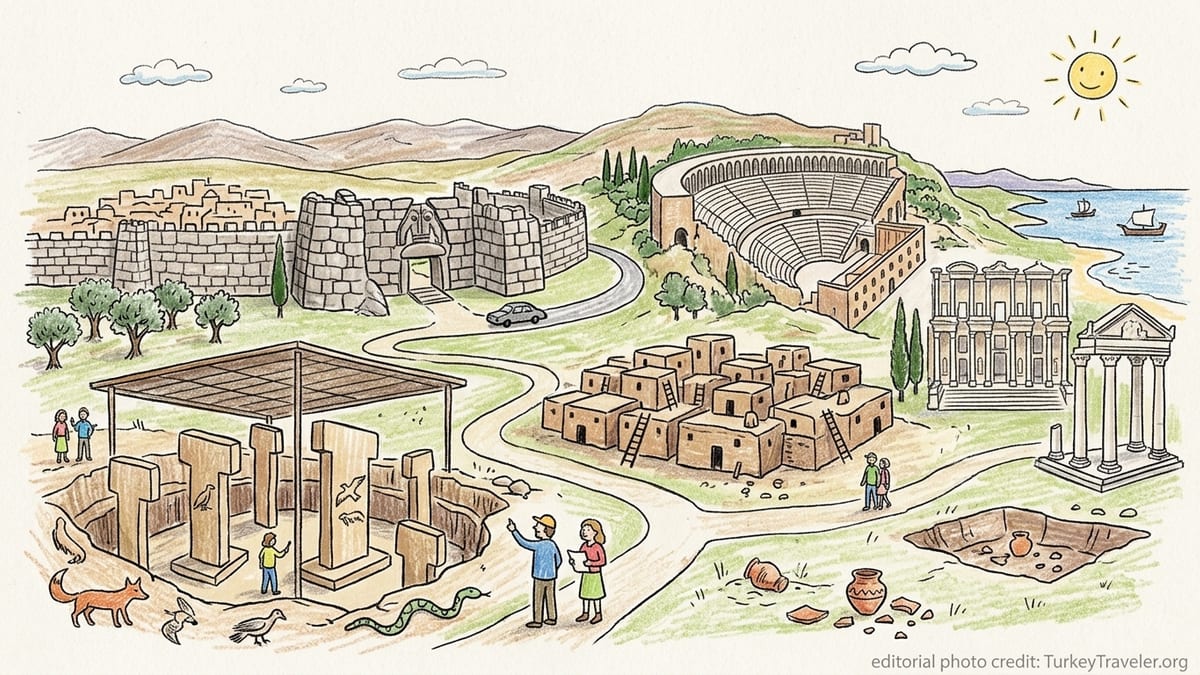
Why Anatolia’s Archaeology Spans 12,000 Years
Anatolia sits at the hinge of continents, where the Anatolian plateau funnels trade and migration between the Balkans, the Aegean and Eastern Mediterranean, northern Mesopotamia and the Caucasus. River systems like the Euphrates, Tigris, Kızılırmak and Büyük Menderes connect inland plains with the sea, while passes through the Taurus and Pontic ranges open routes east to Iran and south to Syria. Because of this geography, new ideas and people have kept arriving here for thousands of years, from Neolithic hunter-gatherers to Hittite emperors, Greek colonists, Roman administrators, Seljuk sultans and Ottoman builders.
That position created an unusually dense archaeological record. Sites like Göbekli Tepe in Şanlıurfa province preserve monumental ritual architecture from the 10th millennium BC, long before pottery or settled farming appeared in much of Europe. By the 2nd millennium BC, Hittite kings ruled from Hattusa in today’s Çorum province. Later, Ionian and other Greek cities lined the Aegean, Roman engineers built vast theaters and agoras at places like Ephesus and Aspendos, and medieval Armenian architects raised churches on the windswept plateau at Ani. As a traveler, you can start a day among Neolithic T-shaped pillars and finish it in a perfectly preserved Roman stadium or Ottoman caravanserai.
Because Anatolia has hosted so many cultures, archaeology here is layered and complex. Troy, for example, is not simply a backdrop for Homer’s Iliad but a mound of nine major levels covering more than 3,000 years of occupation. Many sites were rebuilt after earthquakes or war, so what you see combines original ancient masonry, anastylosis (careful re-erection of fallen blocks) and modern consolidation. Monuments famous from ancient texts, such as the Temple of Artemis at Ephesus or the Mausoleum at Halicarnassus in Bodrum, survive today only as foundations, scattered blocks and museum pieces, not as the towering wonders described by ancient writers.
This guide is organized by period and civilization rather than rankings, to help you see how different regions and cultures overlap. For each site you will find its main civilization and period, best surviving features, the modern province and nearest practical base, a realistic visit duration, the general admission category for foreign visitors, how easy it is to reach, and the main drawback to factor into your planning.
Neolithic and Chalcolithic Beginnings: Göbekli Tepe, Çatalhöyük, Arslantepe
Göbekli Tepe, in Şanlıurfa province, is one of the world’s most discussed archaeological sites. Dated to around 9600–8200 BC, it preserves circular and oval enclosures built by hunter-gatherers with T-shaped limestone pillars carved in low relief with foxes, snakes, birds and abstract symbols. The best surviving features are the great T-pillars of Enclosure D under a modern protective roof and the surrounding landscape views across the plains toward Syria. The site lies about 20 minutes’ drive from Şanlıurfa city, which makes the best base, with frequent domestic flights and mid-range hotels near Balıklıgöl. A focused visit takes about two to three hours including the shuttle ride from the visitor center. As of late 2026, foreign visitors pay about 20 euros for the archaeological site, with a separate small fee for the replica “experience” center, and Göbekli Tepe is included on the 15-day MuseumPass Türkiye, which costs about 165 euros for foreigners. The main drawback is that only part of the site is accessible, with walkways and active excavations limiting your sense of the wider mound, and summer temperatures can exceed 40°C, so early-morning entry around the 08:30 opening is strongly recommended.
Çatalhöyük, near Konya in central Anatolia, represents a very different Neolithic world. Around 7400–6000 BC, early farming communities here built densely packed mudbrick houses without streets, entering from the roof via ladders. The best surviving features are the excavated house plans under large shelters, wall platforms that once supported burials beneath the floor, and reconstructed sections showing how homes abutted each other. Konya city is the usual base, roughly a 45-minute drive away; local agencies and some hotels can arrange taxis or day tours. You can see the site and its small visitor center in one to two hours, often combined with Konya’s archaeology museum and Mevlana complex. Admission for foreign visitors falls in the lower museum fee band, and the site is relatively quiet compared to coastal ruins. The drawback is that much of what made Çatalhöyük special, such as painted wall art and figurines, has been removed to museums, so you need some imagination or a good guide to bring the spaces to life.
Arslantepe, outside Malatya in eastern Turkey, gives a window into the emergence of early political organization in the 4th and 3rd millennia BC. Here, archaeologists have uncovered a mudbrick palace complex with storage rooms, ceremonial spaces, rich wall paintings and a cache of metal weapons that hint at early forms of state control. The standout remains are the palace foundations under shelter, painted plaster fragments, and the on-site replicas of the famous “lion gate” orthostats, with originals in the Ankara Museum of Anatolian Civilizations. Malatya city is about 15 minutes away by taxi, and you can visit Arslantepe comfortably in two hours, often paired with the local museum. Foreign entry fees are moderate, but check locally because eastern sites sometimes adjust hours seasonally. Access is straightforward by road, yet the drawback is limited tourist infrastructure compared with western Turkey; English signage, while improving, can be patchy, so an informed guidebook or downloaded site plan is useful.
Bronze Age Empires: Hattusa, Yazılıkaya and Multi-Layered Troy
In the Late Bronze Age, around the 14th and 13th centuries BC, the Hittite Empire rivaled New Kingdom Egypt and ruled much of central Anatolia from its capital Hattusa. Today, the ruins of Hattusa near Boğazkale village in Çorum province include massive city walls, monumental gates such as the Lion Gate and King’s Gate, the vast Great Temple precinct and tiers of administrative buildings. The best surviving features are the fortification circuit that you can largely drive around by car, the postern tunnels built with corbelled stone, and views across the rolling plateau. Boğazkale or the nearby town of Sungurlu provide small-scale accommodation, but many travelers base themselves in Ankara and visit on a long day trip of around 10 to 12 hours including driving. Time on site itself is usually three to four hours. Hattusa and its sanctuary are on the standard national museum ticket list; entry for foreign visitors is in the mid-range euro equivalent and covered by MuseumPass Türkiye. The main drawback is that distances inside the site are long and shade is limited, so having a rental car or prearranged driver is almost essential unless you are prepared for substantial walking.
Just outside Hattusa lies Yazılıkaya, an open-air rock sanctuary where Hittite rulers carved processions of gods into natural limestone outcrops. Dating from the same imperial period, Yazılıkaya’s best features are Chambers A and B, whose reliefs show deities standing atop mountains or animals and a possible representation of the underworld. The carvings are original Hittite fabric, though erosion has softened some details, and low modern barriers and walkways protect them. Yazılıkaya is usually visited together with Hattusa and adds about an hour to your itinerary. The admission category is similar to Hattusa, and access is easy by car from Boğazkale. The drawback is that the sanctuary is compact, so if you arrive with a big coach group it can feel crowded, and interpretation relies heavily on panels and your own reading beforehand.
Troy, near the town of Tevfikiye in Çanakkale province, is one of the most famous archaeological names in the world, yet it rewards visitors who think beyond Homer. The mound preserves at least nine major settlement layers from the Early Bronze Age around 3000 BC through the Roman period. The best surviving features are the massive stone fortification walls and gates of Troy VI and VII, the reconstructed section of ramp, the outlines of megaron houses, and Roman-period theater and odeon. A new site museum at the entrance displays finds from the excavations, including domestic pottery and architectural fragments. Çanakkale city, connected by coach services and domestic flights, makes the easiest base, with organized day tours that combine Troy and the Gallipoli battlefields. Plan at least three hours including the museum. For foreign visitors, Troy sits in the mid-tier euro price band and is usually included in multi-day Aegean passes. The biggest drawback is that a relatively small portion of the mound is visually impressive; without a guide or good plan, it can be hard to match what you see to specific periods, and those expecting towering Homeric walls may be underwhelmed.
Iron Age Kingdoms: Hittite Successors, Phrygians at Gordion and Lydians at Sardis
After the fall of the Hittite Empire around 1200 BC, power in central and western Anatolia shifted to smaller kingdoms and cultural groups. One of the best places to explore this Iron Age landscape is Gordion, capital of the Phrygians, about 90 kilometers southwest of Ankara near the modern village of Yassıhöyük in Ankara province. Here you will find the citadel mound with its gate and megaron buildings, an excellent site museum and a field of tumuli, including the colossal Tumulus MM, traditionally linked to King Midas. The highlight for most visitors is entering the timber burial chamber of Tumulus MM via a modern tunnel, where the ancient log structure is preserved in situ behind supports. Ankara is the natural base, with car rental and organized day trips; allow a half day, around four to five hours including travel. Entry costs for foreigners are modest compared with headline coastal sites and the area is rarely crowded. The drawback is that wind and exposure on the plateau can make visits in winter uncomfortable, and ongoing conservation means some areas of the citadel may be roped off.
Sardis, near Salihli in Manisa province, was the capital of the Lydian kingdom in the 7th and 6th centuries BC, famous for early coinage and the legendary wealth of King Croesus. Later, it became an important Hellenistic and Roman city. The best surviving features are the impressive Roman gymnasium-bath complex with its restored marble facade through anastylosis, the adjacent late antique synagogue with mosaic floors and inscriptions, and scattered remains of the Artemis Temple a few kilometers away. The coins that helped make Sardis rich are displayed mainly in museums, but interpretive panels on site explain their significance. İzmir or Salihli serve as bases; by car, Sardis is about 1.5 hours from İzmir, and some Aegean tours include it alongside Ephesus or Pergamon. Plan two to three hours on site, longer if you also visit the Artemis Temple zone. Admission for foreign visitors is in the same range as many western Anatolian sites, and parking is straightforward near the entrance. The drawback is that the Lydian royal quarter is largely buried or subtle in the landscape, so much of what you see belongs to the later Roman period, and shade can be limited in summer.
Farther inland and in eastern Anatolia, numerous Iron Age fortresses and Urartian, Phrygian and Neo-Hittite sites dot the landscape, but they are less developed for casual visitors. For travelers with more time and a rental car, regional museums in Ankara, Kayseri, Van and Gaziantep bring together objects from these smaller kingdoms and help connect the dots between better-known capitals like Gordion and Sardis.
Classical and Roman Cities: Distinct Characters Across the Aegean and Mediterranean
Western and southern Turkey hold a dense band of Greek and Roman sites, but each has a different personality. Ephesus, near Selçuk in İzmir province, was one of the largest cities in the Roman Empire and a key center of early Christianity. The best surviving features include the marble-paved Curetes Street, the Library of Celsus facade carefully re-erected through anastylosis, the vast Great Theatre seating around 25,000, and the Terrace Houses with intact mosaics and wall paintings under a protective roof. The celebrated Temple of Artemis, once a Wonder of the Ancient World, is represented today only by foundations and fragments in the landscape and museums. Selçuk town makes the ideal base with frequent trains from İzmir and on to Denizli, plus guesthouses in walking distance of the Ephesus Museum. As of October 2026, a combined ticket for the archaeological site and Ephesus “experience” museum costs around 40 euros for foreigners, with the Terrace Houses as an additional ticket around the mid-teens in euros; there is also a 72-hour combined ticket that covers Ephesus, the Terrace Houses, the museum and the Basilica of St John at a slight discount. Expect to spend at least three to four hours on site and more if you include the museum. The main drawbacks are heavy crowds from cruise ships in summer and limited shade along the main streets, so arriving for the 08:00 opening reduces both heat and congestion.
Pergamon (Bergama), in İzmir province north of İzmir city, offers a dramatically different experience. The Hellenistic acropolis crowns a steep hill above modern Bergama, with sweeping views across the Bakırçay valley. The standout remains are the steep theater cascading down the slope, foundations of the Altar of Zeus (whose sculptural frieze is now in Berlin), the Trajaneum temple platform, and a Roman-era hillside sanctuary of Asclepius in the lower town. Much of what you see on the acropolis is original masonry with protective consolidation; reconstructions are limited to restoring walls and column fragments. Bergama town makes a friendly base, with a cable car up to the acropolis. A full visit including the acropolis and Asclepieion takes four to five hours. For foreign visitors, Pergamon falls within the higher fee category used for major Aegean sites but still costs less than many European equivalents. The main drawback is that the acropolis is very exposed, and the steep terrain and stairs make it challenging for visitors with limited mobility.
Aphrodisias, in Aydın province near Geyre village, is beloved by archaeologists for its marble sculpture and relatively rural, uncrowded setting. The city, prominent in the Roman Imperial period and dedicated to Aphrodite, preserves a magnificent stadium that is one of the best in the ancient world, the restored Tetrapylon gateway reconstructed through anastylosis using original blocks, the temple-basilica complex and an outstanding on-site museum full of reliefs and portraits. Many visitors stay in Pamukkale or Denizli and visit Aphrodisias on a day trip of around eight hours including driving, but there are also small guesthouses closer to the site. Allow at least three to four hours to explore the ruins and museum. Entry fees for foreign visitors are moderate, and the site is included in many regional museum passes. The drawback is transportation complexity without a car; public transport connections are limited, so most travelers join a small tour or hire a driver.
Hierapolis, perched above the travertine terraces of Pamukkale in Denizli province, offers the most theatrical setting of any Anatolian Roman city. Built as a spa and religious center, it features a large theater with original seating and partially restored stage buildings, a vast necropolis with sarcophagi lining the approach roads, the Martyrium associated with St Philip and bath complexes integrated with hot springs. The best surviving features mix original stonework, careful anastylosis and more recent reconstruction in limited sections. Pamukkale village immediately below the terraces serves as the natural base, offering everything from budget pensions to mid-range thermal hotels. Many travelers visit on bus tours from İzmir or Antalya, but an overnight stay allows you to enjoy the terraces in early morning light. Entry tickets for foreign visitors cover both the terraces and Hierapolis archaeological zone and sit in the upper pricing tier; there is also a separate fee for the antique pool. The drawback is intense crowding around the main pools in peak season and the challenge of balancing time between natural and archaeological attractions in a single day.
Along the Mediterranean coast near Antalya, several classical sites cluster within easy reach. Perge, just east of Antalya city, preserves a straight Roman colonnaded street, a well-preserved stadium, baths and Hellenistic towers flanking the gate. Most of what you see is original stone stabilized with modern mortar, with selective anastylosis of columns along the streets. You can visit Perge in two to three hours from a hotel in central Antalya by tram and taxi or on a half-day tour; entry falls into the mid-range band. The drawback is summer heat reflecting off wide stone streets and limited interpretation panels in English.
Aspendos, inland from Belek in Antalya province, is famous for having one of the best-preserved Roman theaters anywhere. The cavea, stage building and acoustics are largely original, with careful conservation and structural support. Modern seating and backstage interventions are minimal, so the theater feels impressively intact. Belek or Antalya provide the easiest bases, and many tours pair Aspendos with Perge and waterfalls nearby in a full-day outing. Admission for foreigners is in the same bracket as Perge. The main drawback is that during festival events or performances you may find parts of the theater set up with modern equipment, which can distract from the ancient atmosphere.
Side, on a small peninsula east of Antalya, combines resort town and ruins. Its principal surviving features are a large theater adapted from a Hellenistic to Roman design, the sea-facing Temple of Apollo and Athena columns re-erected by anastylosis on the promontory, city walls and an on-site museum in the Roman baths. Many visitors stay in Side’s hotels and stroll among ruins at sunset, which gives it a different mood from isolated archaeological parks. Entry fees for the theater and museum are modest, and you can explore the surrounding streets freely. The drawback is strong commercialization, with bars, shops and beach crowds surrounding world-class heritage.
Priene and Miletus, in Aydın province near the modern town of Söke, showcase the rational city plans of the Ionian Greeks. Priene, set on a hillside below Mount Mycale, preserves a grid street plan, a compact theater with original seating, the remains of the Temple of Athena with some columns re-erected in anastylosis and fine views across the floodplain. Miletus, once a major port, now sits inland and features a large theater, bath complexes and scattered temples. Many travelers visit both from Kuşadası or Selçuk on a full-day excursion that might also include Didyma’s monumental temple. Entry prices for each are in the lower to mid-euro range. The drawback is limited public transport; without a rental car, you will likely rely on day tours or private drivers, and summer vegetation can obscure some structures.
Patara, near Gelemiş in Antalya province, was an important Lycian and later Roman harbor. Today, sand has partly reclaimed the site, but you can walk through a restored Roman theater, a rebuilt assembly building that once housed the Lycian League council, colonnaded streets and the remains of a lighthouse. Conservation work at Patara includes substantial anastylosis and reconstruction using original blocks where possible, so you get a sense of volume without mistaking it for untouched antiquity. Many visitors base themselves in nearby Kalkan or Kaş and combine a half-day visit to Patara with time on its long sandy beach, accessed via the same entrance road and protected as a nesting ground for loggerhead turtles. Entry fees for foreign visitors sit in the mid-range, and a car park is included. The drawback is summer heat on the exposed dunes and the need to manage time carefully if you want to see both ruins and beach before the late-afternoon winds pick up.
Lycian Politics and Tombs, Commagene Peaks and Medieval Ani
The mountainous Teke Peninsula between Fethiye and Antalya once formed the core of ancient Lycia, a federation of cities with a distinctive language and funerary culture. Xanthos-Letoon, in Antalya province near Kınık, is a UNESCO-listed double site that combines a city and its federal sanctuary. At Xanthos you can see rock-cut tombs carved into cliffs, pillar tomb bases, a theater and acropolis; at nearby Letoon the remains of temples dedicated to Leto, Apollo and Artemis stand beside a marshy sacred pool. Many inscriptions from Xanthos are bilingual in Lycian and Greek, and casts or originals are in major museums, but onsite panels explain their importance for deciphering the Lycian language. Visitors usually base in Kaş, Kalkan or Fethiye and include Xanthos-Letoon on a circuit of coastal sites; allow two to three hours for both, plus driving time. Entry for foreign visitors is moderate and the MuseumPass covers the site. The drawback is that some of the most famous sculptures were removed to foreign museums in the 19th century, so the setting feels quieter than its history suggests.
Myra, near today’s Demre in Antalya province, combines Lycian tombs and later Christian heritage. The best-known features are the honeycomb of rock-cut Lycian tombs above the Roman theater and, in town, the Church of St Nicholas associated with the historical bishop who inspired the Santa Claus legend. The tomb facades and theater seating are original stone, though walkways and railings are modern additions. Demre makes an easy base with pensions and small hotels, and many day trips along the coast stop at Myra together with boat excursions to the partially submerged ruins at Kekova. You can see both the tombs and the church in two to three hours. Entry fees are separate for the two sites and in the lower euro range compared with marquee destinations. The drawback is heavy coach traffic in peak season, and the tomb area itself is compact, so it can feel crowded when multiple groups arrive at once.
Nemrut Dağ, in Adıyaman province in southeastern Turkey, offers one of the most surreal archaeological landscapes in the country without veering into fantasy. On a 2,134-meter-high peak, King Antiochus I of Commagene in the 1st century BC built a tumulus flanked by terraces lined with colossal seated statues of gods, eagles and lions, along with stelae showing the king shaking hands with deities. The heads of the statues, toppled by earthquakes, now sit at ground level, giving the site its iconic photographic angles. The statues are original Hellenistic stone, though stabilized and protected with discreet supports. Travelers typically base themselves in Kahta or Adıyaman city, with small hotels offering sunrise and sunset tours that include minibus transport up the winding mountain road. Entry to the Nemrut archaeological zone and surrounding national park carries a modest fee for foreign visitors, with a separate charge for vehicle access. A visit from Kahta takes about half a day, but almost all travelers time their arrival for sunrise or sunset to see the changing light on the limestone. The biggest drawbacks are altitude, steep uneven steps that challenge less mobile visitors, and limited facilities on the summit; in April and late autumn nights can be close to freezing even when nearby valleys feel mild.
Far to the northeast, Ani in Kars province sits on a windswept plateau above the Arpaçay River, close to the border with Armenia. Once a flourishing medieval Armenian capital and trading hub, Ani preserves a remarkable mix of 10th to 13th century Armenian churches, defensive walls, Seljuk-era caravanserais and mosques. The best surviving features include the city walls with their towers and gateways, the Cathedral of Ani with soaring pointed arches, the Church of the Redeemer with its partial dome, and the Seljuk mosque of Manuchihr with its minaret overlooking the gorge. Most buildings are original medieval fabric with careful consolidation; missing volumes are left as ruins rather than reconstructed. Kars city, about 45 minutes away by road, is the standard base, with mid-range hotels and winter access via flights and the popular Eastern Express train from Ankara. As of late 2026, foreign visitors pay around 8 euros for entry, with children under eight entering free; the site operates extended hours in summer and shorter hours in winter. A thorough visit takes at least three to four hours, and the exposed plateau means you should bring layers even in summer. The main drawbacks are its remote location from other major tourist centers and limited shade or shelter on site; in winter, snow can partly cover paths, making sturdy footwear essential.
Original Stone, Reconstruction and What No Longer Stands
At almost every archaeological site in Turkey you will encounter a mix of original ancient fabric, discrete reconstruction and full anastylosis. Understanding these categories helps you read what you see. At Aspendos, for example, most of the theater’s structure is original Roman masonry carefully conserved; the use of modern materials is largely limited to safety railings and small patches of mortar. In contrast, the Library of Celsus at Ephesus and the Tetrapylon at Aphrodisias were re-erected from collapsed blocks in the 20th century, with missing pieces filled or supported so that visitors can understand the monuments’ original height and appearance. Panels usually indicate which elements have been reassembled.
Anastylosis, the re-erection of original elements in their original positions, is widely used in Turkey as a middle path between leaving ruins collapsed and engaging in speculative rebuilding. At Patara’s assembly building and theater, for instance, archaeologists re-used original stones and supplemented them with clearly distinguishable modern blocks to visualize how the structures worked. This approach gives you a better sense of space while still respecting authenticity. When you walk through these structures, look for subtle differences in stone color or texture that mark new material.
Some of the most famous ancient monuments in Anatolia, however, simply no longer exist in their celebrated form. The Temple of Artemis at Ephesus, once described as larger than the Parthenon, was destroyed and reused as building material over centuries; today only one re-erected column and foundation outlines remain in a marshy field, while sculptural fragments sit in museums in Selçuk, Istanbul, London and elsewhere. The Mausoleum at Halicarnassus in Bodrum, another canonical Wonder of the Ancient World, survives as a low platform and a scatter of column drums and sculpted blocks in a small archaeological precinct; many of its reliefs and statues were removed in earlier centuries. Managing expectations is important: modern travelers sometimes arrive expecting towering temples and instead find evocative foundations. The reward is the broader story you gain by visiting several sites and museums rather than a single “spectacle.”
Because conservation philosophy in Turkey emphasizes stabilizing ruins where they are found, fully rebuilt monuments are relatively rare. Exceptions include select portions of city walls or agoras reconstructed to protect underlying layers or to support visitor circulation. Whenever you see freshly cut stone at the base of a column or arch, it usually marks a modern intervention. Asking local guides about which parts are original and which are restored can add depth to your visit and helps support responsible tourism that values authenticity over spectacle.
Planning Archaeological Itineraries: West, Center and Southeast
If your time is limited, organizing travel by region rather than hopping across the country saves long bus and flight days. A classic western itinerary uses İzmir and Antalya as hubs. From İzmir, base yourself in Selçuk for at least two nights to explore Ephesus, the Ephesus Museum and the modest remains of the Temple of Artemis, with optional side trips to Priene, Miletus and Didyma. From there, you can travel by train or bus to Denizli for one or two nights at Pamukkale to see Hierapolis and the travertines, then continue to Aphrodisias either on a day trip or with an overnight near Geyre. Returning to the coast, you might spend several days working your way down through Bodrum, Fethiye, Kaş and Antalya, visiting Xanthos-Letoon, Patara, Myra and Perge-Aspendos-Side along the way. This western circuit works well in spring and autumn, when daytime temperatures are comfortable and coastal services run frequently.
A central Anatolia itinerary focuses on Ankara, Cappadocia and the plateau. Ankara’s Museum of Anatolian Civilizations makes an excellent starting point, with collections from Göbekli Tepe, Çatalhöyük, Hittite and Phrygian sites that frame what you will see in the field. From Ankara, you can visit Gordion on a half day and Hattusa and Yazılıkaya on a long day trip or overnight in Boğazkale. Continuing east or south, Cappadocia’s rock-cut churches, underground cities and valleys, while mostly Byzantine rather than ancient, add another layer to your understanding of Anatolian history. Central itineraries are particularly appealing in May–June and September–October, when the high plateau avoids the extremes of winter snow and summer heat. Renting a car for several days in this region often works out cheaper and more flexible than piecing together minibus connections, especially if two or more people travel together.
For travelers interested in the deepest time-depth, a southeastern itinerary linking Şanlıurfa, Nemrut Dağ and potentially Gaziantep is rewarding. You can fly into Şanlıurfa, spend one to two full days visiting Göbekli Tepe, the excellent Şanlıurfa Archaeology and Mosaic Museums and the historic old town, then travel by bus or private transfer to Kahta or Adıyaman for a sunrise or sunset ascent of Nemrut Dağ. From there, some routes continue on to Gaziantep, whose archaeology museum showcases mosaics from the Roman city of Zeugma, or even farther east toward Diyarbakır’s city walls. Security and infrastructure in southeastern provinces are generally stable as of 2026, but because conditions can change, it is wise to check recent government travel advisories and consult local tour operators before finalizing plans.
Reaching Ani in the northeast often requires a dedicated side trip. Many travelers fly to Kars or take the scenic overnight Eastern Express train from Ankara, stay two or three nights in Kars, and spend a half to full day exploring the Ani plateau. Winter visits have a romantic, snowbound atmosphere but require proper cold-weather gear; in summer, strong sun and wind mean hats and water are essential. Combining Ani with Lake Çıldır or local villages adds cultural variety to what is otherwise a focused archaeological excursion. Whatever regional itinerary you choose, consider investing in MuseumPass Türkiye if you expect to visit many state-run sites within 15 days; at around 165 euros, it quickly becomes cost-effective compared to individual tickets if you are covering a broad list of major ruins and museums.
FAQ
Q1. Do I need a guide to appreciate Turkey’s archaeological sites?
Many sites are visitable independently, with basic English signage. However, at complex places like Troy, Hattusa or Çatalhöyük, a licensed guide or a detailed guidebook adds significant value by explaining layers, chronology and recent interpretations that panels only summarize.
Q2. What is the MuseumPass Türkiye and is it worth it?
MuseumPass Türkiye is a card sold by the Ministry of Culture that offers foreign visitors 15 days of access to hundreds of state-run museums and archaeological sites for about 165 euros. If your itinerary includes multiple major sites such as Göbekli Tepe, Ephesus, Hierapolis, Pergamon, Aphrodisias and several museums, the pass often saves money and reduces time spent buying separate tickets.
Q3. When is the best season to visit outdoor ruins in Turkey?
Spring (April to early June) and autumn (late September to early November) usually offer comfortable temperatures and fewer crowds, especially at exposed sites like Hattusa, Pergamon and Nemrut Dağ. July and August can be extremely hot in western and southeastern Turkey, making early morning or late afternoon visits essential.
Q4. How much should I budget for entry fees on a two-week archaeological trip?
Entry fees for foreign visitors to major sites and museums typically range from a few euros at smaller sites to around 40 euros at flagship destinations like Ephesus with its experience museum. On a two-week trip visiting multiple big-name sites every day, independent travelers commonly spend several hundred euros on admissions alone unless they buy a MuseumPass to bundle costs.
Q5. Are the famous Wonders of the Ancient World still standing in Turkey?
No. The Temple of Artemis at Ephesus and the Mausoleum at Halicarnassus in Bodrum survive only as foundations, scattered blocks and museum fragments. You can visit the locations and see remains and reconstructions in museums, but the monumental temples and tombs described by ancient writers are gone.
Q6. How accessible are these sites for travelers with limited mobility?
Accessibility varies widely. Some places, such as portions of Ephesus and the lower areas of Hierapolis, have relatively smooth paths and ramps, while steep hill sites like Pergamon’s acropolis, Priene, Nemrut Dağ and parts of Ani involve uneven ground and many steps. It is important to research each site’s current accessibility information or consult tour operators who can adapt routes.
Q7. Can I rely on public transport to reach major archaeological sites?
Public transport works well for popular sites near towns, such as Ephesus from Selçuk or Hierapolis from Denizli, where minibuses and taxis are frequent. For more remote locations like Hattusa, Gordion, Aphrodisias, Xanthos-Letoon or Nemrut Dağ, renting a car or joining an organized tour is usually more practical than piecing together infrequent minibuses.
Q8. Is it safe to visit southeastern and eastern archaeological sites?
As of late 2026, sites such as Göbekli Tepe, Nemrut Dağ and Ani are open and receive regular tourism, and main roads are maintained. However, because security conditions can change, travelers should check current advisories from their government and consult local operators before heading to border or mountainous regions.
Q9. What should I pack for a trip focused on ruins and ancient cities?
Sturdy walking shoes with good grip, a wide-brimmed hat, sunscreen, a refillable water bottle and lightweight layers are essential for exposed sites. Many travelers also bring a small umbrella for shade, a paper or digital plan of each site, and a power bank so they can keep phones or cameras charged during long days outdoors.
Q10. How can I visit responsibly and help protect these ancient places?
Stay on marked paths, avoid touching carvings or climbing on walls, and follow photography rules in museums and at sensitive sites. Using refillable bottles instead of single-use plastic, supporting local guides and small guesthouses, and giving yourself enough time so you are not tempted to rush or cut corners all contribute to preserving Turkey’s archaeological heritage while still enjoying it.