


I arrived in Şanlıurfa with my head full of superlatives. Göbekli Tepe had been sold to me as a 12,000 year old temple that rewrote human history, the place that proved religion came before agriculture. Travel agencies in Istanbul called it the zero point of civilization. Airline magazines described those T shaped pillars as the oldest temple on Earth. That is the weight of expectation you carry when you step off the plane and point a taxi toward the plateau east of the city. The question is whether what you actually experience, from the visitor center to the controlled walkways around the excavations, lives up to that hype.
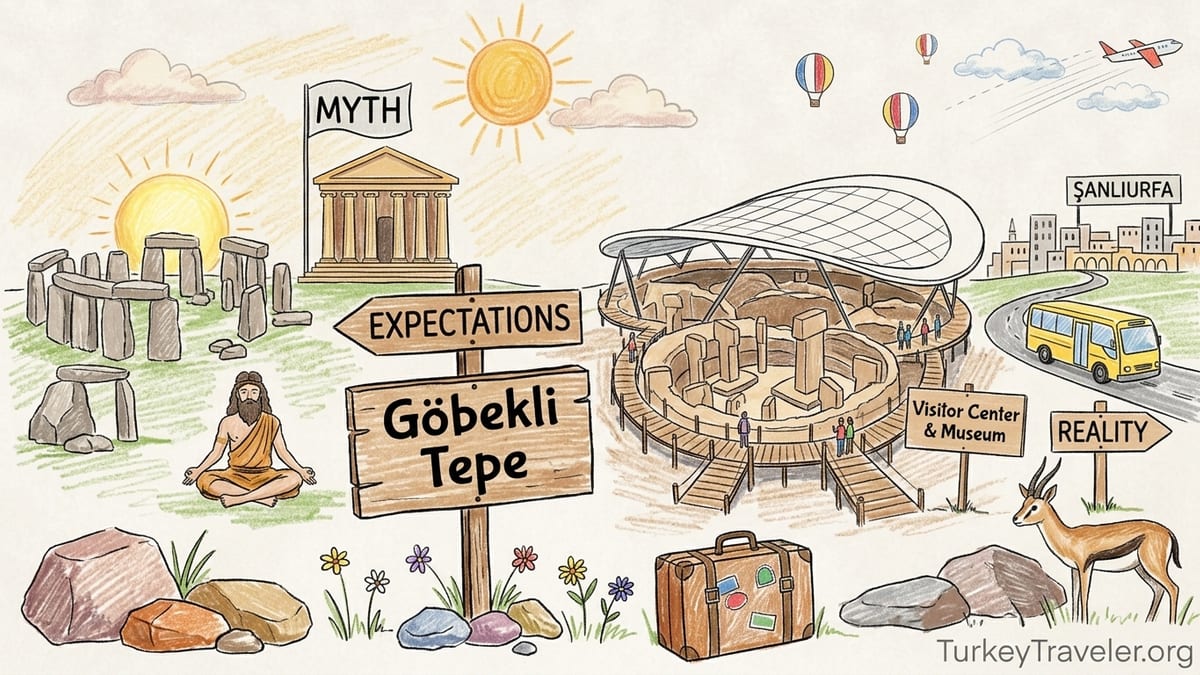
From Şanlıurfa to the Hilltop: Expectations vs Reality
Şanlıurfa today is a busy regional city, a mix of concrete apartment blocks and a compact, older center of mosques and bazaars. Göbekli Tepe lies roughly 20 kilometers to the northeast, on a low limestone ridge. Getting there already hints at the gap between headline and reality. The glossy brochures talk about the cradle of civilization, but the practical question is whether you will take a taxi, join a tour, or use the shuttle bus that leaves from near the Şanlıurfa Archaeology Museum. A metered taxi from the city center usually runs in the region of what you would expect for a 25 to 30 minute interurban ride in Turkey; drivers in 2026 commonly quote a flat price at the stand, and you should agree it clearly before setting off.
You do not drive directly to the stones themselves. Vehicles stop at a modern visitor center complex with ticket booths, a café, souvenir shops and interpretation displays. From there, a small shuttle bus or electric tram carries visitors up to the actual mound. This is the first moment when the phrase world’s oldest temple feels inflated. You are not entering some untouched prehistoric sanctuary. You are boarding a park shuttle under a steel and glass canopy, clutching a printed ticket, mentally checking the return departure time back to town.
On the morning I visited, the official opening hours for Göbekli Tepe were posted as 08:30 to 17:30, with last tickets sold at 17:00, in line with the winter schedule confirmed by Turkey’s culture ministry and recent visiting guidance reviewed in late October 2026. I still double checked at my hotel, because published hours for Turkish sites can shift between winter and summer, and the ministry’s own pages are not always synchronized. The lesson is simple but important: take the headline times as a guide, but confirm locally a day or two before you go.
By the time the shuttle left the visitor center car park and wound up toward the shelters on the hill, I realized how much my imagination had been shaped by marketing language. I was looking for a Stonehenge in the desert, a monumental ring you could walk among. What I found instead was an active research site carefully fenced, roofed and mediated for visitors.
What the Archaeology Actually Shows: Dates, Pillars and Uncertainty
The excavated parts of Göbekli Tepe consist of a series of circular and oval enclosures cut into the bedrock and lined with massive T shaped limestone pillars. These enclosures sit within a broader mound that also preserves smaller buildings, work areas and later activity. Radiocarbon dates and stratigraphic work place the main monumental phase between roughly 9600 and 8200 BCE, within the Pre Pottery Neolithic. That makes the site older than Stonehenge and the Egyptian pyramids by many millennia, which is the kernel of truth behind the breathless slogans.
Walking the elevated wooden paths that now ring the principal excavation area, you see pillars rising three to five meters high, some more massive, some slimmer, all carved from local limestone. On several, sculptors incised reliefs of wild animals: snarling felines, birds, snakes, foxes, wild boar. Some pillars bear stylized human arms and hands folded in front, which is why archaeologists describe them as anthropomorphic T shapes rather than simple posts. Between and around these stand lower stones and walls, giving the impression of a sunken circular space framed by a ring of upright figures.
Yet the phrase world’s oldest temple distorts more than it explains. Official language from UNESCO and the Turkish authorities is more cautious. They describe monumental communal buildings likely tied to gatherings and ritual activity, but emphasize that the exact function remains debated. Excavations have also uncovered smaller, less monumental structures and domestic style features that do not fit neatly into the pure temple idea. Some scholars argue that Göbekli Tepe should be understood as part of a landscape of early sedentary communities, where ritual, feasting, craft and daily life overlapped rather than remained strictly separated.
From the visitor walkway, that debate is mostly invisible. You see grand architecture and dramatic carvings, which encourages you to accept the simplest story offered on a guide’s microphone. It takes effort to remember that the same radiocarbon sequence that dates the site so early also shows change over time, and that those changes need more nuance than one big slogan about a temple that appeared fully formed at the edge of the Ice Age.
Does Göbekli Tepe Really Prove Religion Came Before Agriculture?
One of the most persistent claims in popular coverage is that Göbekli Tepe proves religion came first and agriculture followed, a neat reversal of the old model in which farming villages gradually produced organized religion. The stones themselves cannot be so easily enlisted in that narrative. Yes, the earliest enclosures date from a period when the people of Upper Mesopotamia were still primarily foragers experimenting with wild cereals and herd animals rather than fully farming them. But the broader archaeological record of the region shows a patchwork of sites where cultivation, sedentism, hunting, herding and ritual practices all changed over several thousand years.
Sites such as Nevalı Çori, Karahan Tepe and others in the wider Taş Tepeler (Stone Hills) network contain similar T shaped pillars and special buildings alongside more conventional domestic structures. At some locations, grinding stones, storage pits and plant remains point to intensified use of certain cereals and perhaps early cultivation. In others, faunal remains indicate heavy reliance on wild gazelle or other game. In every case, ritual features like stone benches, decorated pillars or deliberately buried buildings appear embedded in daily life, not floating above it.
The honest conclusion is that Göbekli Tepe demonstrates how closely interwoven ritual behavior and changing subsistence strategies were in the early Holocene. People met, feasted, carved, erected pillars, butchered animals and experimented with managing plants and herds across the same landscapes. Religion versus agriculture is a modern binary. On the ground, in the hills outside Şanlıurfa 11,000 years ago, social gatherings, symbolic expression and economic change blurred together.
This matters for visitors because many agencies now package Göbekli Tepe as the moment everything began, complete with taglines suggesting it overturned all previous knowledge of human history. In reality, it refined and enriched our understanding of an already complex transition. That is intellectually thrilling, but it is less tidy than the sales copy, and you will not grasp it fully unless you spend time with the site plans and the broader regional story, especially at the Şanlıurfa Archaeology Museum back in town.
Controlled Access: Walkways, Roofs and What You Actually See
The second major gap between hype and experience becomes obvious as soon as you step off the shuttle and onto the main viewing platform. Visitors do not wander freely among the pillars. You do not stand inside the excavated circles or place your hand on the carved foxes. Göbekli Tepe is an active and fragile excavation, and access is tightly controlled to protect the stones and allow continuing research.
Today, a network of raised wooden walkways loops around and partly above the principal enclosures, protected by large white canopy roofs that shield the stones from rain, wind and direct sunlight. From the planks, you can look down into the circular spaces from a variety of angles. In some spots you are within a few meters of the nearest pillar; in others you peer across a larger span, craning to see carved reliefs on the far side. Guardrails prevent you from leaning out or descending, and ropes block any side paths toward ongoing dig areas. Uniformed staff and discreet cameras ensure nobody steps off the permitted route.
Photographically, the roofs are a mixed blessing. They preserve the site, which is more important than any snapshot, but they also cast diffuse, sometimes flat light across the stones. Wide shots often include the skeletal steel supports of the shelter, which can be disappointing if you arrived expecting unobstructed, cinematic views. With a decent camera or a modern phone, you can still capture tight details of the carvings by zooming or cropping around the beams, but the overall aesthetic is undeniably one of a managed heritage site rather than a ruin in the wild. Visitors hoping to recreate the atmospheric press photos shot before the roofing was installed will not be able to do so from the public paths.
Understanding this in advance changes how you plan your visit. Rather than picturing hours wandering between megaliths, think of a circuit walk broken by several long viewing pauses. Most independent travelers I spoke with spent between 60 and 90 minutes at the top, including time to read panels and listen to the audio guide. For some, especially those who had flown across continents drawn by the zero point of civilization slogan, that felt short compared with their expectations.
Tickets, Hours and Interpretation: Value for Money
As of late October 2026, foreign visitors pay a ticket price in the approximate range of 20 euros equivalent for Göbekli Tepe, according to the latest fee schedule compiled from official ministry tariffs and recent visitor reports. The site accepts the nationwide Museum Pass Türkiye, which can be worthwhile if you are combining Göbekli Tepe with other major Turkish museums and ancient sites in a short period. There is no separate fee for the shuttle from the visitor center to the mound; it is included in the entry.
Officially, winter opening hours run from 08:30 to 17:30 with the ticket office closing at 17:00. Earlier seasonal documents from the ministry outline a general pattern in which sites shift to longer evening hours between April and early October and revert to shorter days in winter. However, different language versions of the Taş Tepeler and museum pages have occasionally listed conflicting times, and one internal document even marked Göbekli Tepe as closed while other channels showed it open. That bureaucratic noise is a reminder to double check hours through your hotel or a reputable local agency just before you go, especially if you are planning an afternoon visit that pushes against the last entry.
Once inside, interpretation quality is mixed. The small exhibition space at the visitor center presents 3D models, brief timeline panels and some replica pillars. It does a fair job of situating Göbekli Tepe within the Neolithic, but glosses over ongoing academic disagreements in favor of digestible phrases about the world’s oldest temple and the site that changed history. Up at the mound, freestanding panels identify individual enclosures and point out selected carvings. A free audio guide app available through the official system, which several recent visitors have praised, adds more depth if you download it in advance or use the headsets sold on site.
Where the interpretation falls short is in connecting this single hill to the broader Upper Mesopotamian story in a rigorous way. A casual visitor could easily leave thinking that humanity made one great leap here and then spread civilization outward, when in fact the archaeological record shows a web of interacting communities and sites. Considering the ticket price and Göbekli Tepe’s global fame, the on site displays could afford to trust visitors with a more complex and honest narrative.
Göbekli Tepe Within the Taş Tepeler Network and the Karahantepe Problem
Göbekli Tepe is only one of a cluster of early Neolithic sites scattered around Şanlıurfa, grouped by Turkish authorities under the brand Taş Tepeler, the Stone Hills. Karahantepe, Sayburç, Sefertepe and several others share similar carved pillars or special buildings. In academic terms, this is a strength: it allows archaeologists to compare how communities across a region experimented with new forms of architecture and ritual over centuries. For visitors, however, it has created a marketing problem, particularly around Karahantepe.
Travel brochures and online tour descriptions in 2025 and 2026 increasingly promoted combined Göbekli Tepe and Karahantepe itineraries, with language suggesting guaranteed access to both sites in one day. Yet when I checked the most recent official status updates in October 2026, Karahantepe remained listed as closed to regular visitors, with authorities emphasizing ongoing excavation work and preservation needs. Independent visit planners and regional information portals likewise flagged the site as not yet open for routine tourist access, despite occasional controlled visits by specialist groups or during limited events.
This disconnect matters if you are booking a two site tour from afar. A number of operators still advertise Karahantepe in their itineraries while burying the possibility of a substitute stop in the fine print. In practice, several travelers have reported that their supposed Karahantepe visit turned into a stop at a viewpoint outside the fenced area, a detour to another archaeological mound, or extra time at Göbekli Tepe itself. None of those are necessarily bad experiences, but they are not the second major excavation that guests thought they were paying for.
Before you commit to a combined tour, ask the operator directly whether they have confirmed access to Karahantepe for the specific date of your visit, whether any permit is in hand, and what replacement will be offered if the site remains closed. Be wary of anyone promising guaranteed entry despite the official closure notices still in place in October 2026. The Taş Tepeler brand is exciting, but it should not be used to oversell on the backs of sites that are not yet visitor ready.
Şanlıurfa Archaeology Museum: The Essential Second Half
If Göbekli Tepe on the hill feels visually underwhelming compared with the promotional images, the Şanlıurfa Archaeology Museum in the city is where much of the intellectual power of the story emerges. Housed in a modern complex in the Haleplibahçe district, opposite a large shopping mall, the museum holds the key finds from Göbekli Tepe along with material from Karahantepe and other early Neolithic and later sites. The carved pillars in situ on the hill are impressive; the reliefs and sculptures displayed at eye level in the museum are astonishing.
As of late 2026, a single combined ticket for the Şanlıurfa Archaeology Museum and the adjacent Haleplibahçe Mosaic Museum costs in the region of 10 euros for foreign visitors, according to the ministry’s published tariff and the current e ticket system. Hours have varied in recent updates, with some channels listing 08:30 to 17:00 and others indicating extended evening opening and even night museum sessions. Here again, the safe choice is to plan a daytime visit and verify the current schedule with your hotel or by phone once in town.
Inside, a dedicated Karahantepe and Neolithic Human exhibit runs through at least early 2027, highlighting finds from the wider Taş Tepeler project. One of the star pieces is a life sized anthropomorphic statue sometimes described as one of the oldest known human scale sculptures. Other galleries present the portable art, tools and animal bones that give texture to life around these early monumental sites. Labels, while not exhaustive, are more detailed and careful than the brief panels on the hill, and the spatial arrangement helps you see Göbekli Tepe not as a lone miracle but as part of a continuum of human experimentation in settlement and symbolism.
Put bluntly, if you visit Göbekli Tepe without visiting the Şanlıurfa Archaeology Museum, you will see the stones but miss much of the meaning. Together, they form a coherent experience. Alone, the hilltop site risks becoming a box to tick, a rushed hour on walkways high above carvings whose context you have not yet learned to read.
Sensational Claims and Pseudoscience: What the Evidence Does Not Say
Given Göbekli Tepe’s age and enigmatic architecture, it has inevitably attracted a cloud of speculative theories that go far beyond the evidence. Some television programs and popular books have suggested extraterrestrial influence, a lost advanced civilization, encoded prophecies or maps of the stars hidden in the pillar arrangements. These ideas make for compelling headlines and documentary narration, but they are not supported by the excavation data or the broader archaeological record.
The pillars at Göbekli Tepe were carved with stone tools by communities that also left behind flint blades, grinding stones, animal bones and refuse typical of Pre Pottery Neolithic sites in the region. The engineering required to raise them is impressive, but comparable feats of organized labor are visible at many later prehistoric monuments built without any hint of alien technology. Alignments between pillars and particular constellations, when statistically tested, do not rise above the level of coincidence one would expect in any ring of multiple upright stones.
None of this strips Göbekli Tepe of its wonder. If anything, knowing that people with no metal, no pottery and no cities mobilized to create such a complex, layered site makes it more humanly impressive. But it does mean that when you stand on the walkways and listen to a guide, you should be attentive to where interpretation ends and imagination begins. An honest guide will talk about stone extraction, carving techniques, refilling of enclosures over time and comparisons with other Taş Tepeler sites, not about aliens or end times prophecies.
For travelers, this distinction matters because sensational stories can boost expectations unrealistically. If you arrive primed to see a message from the stars, the reality of eroded limestone under a modern roof might feel flat. If you come prepared to contemplate how early communities organized themselves, collaborated, remembered ancestors and experimented with new ways of being together in a changing climate, the same view down into those circular enclosures can be deeply affecting.
Five Concrete Criticisms: Where the Hype Outruns the Hill
Looking back on my visit and the broader research around it, at least five specific criticisms stand out. The first involves exaggerated terminology. Calling Göbekli Tepe the world’s oldest temple may be defensible as a shorthand for its monumental communal buildings, but it glosses over the uncertainty about function and the evidence for other, perhaps more domestic structures on the same mound and at neighboring sites. The phrase suggests a single, clear purpose comparable to a later church or mosque, which the archaeology does not support.
The second criticism concerns the narrative that Göbekli Tepe proves religion predates agriculture. This claim has been repeated so often in tourism marketing and media coverage that it now appears almost as a fact. Yet the detailed record from multiple Upper Mesopotamian sites shows a gradual, overlapping evolution of ritual practice, plant use, settlement patterns and animal management. To insist on a simple religion first storyline misrepresents the nuance and robs visitors of a richer understanding.
The third centers on restricted visitor access. Protective roofs and elevated walkways are necessary to preserve the site, but they also limit the sensory immediacy of the experience. You cannot enter the spaces, touch the carvings or walk between the pillars. Some travelers leave feeling that they have observed a remarkable excavation from a distance rather than inhabited it. This is not a flaw of the archaeology, but it is a reality that should be communicated more clearly in promotional material.
The fourth criticism targets interpretation quality and cost. Between the relatively high ticket price by regional standards and Göbekli Tepe’s stature, one might reasonably expect on site displays that fully explore competing theories, explain the Taş Tepeler network in depth and make clear how dating, stratigraphy and material culture support current models. Instead, the hilltop panels and some guide narratives lean heavily on spectacle and simplified claims, leaving the more robust explanations to the museum in town.
The fifth concerns misleading promises around Karahantepe access. With official channels still listing the site as closed in October 2026, package tours that market guaranteed two site visits without explicit caveats risk disappointing or misleading clients. The integrity of heritage tourism in the region would be better served by transparent descriptions that treat any Karahantepe stop as conditional or observational unless and until proper visitor infrastructure and regulations are in place.
The Takeaway
So, is Göbekli Tepe overhyped? In terms of raw visual spectacle on the day, perhaps yes. You arrive with images of an open air stone circle at the dawn of time and find instead an important but tightly managed excavation under bright white roofs, ringed by wooden walkways and populated by selfie sticks. Your visit may last little more than an hour at the top, plus time in the visitor center, and the experience will feel more like an archaeological site tour than a mystical encounter.
In terms of intellectual significance, however, Göbekli Tepe may still be underappreciated. The site, in combination with the broader Taş Tepeler network and the collections at the Şanlıurfa Archaeology Museum, challenges older, linear stories about the birth of settled life. It shows how social gatherings, symbolic expression and economic experimentation were entangled from the start. It invites us to imagine communities who carved meaning into stone long before cities and states, in a landscape that still supports villages and flocks today.
Who should visit? Travelers with a genuine interest in archaeology, human origins or the deep prehistory of the Near East will find Göbekli Tepe immensely rewarding, especially if they allocate time for the museum and arrive armed with some background reading. Photographers seeking iconic, solitary megalith shots may be disappointed by the roofs and railings. Casual tourists on a tight schedule might decide that the cost and effort are better spent on the rich Islamic and Ottoman heritage within Şanlıurfa’s old town.
If you go, go honestly. Expect controlled access, a short but dense visit on the hill, and a second, crucial chapter in the city museum. Treat world’s oldest temple as a provocative sales pitch rather than a settled description. The stones on the ridge east of Şanlıurfa do not need aliens or slogans to be extraordinary. They ask instead for curiosity, patience and a willingness to embrace complexity over myth.
FAQ
Q1. Is Göbekli Tepe really the world’s oldest temple?
Archaeologists agree that Göbekli Tepe is among the oldest known monumental ritual sites, dating to around 9600 to 8200 BCE, but the word temple is debated and may oversimplify its multiple possible functions.
Q2. How much time should I plan for a visit to Göbekli Tepe?
Most independent visitors spend about 60 to 90 minutes on the hilltop walkways plus additional time at the visitor center, and you should reserve a separate half day for the Şanlıurfa Archaeology Museum.
Q3. Can I walk among the pillars or touch the carvings?
No. Visitors are restricted to elevated wooden walkways around the enclosures and cannot enter the excavated circles, touch the T shaped pillars or access active excavation zones.
Q4. What are the current opening hours and ticket arrangements?
As of late October 2026, published winter hours list Göbekli Tepe open roughly 08:30 to 17:30 with last tickets around 17:00 and a foreign visitor ticket price in the region of 20 euros equivalent, but you should confirm locally shortly before your visit.
Q5. Is Karahantepe open to visitors in October 2026?
Official sources still describe Karahantepe as closed to regular tourist visits in October 2026 despite some tours advertising it. Any access is limited and controlled, so treat guaranteed Karahantepe stops with caution.
Q6. Do I really need to visit the Şanlıurfa Archaeology Museum as well?
Yes, if you care about understanding the site. The museum holds key finds from Göbekli Tepe and other Taş Tepeler excavations and provides the context that the hilltop alone cannot convey.
Q7. Does Göbekli Tepe prove that religion came before agriculture?
No. It shows that ritual activity and monumental building were present very early, but evidence from multiple regional sites indicates a gradual, overlapping development of ritual, cultivation and sedentary life.
Q8. Are the sensational claims about aliens or lost civilizations credible?
No. The architecture and carvings at Göbekli Tepe can be explained by human communities of the Pre Pottery Neolithic using known tools and techniques, and there is no reliable evidence for extraterrestrial or lost advanced civilizations here.
Q9. What is the best way to get to Göbekli Tepe from Şanlıurfa?
You can take a taxi from the city center, join a guided tour that includes transport, or use the shuttle bus service linked to the Şanlıurfa Archaeology Museum, all of which reach the hilltop visitor center in roughly 30 minutes.
Q10. Who will enjoy Göbekli Tepe the most?
Travelers with a strong interest in archaeology, human prehistory or critical history writing will find Göbekli Tepe deeply engaging, while those seeking purely dramatic ruins or hands on access may prefer to focus on other sites.