


Satellite maps and social media make the Turquoise Coast between Fethiye and Kaş look like an uninterrupted run of perfect turquoise coves. On the ground, access is far more complicated. Some bays are on busy dolmuş routes, others hide behind long staircases, rough tracks or expensive boat trips, and a few are simply not realistic for families, nervous drivers or anyone with limited mobility. This guide focuses on what you can actually reach safely and comfortably, dividing the coast into three access categories and comparing real travel times, costs and swimming quality so your days on the water match the dream in your head.
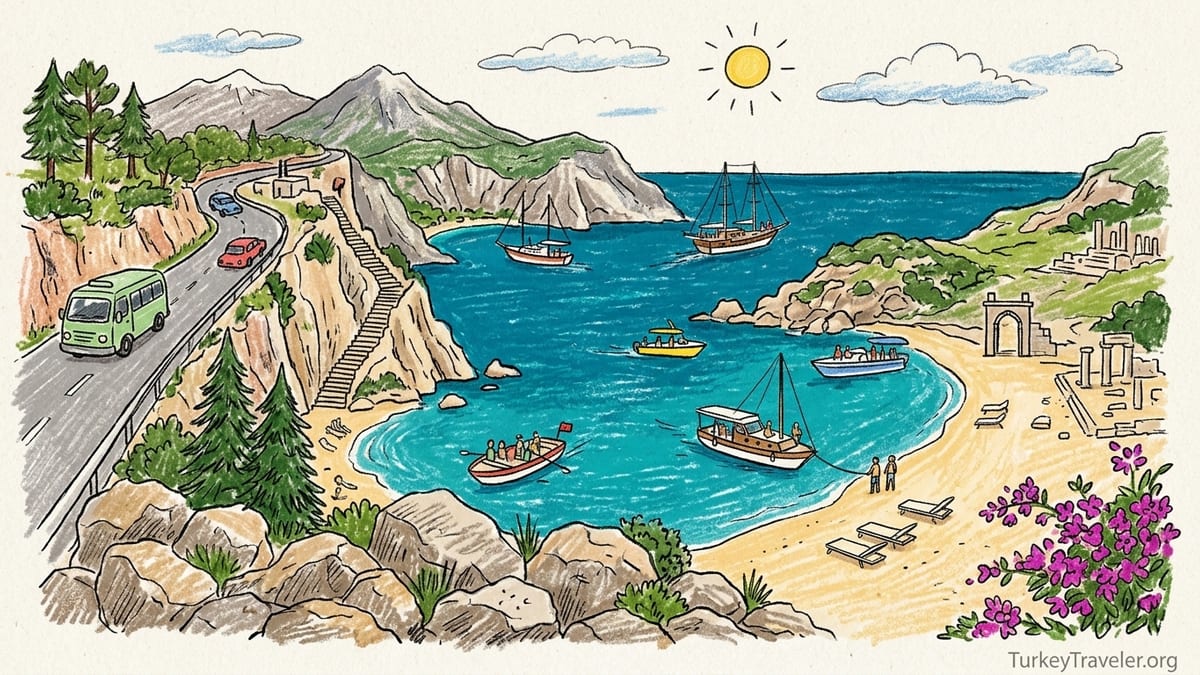
How To Think About Access Along the Turquoise Coast
Between Fethiye, Ölüdeniz, Kalkan and Kaş you are dealing with steep mountains dropping straight into deep water. That geography creates glorious views and very uneven access. A cove that looks close on a map can mean switchback roads, a cliff path or a boat-only landing, while a less glamorous town beach might sit right on a flat promenade with frequent buses. Treat every beach in three layers: how you get there, what it costs in both money and time, and what kind of swimming you actually get when you arrive.
For this guide, beaches are grouped into three categories. First come the straightforward road beaches that an ordinary rental car or local dolmuş can reach without stress: Çalış, Belcekız, the Kumburnu Blue Lagoon, Kıdrak, Kaputaş, Patara, Küçük Çakıl, Büyük Çakıl and Akçagerme. Then there are places with more complicated access such as Kabak Bay, Gemiler Beach and Limanağzı, where steep descents, boat shuttles or rougher roads make planning essential. Finally, some coves like Butterfly Valley and certain Fethiye–Göcek or Kekova bays are genuinely boat access only. They reward the effort but require you to think in terms of boat schedules and cruise styles rather than car parks.
Another key distinction is between visual drama and practical swimming. Instagram loves narrow shingle coves with vertical cliffs and instant drop-off into deep water. Strong swimmers may be delighted. Young children, people who tire easily in the sea or anyone who likes to stand on firm sand often do far better at big sandy arcs such as Patara or sheltered, shallow Kumburnu than at those postcard coves. Throughout this article, picture not just the photograph from above but yourself waist deep in the water: how easy is the entry, how strong are the waves, and can everyone in your group get back out comfortably.
Straightforward Road & Dolmuş Beaches
Çalış Beach, on the western side of Fethiye Bay about 5 kilometres from the centre, is one of the easiest beaches on this coast to reach without a car. Dolmuş minibuses run every few minutes in summer between Fethiye and Çalış, and there is also a small fleet of water taxis across the bay from Fethiye marina. These services make Çalış a practical first swim straight after arrival from Dalaman Airport: the common pattern is airport shuttle to Fethiye bus station then a short dolmuş ride or boat hop to the seafront. The long, mostly pebbly shoreline is backed by a flat promenade, so it works well for strollers and travellers with moderate mobility issues, though the shingle can be awkward under bare feet.
Belcekız Beach in Ölüdeniz sits at the foot of a developed resort village with level streets and constant buses from Fethiye. It is a coarse-sand and shingle bay open to the full force of the sea, with paragliders constantly landing behind the beach. Access is nearly step free from the main strip, which makes it convenient, but the water shelves fairly quickly. Many families and weaker swimmers walk a few minutes further into the protected Kumburnu lagoon area, accepting an entrance fee in exchange for protection from waves and a much gentler gradient underfoot.
Kumburnu, often called the Ölüdeniz Blue Lagoon, occupies the sandy spit that closes off the far side of the bay. It forms part of Ölüdeniz Nature Park and charges entry both for pedestrians and for cars at the gate, with prices updated for the 2026 summer season. Inside, the lagoon water is usually calm even when Belcekız is rough, and the curve of the spit creates pockets of shallow, sandy-bottomed water ideal for toddlers with inflatable armbands. Shade comes from pines and beach clubs with sunbed rentals. The drawback is crowding and cost, but for nervous swimmers and young families the trade-off is often worth it.
Just beyond Ölüdeniz on the coastal road sits Kıdrak Beach, signposted as a nature park with its own small car park and gate. Drivers follow the main sealed road and turn off onto a short access lane, while dolmuş services from Fethiye and Ölüdeniz also stop near the entrance in season. Kıdrak offers a mix of sand and fine shingle with clear, usually calm water in a more natural setting than Belcekız or Çalış. You still pay a modest nature park fee at the gate, and there are sunbeds and a café, but the forested backdrop and slightly steeper drop-off into the sea make it feel wilder than Kumburnu. For independent swimmers who dislike full resort crowds but still want easy road access, it strikes a good balance.
Iconic Road Beaches: Kaputaş and Patara
Between Kalkan and Kaş on the D400 highway, Kaputaş Beach is the classic Turquoise Coast photograph: a narrow cove of bright pebbles squeezed between cliffs and intense turquoise water. In access terms, two facts matter. First is the staircase. You park on the roadside shoulder at cliff level and then descend close to 190 concrete steps to the sand. That is manageable for many healthy adults but is not trivial in the midday sun and becomes a serious barrier for anyone with knee issues, small children who need carrying or travellers with even moderate mobility limitations. There is no lift, no ramp and no realistic way to visit Kaputaş with a wheelchair.
The second access challenge at Kaputaş is parking. There is no dedicated car park, only limited marked bays and informal roadside stopping spots along the D400, a busy through road used by coaches and trucks. In high season these spaces fill quickly in the morning, and a late arrival can mean circling or stopping uncomfortably far away before walking back along the roadside. Many local drivers aim for an early morning swim or a late afternoon visit when traffic is lighter, the sun is lower and the steps are less punishing. Importantly for planning, Kaputaş is more visually famous than it is practical for long family beach days. The cove is small, the pebbles are coarse, and waves can feel powerful when there is swell. Strong adult swimmers will love diving into deep blue water; less confident swimmers may be happier treating Kaputaş as a short scenic stop rather than their only swim of the day.
Patara, about 40 minutes by car from Kaş and 20 from Kalkan, is the opposite in character. Instead of a tight cliff cove you arrive at a wide sandy world where the coast runs for many kilometres behind dunes. Access begins inland at the entrance gate to the Patara archaeological site and beach, where you buy a combined ticket that covers both the ruins and the sea. From there a paved road leads past the Lycian and Roman remains down to a large main car park just behind the sand. Dolmuş services from Kaş and Kalkan drop passengers at or close to the gate in season, so you can visit without a car if you are willing to walk a short distance or wait for connecting local minibuses.
The sand at Patara is soft and extensive, the sea shallows relatively gently and there is room to spread out and walk away from the main facilities. This is prime loggerhead turtle nesting habitat, which brings strict rules. Conservation reports for the area confirm a ban on driving vehicles onto the beach, and local regulations prohibit camping on the sand, using bright lights at night, playing loud music in nesting zones and entering certain areas after evening closure. Visitors typically find that beach facilities such as sunbeds and the main café shut by early evening to protect the shoreline. For travellers, those restrictions mean Patara is more of a daytime nature and culture excursion than a place to linger late over drinks at the water’s edge, but they also protect the sense of space and keep night-time disturbance low.
Compact Town Beaches Around Kaş
Within and near Kaş itself you find a different scale of beach. Küçük Çakıl is a tiny cove east of the harbour, transformed into a cluster of platform-style beach clubs facing very clear, deep water. Access is by short flights of steps from the street level down through each beach club to the waterline. The sea is deep almost immediately, with ladders rather than sand entries. For strong swimmers and underwater photographers who want to slip into clear blue water within a few minutes’ walk of a pension in Kaş old town, it is ideal. For toddlers or anyone seeking to stand ankle deep on firm sand, it is a poor fit despite the beauty of the water.
About two kilometres further east along the coast road lies Büyük Çakıl, a larger, pebbly cove with a ring of simple cafés and pensions behind it. You can walk from Kaş in about half an hour along the main road or take a short taxi ride, and there is informal roadside parking for self-drivers. The beach surface is rounded shingle and pebbles, not sand, and the sea deepens quickly. Entry in rubber water shoes makes walking far more comfortable. In return, you get strikingly clear water and a more relaxed village edge atmosphere than at the tiny urban coves.
On the opposite side of the Kaş peninsula road, Akçagerme Beach sits beside a section of the main route toward Kalkan and the bus station. It has been developed as a family-friendly spot, with a small water park area, sunbeds and a mix of sand and fine gravel arranged behind protective breakwaters. Access from the road is straightforward with flat paths, which makes it one of the more mobility-friendly public beaches in the area. The water is usually calm in the enclosed areas, so it is popular with local families teaching children to swim, though the surroundings are less dramatic than at the open, rocky coves.
More Complicated Access: Kabak, Gemiler and Limanağzı
Kabak Bay sits south of Faralya village, beyond the end of mainstream hotel development. Access begins on the same mountain road used for Faralya, with its hairpin bends and steep drops, then continues to a small parking and minibus transfer area above the bay. In recent seasons, travellers report a dedicated dolmuş line between Fethiye or Ölüdeniz and Kabak that covers the main climb, after which most visitors transfer to local jeeps or minibuses that navigate the very steep final descent toward the bay. From the lower drop-off point you still walk down footpaths to reach the beach itself. This combination makes Kabak unsuitable for those with significant mobility issues and stressful for nervous drivers in standard rental cars, particularly at night or in bad weather.
On the reward side, Kabak offers a crescent of shingle and coarse sand with a backdrop of forested slopes and a mix of rustic camps and small guesthouses. The sea can be rough on windy days and gets deep fairly quickly, so it is more a destination for adult couples and hikers than for prams and paddling pools. Plan extra time on travel days because connections between the main road, the upper village and the footpaths rarely line up to the minute. Treat Kabak as a two or three night retreat where the access effort is repaid over several swims and long evenings, not as a casual half-day dip from Fethiye.
Closer to Fethiye, Gemiler Beach lies below the abandoned village of Kayaköy, facing the offshore ruins of Gemiler Island. The important distinction here is that Gemiler Beach is on the mainland at the end of a narrow but paved road, while Gemiler Island has no road at all and must be reached by boat. Drivers approach via Kayaköy on a winding lane that becomes single track in places but remains manageable in a normal car taken slowly. At the bottom, simple beach restaurants offer sunbeds and meals on the shingle shore, and local boatmen advertise short crossings to the island or coastal cruises that combine Gemiler, Cold Water Bay and Ölüdeniz.
For access planning, Gemiler Beach works well as a combined road and boat day from Fethiye or Ölüdeniz. You can visit Kayaköy in the cooler hours, continue by car to Gemiler for lunch and a swim, then decide locally whether to pay for a short boat trip. There is no scheduled ferry to the island, so crossings depend on weather and which boatmen are operating that day. Swimming quality at Gemiler is classic shingle bay: clear water that deepens steadily from a pebble shore. It is an attractive compromise for travellers who want both easy road access and the option of a short, low-key boat hop without committing to a full-day cruise.
Limanağzı, on the other hand, is essentially a boat-access beach complex directly across the bay from Kaş. There is a rough path along the Lycian Way for hikers, but most day visitors simply walk down to the small harbour in Kaş and take a water taxi. Several operators run these throughout the day in season, often with return tickets valid on any company. The ride takes only a few minutes and delivers you to jetties belonging to different beach clubs spread along the rocky shore. Access to the sea is by ladders or small platforms into deep, very clear water. For families with older children who swim confidently and love snorkelling, Limanağzı is an easy adventure. For those who need shallow paddling zones or wheels, it is not appropriate.
Genuine Boat Access: Butterfly Valley, Göcek Coves and Kekova
Some of the most photographed bays on this stretch of coast do not have practical land access for ordinary visitors. Butterfly Valley is a prime example. The valley itself runs down from the cliffs below Faralya to a narrow arc of pale shingle where the stream meets the sea. Official tourist information and current local guides are clear that the path down from Faralya involves scrambling and unprotected sections. It is not an ordinary family hike and should not be attempted in flip-flops, with small children or by anyone uncomfortable with steep drop-offs. For most travellers the sensible access is by sea, using shuttle boats or day cruises from Ölüdeniz.
As of late 2026, return boat shuttles to Butterfly Valley operate from Belcekız Beach during the main season, with a fixed per person fare published locally. The crossing takes roughly 30 minutes each way. Longer, multi-stop boat trips from Ölüdeniz and Fethiye may also pause at the valley for swimming, either offshore or with passengers brought to the shingle for a limited time. For planning, distinguish clearly between a dedicated shuttle that prioritises time ashore and a sightseeing cruise that offers only a short dip. Nervous swimmers may prefer the structured environment of a bigger boat, while those who want to explore the valley floor will do better with the simpler there-and-back shuttle.
North from Fethiye toward Göcek, the coast breaks into a maze of sheltered inlets and forested peninsulas. Many of the prettiest bays on this stretch, often referred to collectively as the Fethiye–Göcek coves, have jetties or mooring points but no public road right to the water. Common examples on day-cruise itineraries include Aquarium Bay and various “island” and “cold water” stops where fresh springs meet the sea. Boats serving these coves range from large shared day boats with lunch included to small gulet charters and private speedboat hires. Actual swimming time on a shared day cruise might be three to four hours spread across several stops, against eight hours total on the water. A private charter at higher cost lets you compress cruising and linger longer in one or two favourite bays.
East of Kaş, the Kekova region offers another classic boat-only landscape. The semi-submerged ruins of the so-called sunken city line the shore of Kekova Island, and the quiet village of Kaleköy rises steeply from the water opposite. There are no car ferries to Kaleköy or Kekova Island themselves, only small passenger boats. Day trips from Kaş and Demre typically combine open-water cruising, a swim stop or two in protected bays and a landing at Kaleköy for a steep but rewarding castle climb. While these itineraries are led by tour operators, the crucial planning question is the same as elsewhere: are you choosing a relaxed day focused on long swim stops or a sightseeing-heavy loop with short dips in between.
For visitors focused on swimming isolation rather than ancient walls, hiring a small private boat from Kaş, Üçağız or Göcek for a group can be worthwhile. The cost rises compared with shared cruises, but you trade set schedules for the freedom to anchor in a quiet cove and stay until you are tired of the water instead of moving on when the majority is ready. In all cases, remember that these are boat-first destinations. Walking access from inland roads, where it exists at all, is either very long, very steep or both.
Comparing Access Styles: Time, Cost and Swim Quality
To choose between road, dolmuş and boat, think of your day in three currencies. The first is cash. A dolmuş ride from Fethiye town to Çalış or Ölüdeniz costs only a modest sum per person, while entrance fees at Kumburnu or Patara and extras such as sunbeds and drinks add steadily to the bill. A shared boat trip from Fethiye, Ölüdeniz, Kaş or Kalkan typically costs more per person than a couple of bus rides but includes multiple bays and, in many cases, lunch. Private boat hire sits highest in price but lowest in compromise. If you have a group of family or friends, per person costs narrow compared with organised tours and you can shape the itinerary to your exact swimming priorities.
The second currency is time. Road-based exploration between Fethiye, Kalkan and Kaş gives you faster point-to-point transfers in most cases. For example, the drive from Kalkan to Kaputaş may be less than 15 minutes, and Kalkan to Patara’s car park often takes under half an hour outside peak traffic, giving you long anchored spells on one chosen beach. By contrast, a full-day boat cruise between Fethiye and Göcek can involve more than eight hours from first casting off to final docking, with the genuine swimming periods broken into multiple 30 to 60 minute stops. Boat-time is not wasted time for many travellers, but it is a different experience from parking once and leaving your towel in one place all afternoon.
The third currency is swim quality. Big sandy bays such as Patara or protected lagoons like Kumburnu allow you to choose your depth and control your footing. Families can let children play at ankle depth while adults take turns swimming properly offshore. Narrow shingle coves such as Kaputaş, Büyük Çakıl, Kabak or many Göcek and Kekova bays provide immediate depth and often glass-clear water that suits snorkellers and confident swimmers but demands more concentration. Deep-water platforms at Küçük Çakıl and Limanağzı deliver instant access to blue depths that work brilliantly for underwater photography and freediving practice, at the cost of any secure paddling zone. Matching your group to the right style of entry is more important than chasing the single most famous photograph.
Concrete daily choices might look like this. A family with a toddler and a nervous grandparent staying in Fethiye might spend one day using the dolmuş to Ölüdeniz, paying for Kumburnu to enjoy shallow, sheltered water, and another at Patara where adults explore the ruins before joining the children on the gradually shelving surf. A pair of experienced swimmers in Kaş might split time between Küçük Çakıl platforms for morning laps and a private boat afternoon out to Limanağzı and nearby coves, accepting extra cost for hours of deep, clear water. A budget-conscious solo traveller could prioritise free-entry shingle beaches such as Belcekız, Çalış or Büyük Çakıl, using only public transport and skipping lagoon entrance fees entirely.
Three Practical One-Day Itineraries
For a car-free base in Fethiye, a realistic beach day that prioritises swimming over logistics starts with an early dolmuş from the centre to Ölüdeniz. From there, you can either pay the entrance at Kumburnu and claim a shady spot on the lagoon spit or stay on the open Belcekız shore if the sea is calm and your group swims confidently. After a morning in the water, a simple lunch in Ölüdeniz sets you up for an afternoon boat trip. Budget travellers can walk along the promenade and join a shared half-day cruise that includes at least one calm cove and, in some cases, a Butterfly Valley swim stop without going ashore. Return to Fethiye by dolmuş in the golden hour and, if you still have energy, finish the day with an easy stroll along Çalış promenade reached by a short bus or water taxi ride.
A self-drive Kaş–Kalkan day focused on two of the region’s most famous but contrasting beaches works best outside the absolute peak midday heat. Leave Kaş by mid-morning, take the D400 west and stop at Kaputaş. If you find a safe roadside parking space close enough to the staircase and your party is comfortable with the near-200-step descent, spend an hour enjoying the intense colour and quick deep water. Treat it as a visually spectacular swim rather than your entire day. Climb back up before the hottest sun, then continue to Patara via the inland turnoff signposted from the D400. After paying the combined archaeological and beach entrance, take time among the ruins before driving down to the main car park and finishing the afternoon on Patara’s expansive sand. Drive back to Kaş in the early evening light, when both traffic and temperatures are softer.
A boat-based inaccessible-coves itinerary can be built from either Fethiye, Ölüdeniz or Kaş. From Ölüdeniz, you might start with a dedicated shuttle to Butterfly Valley, giving yourself a few hours ashore to explore the flat valley floor and swim off the shingle before returning on a pre-agreed boat. Back in Ölüdeniz, join a late-afternoon shared cruise that visits one or two additional Fethiye–Göcek style coves, turning the whole day into a sequence of deep-water swims in places with no practical road access. From Kaş, an equivalent day would be a Kekova-focused cruise with long swim stops in sheltered bays and a short landing at Kaleköy. In each case, you pay more per person than for simple buses but buy direct access to coves that would otherwise exist only on your map.
The Takeaway
The stretch of Mediterranean between Fethiye, Ölüdeniz, Kalkan and Kaş rewards travellers who match their ambitions to real-world access. On a screen, every turquoise inlet looks equal. On the ground, Çalış, Kumburnu, Patara, Küçük Çakıl, Büyük Çakıl and Akçagerme offer straightforward arrivals by road or dolmuş, with compromises in crowding or shingle. Kabak, Gemiler and Limanağzı introduce rougher roads, boat shuttles and steeper paths that filter out casual visitors. Butterfly Valley, many Fethiye–Göcek coves and the quiet corners of Kekova truly belong to those who plan around boat schedules rather than car keys.
Successful days along this coast come from clarity. Decide whether you want sandy shallows or instant deep water, long settled hours on one beach or multiple short swims, minimal spending or the freedom of a charter. Respect physical realities such as Kaputaş’s long staircase, Patara’s turtle-protection rules and the serious nature of the Faralya descent to Butterfly Valley. If you calibrate your plans honestly to your group’s abilities, budget and appetite for boats and buses, the Turquoise Coast will reward you with not only beautiful photographs but also genuinely relaxed, safe and satisfying time in the sea.
FAQ
Q1. Which beach between Fethiye and Kaş is best for young children?
Patara and the Kumburnu Blue Lagoon at Ölüdeniz are the strongest choices, thanks to their relatively gentle, sandy entries and sheltered water compared with steep shingle coves.
Q2. Are any of these beaches suitable for travellers with limited mobility?
Çalış, parts of Belcekız, Kumburnu’s inner paths and Akçagerme offer the flattest access from promenade or car park to the shore, although soft sand and shingle can still be challenging for wheelchairs.
Q3. Can I explore this coast without renting a car?
Yes. Dolmuş services link Fethiye with Çalış, Ölüdeniz and Kıdrak, and connect Kaş with Kalkan and Patara in season. Water taxis and shared boat trips then open up Limanağzı, Butterfly Valley and many coves.
Q4. How difficult is the staircase at Kaputaş Beach really?
The staircase involves close to 190 fairly steep steps each way with no lift or ramp. Most healthy adults manage it, but it is strenuous in summer heat and unsuitable for buggies or wheelchairs.
Q5. Is the walk down from Faralya to Butterfly Valley safe for families?
No. The descent includes exposed, scrambling sections and fixed ropes. It is not a casual family walk and is best avoided by anyone uncomfortable with serious, steep terrain.
Q6. Do I need to join an organised tour to visit Kekova or the Fethiye–Göcek coves?
You do not have to join a big group tour, but you do need a boat. Options range from shared day cruises sold from harbours in Fethiye, Ölüdeniz and Kaş to private small-boat charters for your own group.
Q7. What should underwater photographers prioritise when choosing beaches?
Look for clear, deep water with rocky or seagrass bottoms. Küçük Çakıl, Limanağzı, parts of Kaputaş and many Göcek and Kekova coves are excellent for visibility and dramatic underwater rock formations.
Q8. How are sea turtles protected at Patara and what does that mean for visitors?
Vehicle access to the sand is banned, camping and fires are prohibited and the beach closes at night in nesting zones. Visitors should respect marked areas and avoid lights or loud noise after dusk.
Q9. If I dislike crowds, which accessible beaches work best in high season?
Early mornings or late afternoons at Kıdrak, Büyük Çakıl, Gemiler Beach or selected Limanağzı platforms often feel quieter than midday at Kaputaş, Kumburnu or central Belcekız.
Q10. Are there good options if I want to avoid organised tours but still reach remote coves?
Yes. Hiring a small private boat from Kaş, Üçağız, Göcek or Fethiye lets you design your own route to less-visited bays without joining a large group, though at higher overall cost.