


The northerly Aegean wind was already up when I rolled into Geyikli ferry terminal on a cool October Saturday morning. Locals call it the poyraz, and on Bozcaada it shapes everything from ferry crossings to which beach actually feels like paradise on a given day. I had come for a quick weekend escape, planning my two days around that wind: a south-facing sweep of Ayazma Beach when the north blew hard, quieter coves when it dropped, and a close look at how the island’s vineyards and stone streets fit around the shifting sea.
Planning the Crossing from Geyikli to Bozcaada
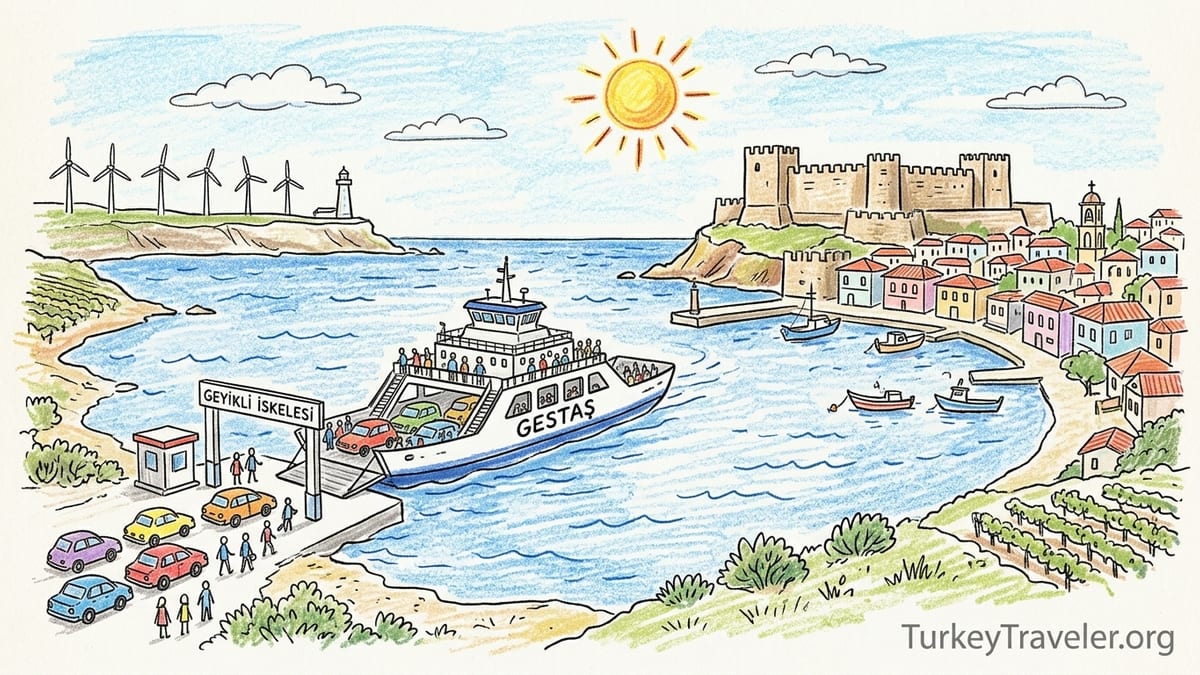
I reached Geyikli İskelesi a little after 09:15, aiming for the 11:00 GESTAŞ ferry to Bozcaada that is part of the current autumn and winter timetable introduced on 5 October 2026. According to the schedule posted on the electronic boards at the pier and on GESTAŞ’s own announcements, the Geyikli to Bozcaada sailings now run at 08:00, 11:00, 15:00 and 19:00 daily, with an additional 23:00 departure on Fridays, Saturdays and Sundays. The returns from Bozcaada are at 07:00, 10:00, 14:00 and 18:00, plus a 22:00 sailing on weekend nights. The crossing time is listed as 35 minutes and, watching the previous ferry arrive and unload, that felt realistic.
Ticketing for this route can be confusing because GESTAŞ issues only return tickets and updated its fares earlier in 2026. The current published tariff for the Geyikli–Bozcaada line gives a return foot passenger fare of 200 Turkish lira and a standard car fare of 2,485 lira, with the vehicle ticket covering only the driver. Other passengers must buy their own foot tickets. There are discounted GestCard and AdaKart categories for residents and students, but as a regular visitor I paid the standard rate. I bought my ticket directly at the terminal window, but signs also pointed to online purchase options for those who want to secure a place in advance.
On the Geyikli side, autumn is noticeably calmer than peak summer. In July and August the vehicle queue is known to snake out of the fenced holding area, which is why GESTAŞ had enforced mandatory online reservations for returns from Bozcaada. That requirement ended on 15 September 2026, a change clearly stated in their latest notices and repeated at the pier. From that date onward, returns operate on a first come, first served basis again, which makes spontaneous weekend trips like mine much easier outside high season. Even so, the company still recommends, both online and at the ticket office, that passengers be at the terminal at least 30 minutes before departure, and I found that advice realistic.
Because I was traveling as a foot passenger, boarding was straightforward. At around 10:35 staff opened the pedestrian gate and scanned people through, while cars were marshalled into lanes to drive aboard by license plate. The ship itself was a standard GESTAŞ double ended ferry with indoor and outdoor seating. Once loaded, we left Geyikli a couple of minutes after 11:00, the poyraz pushing choppy whitecaps across the strait. Including the time weaving away from the dock and easing into Bozcaada harbor, my watch showed just under 40 minutes pier to pier.
First Impressions: Bozcaada Harbor, Castle and Old Streets
Arriving at Bozcaada by ferry is one of those classic Aegean moments. The first landmark that dominates the view is Bozcaada Castle, a hulking fortification that stands directly above the harbor. Its current form mostly reflects Ottoman era rebuilding on much older Byzantine and possibly Venetian foundations, but from the ship what you notice are the solid stone walls and bastions looking straight back at you. To the right, pastel painted facades and red tiled roofs of the town step up gently from the quay, with the Greek Orthodox church bell tower poking above the rooftops.
Stepping off the ferry as a foot passenger, you walk directly into the compact harbor area. Fishing boats and excursion craft line the inner basin, and a scattering of cafes and lokantas offer tea, grilled fish and the island’s ever present grape leaves. Even without a car it is an easy few minutes on foot from the terminal to reach both the castle entrance and the heart of the old town. The streets here tell the story of Bozcaada’s mixed past as the Greek island of Tenedos and its later history as part of the Turkish Republic. On one block I passed narrow, tall houses with wooden balconies and shuttered windows that clearly reflected Greek architectural traditions. Around the corner, low stone houses with courtyards and carved door frames felt more in line with Anatolian styles.
Bozcaada’s center effectively consists of two interlocking quarters that locals often refer to as the Turkish and Greek neighborhoods. The differences today are more about atmosphere and details than strict separation. In what is commonly called the former Greek quarter, streets are tighter and houses tend to be two or three stories, with brightly painted doors and climbing bougainvillea adding color. The so called Turkish quarter has slightly wider streets, a number of small mosques and more ground floor workshops and bakeries. Wandering without a map is the best way to appreciate this, and it also gives you a feel for how small the town really is. From the harbor to the back edge of both neighborhoods took me no more than fifteen minutes of relaxed walking, with plenty of stops to photograph doorways and cats.
Before heading to the beaches, I took a short walk up toward the castle. Entry times and fees can vary and, as I had arrived close to noon on a breezy autumn weekend, I opted not to go inside. Instead I skirted the outer wall and looked back over the harbor. From this vantage point you can already see how exposed the north and east coasts of the island are to the prevailing winds. Whitecaps foamed under the poyraz across the open water, while the south shore where Ayazma and the other main beaches lie looked comparatively calm and inviting.
Day One: Chasing Shelter at Ayazma, Sulubahçe and Habbele
Bozcaada’s main beaches all sit on the south coast, about five to seven kilometers from town. During the high summer months a network of seasonal minibuses (dolmuş) connects the center with Ayazma, Sulubahçe, Habbele and a couple of smaller bays. In October, however, this service becomes more limited. When I checked with a driver near the main square and again with the tourist information office, both said that weekend services were still running but weekdays were down to a reduced schedule and could be cancelled if there were too few passengers or bad weather. Nothing is guaranteed year round, so if you are visiting outside peak summer it is safest to confirm operating days on arrival rather than assuming a full timetable.
I caught a late morning minibus marked “Ayazma” from the tiny dolmuş stop near the harbor. The ride took about ten minutes, passing vineyards and low stone walls. Ayazma Beach appeared suddenly below the road, a neat arc of pale sand facing southwest. Even in early October there were several beach clubs operating, with rows of sunbeds and umbrellas set out on the sand, though some of the more summer focused venues were already closed or half dismantled for the season. Signs at one of the open establishments listed sunbed and umbrella rentals at around a few hundred lira for two loungers and an umbrella for the day, with coffee and soft drinks priced at a level typical for popular Aegean resorts, higher than inland towns but still accessible compared to big city beach clubs.
The sea itself was surprisingly inviting. Long term sea temperature records for the Bozcaada area suggest that October water temperatures usually hover in the low twenties Celsius, often around 21 to 22 degrees, and that matched what I felt as I waded in. The first shock of coolness faded quickly, making it comfortable for long swims as long as you kept moving. The north wind that had ruffled the crossing earlier was still blowing, but because Ayazma faces away from that direction, the water stayed relatively clear and organized, with low rolling waves rather than chop. Sand underfoot was firm and clean, and the Blue Flag designation that Ayazma has held in recent seasons seemed deserved.
As the afternoon wore on, the poyraz strengthened and the differences between adjacent beaches became obvious. Just to the east, Sulubahçe Bay looked slightly more exposed to the wind, its curve of shore catching more of the swell. I walked over along the coastal path, passing by low dunes and scrub. Here, the beach was narrower and felt less serviced, with only a modest number of umbrellas and a small snack stand still open at this time of year. The water remained clear, but small wind driven waves broke closer to shore, and the gusts blew sand along the surface. For people who like a more natural feel and do not mind some wind, Sulubahçe can be appealing. On strong north wind days, however, Ayazma’s more sheltered orientation offers a noticeably calmer swim.
Further east again, Habbele Bay occupies a deeper indentation in the coast and has long been popular with both locals and visitors. The beach here is pebbly in places and the bay somewhat narrower than Ayazma, which can help reduce the fetch of the wind and associated waves. By the time I reached Habbele in the late afternoon, the wind was tugging at towels but the water in the lee of the rocks on one side was glassy. Some long running beach facilities here were still in operation, though at reduced capacity, offering showers, basic changing areas and a seaside cafe menu of toast sandwiches, fried potatoes and cold beer. Prices were in a similar bracket to Ayazma, with a typical simple lunch and drink coming to a moderate amount for one person. What you pay extra for, in many visitors’ eyes, is the balance of shelter and scenery when the poyraz is blowing.
Evening in Town: Bakeries, Wine and Island Rhythms
Back in town after the beach, Bozcaada’s compact scale made it easy to shift gears from sandy towel to strolling clothes. I returned with the same minibus that had taken me to Ayazma, paying a short distance fare that felt fair for the ten minute ride. In the main streets near the harbor, a handful of bakeries were still open into the early evening, their windows stacked with sesame covered simit, olive breads and trays of syrup soaked pastries. I stopped at a small family run bakery in the so called Turkish quarter, where the shelves held crusty village loaves and grape pekmez in glass jars. Conversation with the owner quickly turned to the harvest, as vineyards ring Bozcaada and grapes are central to both the economy and culture here.
Bozcaada is one of Turkey’s most noted wine islands, with several established wineries offering tastings and sales. Instead of arranging a formal vineyard tour, I opted for a simpler tasting room visit in the town itself. One producer with a long history on the island had a small shop set in a stone building off a side street. Inside, I sampled a flight of local wines, including a crisp white made from the island’s Vasilaki grape and a structured red based on Karalahna and Kuntra, both traditional Bozcaada varieties. A small tasting set of three or four wines came in at a price comparable to other boutique Turkish wineries, not cheap by local standards but reasonable for the quality. Bottles ranged from moderate to higher prices, again reflecting the artisanal nature of production.
For dinner I chose a casual lokanta near the harbor rather than one of the more formal fish restaurants. The menu centered on home style dishes: stewed beans, stuffed vegetables, grilled chicken and daily seafood. A filling meal with a starter meze, main course and a glass of house wine cost what I would describe as mid range for Turkey in 2026, noticeably more than an inland provincial town but still below big city waterfront prices. Eating at one of the harborside balık restaurants would have pushed the bill higher, particularly with fresh fish sold by weight. After dinner, I wandered the lanes as the wind softened and street cats reclaimed warm stoops. The town quietened early, confirming that by late October Bozcaada is more about slow evenings than buzzing nightlife.
Day Two: Akvaryum Bay and the Windy Expanse of Çayır Beach
On my second morning the poyraz was back, steady but a little gentler than the day before. I wanted to see how one of Bozcaada’s smaller coves compared to the main south coast strip, so I set my sights on Akvaryum Koyu. This compact bay sits on the south side of the island, backed by low cliffs and accessible by a small road. In full summer, some minibuses extend their routes here or private shuttles link it to town, but when I asked at the dolmuş stop I learned that, at this late point in the season, scheduled minibuses were focusing on Ayazma and Habbele only, and even those depended on weekend demand. There was no guarantee of any official service to Akvaryum in October, which is important for visitors to understand.
Without my own car, I arranged a shared taxi from town’s central square with two other travelers I met near the harbor. Split three ways, the cost stayed manageable for a short hop, though naturally more expensive than a dolmuş fare would have been. The road wound through vineyards and small farm plots before dropping toward the bay. Akvaryum was true to its name: a clear pool of water framed by rocks, with a narrow curve of coarse sand and pebbles. There were no large beach clubs here, just a more modest setup that someone had described to me as semi wild earlier in the year. By late October, sunbeds were largely stacked away and the crowd numbered only a couple of dozen people, many locals.
In the lee of the low cliffs and because of its orientation, Akvaryum felt especially calm despite the persistent northerly. The water here benefits from a combination of rocky bottom and limited runoff, giving it good clarity. Snorkelers hugged the rocks at the sides, and even swimming straight out I could see fish flickering below. Compared with Ayazma, the sea in Akvaryum felt slightly cooler but also more protected from surface chop. Facilities were minimal by this point in the season: one small kiosk serving tea, soft drinks and packaged snacks, no full restaurant menu and only basic changing options. That suited the setting well, but anyone who expects full service beach clubs year round would be disappointed.
Later that afternoon I wanted to experience the opposite: a beach that fully faces the wind. Çayır Beach, on Bozcaada’s northeast coast, is known among windsurfers and kite surfers precisely because it is exposed. The open fetch of the Aegean meets the poyraz here without much obstruction, creating conditions that can be exhilarating or downright harsh depending on your perspective. Getting there without a car required another informal arrangement, this time a short taxi ride arranged through my guesthouse host. There was no evidence of any seasonal dolmuş running to Çayır in late October, and locals confirmed that public transport to this side of the island tends to be sporadic or absent outside the core months.
Standing on Çayır’s long stretch of mixed sand and shingle, the contrast with the south coast was immediate. The wind blew almost head on, whipping the tops off waves and sending spray sideways. Two windsurfers and a kite rig were already out, zigzagging across the bay at speed, taking advantage of the conditions that make this area something of a small scale hub for the sport. For regular swimmers, though, this is far from an idyllic lounging beach when the northerly is strong. The water was rough, entry and exit looked tricky, and sand stung the skin when gusts rose. On calmer days Çayır can be an atmospheric place to walk and watch the sky, but my visit underlined how important it is on Bozcaada to match your beach choice to the wind direction and strength.
Polente Lighthouse, Vineyard Landscapes and the Question of Access
As the afternoon waned on my second day, I turned my attention back toward the west of the island, where Bozcaada’s wind turbines and the famous Polente Lighthouse line the cliffs. This is traditionally one of the island’s favorite sunset spots, with people driving or cycling out to watch the sun dip behind the Aegean. However, in recent years local authorities have introduced restrictions in response to erosion, litter and safety concerns. Before setting out, I checked in town and with my guesthouse owner about the current access rules. The consistent message was that certain areas around the wind turbines and the cliff edge had been closed off at various times, and that visitors needed to respect any barriers or signs in place.
With that in mind, I joined a small group heading out along the west road in the late afternoon. We drove as far as allowed, parking well back from the most sensitive areas where signs requested no further vehicle access. From there it was a short walk on a tracked path to a viewpoint where the lighthouse was visible in the distance and the full sweep of sea opened out ahead. This spot, being set back from the crumbling edges, felt safe and clearly within the currently permitted zone. Sitting among low shrubs with a paper cup of island wine bought earlier in town, I watched the sky shift through apricot to deep orange.
The vineyards that unfurl around this western edge are among Bozcaada’s most photogenic features. Gnarled vines marched in rows toward the horizon, their leaves just beginning to turn at the end of harvest season. Some plots belonged to larger commercial wineries, others to smaller family holdings. Walking a short way between them, it was easy to understand why wine has become central to how many visitors experience the island. Yet the modest scale of most operations, and the fact that many vineyards are also working farms, is a reminder to tread lightly, stay on existing paths and avoid trampling vines or entering private property uninvited. My own sunset stop remained firmly on a recognized track, and I would advise others to be similarly cautious, especially as specific access points continue to evolve in response to environmental pressures.
The Takeaway: Beaches, Town, Wine or the Combination
By the time I boarded the Sunday 18:00 ferry back to Geyikli, the poyraz had calmed slightly, but gusts still rattled loose halyards against the masts of fishing boats in the harbor. I had arrived on Bozcaada expecting the beaches to be the star attraction, and in some ways they were. Ayazma’s long arc of sand, Akvaryum’s glassy cove and the raw power of Çayır Beach under wind all showed different faces of the same island. Yet the most important thing I learned is that none of these beaches can be understood without thinking about the wind. A spot that feels postcard perfect in photos can actually be unpleasant on a day when the northerly is howling straight into it, while another, less famous cove can turn into a sheltered haven.
At the same time, Bozcaada’s historic town quietly worked its way into my memory. The Turkish and Greek architectural layers, the small bakeries still kneading dough in old ovens, the modest churches and mosques, and the intimate scale of the streets gave the island a sense of lived in continuity that pure resort destinations often lack. Even a short, two day visit allowed me to see how off season rhythms slow everything down. Shops closed earlier, some beach clubs had already shuttered for the year, and yet that only seemed to sharpen the charms of what remained, from the smell of baking bread to the clink of wine glasses in a tucked away tasting room.
Then there is the wine culture, which threads through both landscape and table. Without signing up for a formal tour, I still managed to sample local varieties in a town cellar, drive or ride past vineyards in every direction and sip a cup of island wine while watching the sun set near Polente. Grapes and wind turbines might seem like an odd pairing, but on Bozcaada they symbolise the mix of tradition and adaptation that defines the island’s present. The viticulture speaks to centuries of agricultural practice, while the turbines and the new access rules around them show a community grappling with modern energy needs and environmental limits.
If I had to choose Bozcaada’s strongest single appeal, I would struggle. The beaches alone would be less compelling if they were not backed by a real town and ringed by vineyards. The old streets would not feel as magical without the prospect of diving into clear water a short bus ride away. The wine would be less memorable without the backdrop of rocky headlands and shifting whitecaps. In the end, it is precisely the combination that made this short weekend trip feel longer and richer than it was. For future visitors, my main recommendation would be to respect the wind, build your days around its direction and strength, and leave enough unplanned time to wander both the town’s alleys and the vineyard fringed roads. That, more than any fixed checklist, is how Bozcaada reveals itself.
FAQ
Q1. How long does the Geyikli to Bozcaada ferry take and how much does it cost?
The GESTAŞ car and passenger ferry between Geyikli and Bozcaada usually takes about 35 minutes from pier to pier. As of autumn 2026, return tickets for foot passengers are published at around 200 Turkish lira, while a standard car return is listed at roughly 2,485 lira, with the driver included but any additional passengers paying separate foot fares.
Q2. Do I need an advance reservation for the Bozcaada ferry in autumn?
For much of summer 2026, GESTAŞ required online reservations for vehicles returning from Bozcaada, but this system was officially discontinued on 15 September 2026. In autumn, crossings operate on a first come, first served basis again. Reservations are not mandatory for foot passengers, but you should still arrive at least 30 minutes before departure, and vehicle drivers may prefer to buy tickets in advance on busy weekends.
Q3. What are the current ferry departure times between Geyikli and Bozcaada?
According to the timetable introduced on 5 October 2026, ferries from Geyikli to Bozcaada depart at 08:00, 11:00, 15:00 and 19:00 daily, with an extra 23:00 sailing on Fridays, Saturdays and Sundays. From Bozcaada back to Geyikli, sailings leave at 07:00, 10:00, 14:00 and 18:00, plus 22:00 on weekend nights. You should always confirm on the day with GESTAŞ or at the terminal in case of weather related changes.
Q4. Is there public transport from Bozcaada town to Ayazma and other beaches outside summer?
Seasonal minibuses (dolmuş) usually connect the town with Ayazma, Habbele and Sulubahçe during the main summer months, with more frequent services on weekends. By October, these routes often run only on certain days, mainly weekends, and may be reduced or cancelled in bad weather or if demand is low. There is no reliable, year round scheduled service to Akvaryum or Çayır beaches, so in the shoulder seasons you should be prepared to use taxis, walk part of the way or stay flexible.
Q5. What is the sea temperature like around Bozcaada in October?
Long term sea surface data for the northern Aegean shows that water temperatures around Bozcaada in October typically sit in the low twenties Celsius, often about 21 to 22 degrees. In practice this means the sea can feel cool at first but is comfortable for swimming once you are in, especially on sunny days and if the wind is not too strong. Conditions are usually warmer earlier in the month and gradually cool as November approaches.
Q6. Which Bozcaada beach is best when the northerly wind is strong?
When the poyraz blows from the north, south facing beaches such as Ayazma, Sulubahçe, Habbele and Akvaryum are generally more sheltered and offer calmer water. Among these, Ayazma and Habbele tend to balance protection with facilities, while Akvaryum provides a smaller, more intimate cove experience. North and northeast facing Çayır Beach, by contrast, becomes rough and windy under strong northerlies and is then best left to experienced windsurfers.
Q7. Is it safe and legal to visit Polente Lighthouse for sunset?
Polente and the west coast cliffs remain one of Bozcaada’s classic sunset areas, but access has been tightened in recent years to protect the environment and ensure safety around the wind turbines. Some tracks and cliff edge spots are now closed or restricted. It is important to follow all signs and barriers, park only where allowed and stay on established paths. Before heading out, check with local accommodation or officials in town about the latest rules so you can enjoy the sunset without risking fines or environmental damage.
Q8. How expensive is food and wine on Bozcaada compared to the Turkish mainland?
In 2026, eating out and drinking wine on Bozcaada is generally a bit more expensive than in inland provincial towns, but often cheaper than in major city waterfront districts. Casual lokantas and bakeries offer reasonably priced meals, while seafood restaurants on the harbor and boutique wine tastings cost more. Locally produced wines are usually priced at a mid range to premium level for Turkey, reflecting small scale production and the island’s reputation.
Q9. Can I visit Bozcaada without a car and still enjoy the beaches and vineyards?
Yes, it is possible to visit without a car, especially if you base yourself in town. You can walk almost everywhere in the center, and during the main season minibuses and occasional shuttles reach Ayazma, Habbele and sometimes other bays. Outside peak months you may need to combine limited public transport with taxis or shared rides arranged through your guesthouse. Vineyards close to the road network can be admired on foot or by bicycle, but reaching more remote corners will always be easier with a vehicle.
Q10. What makes Bozcaada special compared with other Aegean islands?
Bozcaada’s character comes from the way several elements intersect on a small, manageable scale. It has clear Aegean waters and sandy beaches, but also a compact historic town shaped by both Turkish and Greek heritage, a ring of working vineyards that still anchor local life and a persistent northerly wind that gives the landscape energy. Rather than being a pure resort, it feels like a lived in island where beaches, wine and history sit side by side, rewarding visitors who pay attention to weather, seasons and local rhythms.