


On the morning I finally sailed to Turkey’s so called Maldives, the most striking sight was not the colour of the water. It was the line of tour buses and the forest of masts jammed together in Adrasan’s tiny harbour. Suluada, a small, rocky island off the Kumluca coast, has become one of Antalya’s most promoted day trips. The brochures promise powder white beaches and unreal turquoise, but they rarely show what it takes to reach them on a standard organized boat tour. I went to see how the marketing squares with reality.
Booking From Adrasan: The Numbers Behind the Dream
I started the way most independent travellers do, by walking along Adrasan’s waterfront the afternoon before my trip and comparing the chalkboards and laminated posters that every captain now seems to display. Almost all of them used the same phrase in Turkish and English, calling Suluada the Turkish Maldives and showing carefully cropped photos of empty white coves. None of them showed the row upon row of similar boats tied up at the quay behind me.
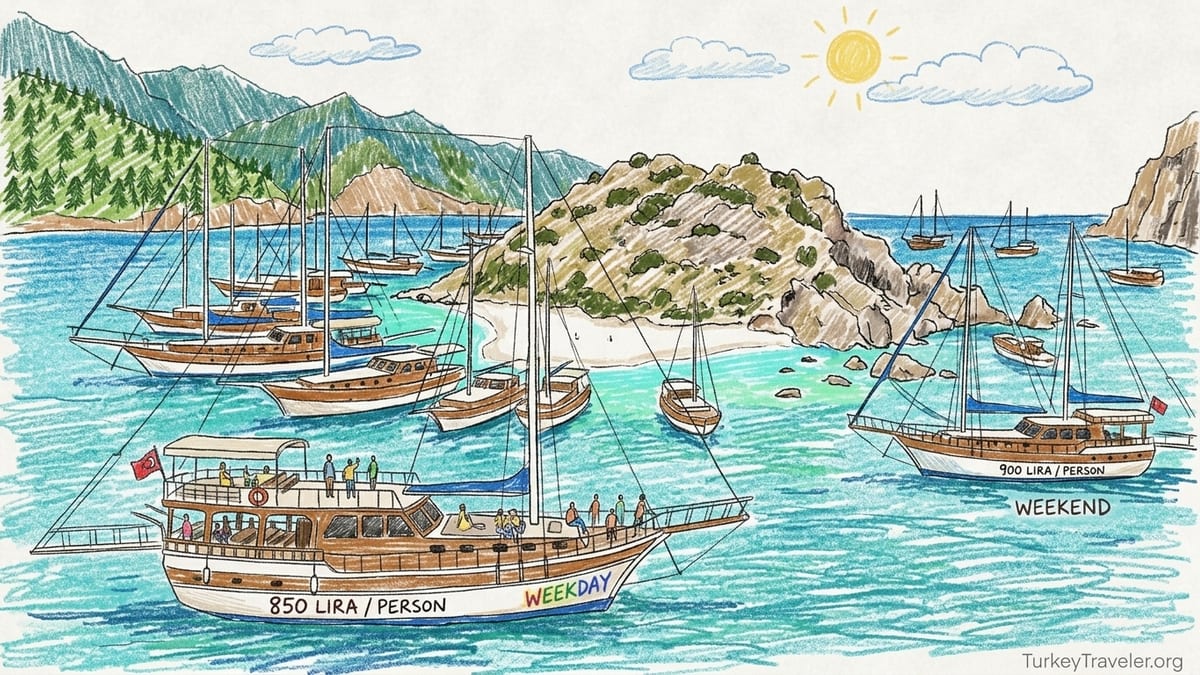
For this investigation, I booked directly with a mid range operator advertising a Suluada and bays itinerary. The price in September 2026 was 850 Turkish lira per person on a weekday and 900 lira on weekends, in line with several local operators publishing their 2025 and 2026 rates online, which cluster in the 800 to 1,000 lira band for Adrasan departures including lunch. A child discount down to around 750 lira for ages two to five was common among family focused boats. Prices from Antalya city, where agencies bundle the same boat trip with bus transfers, ran much higher, typically converted into euros or dollars and starting around 50 US dollars per person.
The vessel itself was a traditional style wooden gulet, roughly 20 to 22 metres long, with two decks and a published capacity of 60 passengers plus crew. On my sailing, we left the harbour with 52 guests, which the captain proudly described as not full. Other boats that morning looked similar or slightly larger, with some of the biggest double decker gulets carrying visibly more than 70 people. Only a handful of smaller motorboats and so called VIP tours were on the quay, and those advertised significantly higher per person prices in exchange for capping numbers around 20.
The promised itinerary on my ticket was typical of Adrasan based Suluada tours in 2026: two swimming and beach stops at Suluada itself, plus two additional swim breaks at coves on the mainland such as Hacivat or Sazak bays. Departure was scheduled for 9.30 in the morning, return around 17.00, with lunch and basic tea included, drinks and ice creams sold separately from a bar counter on the lower deck.
What Suluada Really Is (And Is Not)
Nothing in that booking process made it sufficiently clear what Suluada actually is. The island lies roughly seven to eight kilometres offshore from Adrasan and is officially uninhabited. There are no hotels, no beach clubs, no jet skis, no sunbed concessions and no pier side cafes. There is no pier at all. There is also no legal way to stay overnight. Local and national regulations treat Suluada as a protected natural area, and authorities and tour operators consistently state that camping and overnighting on the island are prohibited.
In other words, Suluada is not a tropical resort island. The Maldives comparison, repeated on banners, Instagram reels and even some Turkish tourism promotion material, is a loose visual analogy at best. Both have bright water over pale bottoms, but that is where the similarity ends. Suluada is a small, rocky outcrop with two narrow crescents of pale sand and gravel formed from eroded limestone and shell fragments. The vegetation is low and scrubby, the rocks are jagged, and the climate is Mediterranean, with hot, dry summers and cool, occasionally stormy winters.
The absence of infrastructure is, on one level, precisely what makes Suluada attractive. You really are landing on a wild, undeveloped island. Yet for travellers seduced by marketing into imagining a Maldives style beach resort, the reality can feel jarring. There are no changing cabins, no toilets on land, no lifeguards and no shaded lounging areas beyond what you can improvise with your towel and the narrow strip of rocks at the back of the beach. Everything from fresh water to music comes from the boat you arrive on.
Almost every visitor comes on a day boat. Private yachts, small fishing boats and individual kayakers exist, but they are a minority against a backdrop of dozens of excursion vessels. That has two important consequences. First, your experience of Suluada is dictated almost entirely by your choice of operator. Second, the island’s capacity on any given morning or early afternoon is essentially determined by how many boats show up at once.
Reconstructing the Real Itinerary: Time Sailing Versus Time Ashore
The day of my trip began as advertised. Boarding took place between 9.15 and 9.30, with the quay already crowded as passengers for multiple boats tried to find their vessels. We finally untied from the dock close to 9.45, after waiting our turn while other boats manoeuvred out of the narrow harbour. The crew used this idle time to take drink orders and start the familiar holiday soundtrack that would run for most of the day.
The crossing to Suluada took just under an hour in calm late summer seas. We arrived from the Adrasan side, which meant our first contact with the island was not the famous twin beaches but the rocky shoreline and the small freshwater spring bay. The captain slowed to give everyone a chance to photograph the cliffs, then joined a loose queue of boats already idling just offshore, jostling for position as earlier arrivals ferried passengers back and forth in small dinghies or with stern lines nudged against the rocks.
Our first swim stop at Suluada lasted around 45 minutes. That sounds generous on paper, but subtract the ten minutes spent waiting for our turn to edge closer, the time required to help children and weaker swimmers down the vertical ladder, and the inevitable need to be back on board a little early, and most guests had around half an hour actually in the water or on the narrow strip of beach. We were instructed to stay on the boat while the crew shuttled the lunch grill into motion to keep the schedule on track.
We then left Suluada and spent another 40 minutes sailing to a mainland bay, where the boat anchored for a one hour combined swim and lunch break. The second Suluada stop in the afternoon, this time at one of the postcard famous pale coves, was again around 45 minutes in total. The return to Adrasan took a little over an hour. By the time we stepped back onto the quay shortly after 17.00, a rough tally showed that we had spent perhaps one hour and a half total around Suluada across two stops, around two and a half hours sailing or waiting near the island or in transit, and the remaining time anchored in other bays.
This pattern matches both what multiple current operators advertise and what many recent guests describe. A Suluada tour is, in practice, a full day at sea with short windows on the island itself. Anyone expecting to step off the boat at 10.30 and while away a lazy six hour beach day under the pines will be disappointed. The logistics of moving hundreds of people safely on and off boats without a pier mean that long stays are not feasible, especially in high season.
Crowds, Boarding and Safety: Families Versus Reality
Boarding and disembarkation are where the glossy Maldives narrative collides most abruptly with reality. At Adrasan harbour, access to the boats involves narrow gangplanks, lines of passengers from multiple agencies intermingling on the quay, and limited signage in any language. The overall mood the morning I sailed was cheerful but chaotic. Crew members called out boat names, shepherded late arrivals, and urged people to hurry so that departures could remain loosely synchronized.
On my gulet, the main access to the water during swim stops was a vertical metal ladder bolted to the stern. There were also two side ladders for the lower deck. None of the ladders resembled the broad flight of steps you might find at a hotel pool. The combination of boat movement, wet metal rungs and a queue of excited swimmers meant that cautious, slow entry was essential. Families with small children relied heavily on crew assistance, boosters under the arms and occasional lowering of children into the sea by hand.
Suluada itself offers only deep water entry for much of the day when boats are forced to anchor a little off the beach. In calm conditions, confident swimmers enjoyed leaping from the side deck and floating in the startlingly clear water. For weaker swimmers, older travellers and anyone with mobility limitations, the experience was more fraught. Life jackets were available on my boat in sufficient numbers, but they were stored on the upper deck and passengers had to ask directly. I did not see a structured safety briefing beyond a quick mention of where the jackets were and a reminder not to swim too far from the boat.
Crowding peaked around late morning. At one point during our first Suluada stop, I counted over twenty excursion boats of various sizes visible around the island’s main bays. They were not all pressed together in a single cluster, and it would be misleading to imagine hundreds of boats pointed at the same strip of sand. Still, the combined effect was busy. Engines idled, music overlapped, drone cameras buzzed overhead, and the sudden shadow of another hull occasionally swept across the water just as you raised your camera for that turquoise and white view.
The overall atmosphere relaxed slightly in the afternoon, especially during our second island stop. By then some of the earlier boats had peeled away toward other bays or begun their return to Adrasan. This quieter second window is consistent with how some operators now market late departure or small group trips, suggesting that the worst pressure comes between about 10.30 and 14.30 in July and August. In shoulder months like September, the difference is even more pronounced, with many captains and regular visitors agreeing that the island feels noticeably less crowded outside peak school holiday dates.
Tourism Scale and Waste Pressure: What the Numbers Suggest
One of the starkest indicators of how heavily this small corner of the Mediterranean is now used comes not from tourism brochures but from municipal documents. In its recent environmental and activity reporting for 2024, the Antalya Metropolitan Municipality described a 200 cubic metre capacity marine wastewater reception vessel operating in the Adrasan region, specifically to serve excursion traffic around Adrasan Bay, Suluada, Sazak and Ceneviz bays. The same reporting and related presentations mention that this vessel and associated infrastructure were put in place to handle waste from roughly 160 excursion and tour boats active along this stretch of coast.
Those figures do not mean that 160 boats crowd Suluada at once. Many of those vessels work different routes, alternate days or serve other bays such as Sazak or Ceneviz without calling at the island. But the need for a dedicated 200 cubic metre waste reception ship gives a sense of scale. This is not a handful of fishing boats doing the odd picnic run. It is a medium sized day cruise industry in its own right, requiring formal waste management just to prevent sewage and grey water from turning the fabled turquoise into something far less appealing.
Academic work and local media have also documented ongoing challenges with waste handling along the Antalya coast. Studies of the Blue Card system, the electronic scheme meant to track and control marine waste discharges, have highlighted gaps between policy and practice, such as pumps not functioning at certain ports or waste data being entered based on declarations rather than direct measurement. That context makes the dedicated Adrasan reception ship a positive development, but it should also temper any romantic idea of Suluada as an untouched paradise. The island might be uninhabited, but it is far from untouched by human activity.
On the day I visited, I did not see obvious floating rubbish at Suluada, and the water quality appeared excellent. Crews collected plastic cups and plates diligently after lunch, and the captain made a point of telling passengers not to throw cigarette butts overboard. Yet the simple arithmetic of hundreds of people a day using toilets on boats, washing plates in sinks and rinsing off salt water makes it clear why Antalya has invested in this waste reception infrastructure. The destination’s long term appeal will depend on more than clever marketing names.
Comparing Operators: Boat Size, Extras and Actual Swim Time
Choosing the right operator can make a meaningful difference to how Suluada feels, but only within the constraints of the wider system. For this investigation, I compared three common options that reflect what travellers are likely to encounter in 2026. First are the large standard gulets based in Adrasan itself. These boats, similar to the one I sailed on, typically charge in the high hundreds of lira per person from Adrasan, include a simple grilled lunch and tea, and aim to keep prices down by filling as many places as possible. Transfers are not usually included; guests make their own way to the harbour or arrange taxis from nearby pensions.
Second are the package style tours that start in Antalya city or Kemer. These often operate through agencies that bundle a coach transfer of one and a half to two hours each way with a place on one of the Adrasan boats. Prices published in late 2026 by such agencies for the 2027 season start around 50 US dollars per person, including lunch and the boat trip but excluding most drinks. Some quote environmental or marine park fees within that price, while others add small surcharges on the day. Cancellation policies tend to be stricter because the agencies are coordinating bus loads of guests from multiple hotels.
Third are the smaller group or so called VIP Suluada tours booked either directly at the harbour or through dedicated online operators. These boats cap numbers around 15 to 25 passengers, focus on quieter music or no amplified sound at all, and sometimes adjust departure times to avoid the main flotilla. Prices per person can be double the standard gulet rate when booked with transfers from Antalya, but for travellers already staying in Adrasan or nearby villages, walk up rates negotiated on the quay in shoulder season can be surprisingly reasonable. Operators in this category are also more likely to include snorkelling masks or sea noodles, and a few advertise explicit commitments to environmental levies and waste practices.
What all three categories share is a similar basic structure. Boats leave Adrasan between 9.30 and 10.00, visit Suluada twice plus one or two other bays, and return around 17.00. Actual time in the water across the whole day clusters between two and three hours, regardless of whether you sail with 20 or 60 people. The main differences lie in how crowded the decks feel, how loud the music is, how attentive the crew can be to families or non swimmers, and how transparent the pricing is for drinks, snacks and any so called environmental contributions. I saw standard gulets charging the rough equivalent of 2 to 3 euros for soft drinks and 4 to 5 euros for beer or local spirits, which adds up quickly for families who assume an all inclusive style cruise.
Is Suluada Really Like the Maldives?
The Maldives comparison is not pure fiction. When the sun is high and the sea is calm, the water over Suluada’s pale limestone and sand shallows does glow an almost unbelievable turquoise. Drone shots captured from the right angle, when the main flotilla has moved to the next bay or before the day’s first wave of boats arrives, can look convincingly like an Indian Ocean atoll. The island’s lack of buildings does reinforce that castaway illusion, at least until the next gulet swings across your frame.
Yet the geography, climate and ecosystem could hardly be more different. The Maldives sit in the equatorial Indian Ocean, composed entirely of low lying coral atolls and reefs, with coconut palms, lagoons and bath warm water. Suluada is part of the Turkish Mediterranean, off a mountainous coastline where pine forests meet limestone cliffs. Winters are wet and windy, summers hot and dry. The seabed around the island mixes sand, rock and patches of seagrass rather than vast coral gardens, and the marine life reflects that, with bream, small groupers and occasional turtles rather than tropical reef fish.
It is also impossible to ignore the human setting. A true Maldives experience typically means staying in overwater villas or small guesthouse islands where the only boats are supply dhonis, dive tenders and the occasional seaplane. At Suluada, your day revolves around shared excursion boats, amplified music choices you did not select, and the timetable imposed by dozens of captains who all need to use the same narrow bays. The soundscape is one of rumbling diesel engines, Turkish pop hits and shouted instructions rather than rustling palms and lapping waves.
That does not mean Suluada is unworthy of attention. It simply means the comparison, when taken literally, sets visitors up for a mismatch between expectation and reality. If you go seeking a spectacular Mediterranean day trip with clear water, dramatic coastal views and a few photogenic beaches, you are likely to be satisfied. If you go expecting the seclusion, service level and slow time of a tropical island resort, the crowded ladders, short island windows and constant boat traffic will dominate your memory.
Five Substantive Problems With the Current Experience
My own day on and around Suluada left me impressed by the island’s raw beauty but troubled by five concrete issues that repeat across tours and seasons. The first is boat traffic. The cumulative effect of dozens of gulets and tour boats competing for anchoring space around a small island is visually and acoustically overwhelming. Even with regulations and informal coordination, there are simply more hulls than feel comfortable in such a confined area, especially at peak times.
The second issue is the short time actually spent on the island. Counting two stops of roughly 45 minutes each, minus boarding and safety buffers, most passengers enjoyed less than an hour and a half total on or immediately off Suluada’s beaches during an eight hour day. It is difficult to relax, explore the shoreline or even settle into a book when you know that the whistle to reboard will blow soon.
The third problem is crowding on deck and in the water. Large gulets filled close to capacity leave limited shaded space, especially for older travellers or families with napping children. On my tour, many people ended up lying on bare planks in narrow strips of shadow cast by the cabin roof. In the sea, swimmers sometimes bumped into each other while trying to find a patch of clear water away from boat propellers, ropes and the inevitable cluster of people posing for the same social media shot.
The fourth concern revolves around extras, both declared and undeclared. While most operators are upfront about drinks being charged separately, fewer are precise in their on the street advertising about what, exactly, is included in the base price. I encountered confused passengers who had assumed coffee and soft drinks would be free, or who were surprised by small so called environmental or marine park fees added on the day. In a country where inflation has made prices feel volatile, that lack of clarity can easily sour an otherwise pleasant outing.
Finally, Suluada is a poor fit for truly independent beachgoers. There is no option to simply stay behind when your boat’s horn sounds and wait for a quieter afternoon ride. Overnighting is not allowed, there are no rental kayaks or stand up paddleboards on site, and no licensed small shuttle boats nipping back and forth. Once you commit to a tour, your day is locked to its rhythms. For some travellers, that is a relief. For those who cherish unstructured time and quiet corners, it can feel like an elegant cage surrounded by blue water.
The Takeaway
So, is Suluada worth visiting? From my first person vantage point on the deck of a crowded gulet, the answer is a qualified yes. The island’s water really is as clear and pale as the brochures suggest when the sun is high. The view of Adrasan’s green backed bay as you sail out in the morning is lovely, and the combination of pine clad cliffs, stone coves and offshore island gives this corner of Antalya province a distinctive character even amid Turkey’s famously scenic coasts.
However, that beauty comes wrapped in a highly organized, high throughput tourism model that many travellers underestimate. If you are travelling with small children, older relatives or weak swimmers, I would only recommend Suluada under specific conditions. Choose a smaller group operator that caps numbers well below the boat’s maximum and that offers clear information on life jackets, ladder design and crew assistance. Aim for September or very late May, when both the sea and the air are warm but the number of boats is reduced. Be realistic that your island time will be limited and that the day will revolve around the boat rather than the beach.
If your main goal is quiet sunbathing, reading in the shade and the feeling of having a cove to yourself, then a smaller group coastal tour that skips Suluada altogether or a day on one of the region’s less hyped mainland beaches may offer far better value. Places like Adrasan’s own horseshoe bay, nearby Olympos and Çıralı, or even smaller pebbly coves reached on foot can deliver the same turquoise and pine backdrop without the pressure of 50 strangers sharing your soundtrack. In that sense, some locals are right when they say that the most memorable Turkish beach days rarely involve chasing the latest Instagram famous island.
Ultimately, Suluada is genuinely worthwhile if you approach it as a dynamic boat based experience, not as a stationary day at a Maldives style beach resort. Go for the changing perspectives of coast and island, the novelty of swimming off a boat into very clear water, and the social energy of being at sea with others. Accept that you will share that beauty with many people and that the environmental burden of so many hulls in one place is real, even as Antalya authorities work to manage waste and enforcement. If that trade off sits comfortably with you, Suluada can be a highlight. If not, the same Mediterranean horizon is visible from many quieter, less publicized stretches of shoreline.
FAQ
Q1. Can you stay overnight or camp on Suluada?
Overnight stays and camping on Suluada are not allowed. The island is uninhabited and treated as a protected area, so visitors can only go on day trips by boat and must leave the same day.
Q2. How much does a Suluada boat tour cost from Adrasan?
In late 2026, typical prices from Adrasan for a full day Suluada and bays tour are in the range of 800 to 1,000 Turkish lira per adult including lunch but excluding drinks, with discounts for young children.
Q3. How long do you actually spend on Suluada during a tour?
On standard group tours, expect roughly two short stops of about 40 to 50 minutes each, giving you around one and a half hours total near the island during an eight hour day that also includes sailing and other bays.
Q4. Is the water around Suluada safe for weak swimmers and children?
The water is clear and inviting but often deep where boats anchor, and access is usually via vertical ladders. Life jackets are available on reputable boats, but weak swimmers and children will need close supervision and may feel more comfortable on a smaller, less crowded vessel.
Q5. When is the least crowded time to visit Suluada?
Crowds are heaviest from late June through August and in the middle of the day. September and late May tend to be quieter, and some visitors find that afternoon island stops feel less busy than late morning ones.
Q6. Are drinks and environmental fees included in the tour price?
Most tours include lunch and basic tea, but charge separately for soft drinks and alcohol. Some operators fold any environmental or marine fees into the main price, while others add small surcharges on the day, so it is important to ask clearly before booking.
Q7. How many boats operate around Suluada and Adrasan?
Municipal and environmental reporting for 2024 indicates that waste reception infrastructure in the Adrasan region was sized for roughly 160 excursion boats serving Suluada and nearby bays, although not all of these are at the island at the same time.
Q8. What is the difference between standard and VIP Suluada tours?
Standard tours use large gulets carrying 40 to 70 passengers at lower per person prices. Small group or VIP tours cap numbers closer to 15 to 25, charge more, and often offer quieter decks, slightly more flexible timing and extra equipment like snorkelling gear.
Q9. Is Suluada really like the Maldives?
The water can look similarly turquoise over pale sand, but the geography, climate and ecosystem are Mediterranean, not tropical. There are no resorts or overwater villas, only day trip boats and undeveloped rocky shores, so the comparison should be taken as marketing rather than a literal match.
Q10. Who will enjoy Suluada and who is better off skipping it?
Travellers who enjoy social boat days, frequent swimming and dramatic coastal scenery often come away happy, especially outside peak season. Those who prioritize quiet, independent beach time or who dislike crowds and fixed timetables may find a smaller group coastal tour or a relaxed day at a mainland beach to be a better fit.